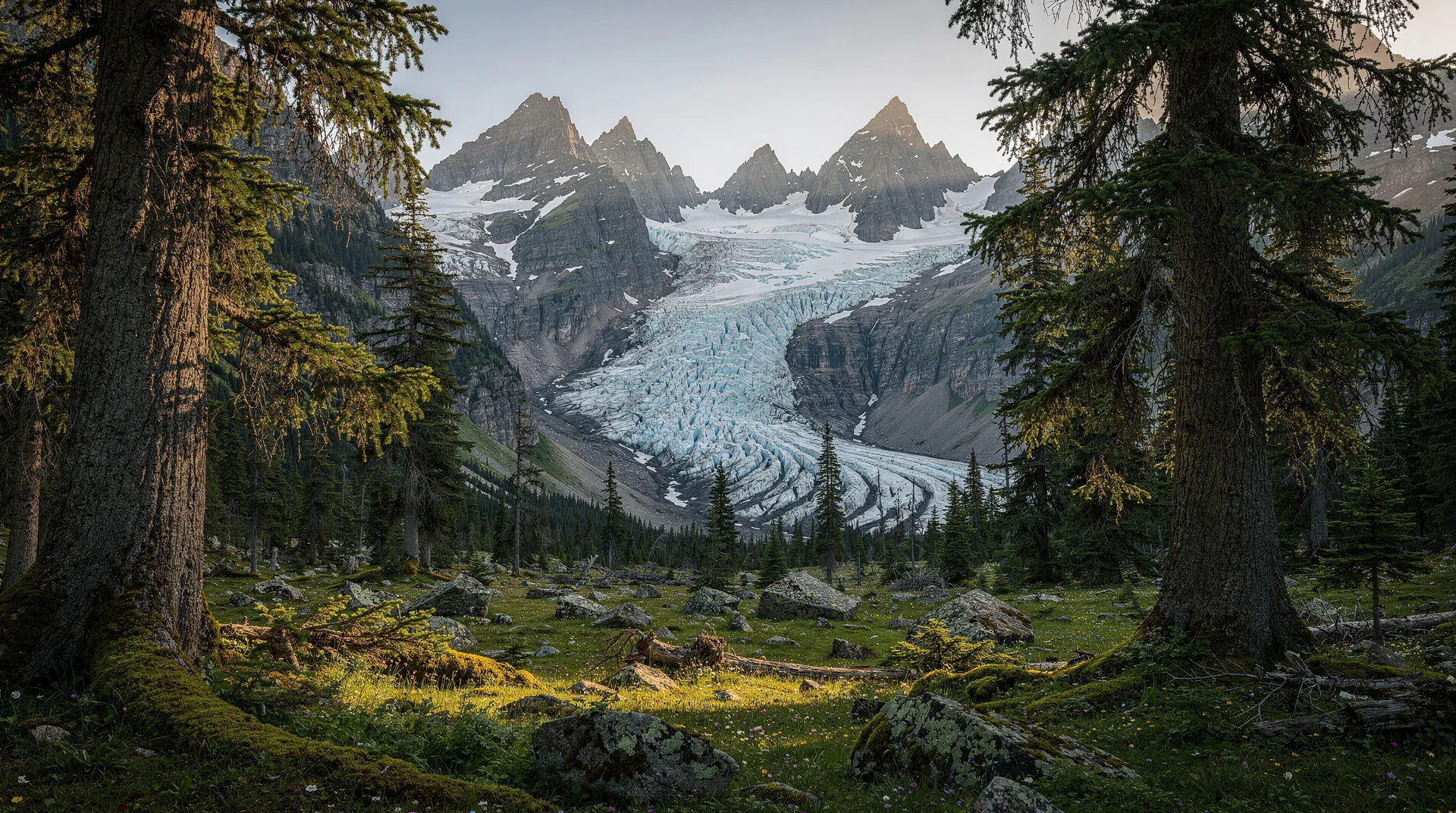
Glacier National Park BC guide: Rogers Pass, glaciers and the Selkirks
What is Glacier National Park BC known for?
Canada's Glacier National Park in BC (distinct from the US park of the same name) protects the rugged Selkirk Mountains and over 400 glaciers. It is centred on Rogers Pass — a National Historic Site — and features exceptional wilderness hiking to active glaciers, old-growth cedar, and extraordinary avalanche terrain.
A note of geography before anything else: Canada’s Glacier National Park in British Columbia is a distinct park from the Glacier National Park in Montana, USA. The Canadian park protects the Selkirk Mountains in the interior of BC; the US park borders southern Alberta. They share a name, share a family resemblance in their mountain and glacier scenery, but are separated by several hundred kilometres and an international border. This guide covers the Canadian park.
Glacier National Park in BC covers 1,349 square kilometres of the Selkirk Mountains, a range geologically distinct from and older than the Rocky Mountains to the east. The park is centred on Rogers Pass (1,330 m), the historic route through which the Canadian Pacific Railway first crossed the Selkirks in 1885, and which was instrumental in the development of Canada as a transcontinental nation.
The Trans-Canada Highway through the pass was completed in 1962, replacing the original railway alignment and opening the route to year-round vehicle traffic. Today, Rogers Pass is a National Historic Site as well as a national park, and the Rogers Pass Discovery Centre provides one of the finest combined natural and human history interpretation facilities in the Canadian mountain parks.
The park contains over 400 glaciers — the highest density of glaciers of any national park in southern Canada. The Selkirk Mountains rise to over 3,500 metres, capturing extraordinary amounts of moisture from Pacific storm systems. The resulting snowpacks feed not only the glaciers but also the avalanche paths that define the landscape — Rogers Pass is the most heavily avalanche-controlled highway corridor in the world. The combination of glaciers, deep valleys, old-growth forest, and the epic engineering challenge of keeping the pass open through the winter creates a park unlike any other in Canada.
At a glance
| Where | Selkirk Mountains, BC, on the Trans-Canada Highway between Revelstoke and Golden |
| Cost | Around CA$9.50/day adult park entry, or a Parks Canada Discovery Pass |
| Time needed | A half day for the roadside sights, a full day for the Illecillewaet glacier hikes |
| Getting there | Self-drive is the only realistic option; nearest airports are Calgary and Vancouver |
| Best time | July-August for full trail access, with June and September as quieter shoulder options |
Rogers Pass and the birth of a transcontinental nation
The story of Rogers Pass is inseparable from the story of modern Canada. The Canadian Pacific Railway, under intense pressure to connect the country as a condition of British Columbia joining Confederation in 1871, searched for a route through the apparently impenetrable Selkirk Mountains for years. In 1881, Major A.B. Rogers, a survey engineer known for his determination and hard temper, found the pass that now bears his name — a viable route through the mountains that would allow the CPR to avoid the more southerly US territory.
The railway through the pass opened in 1885, the same year the last spike was driven at Craigellachie (50 km west of Rogers Pass). The steep grades and endless avalanche hazard made the route dangerous and expensive to operate — the CPR eventually bored the Connaught Tunnel (8 km long, the longest rail tunnel in North America at its completion in 1916) beneath the pass to avoid the worst avalanche terrain and reduce the grade. The original surface railway line through the pass was abandoned, its grades now visible as hiking and ski touring routes in the park.
The Rogers Pass Discovery Centre at the summit of the pass tells this story with exceptional quality. The museum-quality interpretation covers Rogers’ survey, CPR construction, the engineering challenges of the railway operation, and the ongoing challenge of avalanche control on the Trans-Canada Highway. The Canadian Armed Forces fires artillery at avalanche starting zones to trigger controlled releases — the scale of the operation is extraordinary.
Top things to do in Glacier National Park BC
Hike to the Illecillewaet Glacier
The Glacier Crest Trail and the Perley Rock viewpoint (combined round trip approximately 10-14 km, strenuous) provide access to close-up views of the Illecillewaet Glacier, one of the most accessible active glaciers in the Canadian mountain parks. The Illecillewaet Neve — the icefield that feeds the glacier — is visible from the upper trail sections; the glacier snout itself has retreated significantly over the past century (interpretive panels at the trailhead document the retreat with historic photographs) but remains a dramatic presence in the cirque above the Illecillewaet River valley.
The Perley Rock viewpoint, reached by a steep 5-km approach, provides direct views across the glacier and into the Illecillewaet Neve. Allow 5-7 hours for the full return trip.
Browse BC mountain adventure tours from VancouverVisit the Rogers Pass Discovery Centre
The Rogers Pass Discovery Centre, operated jointly by Parks Canada and the Department of National Defence (which continues to manage avalanche control on the Trans-Canada), is an outstanding facility providing deep interpretation of the park’s natural history and human history. Exhibits cover the geological formation of the Selkirks, the ecology of the inland temperate rainforest, the CPR history, avalanche science, and the ongoing military avalanche control operation. The centre also provides current trail conditions, backcountry permit information, and park overviews.
The centre is open year-round with reduced winter hours. A short walk from the parking area leads to preserved sections of the original CPR grade — a remarkable piece of railway history.
Walk the Great Glacier Trail
The Great Glacier Trail (1.7 km return, easy) is the most accessible trail to a glacier view in the park, reaching the outwash plain of the Asulkan Glacier relatively quickly from the Illecillewaet Campground trailhead. The trail passes through mature forest and ends at an open viewpoint looking up-valley to the glacier snout and surrounding peaks. It is a gentle introduction to the park’s glacier scenery, suitable for all ages and requiring minimal fitness.
Hike through old-growth cedar forest
The Loop Brook Trail (1.6 km loop, easy) from the Loop Brook Campground passes through one of the finest accessible old-growth western red cedar forests in BC’s interior mountain parks. Ancient cedars — some 500 years old or more — stand alongside an interpretive trail that also incorporates remnants of the original CPR railway loop (the engineers built a spiral loop to manage the grade), making this a unique combination of natural and industrial heritage. The boardwalk sections are particularly good for ferns and moisture-loving plants.
Backcountry and ski touring
Glacier National Park is a world-class ski touring and backcountry skiing destination. The Selkirk snowpack — often exceeding 3 metres at the pass — and the extensive terrain accessible from Rogers Pass attract experienced ski tourers from across North America. The park has a designated backcountry skiing permit system and an extensive network of huts (operated by the ACC — Alpine Club of Canada). The Wheeler Hut and Sapphire Col Hut provide bases for multi-day ski touring in the park’s interior.
Hiking in the backcountry (summer) provides access to passes, ridges, and glacier edges not reachable on day trails. The Bald Hills, Sapphire Col, and Asulkan Valley backcountry routes are among the finest in the Selkirks.
Wildlife watching
The Selkirk Mountains support grizzly bears, wolverines, mountain caribou (Selkirk population, critically endangered), and mountain goats. Grizzly bears are commonly sighted along the highway corridor and on the lower valley trails in berry season. Mountain goats are reliably visible on the peaks above the pass; bring binoculars. The critically endangered mountain caribou are present in the park’s interior but extremely rarely encountered; any sighting should be reported to park staff.
Best hikes and trails
Glacier Crest Trail to Perley Rock — 10-14 km return, strenuous. Best glacier views in the park. Allow 5-7 hours. Strenuous trail to Illecillewaet Neve and glacier viewpoint.
Meeting of the Waters Trail — 1.2 km return, easy. Short family walk to the confluence of the Illecillewaet and Asulkan rivers below the campground. Forest atmosphere.
Great Glacier (Asulkan) Trail — 1.7 km return, easy. Accessible glacier outwash view. Suitable for all ages.
Loop Brook Trail — 1.6 km loop, easy. Old-growth cedar forest and original CPR spiral loop heritage. Boardwalk accessible.
Asulkan Valley Trail — 13 km return, strenuous. Full valley approach to the Asulkan Glacier. Outstanding scenery with limited visitor numbers.
Marion Lake Trail — 4.6 km return, easy-moderate. Subalpine lake below the Selkirk peaks. Good wildflower display in July.
Bald Hills via Linda Lake — 18 km return, strenuous. Ridge hike with exceptional panoramic views of the Selkirk icefield complex.
Wildlife you might see
Grizzly bears are common in the park and frequently sighted along the highway corridor and lower valley trails. Standard bear safety (bear spray, group travel, noise-making) is essential on all hikes. Black bears are also present.
Mountain goats are the most reliably visible large mammal above treeline — scan the cliff faces above Rogers Pass with binoculars for white figures on the rock. The mountain (woodland) caribou inhabiting the Selkirks are one of the most endangered ungulate populations in Canada; a small group exists in the park’s interior.
Wolverines are present in the high terrain and occasionally sighted by winter ski tourers. Pika (the rock rabbit, a small mammal sensitive to climate change) inhabit the rocky talus slopes above treeline. Golden eagles soar over the ridgelines in summer.
Getting there
Glacier National Park is located on the Trans-Canada Highway (Highway 1) between Revelstoke (80 km west) and Golden (53 km east). Rogers Pass is the summit of the pass.
From Vancouver, drive east on the Trans-Canada approximately 580 km to Rogers Pass (about 6 hours). From Calgary, drive west on the Trans-Canada approximately 420 km to Rogers Pass (about 4.5 hours).
Regular bus service on the Trans-Canada corridor (FlixBus/Greyhound) passes through Rogers Pass, but stops are limited. The nearest major airports are Vancouver (YVR, 580 km west) and Calgary (YYC, 420 km east). Revelstoke (80 km west) and Golden (53 km east) both have accommodation and car rental. If you would rather not drive the whole route yourself, you can compare guided tours across Canada that include the Rockies and Selkirks.
Where to stay
Rogers Pass itself has only the Discovery Centre and the Illecillewaet Campground — there are no hotels at the pass. Day use, camping, and backcountry camping are the options within the park.
Illecillewaet Campground (operated by Parks Canada) is the park’s main campground, with both serviced and unserviced sites adjacent to the trailheads for the glacier hikes. Open late June to early September.
Revelstoke (80 km west) is the most complete base for visiting the park, with a range of hotels, restaurants, and gear shops. Mount Revelstoke National Park is also based from Revelstoke.
Golden (53 km east) is a smaller but well-equipped outdoor town, providing access to Glacier NP from the east and to Yoho National Park and the Kootenay region further east.
Best time to visit
July and August are the hiking season. Most trail snow is gone by early July; wildflowers peak mid-July to mid-August; conditions are best for glacier hikes. The Illecillewaet Campground is open and all services are available.
June offers earlier access (some upper trails may have snow), spectacular spring runoff in the rivers, and very few crowds. Check Parks Canada for current trail conditions.
September sees reduced crowds and exceptional clarity of light on the glaciers. Trail conditions deteriorate with early snowfall after mid-September in upper terrain.
Winter (December–March): Rogers Pass is a world-renowned ski touring destination. The ACC huts provide shelter for multi-day ski tours. Avalanche control on the Trans-Canada makes the highway corridor safe but extremely active (road closures occur). The Discovery Centre is open year-round.
How it compares to other Rockies glacier stops
Visitors doing a wider Trans-Canada trip often ask whether Glacier NP BC is worth adding alongside the more famous glacier sights further east. The Columbia Icefield on the Icefields Parkway is easier: a paved road, a ticketed Skywalk, and a glacier you can view without hiking. Glacier NP BC is the opposite experience — no roadside glacier viewing platform, but genuinely wild access on foot to the Illecillewaet Neve and a far quieter atmosphere.
If your itinerary already includes Banff National Park and the Icefields Parkway, Glacier NP BC is a worthwhile detour rather than a duplicate; if you only have time for one glacier stop, the Columbia Icefield is the easier and more family-friendly choice, while Glacier NP BC rewards hikers who want solitude and a proper approach on foot.
The park also sits naturally alongside a broader BC hiking trip — see our roundup of BC’s best hikes for how the Illecillewaet and Asulkan trails stack up against the rest of the province, and our canonical guide to wildlife watching in Canada for how grizzly and caribou viewing here compares to other regions.
Bear safety in Glacier National Park BC
Grizzly bears are genuinely common along the highway corridor and on the lower valley trails here, particularly in berry season (roughly August through October), so bear safety is not a theoretical concern. Carry bear spray on every hike, even the short Great Glacier and Loop Brook trails, hike in a group where possible, and make noise on blind corners and near running water where bears may not hear you approaching.
Store all food in the campground’s bear-proof lockers, never in a tent or vehicle interior overnight. Our wildlife safety guide covers the full protocol for encounters, spray deployment, and what to do if a bear approaches — worth reading before any backcountry day in the Selkirks. If bear activity closes a trail, park staff post updated closures at trailheads and the Discovery Centre; always check before setting out, since closures here are taken seriously and enforced.
Practical info
Park entry fee (2026): Adult CA$12.25/day, family/group CA$24.50/day. Parks Canada Discovery Pass covers all national parks.
Rogers Pass backcountry skiing: A permit system operates from November to June for backcountry skiing in the park. Permits are mandatory and available through the Discovery Centre. Skiers must check out with the park on return; the system helps manage avalanche risk.
Cell coverage: Limited at Rogers Pass. Reliable coverage does not extend far from the pass on trails or in the campground. Download offline maps before visiting.
Trans-Canada closures: Winter road closures during active avalanche control are common at Rogers Pass from November to April. Monitor DriveBC for current conditions.
Frequently asked questions about Glacier National Park BC guide: Rogers Pass, glaciers and the Selkirks
Is this Glacier National Park the same as the one in Montana?
No. Canada’s Glacier National Park in BC is a completely separate park from Glacier National Park in Montana, USA. They share a name and both contain glaciers, but they are in different countries, different mountain ranges, and have quite different characters. The Canadian park is in the Selkirk Mountains of BC; the US park straddles the Montana-Alberta border. See our guide to Waterton Lakes National Park for the Canadian park that actually borders the US Glacier NP.
Can I see glaciers without hiking?
The Trans-Canada Highway through Rogers Pass passes below several peaks where glaciers are visible from the road in clear weather. The Illecillewaet Neve and surrounding glaciers are visible from the highway between the Illecillewaet Campground turnoff and Rogers Pass summit. The Great Glacier (Asulkan) Trail to the outwash viewpoint is only 1.7 km return from the campground and requires minimal effort for a ground-level glacier view.
How dangerous is the backcountry skiing at Rogers Pass?
Rogers Pass is an extremely serious avalanche environment — it is not suitable for novice backcountry skiers. The park has the highest concentration of avalanche paths of any travel corridor in Canada. Even experienced ski tourers should have current avalanche safety training, carry appropriate rescue equipment (beacon, probe, shovel), and check the avalanche forecast from Avalanche Canada before every outing. The park’s mandatory permit system includes a briefing on current conditions and specific terrain guidance.
What is the difference between the Selkirk and Rocky Mountains?
The Selkirks and the Rockies are geologically distinct ranges. The Rockies are sedimentary — formed by the folding and thrusting of ancient seafloor sediments. The Selkirks are older and geologically more complex, composed of metamorphic and igneous rock from deeper in the Earth’s crust. The Selkirks are wetter (capturing Pacific moisture before it reaches the Rockies), and their peaks have a more rugged, less layered appearance than the characteristic Rocky Mountain profile. The interior Selkirk valleys support inland temperate rainforest — old-growth cedar and hemlock — that is distinct from anything in the Rocky Mountain parks.
Is the park good for a family with young children?
The park’s accessible trails are limited but high quality for families. The Loop Brook Trail, Great Glacier Trail, and Meeting of the Waters Trail are all suitable for children. The Rogers Pass Discovery Centre is excellent for children with its interactive exhibits on avalanche science and railway history. The park is best visited as part of a Trans-Canada itinerary combining it with Mount Revelstoke National Park (Giant Cedars Trail) and the broader Revelstoke area.
Do I need a Parks Canada pass just to stop and look around?
Yes. A valid park pass or Discovery Pass is required to stop within Glacier National Park BC, including at the Discovery Centre and trailheads, even for a short visit. Passes are sold at the centre and can also be bought online in advance.
When is the best time to see the glaciers without much snow on the trails?
Late July through August gives the most reliable trail access, once the snowpack has cleared from the upper Illecillewaet and Asulkan approaches. For general seasonal planning across the province, see our best time to visit BC guide.