Hopewell Rocks: tidal walk & Flower Pot tour guide
When can I walk on the ocean floor at Hopewell Rocks?
You can walk on the ocean floor at Hopewell Rocks for approximately 2-3 hours centred on low tide. Low tide times change by about 50 minutes each day. Check the park's official tide schedule before visiting — arrive 1-2 hours before low tide for maximum time on the ocean floor.
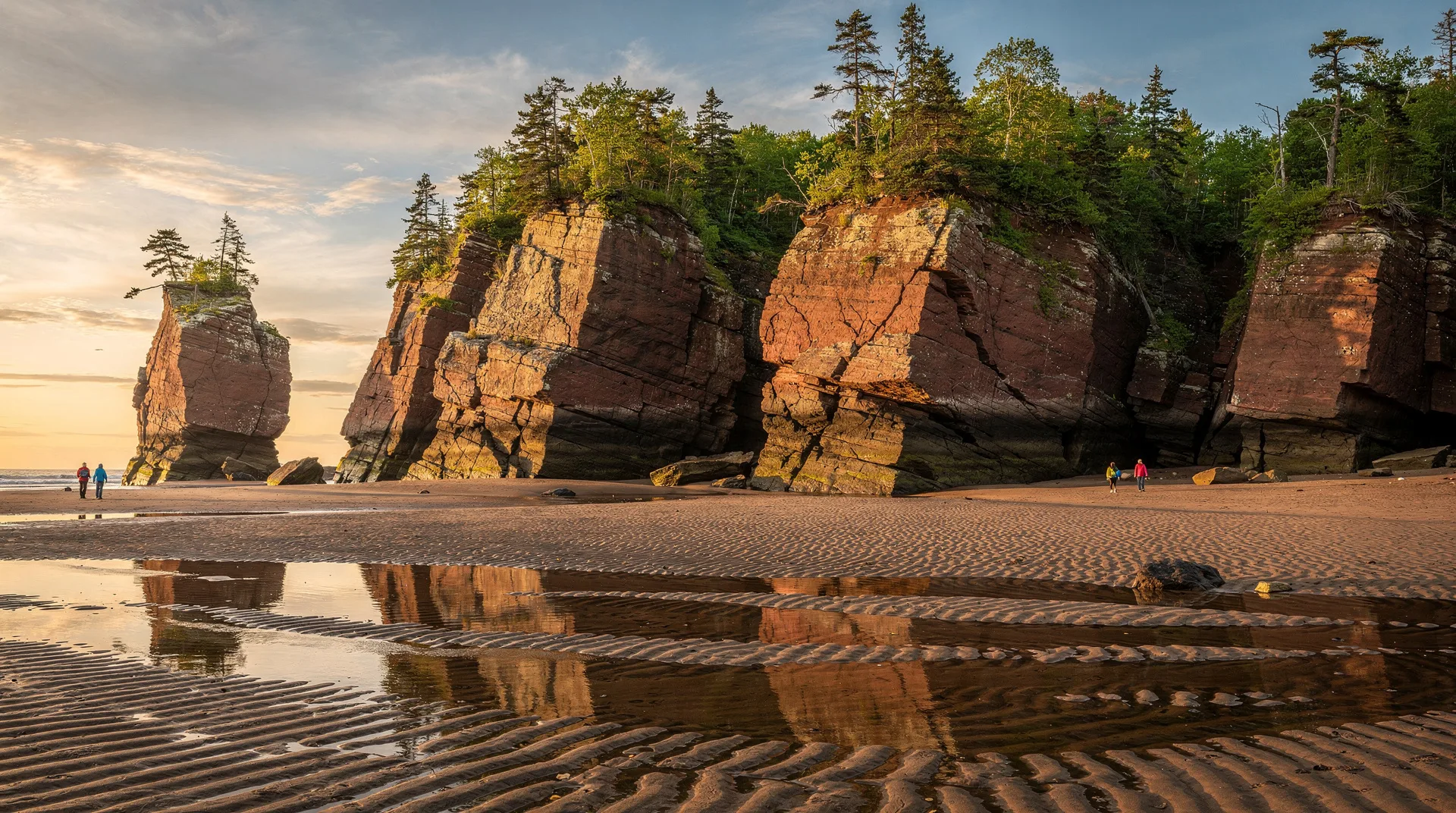
Six hours ago, the ocean floor where you are now standing was beneath 15 metres of seawater. The Flower Pot rock formations towering above you — their bases sculpted into narrow pedestals, their tops crowned with wind-stunted spruce trees — were islands accessible only by boat. In six hours, the water will be back. Walking among them now, looking up at the highwater mark far above your head, you feel the scale of the Bay of Fundy tidal phenomenon in a way that no graph or photograph fully conveys.
Hopewell Rocks Provincial Park is the single most dramatic expression of the world’s highest tides, and the tidal walk — literally descending stairways to the ocean floor and walking among the Flower Pot formations — is one of the most distinctive experiences in Atlantic Canada. This guide covers everything you need to plan your visit well. For the fuller geology, history, and Bay of Fundy context, see the Hopewell Rocks hub guide.
| At a glance | |
|---|---|
| Where | Route 114, around 40 km south of Moncton, New Brunswick |
| Cost | Around CAD $10 adult, $8 for children 6-17, free under 6 |
| Time needed | Around 3-4 hours for the ocean floor walk plus the clifftop trail |
| Getting there | Car essential; no public transit to the park |
| Best time | Arrive 1-2 hours before the day’s low tide; check the tide schedule first |
Understanding the tides
The Bay of Fundy’s extraordinary tidal range — up to 16.3 metres in the Minas Basin at the bay’s head — results from a resonance phenomenon: the bay’s geometry causes it to have a natural oscillation period that closely matches the 12.4-hour tidal cycle. Water literally sloshes in and out like water in a bathtub that has been tipped, and the resonant amplification builds the tidal range to extremes found nowhere else on earth.
At Hopewell Rocks specifically, the tidal range is typically 10-12 metres — not quite the maximum of the bay’s extreme inner reaches, but more than enough to transform the landscape completely. At high tide, the Flower Pots are islands; at low tide, the ocean floor around them is a walking surface of smooth red sandstone, tidal pools, and seaweed.
The tidal cycle runs on lunar time — approximately 12.4 hours between low tides, with each successive low tide occurring about 50 minutes later than the previous one. This means the walkable window shifts significantly from day to day and that the optimal visiting time changes daily throughout the season.
Critical point: You cannot plan a trip to walk on the ocean floor without first checking the tide schedule for your specific date. The park publishes a tide schedule online (hopewellrocks.ca) and it is the first thing to look at when planning your visit.
When to visit: the tidal walk window
The ocean floor at Hopewell Rocks is accessible for a window of approximately 2-4 hours centred on low tide. The exact duration depends on the tidal range on that particular day (spring tides produce lower lows and more floor-walking time; neap tides reduce it).
Optimal arrival time: 1-2 hours before low tide. This allows you to descend when conditions are best (the stairways to the ocean floor close when water covers them), enjoy maximum time on the floor, and still be on your way back up as the tide returns.
Never descend onto the ocean floor less than 1 hour after low tide — the returning tide moves faster than it appears and the stairways back to the cliff top close quickly. Park staff monitor conditions closely and will direct you off the ocean floor as the tide rises; follow their directions immediately. The tide does not give second warnings.
The tidal bore (the incoming tidal wave in the adjacent river systems) at Moncton is a related but separate attraction — see our tidal bore rafting guide for details on that experience.
What to do at Hopewell Rocks
The tidal walk (low tide)
The walk on the ocean floor at Hopewell Rocks is one of those experiences that is simply not reproducible anywhere else. Stairways descend from the clifftop parking and viewing area to the beach level; at low tide, the exposed red sandstone floor extends between and around the Flower Pot formations.
The rocks themselves are extraordinary. The Bay of Fundy’s red sandstone cliffs and shore have been carved over thousands of tidal cycles into pillars, arches, and alcoves. The Flower Pots (formally called “hopewell rocks” but nicknamed for their shape — narrow pedestals topped with trees) are the signature formations, but the entire floor area rewards exploration.
What to look for on the ocean floor:
- Tidal pools in rock depressions, full of sea urchins, periwinkles, mussels, and hermit crabs
- The clear highwater mark visible on the cliff faces — red staining and attached organisms mark the boundary between the tidal zone and the above-tide cliff
- The texture of the sandstone floor, polished smooth by millennia of tidal action
- Small fish stranded in pools, and the shorebirds (particularly sandpipers and plovers in late summer) feeding on them
Allow 1.5-2 hours for the ocean floor walk at a comfortable pace with time to explore tidal pools and photograph the formations.
Footwear: The ocean floor is wet, slippery with algae and seaweed, and uneven. Water-resistant shoes with good grip are essential. Sandals with ankle support (water sandals) are acceptable in good weather; rubber boots are ideal for tidal pool exploration. The park shop rents rubber boots if you haven’t brought appropriate footwear.
Kayaking at high tide
At high tide, when the ocean floor walk is impossible, the Flower Pots become sea stacks surrounded by water — and kayaking around and between them is an extraordinary alternative experience. Kayaking the Hopewell Rocks at high tide is not a better or worse experience than walking the ocean floor — it is a completely different one that reveals different aspects of the formations.
Hopewell Rocks Ocean Tidal Experiences operates guided kayak tours at high tide, typically 2-hour tours that paddle around the formations, into caves and alcoves, and provide the perspective of looking up at the formations from water level. Kayaking experience is not required; guides provide instruction and the protected cove conditions are manageable for beginners in normal weather.
Booking the kayak tour ahead is essential — tours fill quickly in peak season. If you want to compare other options, you can also browse guided tours across Canada before choosing.
The clifftop trail (any tide)
A well-maintained clifftop trail runs along the top of the sandstone cliffs, providing elevated views over the Flower Pot formations and the bay. This trail is accessible at any tide and gives the iconic aerial perspective on the formations that you’ve likely seen in photographs. The 1.5-km trail to the main viewpoints takes about 30 minutes; a longer loop extending to Demoiselle Beach adds another hour.
The clifftop trail is also worth doing even if you’ve walked the ocean floor — the perspective from above is completely different and completes the experience of understanding how the tidal cycle transforms the landscape.
Visiting Hopewell Rocks: practical details
Getting there
Hopewell Rocks Provincial Park is located on Route 114, approximately 40 km south of Moncton (about 35-40 minutes by car). From Alma (the gateway to Fundy National Park, to the south), it is 40 km north on Route 114 — about 35 minutes.
There is no public transit to Hopewell Rocks. A car is essential.
Parking: The main parking lot is large but fills in peak season during optimal tide windows. Arrive early on weekends in July and August during favourable low tides.
Admission
Hopewell Rocks is a provincial park with admission fees: approximately CAD $10 per adult, $8 for children 6-17, free for children under 6 (prices subject to change; check the park website for current rates). The kayak tour is an additional cost, typically CAD $55-65 per person.
When the park is open
The park operates from mid-May through mid-October. The stairways to the ocean floor are opened and closed by park staff according to tide conditions — arrival before low tide is strongly recommended to ensure you get onto the ocean floor.
Browse Bay of Fundy tours and New Brunswick experiencesCombining Hopewell Rocks with other Bay of Fundy experiences
Hopewell Rocks sits on Route 114, the main road between Moncton and Fundy National Park. A logical full-day or two-day combination covers:
Moncton: The city is the practical hub for the Hopewell Rocks visit. The Moncton Magnetic Hill (an optical illusion where vehicles appear to roll uphill) is a short stop worth making. See our Bay of Fundy 7-day loop itinerary for a complete circuit.
Fundy National Park: 40 km south of Hopewell Rocks, Fundy National Park covers 206 km² of Acadian highland and Fundy coastline with 120 km of hiking trails. The Alma, NB area at the park entrance has good seafood restaurants.
Tidal bore rafting: If you’re basing in Moncton, the Shubenacadie River tidal bore rafting is a wilder take on the tidal phenomenon — riding the incoming tidal bore on inflatable rafts through rapids created by the meeting of the tidal bore with the river current.
Whale watching: The Bay of Fundy whale watching at Brier Island (NS) or Grand Manan (NB) can be added to a Hopewell Rocks visit — see our Bay of Fundy whale watching guide for details.
Photography at Hopewell Rocks
Hopewell Rocks is one of the most photographed locations in New Brunswick, and for good reason — but getting beyond the postcard shot requires some planning.
The classic shot: From the clifftop viewpoint above the main Flower Pot formation (accessible via the trail), the view down over the towers with the bay in the background is the defining image. Best in morning or evening light.
Low tide wide-angle: On the ocean floor, a wide-angle lens allows dramatic compositions looking up at the formations with the highwater mark visible above. The perspective of standing at the base of a 15-metre formation that will be underwater in a few hours is difficult to convey through telephoto compression.
High tide kayak views: The perspective from water level at high tide reveals shapes and textures invisible from shore. A waterproof camera or housing is highly advisable.
Light: The red sandstone of the formations is richest in warm early-morning and late-afternoon light. Midday light is flat and harsh. The park is oriented generally eastward, making morning light particularly good on the formations.
Planning your tide-dependent day
Because the walkable window shifts by roughly 50 minutes daily, the single most useful planning habit is checking the official tide schedule before booking accommodation, not after. If you’re building a longer New Brunswick or Nova Scotia loop, work backwards from your target low-tide date rather than picking a fixed arrival day and hoping the tides cooperate.
Two-tide days: Because low tide occurs roughly twice every 24 hours, a full day at Hopewell Rocks can sometimes combine an early-morning ocean floor walk with a late-afternoon kayak tour at the following high tide, or vice versa — check both tide times for your date, not just one.
If you only have one visit slot: Prioritise whichever tide state fits your schedule and don’t force it — the clifftop trail and interpretive centre (covered in the Hopewell Rocks hub guide) are worthwhile at any tide, so a mistimed arrival is not a wasted trip.
Combining with Fundy National Park: Many visitors stay in Moncton or Alma and treat Hopewell Rocks as a half-day stop within a longer Fundy loop that also takes in Fundy National Park and the coastal drive south.
Frequently asked questions about Hopewell Rocks: tidal walk & Flower Pot tour guide
Can I visit Hopewell Rocks at high tide?
Yes — the clifftop trail and viewpoints are accessible at all tide levels. The kayak tours operate at high tide. Only the ocean floor walk requires low tide.
How long should I allow for the visit?
Budget 3-4 hours minimum for a low-tide visit that includes the ocean floor walk and the clifftop trail. A kayak tour adds 2 hours. If combining low tide walk and high tide kayak on the same day, plan for a full day with time for lunch at the park café.
Is the walk on the ocean floor difficult?
The stairways to the ocean floor are steep but have handrails. The ocean floor itself is uneven and slippery; people with significant mobility limitations may find it challenging. The clifftop trail is well-maintained and accessible for most visitors.
What if I miss the low tide window?
Visit the clifftop trail and viewpoints, which are excellent at any tide. The high-tide kayak tour is a genuinely different (and wonderful) experience. Check the tide schedule before you leave your accommodation and plan your arrival accordingly.
Is it safe on the ocean floor?
Yes, if you follow park staff direction. The tide moves quickly but park staff monitor conditions closely and alert visitors when it is time to return to the stairways. Follow their directions immediately and without argument. Do not remain on the ocean floor after being asked to leave.
Can I visit Hopewell Rocks as a day trip from Halifax?
It’s a long day — around 2.5-3 hours’ drive each way from Halifax to Hopewell Rocks. It’s more comfortable as part of a multi-day Fundy loop that overnights in Moncton or Halifax, rather than a single-day round trip.