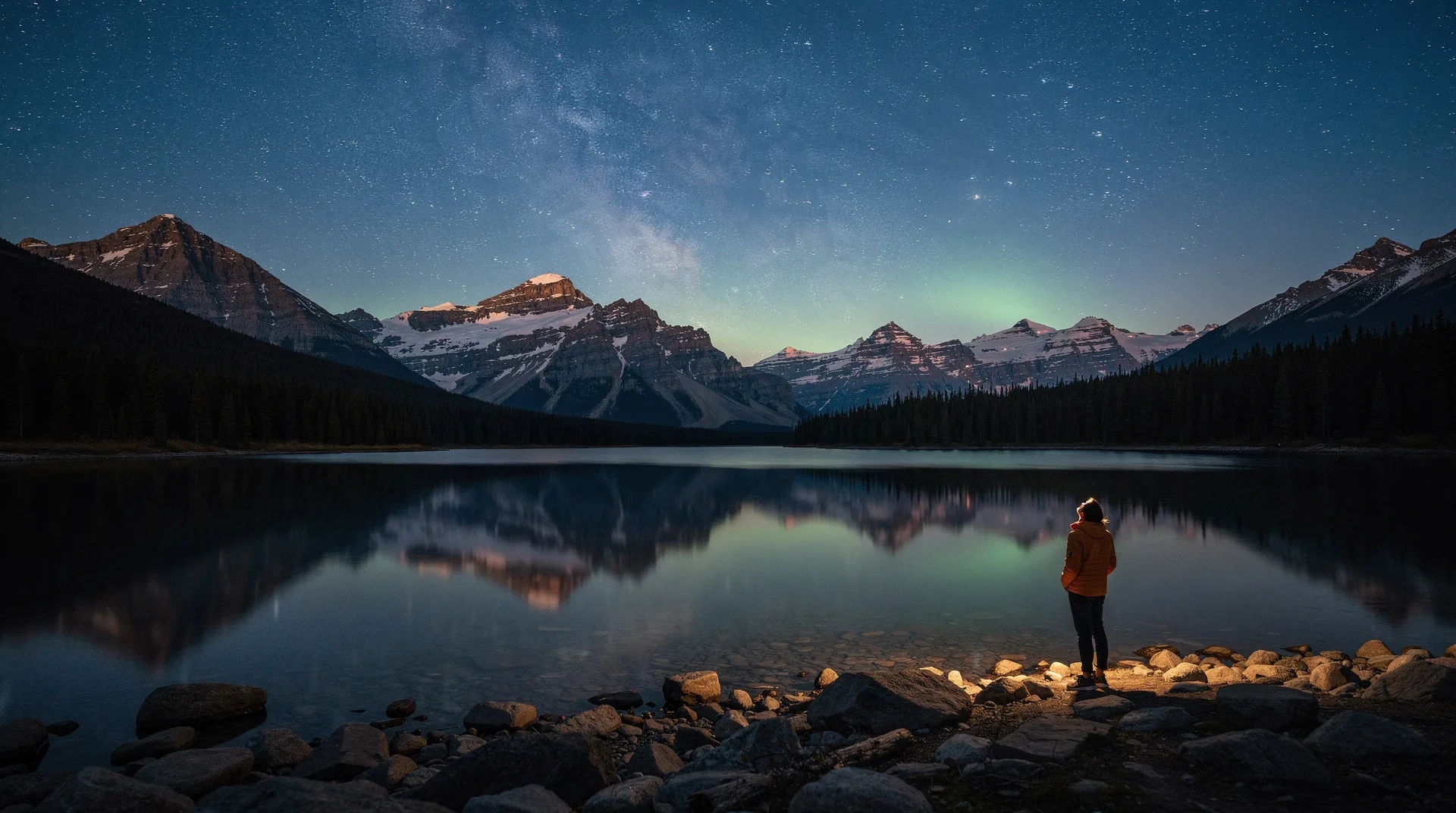
Stargazing in Jasper: guide to the dark sky preserve
Is Jasper really a good place for stargazing?
Yes. Jasper National Park was designated one of the world's largest Dark Sky Preserves in 2011, covering over 11,000 km². Low population density, strict lighting regulations, and dry Alberta air combine to produce exceptional night sky clarity. The annual Dark Sky Festival (October) is the best time for organised stargazing events.
On a clear night in Jasper National Park, away from the glow of any artificial light, the Milky Way is not a faint smear across the sky. It is an architectural structure — a dense central band of billions of stars, with dark lanes of interstellar dust running through it, extending from horizon to horizon. The sky in Jasper is dark enough that experienced astronomers bring serious equipment here; it is also dark enough that visitors with no astronomy background, lying on a blanket in a mountain meadow, are stopped by it.
Jasper National Park was designated a Dark Sky Preserve by the Royal Astronomical Society of Canada in 2011 — one of the largest such preserves in the world at over 11,000 km². This designation required Parks Canada to implement strict lighting protocols within the park, replace fixtures with downward-directed, low-intensity lights, and maintain community commitment to minimising sky glow. The result, decades later, is a national park with genuinely excellent dark sky quality despite having a townsite and road infrastructure.
| Details | |
|---|---|
| Where | Jasper National Park townsite and Icefields Parkway pullouts, Alberta |
| Cost | Free at any roadside pullout beyond the standard Parks Canada park pass; Planetarium tours and Dark Sky Festival events are ticketed separately |
| Time needed | An evening for casual viewing; a full trip built around the October festival for the deepest experience |
| Getting there | A vehicle is needed for most of the best sites beyond the townsite; Pyramid Lake is closest without a car |
| Best time | September-October for dark-early clear nights; the festival is mid-to-late October |
What makes Jasper’s dark sky special
Several factors combine to give Jasper exceptional night sky quality:
Population density: Jasper townsite has a permanent population of approximately 4,500 people — far below the threshold at which significant sky glow develops. The surrounding park has no permanent population.
Distance from major cities: Edmonton, the nearest major city, is 370 km east of Jasper. Its sky glow is visible on the eastern horizon but does not significantly affect zenith dark sky quality.
Lighting regulations: Dark sky preserve designation requires Parks Canada to maintain specific lighting standards throughout the park. Commercial and residential fixtures in Jasper are largely low-pressure sodium or LED with downward-directed optics — minimising upward light scatter.
Alberta climate: The Alberta interior is substantially drier than coastal BC and Quebec. Dry air has less atmospheric moisture to scatter light and produce atmospheric haze. Clear, calm nights in fall are particularly common.
Altitude: Jasper townsite sits at 1,060 m elevation. Higher elevation viewing points (highway pullouts at 1,500–2,000 m) are above a significant portion of the atmospheric moisture column, further improving sky quality.
Best stargazing locations
Pyramid Lake
6 km north of Jasper townsite on Pyramid Lake Road, Pyramid Lake offers a combination of a calm reflective surface (stars reflected in the lake), an open horizon, and minimal nearby light sources. The road is narrow after dark; park at the Pyramid Island parking area and walk to the lake shore.
Best access: The parking area is open year-round. No fee beyond park entry. Bring a headlamp with a red-light mode (red light preserves night vision; white light destroys it).
Athabasca Falls
The falls parking area on the Icefields Parkway (30 km south of Jasper) provides dark sky quality away from town glow, with the river and forest setting providing foreground interest for Milky Way photography.
Best access: The parking area is gated at dusk during summer but accessible year-round. Check Parks Canada seasonal closures.
Sunwapta Valley (Icefields Parkway)
The series of pullouts between Sunwapta Falls and the Columbia Icefield area offer some of the darkest skies accessible from the Icefields Parkway. At 1,500–1,800 m elevation, above much of the valley moisture, these are among the best photographic stargazing positions in the park.
Best access: Highway 93 pullouts. No dedicated stargazing infrastructure; self-guided parking on the roadside.
Maligne Lake Road
The road to Maligne Lake, 48 km from Jasper, passes through excellent dark sky territory. The lake itself (at night) provides extraordinary Milky Way reflections over the surrounding peaks. The road is used for wildlife viewing as well — be aware of elk and other animals on the road after dark.
The Jasper Planetarium
The Jasper Planetarium (operated by Tourism Jasper) offers year-round indoor and outdoor stargazing programs, including telescope viewing, guided constellation tours, and monthly special events. This is the most accessible stargazing experience for visitors who want context and guidance.
What the Planetarium offers:
- Sky tours with professional astronomers
- Telescope access (large-aperture instruments for deep-sky viewing)
- Astrophotography workshops
- Northern Lights viewings (when aurora is active)
- Educational programs
Check the Tourism Jasper and Jasper Planetarium websites for current programming and booking.
Book guided stargazing and dark sky experiences in JasperThe Jasper Dark Sky Festival
The Jasper Dark Sky Festival is held annually in October — typically mid-to-late October when darkness falls early and the Milky Way core positions itself advantageously in the evening sky. The festival is the largest dark sky event in the Canadian Rockies and draws astronomers, astrophotographers, and general visitors from across North America.
Festival events typically include:
- Public telescope viewings at multiple locations in and around Jasper
- Lectures by astronomers on topics ranging from cosmology to practical stargazing
- Astrophotography workshops and competitions
- Educational programs for children (solar viewing, planetarium shows)
- Northern Lights viewings (the October festival date coincides with elevated aurora probability)
- Guided dark sky tours by vehicle and on foot
Booking: Festival events range from free public viewings to ticketed lectures and workshops. Book through the Jasper Dark Sky Festival website. Accommodation in Jasper during the festival fills quickly — book 3–4 months in advance.
Weather: October in Jasper averages clear or partly clear conditions approximately 60% of the time. Cloud is the main uncertainty. The festival schedule usually spans a full week to increase the probability of at least one or two clear nights per attendee.
What to see in Jasper’s night sky
Milky Way
The Milky Way is visible from Jasper from April through October, with the galactic core (the densest part of the band) most prominent from June through August. The core sets earlier each month; by October the Milky Way is better viewed in the pre-dawn hours.
The structure visible from Jasper includes the galactic centre in Sagittarius, the dark dust lanes of the Cygnus Rift, and numerous star-forming nebulae visible to the naked eye as fuzzy patches within the band (notably the Orion Nebula and the Andromeda Galaxy).
Planets
Naked-eye planets (Venus, Jupiter, Saturn, Mars) are visible from Jasper without any equipment when they are in the sky. Jupiter’s four Galilean moons are visible through binoculars. Saturn’s rings are resolved through any telescope above 30x magnification.
Deep-sky objects (with binoculars or telescope)
- Andromeda Galaxy (M31): 2.5 million light-years away; visible naked eye as a fuzzy patch; binoculars reveal its extent spanning 6 times the apparent diameter of the full Moon
- Pleiades (M45): Open cluster in Taurus; spectacular in binoculars, revealing over 100 stars
- Orion Nebula (M42): Even a small telescope reveals this stellar nursery in extraordinary detail
- Double Cluster (NGC 869/884): Two adjacent open clusters in Perseus, best in binoculars
Northern Lights (Aurora Borealis)
Jasper’s latitude (52.9°N) places it within the auroral zone during geomagnetically active periods. The Northern Lights are visible from Jasper approximately 30–40 times per year during active periods, though intense displays occur during solar maximum years (the solar cycle peaks approximately every 11 years; the current cycle’s maximum is anticipated around 2025–2026).
Aurora viewing tips:
- Use a space weather app (SpaceWeather.com, NOAA Space Weather) to monitor Kp index (aurora activity level). Kp 4+ is generally needed for Jasper-area visibility; Kp 6+ produces spectacular displays
- Face north. The aurora appears first on the northern horizon and rises overhead during strong activity
- Get away from town lights — Pyramid Lake, Annette Lake, or any highway pullout north of town
- Camera settings for aurora: ISO 800–3200, aperture f/2.8 or wider, shutter speed 5–15 seconds
Practical tips for dark sky visits
Equipment
For naked-eye stargazing: Nothing required except dark adaptation (20–30 minutes away from white light). Bring a blanket or reclining chair — lying flat and looking up is far more comfortable than craning your neck.
For binoculars: 7x50 or 10x50 binoculars are the ideal first step above naked eye. They reveal star clusters, the Andromeda Galaxy, Jupiter’s moons, and craters on the Moon.
For photography:
- A wide-angle lens (14–24mm on full frame, or equivalent) is ideal
- A sturdy tripod is essential — exposures of 10–25 seconds require complete stability
- Mirrorless or DSLR camera with manual mode
- Intervalometer for time-lapse sequences
Red light only: A red headlamp preserves your night-adapted vision. Standard white headlamps destroy night adaptation immediately; recovering full dark adaptation takes 20–30 minutes. Virtually all outdoor retailers in Jasper sell red-light headlamps.
Clothing for night stargazing
Night temperatures in Jasper fall significantly even in summer:
- Summer (June–August): Evenings can be 5–15°C; night can drop to 0–5°C at 1,000+ m. Layer significantly — it is always colder than expected.
- Fall festival (October): Temperatures regularly below 0°C at night. Full winter layering — insulated jacket, warm hat, mitts, and thermal layers.
- Winter: Below -20°C possible. Stargazing in extreme cold is possible but requires expedition-level preparation.
Building a stargazing trip around the rest of Jasper
Stargazing works best as part of a longer Jasper stay rather than a standalone trip, since clear-sky nights aren’t guaranteed and daytime plans fill the gaps. Visitors timing a trip specifically around dark skies should check Jasper in September and best time to visit Jasper for how shoulder-season weather compares to the Dark Sky Festival window.
For the drive in, driving from Calgary to Jasper via the Icefields Parkway passes directly by several of the pullouts listed above, so daytime scenery and night viewing can share the same route. If you would rather not plan every day yourself, you can browse guided tours across Canada to fill the daytime hours. Travellers deciding between Banff and Jasper as a base for their whole trip, not just for stargazing, can compare the two in Banff National Park vs Jasper National Park.
For aurora specifically, Jasper is one option among several northern Canadian aurora destinations. If the northern lights — rather than the Milky Way or deep-sky objects — are the main goal, it’s worth comparing Jasper’s odds against dedicated aurora bases further north; see Canada’s best aurora months for the broader picture and aurora photography technique for camera settings beyond the basics covered here.
Related guides
- Jasper National Park guide — full Jasper trip planning
- Wildlife watching in Alberta — night drives for wildlife combine naturally with stargazing
- Skyline Trail Jasper — if you’re backpacking, night skies from alpine campsites are extraordinary
- Cavell Meadows hike — daytime highlight for Jasper visitors
- Miette Hot Springs — Miette Road at night for wildlife before or after hot springs
Frequently asked questions about Stargazing in Jasper: guide to the dark sky preserve
When is the best time of year to stargaze in Jasper?
The sweet spot is September–October: dark nights fall early (dusk at 8–9 pm), the Milky Way is still in good position in the evening sky, fall weather is often settled and clear, and the Dark Sky Festival (October) concentrates events and expertise. July and August offer very late darkness (dusk at 10 pm+) in exchange for warm temperatures and reliable conditions.
Do I need to buy a telescope to enjoy Jasper’s dark sky?
No. The naked-eye experience in Jasper — simply lying under a clear sky and watching the Milky Way structure — is extraordinary without any equipment. Binoculars add significant depth of experience and are affordable and practical. Telescopes are worthwhile for serious observers but not necessary for a memorable experience.
Are the Northern Lights visible from Jasper?
Yes, when geomagnetically active. Jasper’s latitude makes it a reasonable aurora destination during moderate to high solar activity. The aurora is not predictable or guaranteed; monitor space weather forecasts during your visit and be prepared to go out on short notice when conditions activate. The October Dark Sky Festival intentionally targets the increased aurora probability of autumn.
Is Jasper better than Banff for stargazing?
Jasper is measurably better. The town is smaller (less sky glow), the park is larger (more dark-sky area), and the formal Dark Sky Preserve designation ensures better lighting compliance. Banff’s proximity to Calgary (100 km east) creates a residual glow on the eastern horizon that Jasper avoids. Both offer outstanding stargazing by global standards; Jasper is the superior astronomical destination.
Do I need a park pass to go stargazing in Jasper?
Yes. Roadside pullouts and viewpoints inside Jasper National Park still require a valid Parks Canada park pass (day pass or Discovery Pass), the same as any daytime visit — stargazing after dark doesn’t exempt you from the entry requirement.