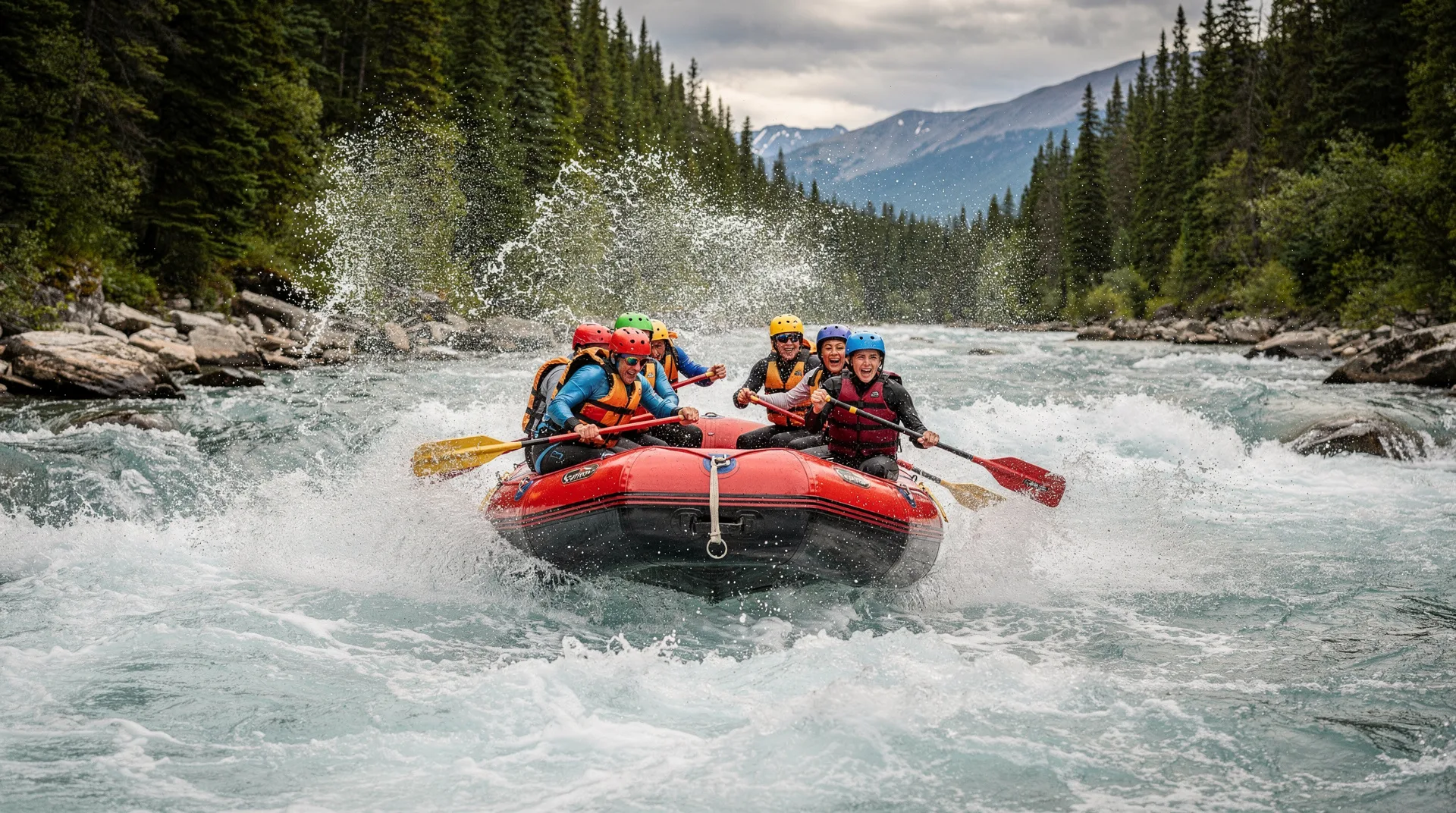
White Water Rafting in Jasper: Athabasca River Guide
Is white water rafting in Jasper worth it?
Yes — the Athabasca River offers excellent beginner-to-intermediate rafting in a spectacular setting. Standard trips are 3 hours (Athabasca Falls section, Class II-III) or more intense (Sunwapta River, Class III). Suitable for ages 6+ on calmer sections; families and first-time rafters welcome. Operates June through early September.
| At a glance | |
|---|---|
| Where | Athabasca River below Athabasca Falls, and the Sunwapta River, Jasper National Park |
| Cost | Around CAD 90-120 (Athabasca) or CAD 100-140 (Sunwapta) per adult |
| Time needed | 3-4 hours including shuttle and gear-up |
| Getting there | Operator bases in Jasper town or along Highway 93; a Parks Canada park pass is required to be in Jasper National Park |
| Best time | Late June through August for warmest air and biggest crowds; mid-June to early July for the highest water |
White water rafting is one of Jasper’s signature summer experiences. The Athabasca River — the same river that eventually flows all the way to the Arctic Ocean — runs fast and cold through Jasper National Park, fed by glacial meltwater from the Columbia Icefield upstream. Below Athabasca Falls, the river creates a reliable stretch of Class II-III white water that’s ideal for introductory to intermediate rafting. Further south on the Sunwapta River, more intense Class III rapids offer experienced adrenaline-seekers something more challenging.
For visitors spending time in Jasper National Park in summer, a rafting trip delivers an excellent mix of genuine adventure, impressive scenery from water level, and introductory wildlife viewing — all in a 3-4 hour excursion that fits easily into a Jasper day.
The two main rafting options
Athabasca River — Athabasca Falls section (Class II-III)
The most popular rafting trip in Jasper runs on the Athabasca River below Athabasca Falls. The section combines moving flat water with several named rapids — the Cauldron, the Rock Garden, and others — that give genuine white water thrills without being genuinely dangerous.
Distance: Approximately 18 km of river Duration: 3 hours (including shuttle, safety briefing, and gear-up) Difficulty: Class II-III (moderate to moderately difficult) Age minimum: Most operators 6 years; some 8 years Price: Typically CAD $90-120 per adult
This is the standard “first time rafting” trip that most visitors do. Suitable for families, casual travellers, and anyone who wants a fun adventure without serious technical paddling. Older, younger, or less athletic visitors all do well on this section.
Sunwapta River (Class III)
More intense rafting happens on the Sunwapta River, a tributary of the Athabasca upstream of the main river. The Sunwapta offers consistently faster water, more intense rapids, and a genuine adrenaline experience.
Distance: Approximately 13 km Duration: 3 hours Difficulty: Class III (moderately difficult to challenging) Age minimum: Typically 12 years Price: Typically CAD $100-140
This is the option for visitors wanting more excitement. Not appropriate for absolute beginners, families with small children, or visitors uncomfortable with more active paddling.
Extended and specialty trips
Some operators offer longer half-day or full-day trips combining multiple river sections, overnight raft camping trips, and scenic float trips that emphasise wildlife rather than white water. Pricing and availability vary.
Athabasca vs Sunwapta at a glance
| Athabasca (Falls section) | Sunwapta River | |
|---|---|---|
| Difficulty | Class II-III | Class III |
| Distance | Around 18 km | Around 13 km |
| Duration | 3 hours | 3 hours |
| Minimum age | 6-8 years | Typically 12 years |
| Price (adult) | Around CAD 90-120 | Around CAD 100-140 |
| Best for | Families, first-timers, casual travellers | Fit adults wanting more adrenaline |
What a typical rafting trip looks like
Arrival at the launch base. You arrive at the operator’s base (typically in Jasper town or just south along Highway 93) 30-45 minutes before the scheduled launch. Check-in, waiver signing, and introductions.
Outfitting. Operators provide wetsuits, splash jackets, splash pants, neoprene boots, personal flotation devices (PFDs), and helmets. You bring swimwear to wear underneath, and may want to bring a change of clothes for after. All technical gear is provided.
Shuttle to the launch point. A school bus or van shuttles the group from the base to the river put-in, typically 15-30 minutes. Your guide rides with you and begins the safety briefing.
Safety briefing at the launch. Before launching, your guide covers paddle commands, what to do in the water, how to help others, and basic river safety. Listen carefully — these briefings are genuinely important.
The river. 2-2.5 hours on the water. Moving water interspersed with paddled rapids. Guides call out commands; rafters paddle in unison. In between rapids, the raft drifts and guides point out wildlife, geology, and river features.
Takeout and return. At the takeout point, the raft is loaded, you change out of gear, and return by shuttle to the base.
What to wear
Provided by the operator
- Wetsuit (full or shorty depending on water temperature)
- Splash jacket
- Neoprene boots
- PFD (personal flotation device)
- Helmet
- Paddle
Bring yourself
- Swimwear (worn underneath the wetsuit)
- Synthetic or wool socks (cotton stays cold and wet)
- Glasses strap if you wear glasses
- Small towel and dry clothes for the trip back (stored in a dry bag by the operator during the run)
- Waterproof camera or action camera with secure attachment (phones are not recommended — loss is highly likely)
Don’t bring
- Loose items (sunglasses without straps, watches, jewellery) — likely to end up in the river
- Thin-soled sandals or flip-flops
- Cotton clothing
Weather and water conditions
Water temperature. The Athabasca River is glacial meltwater. Water temperatures range from approximately 4-10 degC in summer. This is cold. The wetsuit provided makes a significant difference, but immersion time (if you fall in) should be minimised. Instructions for what to do if you end up in the water are part of the safety briefing.
Air temperature. Summer Jasper days range from 15-25 degC. The combination of cold water splash, wind from paddling movement, and periodic sun exposure means layering matters. You will often be too warm paddling and too cold during float sections.
Rain. Rain does not typically cancel trips. You will get wet regardless. Thunderstorms may cause postponement.
High water. Early summer (mid-June to early July) often has the highest, fastest water from peak snowmelt. Trips still run but character changes — rapids are bigger, overall speed higher. Some operators require minimum age increases during high water.
Wildfire smoke. Occasional issue in summer. Trips usually still run but with reduced visibility.
Season and operating schedule
Season: Approximately June 15 to September 15, weather and water dependent. Peak season: July and August. Trips depart multiple times per day. Shoulder: Late June and early September. Fewer daily departures; more intimate trips. Off-season: Mid-September through early June. Too cold for comfortable rafting.
Most operators run 2-4 departures per day in peak season. Morning departures (around 9-10 a.m.) are usually quieter; afternoon departures (1-3 p.m.) are most popular.
Booking
Advance booking: Strongly recommended in July and August. 1-2 weeks ahead is usually sufficient. Walk-up: Sometimes possible for shoulder weekdays but not reliable for peak dates. Group discounts: Often available for groups of 8+; check operator policies. Combining bookings: Some tour operators bundle rafting with other activities (Maligne Lake cruise, SkyTram, etc.) at package discounts.
Browse Jasper rafting trips and combined activity packages.
Is rafting safe?
Jasper’s rafting operators have excellent safety records. Key elements:
- All guides are certified (Paddle Canada certification or equivalent)
- PFDs are worn at all times on the water
- Helmets are provided on Class III sections
- Wetsuits prevent cold shock in the event of immersion
- Guides carry throw bags, first aid, and communication equipment
- Trips don’t run in unsafe water conditions
The main risks are:
- Minor injuries from paddles or gear (occasional bruises, scraped knuckles)
- Cold exposure if you end up in the water (rare; fast recovery if immediate)
- Heat illness on hot days (drink water, apply sunscreen)
- Drowning risk is very low with proper gear and guide oversight but not zero — listen to safety briefings
Wildlife on the river
Rafting provides excellent wildlife viewing because you move silently through corridors difficult to access by road:
- Moose feed in backwater sloughs along the river
- Black bears and grizzly bears are occasionally seen on the banks
- Bald eagles and osprey nest along the river and are routinely seen
- River otter are sometimes visible in calmer sections
- Elk and deer occasionally cross the river or feed along banks
Guides know the good wildlife-watching sections and will slow the raft or point out animals as encountered.
Rafting vs other Jasper water experiences
Maligne Lake boat tour: Passive, scenic, suits all ages. No physical exertion. Ideal for photography of Spirit Island.
Pyramid Lake canoeing: Gentle, family-friendly, independent. Good for relaxed lakeshore paddling.
Athabasca River rafting: Active, adrenaline element, requires physical participation. For ages 6+ with appropriate conditions.
Most visitors doing a full Jasper week find these three water experiences complement each other rather than substitute.
Park pass and practical logistics
Rafting on the Athabasca or Sunwapta happens inside Jasper National Park, so a Parks Canada park pass (day pass or annual Discovery Pass) is required for your vehicle whether or not the rafting price includes it — check with your operator, since some bundle the pass into the trip and others do not. Confirm before arrival to avoid a surprise at the park gate.
Cell coverage along Highway 93 south of Jasper town is patchy, so print or screenshot your booking confirmation and directions to the operator’s base rather than relying on live navigation. Fuel up in Jasper town before heading to a launch site south of town, since services are limited along the highway itself.
If you’re building a longer Jasper stay around the trip, the driving route from Banff to Jasper passes directly by the Columbia Icefield and several rafting operator bases, making it easy to scout locations the day before you raft.
Combining rafting with other Jasper days
Rafting + SkyTram: Morning SkyTram (best for clear weather), afternoon rafting. A classic active Jasper day.
Rafting + Maligne Lake: Morning rafting, afternoon Maligne Lake cruise. Water-focused day.
Rafting + Maligne Canyon: Morning rafting, afternoon Maligne Canyon walk. Athabasca River + ice walking canyons = full river geology experience.
Rafting + hot springs: Post-rafting soak at Miette Hot Springs is a classic recovery move.
Frequently asked questions about White Water Rafting in Jasper: Athabasca River Guide
Do I need to know how to swim? Most operators require basic swimming ability. You will be wearing a PFD and will float readily, but some swimming capacity is expected in the event of immersion.
What if I fall out? Guides cover “swimmer position” in the safety briefing — float feet-downstream on your back. Guides will fish you out within 10-30 seconds in most cases.
Can I bring my phone? Not recommended. Waterproof action cameras (GoPro etc.) with secure mounts work; most operators have mounting points on the raft.
What age works? Athabasca section: 6-8+ years depending on operator. Sunwapta: 12+ years. Check specific operator policies.
Will I definitely get wet? Yes. Waves, splashes, and possibly being soaked through happen on every trip.
How much does it cost? Standard Athabasca trips CAD $90-120 per adult. Sunwapta trips CAD $100-140. Family discounts and group rates available.
Do I need a park pass on top of the rafting fee? Usually yes, separately from the trip price — you need a valid Parks Canada pass to be inside Jasper National Park at all. Confirm with your operator whether it’s included.
Is rafting better in the morning or afternoon? Morning departures (9-10 a.m.) tend to be quieter and slightly calmer light for photos; afternoon departures (1-3 p.m.) are busier but the air is usually warmest, which matters more than it sounds given the glacial water temperature.
Book Jasper white water rafting tours on the Athabasca RiverRelated pages
- Things to do in Jasper — full activity overview
- Jasper in summer — peak rafting season
- Maligne Lake boat tour — passive water experience
- Miette Hot Springs — post-rafting soak
- Jasper SkyTram — pair with afternoon adventure
- Canoeing on Rockies lakes — gentler alternative