Quick facts
- Located in
- Jasper National Park
- Best time
- June to September; December to March
- Getting there
- 362 km from Edmonton Airport; 287 km from Calgary via Banff
- Days needed
- 3-5 days
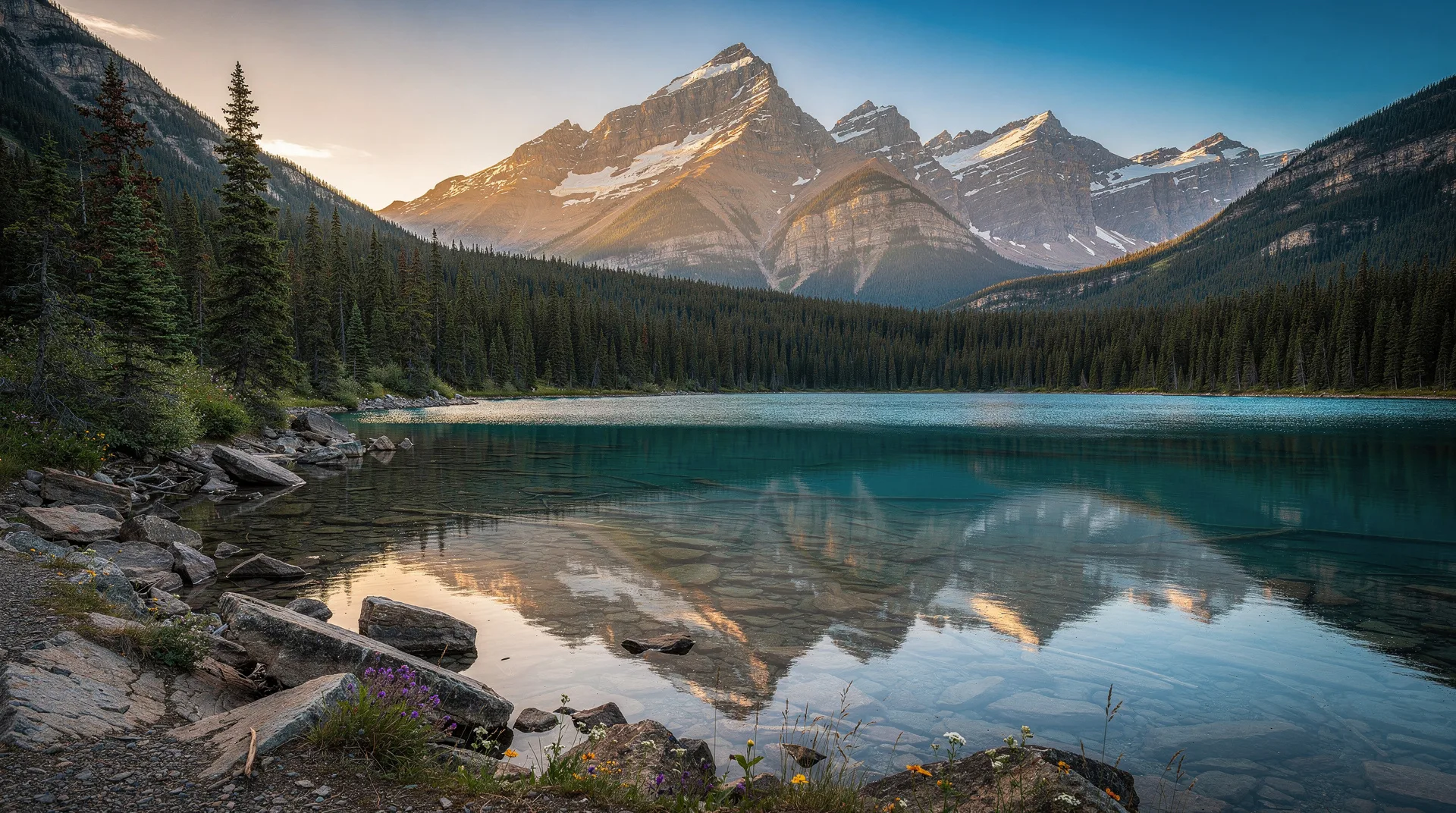
Jasper National Park is the largest park in the Canadian Rockies — nearly twice the size of Banff — and its scale is something you feel from the moment you arrive. The town is smaller, the crowds thinner, and the wilderness closer in every direction. Maligne Lake, 50 kilometres into the park’s interior, is the largest glacially fed lake in the Canadian Rockies. Athabasca Falls drops 23 metres with a volume and intensity that few visitors fully anticipate. And after dark, Jasper’s UNESCO Dark Sky Preserve designation means the Milky Way appears not as a pale suggestion but as a vivid, three-dimensional structure.
Following the 2024 wildfire, Jasper’s major natural attractions — Maligne Lake, Athabasca Falls, the Icefields Parkway, and the SkyTram — remain open and welcoming visitors. The town has shown remarkable resilience and the park itself is in excellent shape.
A Parks Canada Discovery Pass is required for all park visitors. Purchase at the park gate or in advance through Parks Canada.
| At a glance | Detail |
|---|---|
| Where | Jasper National Park, Alberta, largest park in the Canadian Rockies |
| Cost | Parks Canada Discovery Pass required (around CAD $12.25/adult/day); Maligne Lake cruise, SkyTram, and ice walks are separate paid tickets |
| Time needed | 3-5 days to cover the main sights across a season |
| Getting there | around 362 km from Edmonton Airport, around 287 km from Calgary via Banff |
| Best time | June-September for hiking and Maligne Lake; December-March for ice walks and skiing |
First-time visitor priorities
If you only have one full day, prioritise Maligne Lake (with the boat cruise if it’s summer) and Athabasca Falls, both reachable in a single loop drive from town. With a second day, add the SkyTram and a valley-floor hike like the Valley of the Five Lakes. For the full seasonal picture, see Jasper in summer and Jasper in winter for what’s realistically open and worthwhile month by month.
Maligne Lake and Spirit Island
At 22 kilometres long and up to 97 metres deep, Maligne Lake is the dominant natural spectacle in Jasper and justifies the 50-kilometre drive from town on its own. The lake is fed by glacial meltwater from the surrounding peaks — the Maligne Range to the east, the Queen Elizabeth Ranges to the west — and the water carries suspended glacial flour that gives it a remarkable milky turquoise colour.
Spirit Island, a tiny forested island in the lake’s middle section approximately 14 kilometres from the boat dock, is the most photographed location in Jasper. It can be reached by guided boat cruise (the only motorised vessel permitted on the lake, operating in summer) or by a long trail along the lakeshore. The combination of the island’s silhouette against the peak-ringed water is the image most associated with Jasper internationally.
The Bald Hills trail above the lake’s north end (5.7 kilometres one-way, 480 metres elevation gain) climbs through larch forest to open alpine terrain with extraordinary views back down the length of the lake — one of the finest hikes in the park, and spectacular in late September when the larches turn gold.
The drive to Maligne Lake passes two additional significant features: Maligne Canyon (7 kilometres from Jasper town, a dramatic slot gorge) and Medicine Lake (30 kilometres from town, a body of water that partially disappears underground each autumn through a cave system). Allow a full day for the Maligne Valley to appreciate all three.
Athabasca Falls
32 kilometres south of Jasper town on the Icefields Parkway, the Athabasca Falls has no particular visual drama from a distance — the drop is only 23 metres. But the volume of water driving through the narrow quartzite gorge produces a sound and a spray that immediately recalibrate your expectations.
The Athabasca River at this point drains a massive catchment from the Columbia Icefield, and the volume at peak snowmelt (June and July) is extraordinary. The river channels between vertical rock walls in a series of falls and churning plunge pools, with potholes carved into the bedrock visible where the current is slower. A system of paths and bridges on both sides of the gorge provides multiple viewing angles.
Allow 30–45 minutes at Athabasca Falls. It is a logical stop on any drive between Jasper and the Columbia Icefield and is accessible from the parking lot with minimal walking.
The Jasper SkyTram
Canada’s highest aerial tramway carries passengers from the base terminal on Whistlers Mountain (7 kilometres south of Jasper town) to the upper station at 2,277 metres in approximately eight minutes. The views from the upper terminal — across the Athabasca Valley, the town of Jasper reduced to a small cluster of buildings below, and a horizon of Rockies peaks in every direction — are exceptional on clear days.
From the upper terminal, a 1.3-kilometre trail climbs through alpine tundra to the true summit of Whistlers Mountain at 2,466 metres. The trail is steep and the altitude is significant; allow 45 minutes for the ascent and take it slowly if arriving from sea level. The reward is 360-degree views extending over 100 kilometres on clear days.
The SkyTram’s upper station is also Jasper’s premier dark sky viewing location. On scheduled stargazing nights (organised by the park and by astronomy groups during the October Dark Sky Festival and periodically throughout summer), the tramway runs after dark to take visitors to the upper mountain for guided stargazing. Check the Jasper SkyTram website for current schedules.
Maligne Canyon
Seven kilometres east of Jasper town, the Maligne River has carved a 50-metre-deep slot through the limestone bedrock, creating one of the most spectacular river canyons in the Rockies. The trail system bridges the canyon at six points over approximately 3.7 kilometres (one-way), providing views down into the narrow slot where the water churns far below.
In summer, the canyon is green and dramatic — the depth of the slot and the proximity of the bridge walkways to the cliff edges give the trail a genuine sense of exposure. In winter, the canyon partially freezes and guided ice walk tours descend to the canyon floor to walk beneath frozen waterfalls and through ice formations that have no summer equivalent. The February ice walk experience is one of the highlights of Jasper’s winter calendar.
The most visited sections are the first two bridges (closest to the parking lot), but the full walk to the sixth bridge reveals the canyon’s full depth and character. Allow 1.5–2 hours for the return walk to the sixth bridge.
Browse guided hikes and tours in Jasper National ParkWildlife watching in the Athabasca Valley
Jasper has a justified reputation as one of Canada’s premier wildlife destinations. The Athabasca Valley — the broad, flat-floored valley connecting Jasper town to the Columbia Icefield — is prime habitat for large mammals and the most productive wildlife-watching corridor in the park.
Elk are the most reliably encountered large mammal, particularly in and around the town at dawn and dusk. Jasper’s resident elk herd is habituated to town presence and often browses the parks and edges of residential streets.
Grizzly bears are more commonly encountered in Jasper than in Banff — the berry fields and open meadows above the treeline are prime grizzly habitat from late summer onward. The highway shoulders of the Icefields Parkway south of town are good areas to scan.
Black bears are widespread throughout the forested sections of the park from May through October.
Moose are regularly spotted in the wetland areas along the Athabasca River and near the Patricia Lake area north of town. Moose are more common in Jasper than in Banff due to the park’s more extensive wetland and riparian habitat.
Wolves: The Athabasca Valley has an active wolf population. Early morning in winter, when tracks in snow reveal recent activity, is the best time for sightings. Dawn on the highway south of town is the most productive time.
Caribou: Mountain caribou are present in the Tonquin Valley and Maligne Range backcountry — one of the few parks in the southern Rockies where this increasingly rare species persists.
The road between Jasper town and Maligne Canyon (Maligne Road) in the early morning is one of the most reliably productive wildlife drives in the park. Drive slowly and watch the valley meadows and forest edges at dawn.
Icefields Parkway: the Jasper section
The northern section of the Icefields Parkway from Jasper town south to the Columbia Icefield (105 kilometres) passes through some of the most accessible wildlife habitat in the Rockies and includes several major natural stops.
Sunwapta Falls (55 kilometres south of Jasper): The Sunwapta River drops in two distinct falls — the upper falls visible from the roadside parking area and the lower falls accessible by a short trail through the forest. Both are impressive; the lower falls, in a broader canyon, are more dramatic. Combined stop time: 45–60 minutes.
Sunwapta Canyon: Between the falls parking area and the Columbia Icefield, the Sunwapta River has carved a canyon through the valley floor that is worth a brief stop.
Columbia Icefield (105 kilometres south): North America’s largest non-polar ice mass, accessible by Ice Explorer snowcoach or on foot to the Athabasca Glacier’s terminal moraine. The Icefield Centre provides orientation, a restaurant, and a Parks Canada interpretive area. The glacier’s recession markers along the walking trail to its edge are among the most striking visual records of glacial retreat in the country.
The full Jasper-to-Columbia Icefield drive and return takes approximately 5–6 hours with meaningful stops. The full Parkway drive south to Banff or Lake Louise is a separate full-day commitment, and if you continue south, you can browse guided tours in Banff for the next leg.
Pyramid and Patricia lakes
Four to seven kilometres northwest of Jasper town, Pyramid Lake and Patricia Lake form a pair of smaller lakes directly accessible from the townsite — the most practical option for a quick morning or evening lake experience without driving to the Maligne Valley.
Pyramid Lake is the larger and more dramatically positioned of the two, with Pyramid Mountain rising above it and a small island connected to the shore by a footbridge. Canoeing and kayaking equipment is available to rent at the lakeside. The lake’s open setting and distance from town (a 10-minute drive or a 30-minute cycle) make it one of the best accessible dark sky viewing spots — the combination of the mountain silhouette and the unobstructed sky above the water produces spectacular conditions on clear nights.
Patricia Lake is smaller and lower, tucked into the forest closer to town, with a campground and the start of several hiking trails.
The Tonquin Valley
For serious hikers or those willing to invest in an overnight backcountry experience, the Tonquin Valley is one of the great wilderness destinations in the Rockies. The valley is flanked by the Ramparts — a dramatic 9-kilometre wall of quartzite peaks rising 600 metres above the valley floor in a series of towers and buttresses — and contains Amethyst Lake, a large body of water that reflects the Ramparts on calm mornings.
Access is by foot (17 kilometres one-way from the Astoria River trailhead) or horseback. Tonquin Valley Adventures operates a backcountry camp accessible by horse in summer, with guided riding and hiking. The Tonquin Amethyst Lake Lodge provides one of the most spectacular backcountry accommodation settings in Canada.
Day-trip access to the Tonquin Valley is possible but the 34-kilometre return walk makes it suitable only for very fit hikers with an early start.
Hiking in Jasper: a selection
Beyond the Maligne Lake and Tonquin options, Jasper’s trail network covers terrain for all levels.
Valley of the Five Lakes (4.6 kilometres loop): One of the best easy hikes in the park — a flat-to-gentle circuit visiting five small lakes with extraordinary turquoise colours, accessible from the Icefields Parkway south of town.
Skyline Trail (44 kilometres, 3-4 days): Jasper’s signature multi-day route, running along the high ridge above the Athabasca Valley with continuous alpine views. Backcountry permits required through Parks Canada.
Cavell Meadows (8 kilometres return, 300 metres elevation gain): Above the Athabasca Glacier on the slopes of Mount Edith Cavell (2,900 metres), the Cavell Meadows trail passes through spectacular wildflower meadows with views of the Angel Glacier hanging above. The road to Edith Cavell is not accessible to large vehicles or trailers.
Old Fort Point loop (3.5 kilometres loop, 100 metres elevation gain): A short circuit from the edge of Jasper town to a rocky knoll above the confluence of the Athabasca and Miette rivers — a good sunset walk with town and valley views.
Practical visitor notes
Wildfire recovery: Jasper’s attractions are operating normally following the 2024 wildfire. Some areas of forest near town show recovery vegetation and may have altered visual character; the major natural features were unaffected. Check Parks Canada updates for any trail-specific closures.
Parks Canada pass: Required for all visitors. Daily adult: CAD $12.25; annual Discovery Pass: CAD $83.50/adult.
Accommodation: Book well in advance for summer. Some accommodation was damaged in the 2024 wildfire and capacity may be more limited than pre-fire years; early booking is particularly important.
Maligne Lake boat cruises: Operate in summer only. Booking in advance is strongly recommended as the Spirit Island cruises fill quickly.
Bear spray: Carry it on all hikes. Jasper has a healthy grizzly bear population.
How Jasper compares to Banff
| Jasper | Banff | |
|---|---|---|
| Park size | nearly twice the size of Banff | smaller, more concentrated |
| Crowds | noticeably thinner, roughly half Banff’s annual visitors | busier, especially July-August |
| Signature lake | Maligne Lake and Spirit Island | Moraine Lake and Lake Louise (shuttle-only access) |
| Wildlife | grizzlies, moose, and wolves more commonly seen | also strong, but higher traffic pressure |
| Ski resort | Marmot Basin, quieter | Ski Big 3 (Sunshine, Lake Louise, Norquay) |
Frequently asked questions about Best Things to Do in Jasper
How many days do you need in Jasper? Three to five days covers the main sights (Maligne Lake, Athabasca Falls, the SkyTram, a hike or two) at a comfortable pace. Two days is workable if you prioritise ruthlessly, but you’ll likely miss the Maligne Valley’s full day-trip potential.
Is Jasper less crowded than Banff? Yes, noticeably — Jasper receives roughly half of Banff’s annual visitor numbers, and popular sights like Maligne Lake rarely reach the gridlock levels seen at Moraine Lake or Lake Louise in peak season.
Related pages
- Jasper in summer — hiking, lakes, and wildlife in the warm months
- Jasper in winter — ice walks, skiing, and cold-season activities
- Jasper wildlife watching — where and when to see animals
- Jasper dark sky stargazing — the dark sky preserve guide
- Where to stay in Jasper — lodges, hotels, and camping
- Getting to Jasper — from Calgary, Edmonton, and Banff