Quick facts
- Population
- 5,000 (town)
- Best time
- June to September / December to March
- Languages
- English
- Days needed
- 3-4 days
Jasper is the quieter, wilder, more spacious sibling of Banff — and for a certain kind of traveller, it is the preferred option. The town is smaller, the tourist infrastructure less intensive, and the park itself larger: Jasper National Park, at nearly 11,000 square kilometres, is the largest national park in the Canadian Rockies, nearly twice the size of Banff National Park. The landscapes are correspondingly vast.
But Jasper’s defining distinction is darkness. In 2011, Jasper National Park was designated the largest dark sky preserve in the world — a designation that protects the park’s exceptional night skies from light pollution and makes stargazing here a genuine natural experience rather than a nostalgic one. On a clear autumn night above the treeline at Whistlers Mountain or beside Pyramid Lake, the Milky Way is not a vague smear but a three-dimensional structure, and the number of visible stars is genuinely disorienting.
| At a glance | |
|---|---|
| Where | Jasper National Park, Alberta, north end of the Icefields Parkway |
| Cost | Parks Canada Discovery Pass required — around CAD $12.25/adult/day or CAD $83.50/adult annually |
| Time needed | Around 3-4 days to cover the town, Maligne Valley and Icefields Parkway highlights |
| Getting there | Around 3.5 hours by car from Banff; VIA Rail from Edmonton (around 5 hours) or Vancouver (around 17 hours) |
| Best time | Roughly June-September for hiking and wildlife, or winter for dark-sky and skiing |
Jasper and the northern Rockies
The town of Jasper sits at 1,060 metres elevation at the confluence of the Athabasca and Miette rivers, surrounded on all sides by the jagged peaks of the front and main ranges of the Rockies. The Icefields Parkway — the 230-kilometre highway connecting Jasper to Banff and Lake Louise to the south — begins at the town’s edge and is widely considered the most spectacular paved road in North America.
Jasper’s more northerly position means different wildlife populations and different seasonal patterns from Banff. Grizzly bears are more commonly encountered at lower elevations. Caribou — rare in Banff — are a fixture in the Tonquin Valley and Maligne Range backcountry. The Athabasca River, running the length of the park, draws moose, wolves, and an extraordinary variety of waterfowl.
The 2024 wildfire significantly affected the town of Jasper, and while recovery is ongoing, the park itself, the major attractions, and accommodation facilities have largely resumed operations. Check current status with Parks Canada before visiting.
Top things to do in Jasper
Maligne Lake
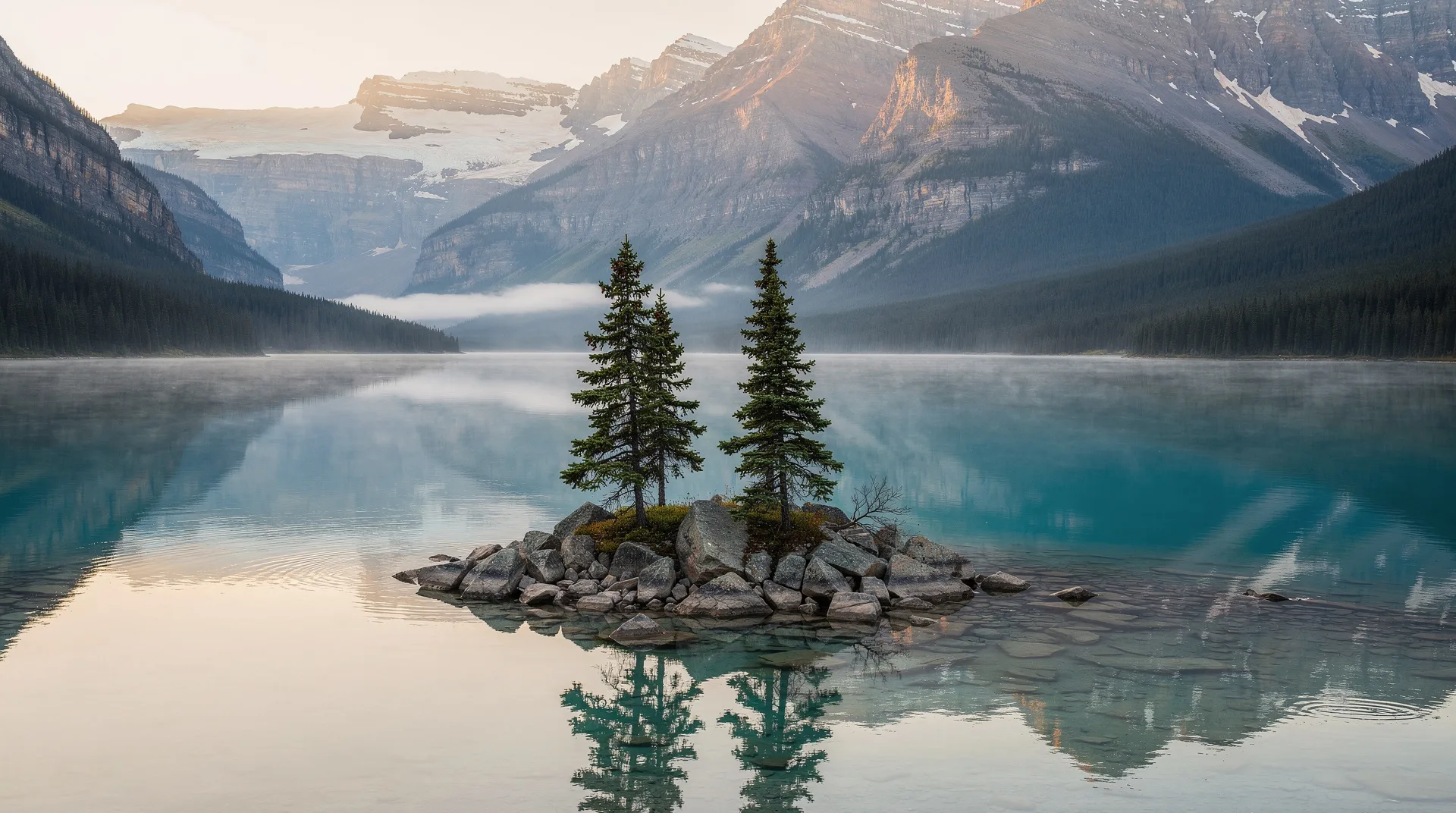
Fifty kilometres southeast of Jasper town at the end of the Maligne Valley road, Maligne Lake is the largest glacially fed lake in the Canadian Rockies — 22 kilometres long and up to 97 metres deep, set in a valley between peaks that rise to 3,000 metres above sea level. The view from the lake’s northern end is one of the most celebrated in the Rockies. Spirit Island — a tiny forested island in the lake’s middle section — is the most photographed location in Jasper and can only be reached by boat or on foot along the shore trail. Guided boat cruises to Spirit Island operate in summer.
The drive up the Maligne Valley passes Maligne Canyon, Maligne Lake, and Medicine Lake — a peculiar body of water that largely disappears underground through an extensive cave system each autumn.
Athabasca Falls
34 kilometres south of Jasper town on the Icefields Parkway, the Athabasca River narrows into a gorge and drops 23 metres over quartzite bedrock in a series of churning falls and pools that display an unusual combination of volume and visual intensity. The spray and noise are considerable. The river at this point is a major drainage system for the Columbia Icefield, and the volume of water is much greater than the modest drop might suggest. Platforms and paths on both sides of the gorge provide multiple viewing angles; allow 30-45 minutes.
Icefields Parkway
The northern section of the Icefields Parkway from Athabasca Falls to Jasper passes through some of the most accessible wildlife habitat in the Rockies. The Sunwapta Falls are a major stop 55 kilometres south of Jasper. The Columbia Icefield Skywalk — a glass-floored platform cantilevered over the Sunwapta Valley 280 metres above the valley floor — is 105 kilometres south of Jasper. The Columbia Icefield itself, accessible by Ice Explorer snowcoach from the Icefield Centre, is 100 kilometres south.
Book the one-way Banff to Jasper tour along the Icefields ParkwayJasper SkyTram
The Jasper SkyTram on Whistlers Mountain carries visitors 2,277 metres above sea level in eight minutes — the highest aerial tramway in Canada. Above the upper terminal, a 1.3-kilometre trail climbs to the true summit at 2,466 metres through alpine tundra with extraordinary 360-degree views of the Rockies and the Jasper townsite below. On exceptionally clear days the views extend over 100 kilometres. The upper mountain is also the premier dark sky viewing platform in the park for organized stargazing events.
Maligne Canyon
One of the most spectacular river canyons in the Canadian Rockies, Maligne Canyon is accessible year-round via a trail system bridging the gorge at multiple points. In summer, the Maligne River has carved a 50-metre-deep slot through limestone, revealing geology that spans millions of years. In winter — particularly in February — the canyon partially freezes and ice walk tours take visitors down into the canyon floor, past frozen waterfalls and ice formations that have no summer equivalent.
Book hiking tours and guided walks in Jasper National ParkDark sky stargazing
Jasper’s UNESCO Dark Sky Preserve designation is not ceremonial. The absence of artificial light for hundreds of kilometres in most directions, combined with the clean mountain air and the latitude, produces truly exceptional night sky conditions. The annual Jasper Dark Sky Festival in October draws astronomers and astrophotographers from around the world. Pyramid Lake and the Athabasca Valley meadows are among the best ground-level viewing spots. The SkyTram summit and Patricia Lake are also excellent.
Wildlife viewing in Jasper
The Athabasca Valley between Jasper town and Maligne Lake is one of the most reliably productive wildlife corridors in the Rockies. Elk are common in town itself. Black bears are regularly seen along roadsides from May through October. Grizzly bears are more commonly encountered here than in Banff — the berry fields above the treeline and the valley meadows are prime habitat. Wolves have been observed hunting elk on the flats south of town. Bighorn sheep are present on the rocky faces above the highway.
Best areas in Jasper
Jasper Town is the service centre — Connaught Drive and Patricia Street form the compact commercial core, with restaurants, gear shops, and the Parks Canada visitor centre. The town sits in an open valley with mountain views in every direction and is exceptionally pleasant to walk.
Maligne Valley (30 minutes east) contains Maligne Canyon, Medicine Lake, and Maligne Lake — the park’s most spectacular lake destination and the area that most visitors prioritise.
Patricia and Pyramid Lakes (4-7 kilometres northwest of town) are two small lakes directly accessible from town, with hiking, canoeing, and the best dark sky viewing close to town.
Tonquin Valley (backcountry, 15 kilometres south) is one of the great wilderness destinations in the Rockies — a remote alpine valley flanked by the Ramparts, a dramatic wall of quartzite peaks. Access by foot or horseback only; Tonquin Valley Adventures operates an excellent backcountry camp.
Food and drink in Jasper
Jasper’s restaurant scene is modest in scale but has several excellent options.
Evil Dave’s Grill on Patricia Street is Jasper’s most celebrated restaurant — creative, slightly irreverent cooking with local game (bison, elk, venison) and Pacific seafood, in a warm room that makes the most of the mountain setting.
Oka Sushi on Connaught Drive is consistently cited as one of the better Japanese restaurants in the Canadian Rockies — an unlikely but welcome presence in a small mountain town.
Famoso Neapolitan Pizzeria is a reliable option for families and groups in the centre of town.
The Bear’s Paw Bakery on Cedar Avenue is Jasper’s essential morning stop — the pastries, breads, and coffee have sustained hikers and cyclists for years.
The Jasper Brewing Company is Canada’s first nationally licensed brewery within a national park, operating a taproom on Connaught Drive with excellent craft ales.
When to visit Jasper
Summer (late June to September) is the peak season and the most accessible time for hiking, Maligne Lake boat tours, and wildlife viewing. The Icefields Parkway is fully open. Days are long and temperatures are pleasant (15-22°C in the valley). July and August are the busiest months — Maligne Lake parking fills by 9am on weekends.
Fall (September to October) is spectacular. The larch trees turn gold in late September, the elk rut begins in September, and the dark sky conditions improve as nights lengthen. Crowds thin after Labour Day and accommodation prices drop.
Winter (December to March) is Jasper’s dark sky season and increasingly its ski season. Marmot Basin ski resort operates 15 minutes from town. Ice walks in Maligne Canyon are a highlight. The Dark Sky Festival in October marks the transition to winter astronomy season.
Spring (April to May) is the quietest period. Higher trails remain snowy until June, but the valley is accessible and bear viewing as animals emerge from hibernation can be excellent.
Where to stay in Jasper
Fairmont Jasper Park Lodge is the grande dame of Jasper accommodation — a sprawling log-and-stone resort on Lac Beauvert 5 kilometres from town, with a championship golf course, private beach, and the classic Canadian National Railway lodge aesthetic. Rooms are expensive but the setting is extraordinary.
The Crimson Jasper (formerly Chateau Jasper) on Geikie Street is the best full-service hotel in the townsite itself — central, well-maintained, and more accessible in price.
Tonquin Inn and Mount Robson Inn are solid mid-range options in town with basic facilities and reasonable rates.
Hostel options include HI Jasper in the town centre. Parks Canada operates campgrounds throughout the park, and the campsite at Wapiti (9 kilometres south) is excellent.
Getting around Jasper
Car is essentially necessary for reaching Maligne Lake, Athabasca Falls, Sunwapta Falls, and the majority of Jasper’s attractions beyond the townsite. All car rental companies operating in Banff and Calgary can arrange one-way pickups in Jasper.
Maligne Adventure Centre shuttles operate scheduled services to Maligne Canyon and Maligne Lake from Jasper town during summer — a car-free option for the park’s most popular attractions.
Cycling is practical within the town and on the Athabasca River trail system. The Valley of the Five Lakes trail is accessible by bike from town.
Icefields Parkway requires a car for most stops. Brewster Express and other operators run guided day tours from Jasper south to the Columbia Icefield and Banff.
Jasper vs Banff: which one first?
Travellers with limited time often have to choose. The honest comparison, in table form:
| Factor | Jasper | Banff |
|---|---|---|
| Crowds | Noticeably lighter, even in July-August | Heaviest crowds in the Rockies, especially Lake Louise/Moraine Lake |
| Signature scenery | Maligne Lake and Spirit Island, dark sky | Lake Louise, Moraine Lake, the Banff Gondola |
| Wildlife odds | Higher — grizzlies and caribou more frequent | Good, but more habituated/roadside |
| Ski resorts | Marmot Basin, smaller and quieter | SkiBig3 (Sunshine, Lake Louise, Norquay) |
| Access | Further from Calgary; VIA Rail stops in town | Closer to Calgary Airport |
A full Banff vs Jasper comparison and a Banff National Park vs Jasper National Park breakdown go deeper on trade-offs. Many visitors do both, connecting the two via the Icefields Parkway stops or a dedicated Banff to Jasper 7-day itinerary.
Bear safety in Jasper
Grizzly encounters are meaningfully more likely in Jasper than in Banff, particularly along the Maligne Valley road and on trails through berry country in August and September. Carry bear spray (rentable in town), make noise on quieter trails, hike in groups where possible, and never approach an animal for a photo — roadside “bear jams” are common and dangerous when visitors get out of their cars. The bear watching in Canada guide and the grizzly bear viewing guide cover etiquette and best practices in more depth. Parks Canada posts current trail closures for wildlife activity at the visitor centre and online — check before any backcountry hike.
Day trips from Jasper
Icefields Parkway south to Banff is the premier excursion — the full drive to Banff via the Parkway takes a full day with stops at Athabasca Falls, Sunwapta Falls, the Columbia Icefield, Bow Lake, and Peyto Lake. Most visitors drive one-way and return by shuttle or fly out from Banff/Calgary.
Mount Robson Provincial Park is 84 kilometres west on the Yellowhead Highway in British Columbia. Mount Robson — the highest peak in the Canadian Rockies at 3,954 metres — is visible from the highway when clear. The Berg Lake Trail is one of the great multi-day hikes in BC.
Miette Hot Springs is 61 kilometres northeast, up the Athabasca Valley — the hottest natural mineral springs in the Canadian Rockies, with outdoor pools at 40°C above an isolated valley. The drive passes through the Fiddle River Valley with excellent wildlife habitat.
Frequently asked questions about Jasper
Is Jasper better than Banff?
They serve different purposes. Banff has the iconic lakes (Lake Louise, Moraine Lake), more infrastructure, and better ski resorts. Jasper has Maligne Lake, the dark sky preserve, a more genuine small-town atmosphere, and generally fewer crowds. Visitors with time should do both — the Icefields Parkway drive between them is itself one of the reasons to come to the Canadian Rockies. If forced to choose, Jasper appeals more to wildlife watchers, hikers, and those who prefer fewer crowds; Banff suits first-time Rockies visitors and families with limited time.
What is the best hike in Jasper National Park?
The Bald Hills above Maligne Lake (5.7 kilometres one-way, 480 metres elevation gain) combines exceptional views of Maligne Lake with larch forests in the upper terrain. The Valley of the Five Lakes near the Icefields Parkway is an excellent easier option (4.6 kilometres loop). The Skyline Trail (44 kilometres, 3-4 days) is the greatest multi-day hike in Jasper for experienced backcountry hikers.
When can you see the Milky Way in Jasper?
The Milky Way core is visible from approximately March to October in the northern hemisphere; the peak viewing season in Jasper is July through September when the galactic core is highest in the sky on warm nights. New moon nights are optimal. The annual Jasper Dark Sky Festival runs in October, organized around new moon timing.
How do you get to Jasper?
By car via the Trans-Canada and Highway 93 North from Banff (230 kilometres, about 3.5 hours). By VIA Rail’s Canadian (or Jasper) train from Vancouver (approximately 17 hours) or Edmonton (approximately 5 hours) — the train stops at Jasper Station in the centre of town. By Brewster or Sun Dog shuttle from Banff (3.5 hours). Jasper does not have its own commercial airport; the nearest is Edmonton International Airport (360 kilometres east).
Is the wildfire damage visible in Jasper?
The 2024 wildfire caused significant damage to portions of Jasper town and the surrounding forest. Recovery and reconstruction are ongoing. The major natural attractions — Maligne Lake, Athabasca Falls, the Icefields Parkway, the SkyTram — were not directly impacted. Some accommodation was destroyed and is being rebuilt. Visitors should check current Parks Canada advisories before travelling.
Do you need a Parks Canada pass for Jasper?
Yes. A Parks Canada Discovery Pass is required for all visitors. Daily passes cost CAD $12.25 per adult; the annual Discovery Pass (CAD $83.50 per adult, CAD $167.50 per family) is worth purchasing if visiting multiple national parks. Passes are available at the park gates, the Jasper visitor centre, and online through Parks Canada.
Can you visit Jasper without a car?
It is possible but limiting. VIA Rail reaches the town centre, and the Maligne Adventure Centre shuttle covers Maligne Canyon and Maligne Lake in summer, but Athabasca Falls, the Columbia Icefield, and most of the Icefields Parkway require either a rental car or a guided day tour, since there is no scheduled public transport along the parkway itself.
Is Jasper or Kananaskis better for avoiding crowds?
Both are quieter than Banff, but for different reasons: Kananaskis is close to Calgary with no park pass required and excellent day-trip access, while Jasper is a genuine multi-day destination further from any major city, with darker skies and a larger backcountry. Choose Kananaskis for a short, low-cost escape and Jasper for a dedicated Rockies trip.