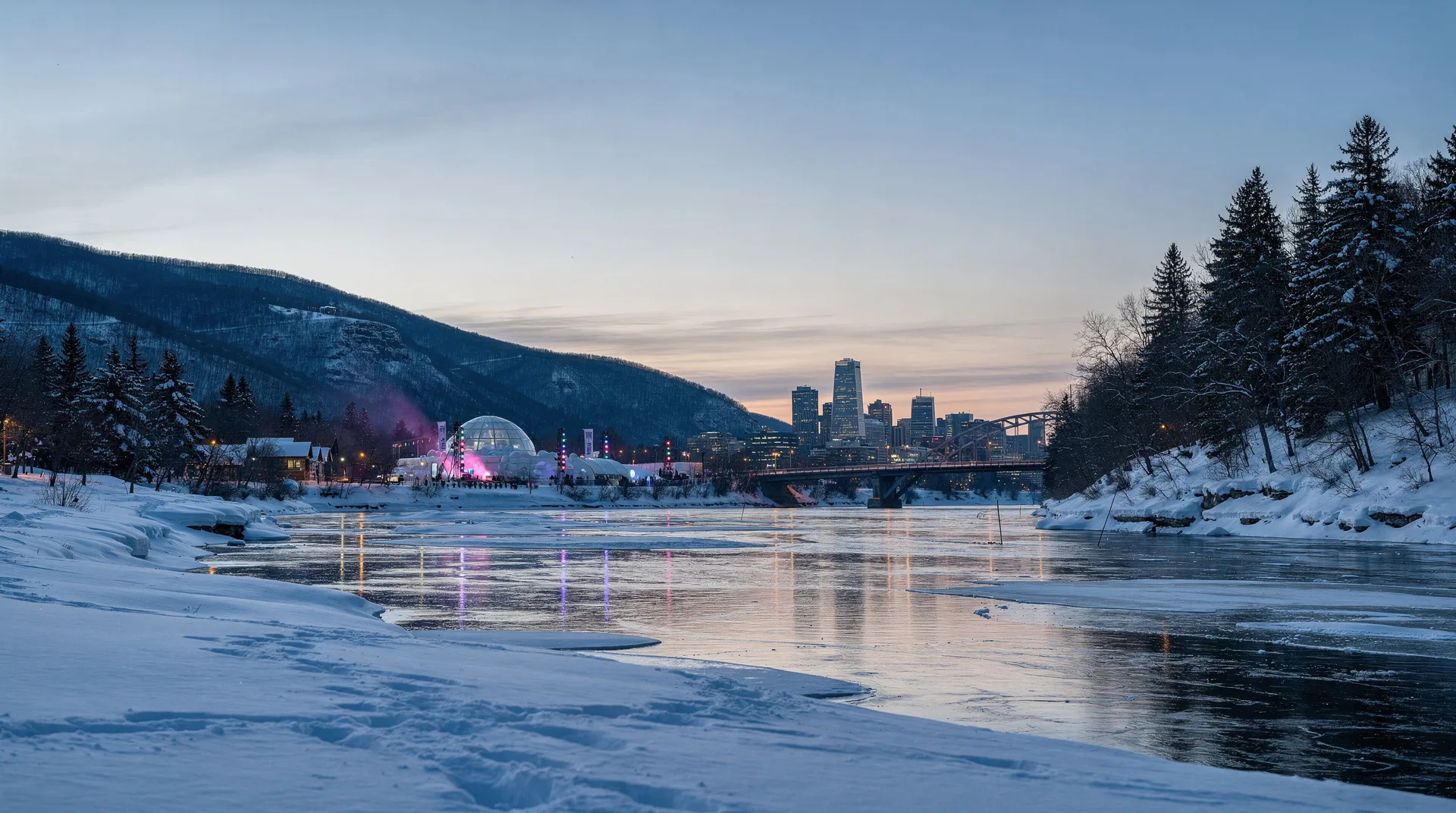
Igloofest Montreal: the world's coldest music festival
What is Igloofest?
Igloofest is Montreal's annual outdoor electronic music festival, held on four weekends in January and February at the Old Port. It routinely runs in temperatures of -20°C or colder, features major international electronic acts, and has become one of Canada's most distinctive winter events. Tickets cost CAD 30–50 per night.
Igloofest is the festival that sounds impossible until you attend one: an outdoor electronic music festival in Montreal’s Old Port, held on four consecutive weekends in late January and early February, running at temperatures that are regularly –20°C and have hit –30°C on record nights. What began in 2007 as a small curiosity has become one of Canada’s most distinctive winter events — now drawing international DJs and some 120,000 attendees each season, with a visual production scheme (LED installations, pyrotechnic ice sculptures, a winter-themed stage) that matches the ambition of summer’s big electronic festivals.
For any visitor in Montreal during the Igloofest weeks, going to at least one night is a quintessentially Montreal experience. This guide covers when Igloofest runs, how to get tickets, what to wear (genuinely a survival question), what to expect, and how Igloofest compares to the city’s other major music festivals.
| At a glance | |
|---|---|
| Where | Jacques-Cartier Pier, Old Port of Montreal |
| Cost | around CAD 30-50 per night; multi-night pass around CAD 100-150 |
| Time needed | one evening (roughly 7pm-1am); most visitors do one or two nights |
| Getting there | metro (orange line) to Champ-de-Mars or Place-d’Armes, then a 10-minute walk |
| Best time | any of the four weekends; headliner nights sell out fastest |
When and where
Season: Igloofest runs four consecutive Thursday–Saturday weekends, typically from the third weekend of January through the second weekend of February. Exact 2026 dates are published each November on igloofest.ca.
Location: Jacques-Cartier Pier, Old Port of Montreal. The pier sits directly on the St. Lawrence River; the stages face the river with downtown Montreal’s skyline behind.
Hours: roughly 7pm to 1am each night.
Getting there: metro to Champ-de-Mars or Place-d’Armes (orange line), then 10 minutes’ walk to the Old Port. Do not drive — parking is limited and the Champ-de-Mars lot fills. Uber/Lyft work for late-night returns.
Who plays
Igloofest books international electronic music — primarily house, techno, bass music, and adjacent genres. Recent years have featured headliners like Carl Cox, Eric Prydz, Skrillex, The Blessed Madonna, Peggy Gou, and major Montreal acts (Jacques Greene, CRi, Kaytranada has played).
Each night typically has one main-stage headliner plus 4–6 support acts across two or three stages. The lineup skews toward acts that can hold a crowd in cold weather — high-energy sets, strong visual production.
Lineup announcement: typically late November / early December. Tickets go on sale immediately after.
Tickets
Single-night ticket: roughly $30–50 depending on lineup and advance booking.
Multi-night pass: the 4-weekend “Pass Igloofest” discounts the per-night rate significantly. Full-season pass roughly $100–150.
VIP: Igloofest operates a VIP zone with better views, covered bars, and heated washrooms. Tickets $75–120 per night.
Tickets via igloofest.ca — sells well but usually available day-of for non-headliner nights.
Under 18: Igloofest is typically 18+, with ID checks. Some family-oriented events run early evening (6–9pm) before the main festival on certain dates.
What to wear — genuinely a survival question
This is the most important section of this guide. Igloofest is genuinely cold, and the party starts at 9pm and runs to 1am — you will be outside in –15 to –25°C for 4 hours.
Essentials:
- Parka rated to –30°C minimum. Canada Goose, Kanuk, or similar serious winter parkas. Not a thin down jacket.
- Thermal base layer (both tops and bottoms). Merino wool or synthetic technical fabrics.
- Mid-layer fleece on top.
- Insulated snow pants worn over the base layer. Not jeans.
- Winter boots rated to –40°C (Sorel Caribou or equivalent).
Your feet will be in snow or cold concrete for 4 hours.
- Two pairs of socks: thin liner + thick wool.
- Hat covering ears. Ideally with hood over hat.
- Mittens (warmer than gloves). Pocket hand-warmers help for photos and card-taps.
- Neck warmer / buff that you can pull over face.
- Hand warmers (disposable heating pads) — 2–3 packets, some for gloves, some for boots.
What goes wrong: people underdressing and having to leave after 90 minutes. Thin runners. Denim. No gloves. Believing that the “dance floor will warm you up” — it won’t; you’re still at –20°C.
Bathroom logistics: removing all those layers for a bathroom trip is work. The festival has heated washroom tents but wait times can be 15+ minutes. Plan accordingly.
On-site experience
The main stage: built on the pier with the St. Lawrence behind. Video walls and lighting create a dramatic setting. The crowd dances on a compressed-snow surface.
Second stage: smaller, more intimate, usually hosting international acts or local talent.
Warming tents: heated indoor spaces distributed around the site. Get food, warm up briefly, and return to the main stages. Long queues at peak times (10–11pm).
Food and drink: hot food vendors throughout the site (poutine, grilled sandwiches, warm drinks). Alcohol is sold in plastic cups; lineups can be long. Bring cash or tap card.
Cash vs. card: most vendors are tap-only. Some ATMs on-site but they run out of cash some nights.
Phone batteries: cold temperatures drain phone batteries fast. Bring a fully charged power bank (keep it in an inside pocket close to your body).
Photography: phone cameras struggle in the cold; consider bringing a small camera if photography is important to you. The visual production is genuinely spectacular and worth capturing.
The one-liner Igloofest vibe
A 25,000-person electronic music event, at –20°C, with the St. Lawrence frozen behind the stage, downtown Montreal lit up, ice sculptures and laser installations, and a crowd in Canada Goose parkas dancing on compressed snow. The atmosphere is distinctive: friendlier and more communal than summer festivals (everyone is bonded by the cold), with an energy that genuinely can’t be replicated elsewhere.
Combining with a Montreal winter visit
Igloofest is best combined with a 3–4 day Montreal winter trip:
- Day 1: arrive; Plateau walking and food.
- Day 2: day activities — Mount Royal snowshoeing, Vieux-Montréal, museums. Igloofest in the evening.
- Day 3: recovery day — Nordik Spa in Chelsea or Bota Bota floating spa in the Old Port, museums. Second Igloofest night optional.
- Day 4: departure.
See our Montreal in winter guide and Quebec winter itinerary for broader context.
How Igloofest compares to other Montreal music festivals
- Osheaga (late July/early August, summer, 100,000+ attendees, indie/pop/hip-hop): Montreal’s summer headline festival. Different audience, different music.
- Piknic Électronik (summer Sunday afternoons, electronic): the summer counterpart to Igloofest. Same promoters. Casual daytime electronic music.
- Jazz Fest (late June/early July): Montreal’s oldest major festival. See our Montreal jazz festival guide.
- Just for Laughs (mid-July, comedy): comedy festival, not music. See Just for Laughs.
- Île Soniq (August, electronic): Osheaga’s sister event, electronic-focused, summer-only.
Igloofest is uniquely winter-focused and uniquely dress-code-determined.
Planning your Igloofest night around the rest of the day
The festival is an evening commitment, so the daytime hours are yours to fill, and how you spend them affects how well you cope with the cold later. A gentle day works better than an exhausting one. Wander the cobbled streets of Old Montreal with our Vieux-Montréal guide, or browse the city’s food scene over a long lunch. If you would rather not plan it all yourself, guided tours in Montreal are an easy way to fill a daytime slot. Save the heavy outdoor activity for another day, because arriving at the pier already tired from hours in the snow makes the cold much harder to enjoy.
If you are staying in the city for several days, the Montreal destination page is a good place to see how the neighbourhoods connect, and Quebec in winter explains what the season feels like across the province. Visitors who want to build a bigger trip around a festival night can start from the Quebec 7-day winter itinerary and slot an Igloofest evening into one of the free nights.
Getting the cold right: a few extra habits
Gear is only half of the equation; habits make the other half. Put your layers on at the hotel rather than in a queue, and keep your outer shell unzipped on the metro so you do not arrive soaked in sweat, since damp base layers lose their warmth quickly once you step outside. Keep your tickets, card and phone in an inside pocket so you never have to bare your hands for long.
Move around during the night. Standing still in front of one stage is the fastest way to get cold, whereas drifting between the main stage, the second stage and the warming tents keeps your blood moving and gives you a fresh view of the show. Take short breaks indoors before you feel chilled, not after: once your toes go numb, recovery is slow. If you are unsure how winter weather behaves in this region, our Canadian weather by region page and the packing list cover the broader clothing picture for a winter trip.
Eating and drinking around the festival
A warm meal before the gates open is part of the plan. Montreal has no shortage of hearty options near the Old Port, and the city’s poutine guide is a useful starting point if you want to try the classic dish before a cold night out. For something more substantial, the Montreal smoked meat guide points to the kind of filling food that stays with you through hours outdoors.
Once inside, treat drinks as a supplement, not your source of warmth. Alcohol can make you feel warm while actually helping your body lose heat, so alternate with water or something hot, and keep an eye on friends who seem to be fading. Having a clear plan for the way home, as covered in the Montreal metro guide, makes the end of the night much less stressful.
Who will enjoy it most
Igloofest rewards people who like crowds, loud music and a bit of adventure. If you are already a fan of electronic music, the lineup and production are the draw. If you are not, the appeal is more about the spectacle: the frozen river, the lights, and a dance floor of strangers in parkas who are all in on the same joke. Groups of friends tend to have the best time, because sharing the cold and the breaks makes the night feel like an event rather than an endurance test.
Visitors who prefer a quieter winter evening have plenty of alternatives in the city. Our Quebec winter activities page lists other ways to enjoy the season, and the Quebec festivals calendar shows what else is on if the dates do not line up with your trip. Those curious about the wider music scene can also read about Quebec music festivals.
Igloofest vs. Quebec City’s Winter Carnival
Visitors sometimes assume Igloofest and Quebec City’s Winter Carnival are the same kind of event because both run in deep winter. They aren’t. Igloofest is a single-city, single-venue electronic music series; Winter Carnival is a much broader, family-oriented city festival across Quebec City with parades, ice sculptures, canoe races and Bonhomme. If you only have one winter weekend and want nightlife and dancing, pick Igloofest; if you want a broader winter-culture experience with kids in tow, Winter Carnival fits better. Some visitors on a longer Quebec winter itinerary combine a Winter Carnival day trip to Quebec City with an Igloofest night back in Montreal.
Is Igloofest worth the cold?
For anyone curious about Montreal’s winter culture beyond skating and hot chocolate, yes — the production quality and crowd energy are genuinely unusual for an outdoor winter event, and a single night is enough to experience it without needing to be an electronic-music devotee. The dress-code discipline is the real barrier, not the ticket price: underdressed visitors leave within an hour and remember only the cold, not the music.
Book Montreal winter experiences on GetYourGuideAfter the music stops
When the last set ends, a lot of people leave at the same moment, so a little patience goes a long way. Walk calmly back toward the metro, keep your group together, and do not stop to take long photos on icy ground. Slippery pavement is a bigger risk than most visitors expect, and good boot grip matters as much on the way out as on the way in.
Back at the hotel, take a few minutes to dry out your gear. Boots, gloves and socks that stay damp will be miserable the next day, and a second night at the festival is far more pleasant with dry layers. Drink something warm, rehydrate, and treat the following morning as a slow start. Our Montreal winter itinerary leaves room for exactly that kind of recovery.
Practical tips
- Hydration: you don’t feel dehydrated in cold weather but you are. Drink water between alcoholic drinks.
- Eat before you go: a big meal at 6pm sets you up for the cold better than eating on-site.
- Meeting friends: cell signal can be unreliable with 20,000 people in one place. Pick fixed meeting points at specific times.
- When to arrive: doors open 7pm; arrive by 8:30pm to avoid entry queues for big-name nights.
- Leaving early: easy — no tracking, just leave. Metro runs to ~1am on weekends; Uber after.
- Hotel proximity: stay in Old Montreal or downtown for the shortest walk home. A 10-minute walk at –20°C is survivable in gear; a 30-minute walk is not.
- Accessibility: the Old Port pier is mostly accessible; winter surfaces can be slippery; heated tents have ramps.
Frequently asked questions about Igloofest Montreal
Is Igloofest suitable for a first-time Montreal visitor with no local friends? Yes. It’s a well-run, ticketed festival with clear signage and heated facilities; solo travellers and small groups attend regularly. The main challenge is dressing correctly, not navigating the event itself.
What happens if a night is cancelled for extreme cold or a storm? Igloofest rarely cancels for cold — the whole premise is deep-winter weather — but organizers do occasionally postpone for severe storms or extreme wind chill warnings. Check igloofest.ca and your ticket email on the day of the event for updates.