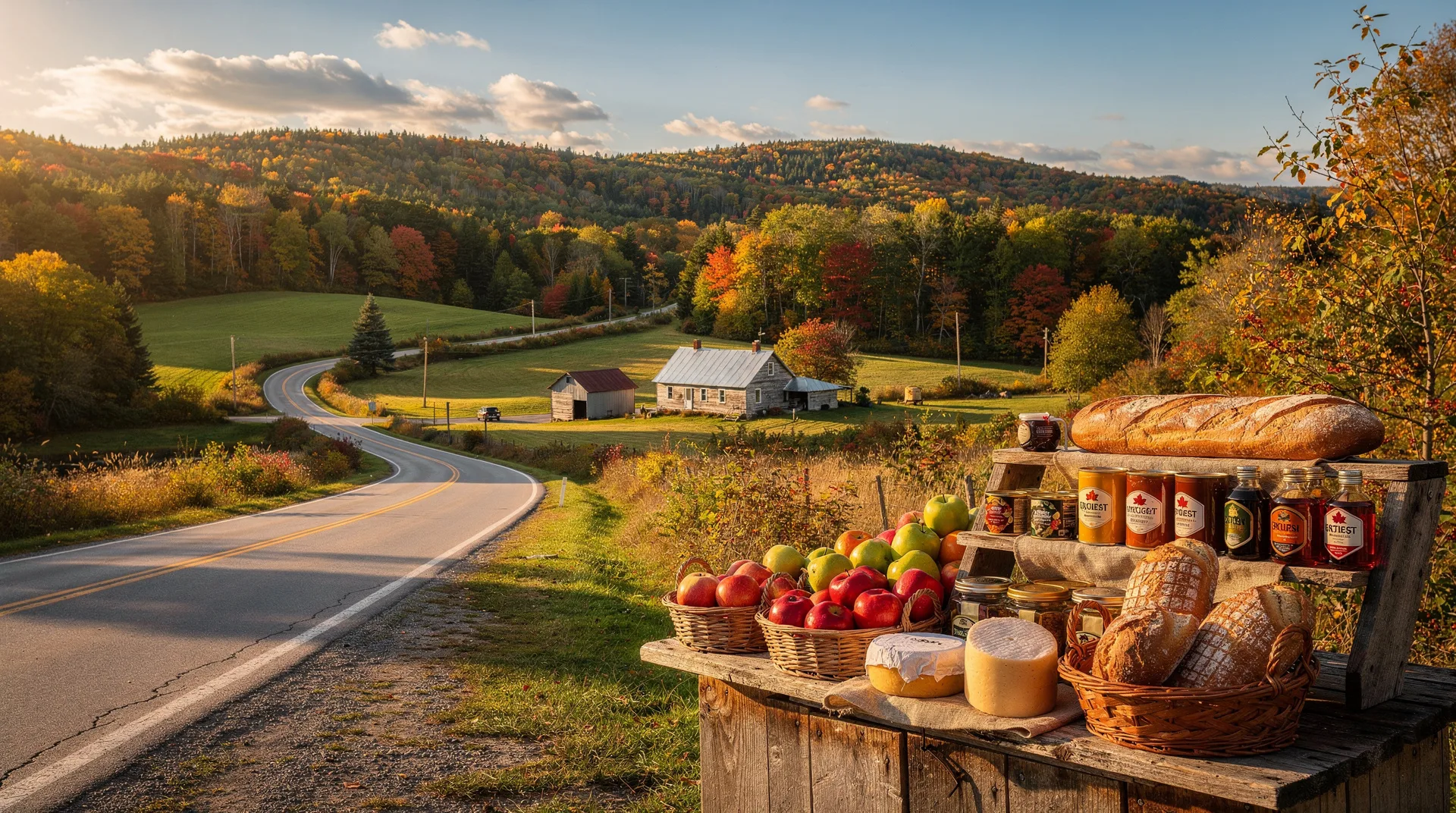
Quebec food deep-dive: tourtière, poutine, pouding chômeur and the full culinary canon
What are the essential dishes of Quebec cuisine?
Poutine, tourtière, pouding chômeur, soupe aux pois, and cipaille are the pillars of Quebec's culinary identity — rooted in French-Canadian tradition and shaped by long winters and rural ingenuity.
Quebec’s cuisine is one of North America’s most distinctive and least internationally understood food cultures. It is not French cuisine transplanted to the New World. It is something that evolved over four centuries from a blend of French culinary inheritance, Indigenous techniques, settler ingenuity, and the particular demands of a sub-Arctic agricultural climate where winters were long, harvests uncertain, and calories were survival currency. The result is a food culture that is rich, satisfying, deeply pork-forward, maple-inflected, and stubbornly itself — resistant to trend, slow to change, and quietly extraordinary.
Understanding Quebec food means understanding a few key principles. First, fat is flavour, and the province’s traditional cuisine does not apologize for it. Second, maple syrup is not a condiment but a foundational ingredient — used in cooking savoury dishes as well as sweet ones. Third, dairy, particularly cheese, plays a role that rivals any European tradition in its regional specificity and artisanal depth. And fourth, the province’s food culture is bifurcated: the everyday tradition of snack bars, sugar shacks, and home cooking runs parallel to a restaurant scene — particularly in Montreal — that is among the most sophisticated in North America.
This guide works through the essential dishes, the regional variations, where to find the best versions, and what each dish reveals about Quebec’s history and identity.
At a glance
| Where | Montreal and Quebec City for restaurants; sugar shacks and épiceries fines province-wide |
| Cost | Snack-bar meal around CAD $12-20; sugar shack feast around CAD $35-50 per adult; mid-range restaurant dinner around CAD $50-80 per person with wine |
| Time needed | A full day covers 2-3 restaurants or one market plus one meal; a Quebec food trip is better spread over 3-5 days |
| Getting there | Most essential eating is walkable within Montreal’s Plateau/Mile-End or Quebec City’s Old Town; a rental car helps for cabane à sucre and orchard visits |
| Best time | Year-round for restaurants; late winter/early spring for sugar shacks; September-October for apple and cranberry season |
The pillars of Quebec cuisine
Tourtière
Tourtière is Quebec’s most emblematic dish and the subject of its most passionate regional argument. At its simplest, it is a meat pie — a double-crust pastry filled with ground or cubed meat, seasoned with warm spices, and baked until golden. The complexity is in the variations, which are so regional that a tourtière from the Lac-Saint-Jean area and one from the Eastern Townships are essentially different dishes that share a name.
Quebec City and southern Quebec style: Ground pork or a pork-veal-beef mix, seasoned with cloves, cinnamon, allspice, and black pepper. The filling is typically quite fine, almost paste-like in the best versions. This is the style eaten at Christmas and New Year’s Eve (réveillon), the most significant meal in the Quebec culinary calendar.
Lac-Saint-Jean tourtière (cipaille style): The Saguenay–Lac-Saint-Jean region’s version is a multi-layered pie of cubed game meat — traditionally venison, rabbit, partridge, and pork — layered with potato and onion, seasoned with summer savoury, and baked for hours in a deep pot with alternating pastry and meat layers. This is cipaille or tourtière du Lac, and it bears little resemblance to the southern version beyond the pastry crust.
The spice profile of a properly made tourtière — particularly the combination of cloves, allspice, and cinnamon in a savoury meat context — is one of Quebec cuisine’s most distinctive flavour signatures. It is warming, complex, and immediately identifiable. You will smell a good tourtière before you see it.
Where to eat it: In Quebec City, bakeries and épiceries fines sell tourtière year-round, with quality peaking around Christmas. Restaurant William and Île-aux-Coudres area restaurants are known for excellent traditional versions. In Montreal, Maison du Nord and Taproom restaurants serve excellent versions in season.
Pouding chômeur
The name translates to “poor man’s pudding” or “unemployed man’s pudding,” and it tells you everything about its origin. Created during the Great Depression of the 1930s by Quebec factory workers (the “chômeurs” — unemployed), this dessert was designed to be made from the cheapest available ingredients: flour, butter, eggs, and brown sugar or maple syrup.
The technique is deceptively simple and produces a result that seems to defy physics. A basic yellow cake batter is poured into a baking dish. Over it is poured a sauce of brown sugar or maple syrup and cream, which is hot and liquid. The batter rises through the baking process, and the sweet sauce migrates to the bottom, where it thickens into a caramel-like layer beneath a cloud of tender cake. Eat it warm — the contrast between the light cake above and the dense, sticky maple sauce below is the entire point.
The best pouding chômeur uses maple syrup, not brown sugar, and the maple version has an intensity and complexity the brown sugar version cannot match. Sugar shacks serve it routinely; it is also available at traditional Quebec restaurants year-round.
Soupe aux pois
Quebec pea soup — thick, slow-cooked, yellow split pea soup with salt pork — is one of the province’s oldest dishes and its most democratic. It appears in exactly the same form in humble diners, sugar shacks, family kitchens, and upscale restaurants that do traditional cuisine. The technique has not changed in three hundred years: yellow split peas are soaked overnight, simmered for hours with salt pork (usually a ham hock or salt pork belly), onions, and salt, until the peas dissolve into a thick, savoury liquid that is almost as much a stew as a soup.
The flavour is deeply savoury, smoky from the pork, and warming in a way that seems physiologically designed for a Quebec February. A bowl of soupe aux pois with crusty bread and a slab of butter is one of Quebec’s most satisfying meals and one of its cheapest.
Cretons
Cretons is Quebec’s answer to the French rillettes — a cold-processed pork spread made from ground pork, lard, onions, and spices (particularly allspice and cinnamon, the characteristic Quebec spice profile again), cooked down to a dense, smooth paste and eaten on toast or crackers, typically at breakfast. It is often available at sugar shacks alongside the other pork products and is a staple of Quebec diners at breakfast.
Poutine: context and evolution
The full story of poutine — origin, construction, where to find the best versions — is covered in the poutine guide. Within the broader context of Quebec cuisine, poutine is significant not just as a dish but as a cultural statement. Its rise from rural snack bar food to national symbol to international export happened simultaneously with Quebec’s assertion of cultural confidence in the 1970s through 1990s. It is unpretentious, satisfying, and works at every price point and social stratum — from the Chez Ashton counter in Quebec City to the foie gras poutine at Au Pied de Cochon in Montreal.
Explore Montreal food tours and culinary experiences on GetYourGuideQuebec’s great regional dishes
Fèves au lard (baked beans)
Quebec baked beans are slow-cooked in a clay pot with salt pork, onions, and maple syrup for eight to twelve hours. The result is sweet, smoky, and deeply flavoured in a way that distinguishes them from American baked beans despite the apparent similarity. They are a standard element of the sugar shack feast and a common breakfast or supper component in traditional Quebec home cooking.
Ragoût de pattes de cochon
Pig’s feet stew with meatballs — ragoût de pattes de cochon et de boulettes — is the quintessential réveillon dish in Quebec and one of the most ancient recipes in the French-Canadian culinary canon. The pig’s feet are braised for hours in a rich, spiced brown sauce thickened with lard-fried flour; meatballs of ground pork and veal, seasoned with cloves and cinnamon, are added toward the end. The sauce becomes gelatinous from the collagen in the pig’s feet. It is a dish that rewards patience and requires neither apology nor explanation.
Cipaille (or cipâte)
The great pie of Eastern Quebec and Saguenay–Lac-Saint-Jean — multiple layers of cubed game meat, game birds, potato, and onion between layers of pastry, baked in a deep vessel for four to six hours. The result is a dense, rich, complex dish that has no direct equivalent elsewhere in North America. Some recipes use venison and rabbit; others add black bear or partridge. The pastry layers between the meat absorb the cooking juices and become part of the filling rather than merely a container.
Oreilles de crisse
One of Quebec cuisine’s most brazenly named dishes: “Christ’s ears” are crispy deep-fried salt pork rinds, so named (according to legend) because of their resemblance to a pair of large ears. They are served at sugar shacks with maple syrup for dipping and are one of the most addictive things produced by Quebec’s pork tradition. The salt pork is boiled, then deep-fried in lard until crackling and crunchy, then drizzled with maple syrup immediately before serving. The combination of salt, fat, crunch, and sweet is close to irresistible.
The Montreal restaurant scene
Montreal’s restaurant scene is consistently ranked among the best in North America, and it operates on a different plane from the traditional cuisine described above — though the best Montreal chefs are deeply engaged with their culinary heritage.
Au Pied de Cochon: Martin Picard’s legendary restaurant near the Plateau-Mont-Royal is the most important restaurant in Quebec’s recent culinary history. Its menu is an extreme, maximalist interpretation of Quebec cuisine: foie gras served twelve ways, duck stuffed with offal, massive portions of traditional dishes reimagined with luxury ingredients. The foie gras poutine is famous worldwide. Reserve well in advance.
Joe Beef: The duo of David McMillan and Frédéric Morin created what may be the most influential restaurant in Montreal’s recent era. The menu changes constantly and ranges from simple bistro food to elaborate creations, all grounded in the belief that Quebec’s culinary tradition is as worth serious attention as any French regional tradition.
Toqué!: Normand Laprise’s long-running fine dining landmark uses Quebec ingredients — duck from Brome County, cheese from local fromageries, maple and foraged mushrooms — in a technically rigorous contemporary framework. It is the most formally sophisticated expression of Quebec cuisine available.
L’Express: The great Montreal bistro, open since 1980, serving classic French bistro food made with Quebec ingredients. The wine list is exceptional; the cassoulet and the steak frites are references. Reservations are difficult and worth persisting for.
Quebec City’s culinary identity
Quebec City’s food scene is smaller and less internationally celebrated than Montreal’s but has its own distinct character. The city’s Old Town restaurants serve food to an international tourist audience, but the neighbourhoods outside the walls — Saint-Roch, Saint-Jean-Baptiste, Limoilou — have genuine local restaurant culture.
Panache in the Auberge Saint-Antoine in Old Quebec is the city’s most celebrated restaurant — housed in former maritime warehouses, serving Quebec cuisine with fine dining technique. The menu emphasises local producers and seasonal ingredients.
Légende par la Tanière offers a tasting menu focused entirely on Quebec’s wild and foraged ingredients — unusual mushrooms, game, roots, wild herbs — prepared with haute cuisine technique. It is one of the most ambitious expressions of terroir in Canadian dining.
L’Affaire est Ketchup in the Saint-Jean-Baptiste neighbourhood is a tiny, no-reservation, table d’hôte restaurant that has become a local institution. The food is market-driven, French-influenced, and priced at a fraction of comparable Montreal restaurants.
For traditional Quebec food in Quebec City, see the Quebec City destinations page for current restaurant recommendations.
Browse Quebec City culinary and historical tours on GetYourGuideSeasonal food rhythms
Quebec’s culinary calendar has a rhythm that visitors should understand:
March–April: Maple season. Sugar shacks open, maple products dominate. See the cabane à sucre guide for full detail.
May–June: Fiddlehead ferns (têtes de violon) — one of Quebec’s great spring vegetables, foraged from riverbanks and briefly available in markets and restaurants. Asparagus from the Laurentians and South Shore also appears.
July–August: Quebec strawberries, then blueberries (particularly from Saguenay–Lac-Saint-Jean). The province grows extraordinary blueberries — smaller, more intensely flavoured than commercial varieties — and the region celebrates them actively.
September–October: Apple season in the Eastern Townships and Montérégie. Apple-picking, fresh cider, ice cider production begins. See the Quebec ice cider guide for detail on this uniquely Quebec product.
October: Cranberry harvest in Centre-du-Québec. See the cranberry harvest guide.
November–December: Game season. Wild deer, boar, and game birds appear on restaurant menus. Réveillon preparation — tourtière, ragoût de pattes — begins in home kitchens.
Practical food notes for visitors
Jean-Talon Market in Montreal’s Mile-End neighbourhood is the essential food market for understanding Quebec ingredients — fromageries, maple producers, charcutiers, vegetable farmers, fishmongers. Plan an entire morning. See the Quebec food markets guide for detail on this and other markets.
Épiceries fines (specialty food stores) across Quebec sell regional products — local cheeses, maple products, artisan charcuterie, cideries’ products — that make excellent edible souvenirs. The SAQ (Société des alcools du Québec) is the province’s wine and spirits retailer, with good selections of Quebec ice ciders, craft spirits, and imported wines.
The cheese tradition: Quebec has over 250 artisan cheeses, and the province’s dairy culture is one of North America’s most sophisticated. See the Quebec cheese trail guide for a full exploration by region.
Cost: Quebec food — particularly at snack bars, diners, and mid-range restaurants — is notably cheaper than comparable quality food in Toronto, Vancouver, or New York. A full traditional meal at a sugar shack costs CAD $35–$50 per adult. A very good dinner at a mid-range Montreal restaurant is typically CAD $50–$80 per person with wine.
Ordering like a local
A few practical habits separate visitors who eat well from visitors who order the safe, generic version of everything. In Montreal bistros and traditional Quebec restaurants, ask for the daily table d’hôte (a fixed-price multi-course menu built around what’s fresh that day) rather than defaulting to à la carte — it is almost always the better value and the more honest read on a kitchen’s real strengths. At sugar shacks, the meal is typically a set menu served family-style; do not expect a menu with choices, and pace yourself, because the courses keep coming. In snack bars and casse-croûtes serving poutine and tourtière, cash is often preferred and portions are large — sharing is normal and not considered odd.
Quebec’s regional food identity is strongest outside Montreal and Quebec City. A trip that only covers the two big cities misses the point that cretons, tourtière, and cipaille taste different — and often better — in the small towns where they originated. The Quebec cheese trail guide and the quebec ice cider guide both cover regions (Charlevoix, the Eastern Townships, Montérégie) where the food is inseparable from the landscape it comes from, and pairing a food-focused day trip with a Quebec fall itinerary or a Quebec foodie 7-day itinerary is the most efficient way to see both.
Vegetarian and dietary notes
Traditional Quebec cuisine is unapologetically pork- and dairy-forward, which makes strict vegetarian and vegan eating harder here than in most large North American cities — though Montreal’s contemporary restaurant scene, distinct from the traditional canon described above, has excellent vegetarian and vegan options, particularly in the Mile-End and Plateau neighbourhoods. Sugar shacks can typically accommodate a vegetarian version of the set menu with advance notice, but few do vegan well by default; ask when booking. Gluten-free diners should note that tourtière, cipaille, and pouding chômeur all rely on wheat pastry or batter, so options narrow quickly outside dedicated modern restaurants.
Frequently asked questions about Quebec food deep-dive
Is Quebec food very different from French food?
Yes. Quebec cuisine descends from French culinary inheritance but evolved separately for four centuries under different ingredients, climate, and history, shaped heavily by Indigenous techniques and the demands of long winters. It shares some vocabulary and technique with France but is its own tradition, not a regional French cuisine.
What should a first-time visitor eat in one day in Montreal?
A reasonable single-day sampling is a smoked meat sandwich, poutine (ideally not the first tourist-facing option you see), and a table d’hôte dinner at a traditional bistro; see the Montreal food guide for a fuller plan.