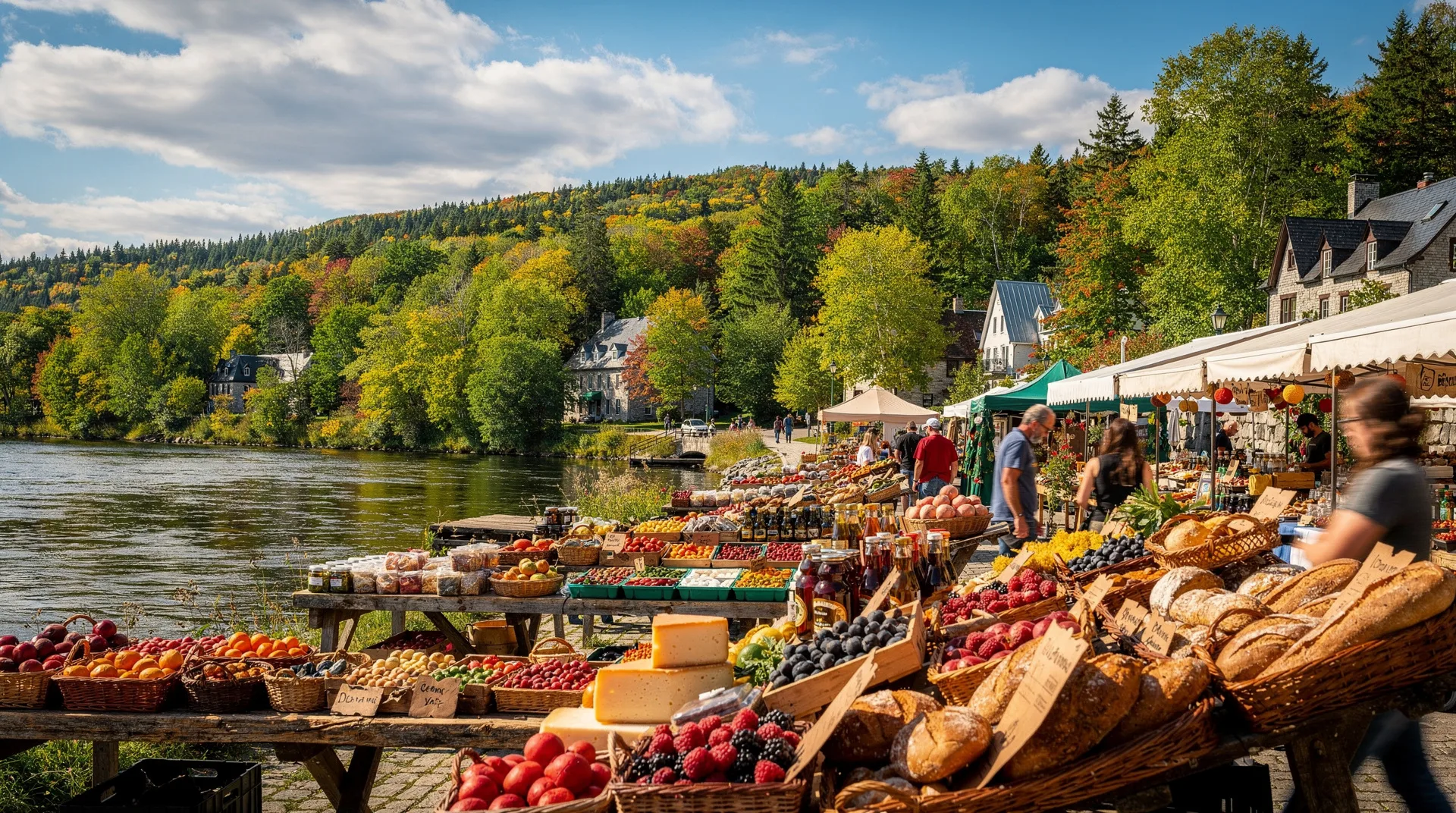
Quebec's best food markets: Jean-Talon, Atwater, Old Port Quebec City
What are Quebec's best food markets?
Jean-Talon Market in Montreal's Mile-End is the province's premier public market. Atwater Market on the Lachine Canal is smaller but excellent. Quebec City's Marché du Vieux-Port is the capital's best market, especially for regional Charlevoix and Centre-du-Québec products.
Quebec’s market culture
Public markets are woven into Quebec’s food identity in a way that distinguishes the province from the rest of Canada. The marché public — a weekly or permanent gathering of farmers, producers, artisans, and specialty food vendors — is not merely a place to buy groceries; it is a social institution, a showcase of regional production, and one of the most effective ways for visitors to understand what Quebec grows, produces, and eats.
The two great markets of Montreal — Jean-Talon in the north and Atwater in the west — are among the best public markets in North America by any measure. They are open year-round (outdoor vendors extend the summer months; permanent indoor stalls continue through winter), they carry an extraordinary diversity of Quebec-grown and Quebec-produced products, and they function as informal community centres for the neighbourhoods around them. Quebec City’s Marché du Vieux-Port, smaller but beautifully situated on the St. Lawrence waterfront, provides a complementary experience centred on the capital region’s producers.
This guide covers each market in detail — layout, best vendors, what to buy in each season, how to eat within the market itself, and practical logistics for planning a market visit. For the broader context of Quebec food culture, see the Quebec food deep-dive guide.
At a glance
| Where | Jean-Talon and Atwater in Montreal; Marché du Vieux-Port in Quebec City |
| Cost | Free to browse; a market breakfast or snack runs around CAD $8-15; a full food-souvenir haul CAD $30-60 |
| Time needed | Around 1.5-2 hours per market for a proper visit; a full morning if combining shopping with eating |
| Getting there | Jean-Talon: Metro Jean-Talon; Atwater: near the Lachine Canal, walkable from Saint-Henri; Vieux-Port: walkable from Old Quebec |
| Best time | Saturday morning (9-11am) for peak atmosphere; weekday mornings for a calmer visit |
Comparing the three markets
| Market | Character | Best for | Busiest time |
|---|---|---|---|
| Jean-Talon | Largest, most diverse, Little Italy influence | Produce, cheese, maple, full immersion | Saturday morning |
| Atwater | Smaller, art deco, canal setting | Butchers, fishmonger, atmosphere over volume | Weekend mornings, summer |
| Marché du Vieux-Port | Compact, waterfront, regional focus | Charlevoix and Île d’Orléans products, easy Old Town access | Summer weekends |
Jean-Talon Market, Montreal
Overview
Jean-Talon is the largest and most important public market in Montreal, and by most accounts the finest public market in Canada. Located in the Marché Jean-Talon building in the Little Italy neighbourhood of north-central Montreal, the market occupies an entire city block with a mix of permanent indoor stalls and outdoor seasonal vendors who fill an open-air courtyard from April through November.
The market traces its origins to 1933, when the City of Montreal established it to serve the agricultural and immigrant communities of the area. The Little Italy connection is still visible in the market’s character — Italian greengrocers, Portuguese cheese vendors, Lebanese spice merchants, and French-Canadian maple and dairy producers all coexist in the dense, colourful interior. But the heart of the market is Québécois: local farmers with strawberries, zucchini blossoms, heritage tomatoes, and garlic; fromageries with regional artisan cheeses; maple producers; cideries; and charcutiers.
What to buy and eat at Jean-Talon
Summer (June–August): Fraises du Québec — Quebec strawberries, smaller and more intense than commercial berries — are one of the great seasonal experiences at Jean-Talon. They appear in June and are gone by mid-July. Buy a basket, eat them immediately. Following the strawberries: heritage tomatoes in every size and colour, zucchini blossoms (a Little Italy influence on a Québécois market), wild mushrooms from foraged batches, sweet corn from the South Shore farms, and the first autumn squash by August.
Fall (September–October): The market’s most abundant and colourful season. Heirloom squash, apple varieties from Montérégie orchards, cranberries from Centre-du-Québec (see the cranberry harvest guide), fresh walnuts, and the concentrated fall harvest of the Quebec farm belt all converge at Jean-Talon.
Winter (November–March): The outdoor courtyard closes or reduces, but the permanent indoor stalls continue year-round. The winter market emphasises preserved and aged products: aged Quebec cheeses, maple products, charcuterie, root vegetables, and imports from warmer climates. Maple season (March–April) brings a concentration of sugar shack products.
Year-round: Quebec artisan cheeses from fromagerie stalls (Migneron de Charlevoix, Riopelle, Oka, aged cheddar), maple syrup in all four grades, cidres de glace from Eastern Townships producers, Quebec microbrewery bottles, smoked meats, prepared charcuterie, fresh pasta from Italian vendors, fresh fish and smoked fish, and fresh bread from multiple boulangers.
Eating at the market: Several prepared food vendors operate from permanent stalls or seasonal counters:
- La Boucherie de Tours and similar charcutiers often sell prepared sandwiches and plates
- Fromagerie Hamel (permanent stall) sells excellent cheese plates with accompaniments
- Chez Chine and other prepared food vendors provide fast meals from the indoor stalls
- The outdoor courtyard in summer hosts occasional food trucks and event vendors
Practical Jean-Talon logistics
Address: 7070 Avenue Henri-Julien, Montreal (corner of Jean-Talon and Henri-Julien)
Hours: Outdoor market: May–October, typically Tuesday–Sunday from 7am to 6pm, extended hours on weekends. Indoor market: year-round, most stalls open Monday–Saturday 8am–6pm, some stalls open Sunday.
Getting there: Metro Station Jean-Talon (Orange or Blue line) is one block north. Cycling from downtown via the Rachel bike lane is also practical.
Best time to visit: Saturday morning from 9–11am is the peak time — maximum produce, maximum vendors, maximum atmosphere. Weekday mornings are calmer if crowd-aversion is a priority.
Book a Montreal food tour including market visits on GetYourGuideAtwater Market, Montreal
Overview
Atwater Market occupies a handsome art deco building on Avenue Atwater at the Lachine Canal, in the Saint-Henri neighbourhood southwest of downtown Montreal. It is smaller than Jean-Talon but in many ways more beautiful — the canal setting, the outdoor seasonal stalls extending toward the water, and the permanent indoor hall (which includes a butcher, fishmonger, and multiple specialty food vendors) make Atwater one of the more atmospheric market experiences in the city.
The market dates to 1933, built at the same time as Jean-Talon as part of the same municipal market initiative. Atwater has always had a slightly more neighbourhood-oriented character — less tourist-facing, more dependent on local clientele — and this gives it an authenticity that some visitors prefer.
What makes Atwater distinctive
The butchers and fishmongers: Atwater’s Boucherie de Veau de Charlevoix and the Poissonnerie du Marché Atwater are among the best in Montreal. The Charlevoix veal — milk-fed, rose-coloured, extremely tender — is a regional product of genuine quality.
Fromagerie Atwater: A specialist cheese shop in the indoor hall with one of the best selections of Quebec artisan cheeses in the city. Staff are knowledgeable and enthusiastic about guiding visitors through the Quebec cheese landscape.
The seasonal outdoor stalls: In summer, the canal-side area fills with flower vendors, vegetable farmers, and fruit producers. The setting — the old canal on one side, the art deco building on the other — is genuinely beautiful on a summer morning.
The surrounding neighbourhood: Saint-Henri is one of Montreal’s most interesting and rapidly evolving neighbourhoods, with excellent cafes, bakeries, and restaurants. A market visit naturally extends into the neighbourhood. The Lachine Canal cycling path begins here and extends to Old Montreal — see Montreal destinations for the city overview.
Hours: Similar to Jean-Talon — outdoor market seasonally, indoor year-round. Tuesday–Sunday, 8am–6pm most stalls.
Marché du Vieux-Port, Quebec City
Overview
Quebec City’s primary public market occupies a large, modern market hall on the waterfront of the Old Port, at the foot of Côte du Palais near the Artillery Park. The setting — overlooking the St. Lawrence River with the Old City rising behind — is among the most dramatically beautiful of any market in Canada.
The market tends to emphasise Quebec City’s regional suppliers: producers from Charlevoix (an hour to the northeast), Île-Orléans (visible from the market in good weather), the Beauce region to the south, and Centre-du-Québec. For visitors staying in Quebec City, it provides the easiest access to regional Quebec food products without leaving the Old Town area.
What to buy at Vieux-Port
Charlevoix products: Cheese from Laiterie Charlevoix, duck and duck products from Canards du Lac Brome, Charlevoix lamb — the regional producers of the most celebrated food region northeast of Quebec City are well-represented.
Île d’Orléans strawberries and preserves: The island in the St. Lawrence immediately downstream from Quebec City is famous for strawberries and various preserved fruit products. See the Île d’Orléans vs Île aux Coudres comparison guide for more on both islands.
Maple products: The Chaudière-Appalaches and Charlevoix maple producers have strong presences at the market. Syrup, butter, vinegar, and confiseries.
Artisan cheeses: A selection of Quebec artisan cheeses from regional producers, including some Charlevoix products not easily found in Montreal.
Local bakeries: Several boulangers and pâtissiers operate from the market. Quebec City’s baking tradition — influenced by the city’s French heritage — produces excellent croissants, pain de campagne, and specialty pastries.
Hours: Typically open Tuesday–Sunday year-round; extended hours in summer. The outdoor areas are most active from May through October.
Explore Quebec City food and culture experiences on GetYourGuideSeasonal market calendar
Quebec’s market system is seasonally driven; understanding what to look for in each season maximises the experience:
March–April (maple season): Both Montreal markets have concentrated maple presence — sugar shack producers set up temporary stalls, and the full range of maple products (syrup, butter, candy, vinegar) is available fresh. Fresh cheese curds from dairy producers also peak during this period.
June–July (strawberry season): Fraises du Québec — small, intensely flavoured local strawberries — are one of Quebec’s most celebrated seasonal products. At their peak for roughly four to six weeks. Also: wild garlic scapes, zucchini blossoms (Jean-Talon), first new potatoes.
August (high summer): Heritage tomatoes, sweet corn, blueberries from Saguenay–Lac-Saint-Jean (available at specialty vendors), fresh herbs, green beans, cucumbers. The outdoor markets are at their most abundant and colourful.
September–October (fall harvest): Heirloom squash, apples (multiple varieties from Montérégie orchards), cranberries, pears, fresh mushrooms, late-season tomatoes. The cranberry season peaks in mid-October. Apple cideries bring their first-press products.
November–March (winter): Root vegetables, aged cheeses, preserved and cured products, imported citrus and tropical fruit. Winter is not the best season for market visits but the permanent indoor stalls remain fully operational and interesting.
Beyond the three main markets
Marché des Jardins (Sainte-Adèle, Laurentians): A smaller seasonal market in the Laurentian ski country, operating summers and falls, with local farmers and producers from the Laurentian region.
Marché de la Gare (Sherbrooke): The Eastern Townships’ most significant public market, operating year-round in Sherbrooke’s train station building. Strong representation from the region’s dairy, apple, and artisan food producers.
Marché public de Drummondville: Centre-du-Québec’s market, notable during cranberry season for the presence of regional cranberry producers.
Smaller neighbourhood markets: Montreal has a growing network of smaller neighbourhood markets — Marché Maisonneuve in the east end, Marché Saint-Jacques in the Centre-Sud — that serve local communities and give a more neighbourhood-specific view of Montreal’s food culture.
Tips for market visits
Go early: The best produce and the best selection — particularly for specialty or limited products — is available in the first two hours of opening. By noon at Jean-Talon on a Saturday, the most popular vendors may be running low.
Bring cash and bags: Most vendors accept credit cards, but cash is faster. Reusable bags are standard; paper bags are available but plastic is increasingly restricted.
Ask questions: Quebec market vendors are generally enthusiastic about their products and happy to explain production methods, suggest preparations, and offer tastes. The language barrier is minimal at the major markets, where most vendors have basic English.
Eat before you buy: Arriving hungry at a Quebec market leads to impulse buying that may exceed what you can eat before it spoils. A market breakfast or coffee before shopping helps calibrate purchasing.
Edible souvenirs: The Quebec markets are the best place to assemble a food-based souvenir package: a tin of maple syrup, a bottle of ice cider, a wheel of aged cheddar, some dried cranberries, a jar of cranberry vinegar, and some maple candy will fit in a checked bag and travel well.
Building a market-based itinerary
Markets are one of the most efficient ways to spend a limited-time morning in either city, because they compress shopping, eating, and a feel for the local food culture into a single stop. In Montreal, pairing Jean-Talon with a stroll through Little Italy, or Atwater with a walk along the Lachine Canal into Montreal’s Old Port area, turns a market visit into a half-day outing without needing a car. In Quebec City, the Vieux-Port market slots naturally into a morning that also covers Old Quebec, since the market sits just outside the walls.
If your trip includes a longer Quebec itinerary, consider timing a market visit to a specific season rather than treating it as an any-day stop: strawberry season (June-July) and fall harvest (September-October) are dramatically more rewarding than a quiet February visit to the indoor stalls only. See the Quebec fall itinerary or the Quebec 7-day itinerary for how a market morning fits into a broader plan.
Frequently asked questions about Quebec’s best food markets
Are Quebec’s public markets open in winter?
Yes, though reduced. The permanent indoor halls at Jean-Talon and Atwater operate year-round, and the Marché du Vieux-Port stays open too, but the outdoor seasonal stalls that add most of the colour and volume close or shrink from November through March.
Which Montreal market is better for a first-time visitor with limited time?
Jean-Talon, for sheer range and the ability to eat a full meal from market stalls. Atwater is worth adding on a second visit or if the canal setting and butcher shops appeal more than volume.
Related pages
- Quebec food deep-dive: tourtière, poutine and the full culinary canon
- Quebec cheese trail: artisan cheese tour by region
- Quebec ice cider: the invention, producers and tastings
- Cranberry harvest tourism Quebec
- Île d’Orléans vs Île aux Coudres: two Quebec islands compared
- Montreal destinations
- Quebec City destinations