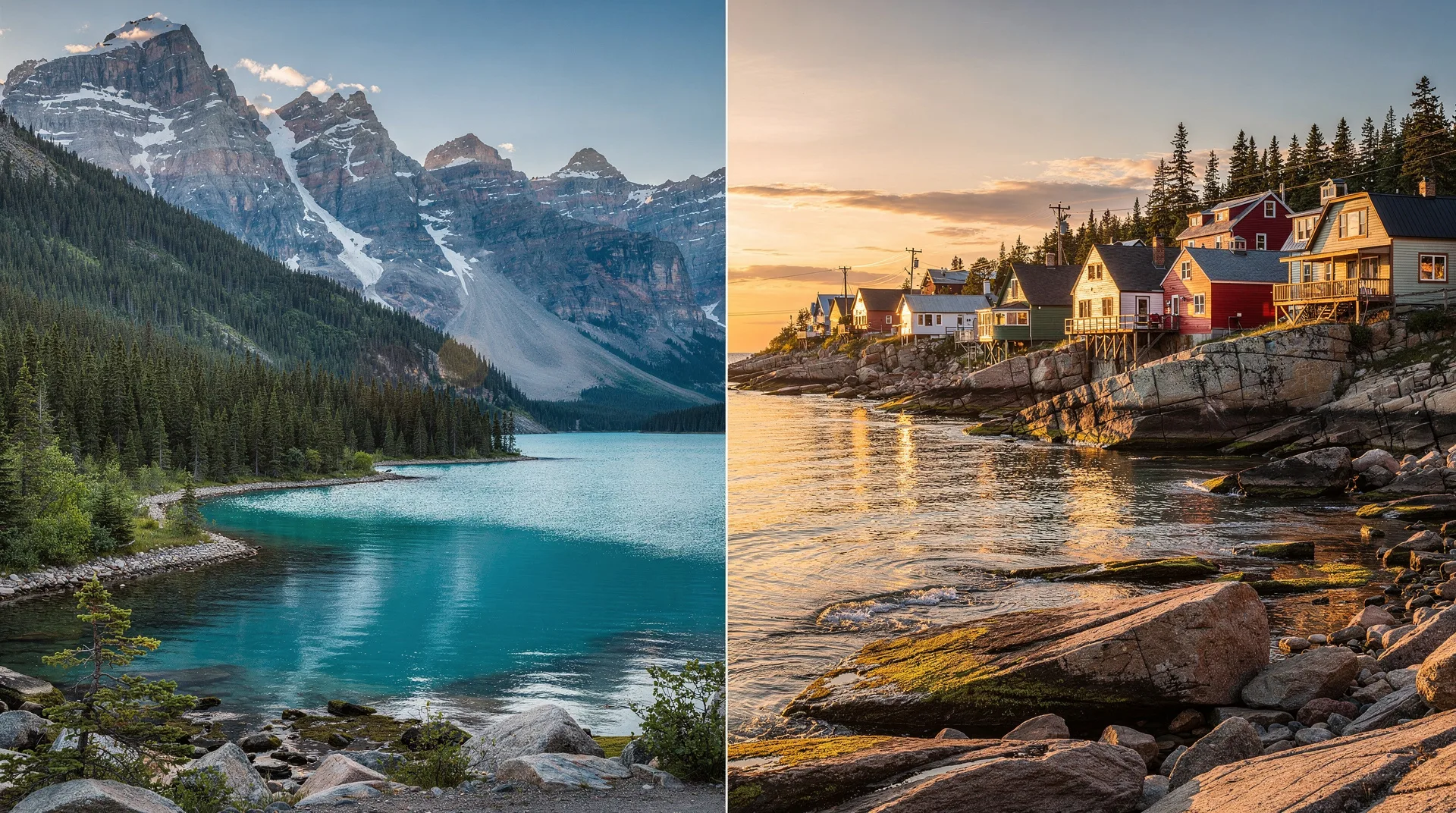
Île d'Orléans vs Île aux Coudres: two Quebec islands compared
Which is better — Île d'Orléans or Île aux Coudres?
Île d'Orléans is easier to access, has more food producers, and suits cyclists and history lovers. Île aux Coudres is more remote, more Charlevoix in character, and better for those seeking tranquillity, whale watching, and exceptional cheese and cider.
At a glance
| Île d’Orléans | Île aux Coudres | |
|---|---|---|
| Where | 15 min from Quebec City by bridge | 90 min from Quebec City, then a free 15-min ferry |
| Cost | Free bridge; food/producer visits typically CAD 5-20 | Free ferry; cheese and charcuterie tastings similarly priced |
| Time needed | Half day to a full day | A full day, ideally an overnight |
| Getting there | Self-drive or bike from Quebec City | Self-drive to Saint-Joseph-de-la-Rive, then ferry |
| Best time | June-October for produce and cycling | June-September for tidal flats and whale watching from shore |
Two islands in the same river, a world apart
The St. Lawrence River between Quebec City and the Saguenay Fjord holds two islands that attract very different visitors for very different reasons. Île d’Orléans — large, green, and close to Quebec City, its bridge visible from the Old Town’s Citadel — is the more visited and the more intensively agricultural, a 67 km loop of berry farms, apple orchards, maple producers, and heritage buildings that has preserved its rural Quebec character against the pressure of suburban expansion.
Île aux Coudres — smaller, further downstream, accessible only by ferry — is part of the Charlevoix landscape in spirit and in designation, with a more remote character, dramatic tidal flats, excellent artisan food producers, and the quietude that comes from being 30 km further from the city.
Understanding the difference between them — and which suits your interests and timeline — is the purpose of this guide. Both are worth visiting; both reward a full day or an overnight stay; and both can be combined in a Quebec City–based itinerary with some planning.
Access and practicality
Île d’Orléans
Île d’Orléans is connected to the mainland by the Pont de l’Île d’Orléans, a fixed bridge 10 km northeast of Old Quebec City. The bridge is free to cross (tolls were eliminated in 2019), and the drive from Quebec City takes approximately 15 minutes. The island is fully accessible by private car — the circuit road (Route 368) runs 67 km around the perimeter with no dead ends and no ferry crossings.
There is no significant public transport to or around the island — a car or bicycle is essential. Cycling the island circuit (see the Route Verte cycling guide for cycling context) takes 4–6 hours at a relaxed pace.
The proximity to Quebec City means that Île d’Orléans is viable as a half-day trip, though a full day or an overnight stay allows a properly unhurried visit.
Île aux Coudres
Île aux Coudres has no bridge connection. It is reached by ferry from Saint-Joseph-de-la-Rive — a free ferry (operated by the Société des traversiers du Québec) that makes the 2.4 km crossing in approximately 15 minutes. The ferry runs frequently during daylight hours (approximately every hour in summer, less frequently in early spring and fall).
Saint-Joseph-de-la-Rive is 90 km from Quebec City by car (about 90 minutes), along Route 138 through Baie-Saint-Paul. The journey from Quebec City to the island’s first buildings is thus approximately 1 hour 45 minutes — a commitment that means most visitors stay at least one night, and the island’s character reflects this: it is oriented toward visitors who are staying, not stopping.
Verdict on access: Île d’Orléans wins decisively on convenience. For visitors with limited time, the island is the logical choice. Île aux Coudres requires more effort — and offers more reward for making it.
Character and landscape
Île d’Orléans
Île d’Orléans is a time capsule of rural Quebec. The island was settled by French colonists in the 1640s and 1650s, and the pattern of strip farms (rangs) — long narrow lots running back from the shore road — is unchanged from the original land grants. The farmhouses, many built in 18th and 19th century Quebec rural style (steeply pitched tin roofs, stone or wood walls, wood shutters), line the circuit road in an almost unbroken sequence.
The six municipalities on the island — Saint-Pierre, Saint-Laurent, Saint-Jean, Saint-François, Sainte-Famille, and Saint-Pétronille — each have a church that serves as the visual anchor of the settlement. The Sainte-Famille church (1749) is the oldest on the island and one of the oldest surviving churches in Quebec. The architecture of Île d’Orléans is among the most intact examples of vernacular French Canadian rural building in the province.
The landscape is pastoral and domesticated — cultivated fields, orchards, berry patches, and vegetable gardens extend from the road to the river on both shores. It is beautiful but not dramatic. The views across the St. Lawrence to the Laurentians (north shore) and Appalachians (south shore) are excellent.
Île aux Coudres
Île aux Coudres is smaller (11 km long, 4 km wide) and more dramatically situated within the St. Lawrence. Downstream from Quebec City, the river here is approaching its widest — the south shore is barely visible on clear days — and the tidal range is significant. The tidal flats exposed at low tide on the southern and eastern shores of the island are remarkable in scale and character: vast expanses of grey-green mudflat populated by shore birds, and in season, by the traditional wooden fish traps (les pêcheries) that have been used by island residents since the 18th century.
The island’s terrain is hillier than Île d’Orléans — the highest point reaches 110 metres, and the interior plateau is noticeably elevated above the shore road, giving views over the river that are more expansive than anything available from the flatter Orléans. The light quality in the Charlevoix region — which Île aux Coudres belongs to geographically and culturally — has drawn painters since the 19th century, and the island’s visual character reflects this: soft, grey-blue, atmospheric.
Verdict on character: Île aux Coudres is more dramatically situated, quieter, and more deeply rural. Île d’Orléans is more historically rich and more intensively farmed. Choose Orléans for heritage; Coudres for atmospheric solitude and tidal drama.
Book Quebec City and region tours including island visits on GetYourGuideFood and artisan producers
Île d’Orléans
The island is known throughout Quebec for the quality and diversity of its agricultural produce and artisan food products. Strawberries from Île d’Orléans are celebrated province-wide — they appear in June and early July, small and intensely flavoured, and are sold from roadside stands that line the circuit road during the season. Following the strawberries: blueberries, raspberries, apples, corn, squash, and a continuous sequence of seasonal produce from June through October.
Cidrerie du Verger Bilodeau (Saint-Pierre): One of the island’s most established cider producers. The cidrerie produces regular and ice cider (see the Quebec ice cider guide for the cidre de glace context), as well as fresh apple juice and apple-based spirits. The tasting room is well-organised and welcomes visitors.
Au Rang des Saveurs and other farm-direct stands: The circuit road has multiple stops where producers sell directly — fresh strawberries, preserves, maple products, apple pastries, and various prepared foods.
Cassis Monna & Filles (Saint-Pierre): A blackcurrant liqueur producer — the island’s most distinctive artisan product. The crème de cassis is used in kir-style drinks and sold in attractive packaging that makes an excellent souvenir.
Le Pain de l’Île and other bakeries: Several producers operate bakeries using locally milled grain and traditional recipes.
Île aux Coudres
Île aux Coudres has a smaller but notably high-quality food producer community, centred on two products that are among the best in their respective categories in Quebec.
Laiterie de l’Île-aux-Coudres (Le Riopelle de l’Isle): The most celebrated cheese produced on the island — and one of the most famous Quebec artisan cheeses — is Le Riopelle de l’Isle, a triple-cream washed-rind cheese named for Quebec painter Jean-Paul Riopelle. The cheese is produced in small quantities, is in high demand, and is available at the fromagerie on the island and at select cheese shops in Quebec City and Montreal. Visiting the fromagerie and buying a wheel of Riopelle where it is made is one of the more memorable food tourism experiences in Quebec. See the Quebec cheese trail guide for full cheese context.
Les Saveurs Oubliées (an artisan charcuterie and preservation producer): Uses traditional techniques — salt-curing, smoking, and fermentation — to produce charcuterie from local farm animals. Their smoked duck, dry-cured pork products, and various terrines have attracted considerable attention from Quebec food media.
Apple producers: The island has several apple orchards and cideries that produce both fresh apple juice and pressed cider during the fall harvest season.
Verdict on food: Île d’Orléans wins on diversity and volume — more producers, more stops, more varieties. Île aux Coudres wins on individual product quality — Le Riopelle is one of the best cheeses in Canada.
Activities
Île d’Orléans
Cycling: The 67 km circuit road is the island’s signature activity for active visitors. The terrain is flat to gently rolling; the road is generally quiet (particularly on weekday mornings); the farm stand stops provide natural pacing. Full circuit takes 4–6 hours; most cyclists bring or rent bikes in Quebec City. See Route Verte cycling guide for rental and logistics.
Driving tour: The circuit road works equally well as a slow car tour — stopping at farm stands, looking into churches, pulling over for the views of the St. Lawrence. Plan 4–6 hours to cover the island properly by car.
Heritage walking in Saint-Pétronille: The westernmost municipality, closest to the bridge, has a cluster of historic buildings and a waterfront that faces directly toward Quebec City — the view of the Old City from the Saint-Pétronille shore is one of the most photographed in the region.
Watching the ice floes in winter: When the St. Lawrence partially freezes, the tidal movement creates spectacular ice floe formations visible from the island shores. This is a winter-only attraction but one of the most dramatic seasonal events in the Quebec City region.
Île aux Coudres
Tidal flat walks at low tide: The dramatic tidal flats on the southern shore are best explored on foot at low tide — check the tide tables, plan to be there 1–2 hours after low tide, and walk the exposed flats with their seabird populations and traditional fish trap structures. This is a completely free, entirely unique experience.
Cycling: The island circuit (22 km) is gentler and quicker than Île d’Orléans but includes the island’s interior climb with spectacular views. Several bike rental operators on the island (near the ferry dock) provide comfortable bikes for the 2–3 hour circuit.
Whale watching from shore: Île aux Coudres is positioned in the St. Lawrence where beluga and minke whales are regularly visible from shore — particularly from the island’s northern and eastern points. No boat required; bring binoculars and patience.
The traditional schooner (goélette): Several historic wooden schooners built on Île aux Coudres are preserved and displayed near Saint-Louis. The island was historically a centre of schooner building, and the boats that moved goods along the St. Lawrence before the railway era were constructed here.
Discover Quebec regional and island experiences on GetYourGuideAccommodation
Île d’Orléans: Several B&Bs and small inns are distributed around the circuit, particularly in Saint-Pétronille, Saint-Pierre, and Saint-Jean. Quality is generally good. The island’s accommodation fills in summer, particularly on weekends — book two to three weeks in advance for July and August.
Île aux Coudres: Fewer options but some of the most atmospheric accommodation in the Charlevoix region. L’Hôtel Cap-aux-Pierres is the island’s main hotel — a historic inn with gardens and river views. Several B&Bs provide a more intimate alternative. Staying overnight on the island is strongly recommended — the evenings and early mornings, when day visitors have gone, reveal the island’s true character.
The combination visit
Both islands can be visited in the same Quebec City-based itinerary. A natural combination:
Day 1 afternoon: Drive to Île d’Orléans (15 minutes from Quebec City). Cycle or drive the circuit, stopping at farm stands. Return to Quebec City for dinner.
Day 2: Day trip to Île aux Coudres (90 minutes from Quebec City via Route 138). Ferry to island. Cycle the circuit, visit Laiterie and buy Riopelle. Tidal flat walk at low tide. Return to Quebec City in early evening.
This two-day structure gives a thorough picture of the St. Lawrence island experience within reach of Quebec City.
Quick comparison
| Criteria | Île d’Orléans | Île aux Coudres |
|---|---|---|
| Access | 15 min, free bridge | 90 min drive + free 15-min ferry |
| Best for | Cycling, food producers, heritage architecture | Tidal flats, whale watching, tranquillity |
| Signature product | Strawberries, Cassis Monna cider | Le Riopelle de l’Isle cheese |
| Overnight needed? | Optional | Recommended |
| Pairs well with | A Quebec City city break | A Charlevoix road trip |
Frequently asked questions about Île d’Orléans vs Île aux Coudres
Can I visit Île aux Coudres without a car?
It is difficult. The ferry from Saint-Joseph-de-la-Rive is free for foot passengers, but reaching Saint-Joseph-de-la-Rive itself from Quebec City requires a car or an organised tour, as there is no direct public transport along Route 138.
Which island is better for a first-time visitor to Quebec?
Île d’Orléans, for its ease of access and concentration of food producers within a short drive of Quebec City. Île aux Coudres rewards visitors with more time who are already exploring the Charlevoix region.
Related pages
- Quebec cheese trail: artisan cheese tour by region
- Quebec ice cider: the invention, producers and tastings
- Quebec cycling routes: Route Verte Canada’s longest cycling network
- Charlevoix vs Gaspésie: which Quebec coast for your trip?
- New France heritage: 400 years of French Canadian history in place
- Quebec City destinations
- Charlevoix destinations