Quick facts
- Best time
- June to October
- Days needed
- 2-3 days
- Languages
- French primarily, some English
- Getting there
- 1.5 hrs from Quebec City
Charlevoix is one of the most quietly extraordinary regions in Canada — a landscape of dramatic cliffs, deep river valleys, and the uninterrupted sweep of the St Lawrence River where it widens from a river into an inland sea, just east of Quebec City. The region extends for about 200 kilometres along the north shore of the St Lawrence from Baie-Saint-Paul to La Malbaie, and it functions simultaneously as an internationally recognized biosphere reserve, a famous artists’ colony, one of Quebec’s most celebrated food regions, and some of the best whale watching territory in the world.
The geological drama here is real: Charlevoix sits at the centre of a 350-million-year-old meteorite impact crater — the Charlevoix Astrobleme — 56 kilometres in diameter. The crash created an unusual concentration of minerals that influenced the region’s soils, supporting the distinctive agriculture (lamb, veal, cheese, grains) that forms the basis of Charlevoix’s culinary identity. The meteorite origin was only confirmed in the 1980s.
At a glance
| Where | North shore of the St Lawrence, roughly 90 minutes east of Quebec City |
| Cost | Whale watching cruises are typically CAD 60-100 per adult; galleries and villages are free to walk |
| Time needed | 2-3 days for the essentials, longer with the Gaspésie or Bas-Saint-Laurent |
| Getting there | Self-drive on Route 138, or the scenic Train de Charlevoix from Quebec City |
| Best time | June to October for whale watching and galleries; February-March for skiing at Le Massif |
An artist’s landscape
The light in Charlevoix has drawn artists since the 19th century. The combination of the river’s immense scale — 20 kilometres wide at Baie-Saint-Paul — the forested hills dropping to the shore, and the quality of the northern light on the water creates a visual environment that painters have been working to capture for 150 years. The Group of Seven visited; Clarence Gagnon spent decades here; the landscape appears in a significant portion of Quebec’s most celebrated paintings.
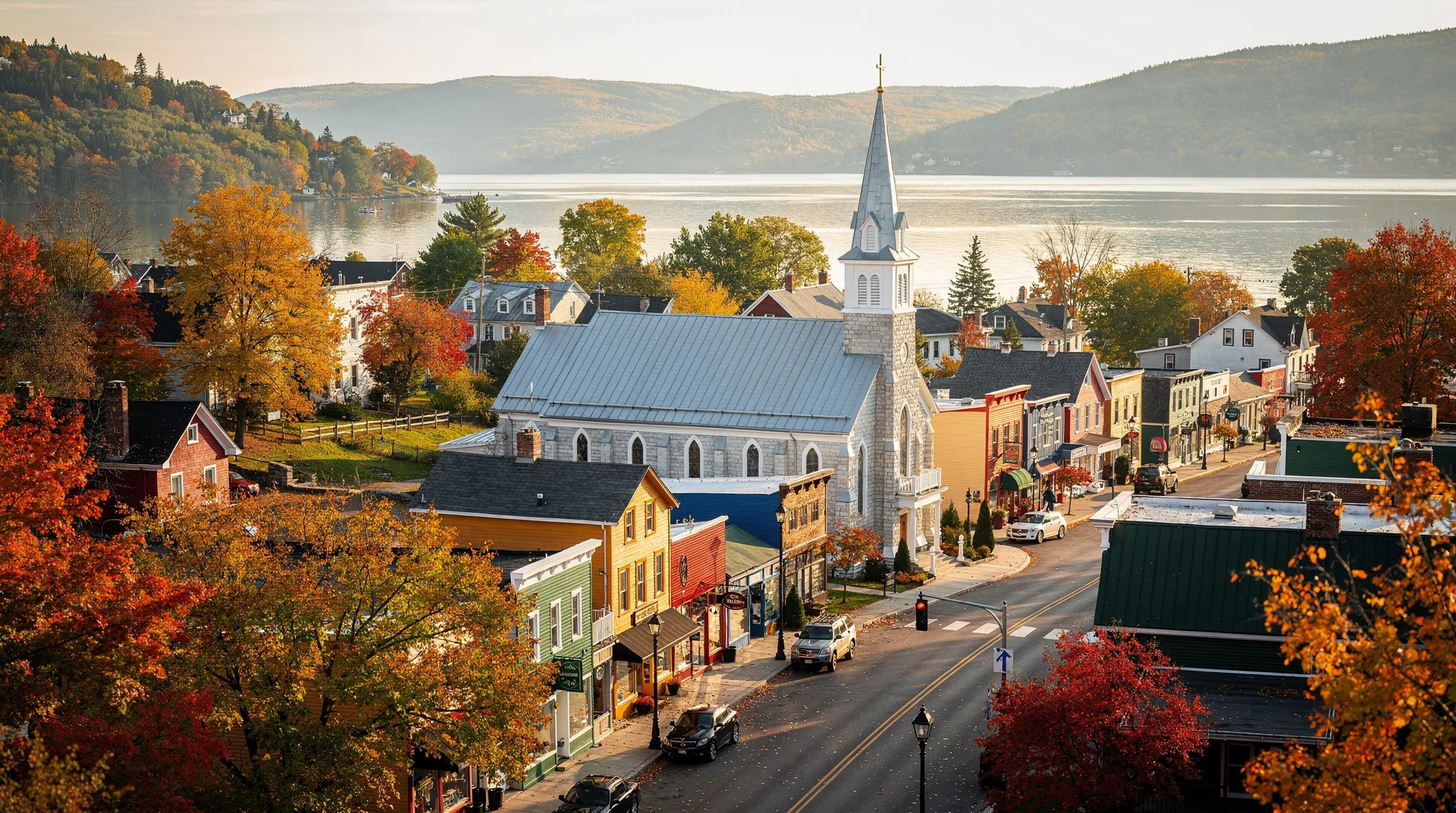
Baie-Saint-Paul is the regional capital of this artistic tradition. The small town of about 7,000 people in the Gouffre River valley, 90 minutes from Quebec City on Route 138, has more art galleries per capita than almost anywhere in Quebec. The Centre d’Exposition de Baie-Saint-Paul presents rotating exhibitions of Quebec art in a purpose-built facility. The commercial galleries on Saint-Jean-Baptiste Street represent both established and emerging artists working largely in the Charlevoix landscape tradition.
The region’s broader cultural credibility was confirmed by its UNESCO Biosphere Reserve designation, which recognizes not only the natural ecosystems but the human cultural landscape — the way traditional agriculture, fishing, and artistic practice have been integrated into a coherent regional identity over several centuries.
Top things to do in Charlevoix
Whale watching at Tadoussac
At Tadoussac, where the Saguenay River meets the St Lawrence, an underwater topography of deep channels and cold nutrient-rich upwellings creates one of the richest marine feeding environments in the world. The result is a whale watching destination of international standing: belugas, minke whales, fin whales, humpbacks, blue whales, and occasionally sperm whales are all regularly observed from June through October.
The beluga whale population that lives year-round in the Saguenay-St Lawrence estuary is the most accessible in the world — beluga are regularly seen from shore at Tadoussac. The larger whales — fins, humpbacks, and blues — appear when capelin schools arrive in June and July. Blue whale sightings are genuinely special: at up to 30 metres, they are the largest animals that have ever existed.
Multiple operators in Tadoussac and Bergeronnes run whale watching excursions on inflatable zodiacs (which provide close-up encounters) and larger observation vessels. Book in advance for July and August.
Browse Quebec experiences and whale watching tours through GetYourGuideBaie-Saint-Paul and the galleries
A half-day in Baie-Saint-Paul is the cultural centrepiece of any Charlevoix visit. Walking the gallery street, stopping at the Centre d’Exposition, having lunch at one of the restaurants that take Charlevoix’s local food culture seriously, and climbing the escarpment above town for the view of the river valley — this is Charlevoix at its most essential. The town’s architecture is classic Quebecois, with stone buildings and tin-roofed farmhouses in the older streets above the commercial district.
Cycling Route Verte and the Route du Massif
Charlevoix is traversed by the Route Verte, Quebec’s 5,000-kilometre long-distance cycling network. The section along the St Lawrence shore between Baie-Saint-Paul and La Malbaie follows a spectacular coastal route with views of the river throughout and access to the region’s farms, villages, and restaurants.
Le Massif de Charlevoix ski area above Baie-Saint-Paul has developed a summer cycling infrastructure on its mountain — gondola-accessed descents through forest and open ski trails. The mountain overlooks the river with views across to the south shore that are among the finest in Quebec.
Le Massif ski resort
Le Massif de Charlevoix is one of the most dramatic ski resorts in eastern Canada — not for vertical drop or acreage, but for setting. The ski trails run from 770 metres elevation down to the level of the St Lawrence River, and from the upper trails on a clear day the river fills the entire horizon. The resort has 52 runs and a genuine river view that no other ski area in North America replicates. The resort village includes a hotel and accommodation in converted railway cars — a deliberate reference to the historic train travel that once brought Montrealers to Charlevoix.
The Charlevoix train (Train de Charlevoix)
The Train de Charlevoix operates a tourist railway between Quebec City and La Malbaie — a 3.5-hour scenic journey along the north shore of the St Lawrence, with panoramic windows and optional stops in the region. The route follows the cliff edge above the river for much of its length, making it one of the more dramatically positioned train rides in Quebec. The train runs from late June through mid-October.
Explore Quebec City and Charlevoix tours departing from the Old CitySaguenay Fjord
The Saguenay River enters the St Lawrence at Tadoussac through a fjord of extraordinary depth — up to 270 metres — and sheer rock walls rising 300 metres from the water. The fjord extends 100 kilometres inland from Tadoussac to Chicoutimi, and is protected as Parc National du Fjord-du-Saguenay. Kayaking the fjord is one of Quebec’s most celebrated paddling experiences — calm water, vertical walls, seals, and the constant possibility of beluga. Boat cruises from Tadoussac or La Baie provide a more passive option.
La Malbaie and the Manoir Richelieu
La Malbaie at the eastern end of Charlevoix was the summer resort of the Anglo-Canadian and American upper class from the 1890s onwards. The Manoir Richelieu, rebuilt as a château-style hotel above the river in 1929 after a fire destroyed the original, is the architectural centrepiece — one of the great hotel buildings of Quebec. The casino in the hotel’s lower levels draws a more contemporary clientele. The town and the surrounding Murray Bay (Pointe-au-Pic) area retain traces of their Belle Époque resort heritage in the summer cottages of the original families.
Best areas in Charlevoix
Baie-Saint-Paul is the artistic and culinary heart — the town to base a Charlevoix visit.
Isle-aux-Coudres (accessible by ferry from Saint-Joseph-de-la-Rive) is a river island of working farms, windmills, and cider producers that feels time-shifted. Cycling the perimeter road (23 km) is the classic island activity.
La Malbaie is the eastern base for the Manoir Richelieu, whale watching day trips to the Fjord, and access to the Hautes-Gorges national park.
Tadoussac (at the far east of the traditional Charlevoix region, at the Saguenay mouth) is the whale watching capital and the most dramatically positioned town in the region.
When to visit
July and August are whale watching season and the warmest months. All restaurants and galleries are fully operational and the region’s farmers’ markets and summer festivals are active.
September and October bring the fall colour to the forested hillsides above the river — the most atmospheric season for photography and cycling, with significantly fewer visitors.
February to March is ski season at Le Massif — the most dramatic river views in winter are from the ski trails.
June offers whale watching at peak intensity (blue whale and fin whale sightings) and an uncrowded landscape before summer visitors arrive in force.
| Season | Weather | Crowds | Highlights |
|---|---|---|---|
| June | Mild, cool mornings | Light | Peak blue and fin whale sightings, uncrowded galleries |
| July-August | Warm, 20-25°C | Heavy, especially weekends | Full whale season, farmers’ markets, festivals |
| September-October | Cool, crisp | Moderate, thinning | Fall colour on the river valley hills, quieter roads |
| February-March | Cold, snow-covered | Light to moderate | Skiing at Le Massif with river views |
Beyond Baie-Saint-Paul: pacing a visit
Because Charlevoix is a linear region strung along roughly 150 kilometres of Route 138, the temptation is to try to see all of it — Baie-Saint-Paul, Isle-aux-Coudres, La Malbaie, and Tadoussac — in a single rushed day. That pace does a disservice to the region. A more realistic two-day visit spends one day around Baie-Saint-Paul (galleries, a hillside view, lunch) and one day further east toward La Malbaie or the Saguenay Fjord, with an overnight allowing an early start on the whale watching boats, which fill by mid-morning in summer.
Visitors combining Charlevoix with a broader St Lawrence itinerary often continue past Tadoussac into the Bas-Saint-Laurent and on toward the Gaspésie — a natural extension of the coastal drive for those with a week or more.
Where to stay
Auberge La Maison Otis in Baie-Saint-Paul is a restored stone inn in the historic core — perhaps the most authentically Charlevoix accommodation experience, with a respected restaurant and a quiet garden.
Manoir Richelieu in La Malbaie (Fairmont) is the grand option — a full resort with spa, golf, and casino in the most dramatically positioned hotel building in Quebec.
Hôtel Le Germain Charlevoix at Le Massif ski resort offers contemporary lodge-style rooms in the converted railway station building, with the mountain and river views directly outside.
Several agri-tourism properties and auberges throughout the region offer farm-based accommodation — staying on a working Charlevoix farm is a genuine regional experience.
Food and drink
Charlevoix has the strongest regional food identity in Quebec outside the city. The Route des Saveurs de Charlevoix — an official agri-tourism circuit — connects farms, cheese producers, boulangeries, and restaurants throughout the region. The key products: Charlevoix lamb from rocky hillside farms above the river; Laiterie Charlevoix cheese (Creamy, Cheddar Vieux); Migneron and Victor et Berthold artisan cheeses; Isle-aux-Coudres apple cidres and Cidrerie Verger Pedneault products.
Restaurants that take Charlevoix produce seriously: Chez Bouquet in Baie-Saint-Paul for upscale local cuisine; Le Saint-Pub in Baie-Saint-Paul for Quebecois bistro food and local microbrews; La Muse hotel restaurant for the most refined use of regional ingredients. In La Malbaie, the Manoir Richelieu’s restaurant uses Charlevoix products throughout its menu.
Getting around
Route 138 (Chemin du Roy) follows the north shore of the St Lawrence from Quebec City through the entire Charlevoix region. From Quebec City to Baie-Saint-Paul takes approximately 90 minutes. A car is essential for exploring the region — the distances between towns and the dispersed nature of the farms, galleries, and natural sites make public transit impractical.
The Train de Charlevoix (Quebec City to La Malbaie) is an excellent alternative for those wanting a scenic journey without driving, though a car remains useful once in the region.
Day trips from Charlevoix
Quebec City (90 minutes west) is the natural bookend to any Charlevoix visit — the most European city in North America, with the Old Town, the Citadelle, and the Plains of Abraham. Covered in detail in the Quebec City guide.
Hautes-Gorges de la Rivière Malbaie National Park (1 hour east of Baie-Saint-Paul, 15 min from La Malbaie) is one of Quebec’s most dramatic canyon landscapes — rock walls rising 700 metres above the Malbaie River, accessible by boat cruise, hiking trail, or canoe.
Lac-Saint-Jean (2 hours north) is the vast interior lake accessible via the Saguenay Valley — a different Quebec landscape of flatlands and blueberry fields.
Honest verdict
Charlevoix is worth it for anyone drawn to art, food, and dramatic river scenery who has already covered Quebec City and wants a slower, more rural extension. It’s less compelling if whale watching is the sole priority and time is short — in that case a focused day trip to Tadoussac alone may suffice rather than a full multi-day Charlevoix stay. Book whale watching cruises and Le Massif accommodation ahead for July, August, and ski weekends; galleries and villages need no reservation.
Mistakes to avoid
- Trying to cover Baie-Saint-Paul to Tadoussac in one day — why: it is a full day of driving alone at a relaxed pace; how to avoid: split the region into at least two overnight stops.
- Booking a whale watching cruise late in summer expecting blue whales — why: blue and fin whales are most reliable in June and early July, then move east; how to avoid: go in June for the biggest species, or accept minke and beluga sightings later in summer.
- Assuming English will carry you everywhere — why: Charlevoix is more francophone than Quebec City; how to avoid: learn a few basic French phrases and expect more limited English outside tourist operations.
- Skipping Isle-aux-Coudres for lack of time — why: it’s one of the region’s most charming stops and only a short, free ferry ride; how to avoid: budget a half day for it if driving through Saint-Joseph-de-la-Rive.
- Driving Route 138 at night expecting well-lit roads — why: much of the highway is rural and unlit with wildlife crossing risk; how to avoid: plan driving during daylight, especially at dusk.
Frequently asked questions about Charlevoix
What is the best season to see blue whales?
Blue whales are most frequently sighted in June and early July when cold-water capelin schools arrive at the mouth of the Saguenay. By August, many large whales move east toward the Gulf of St Lawrence. Fin whales and minke whales are more reliably present through the summer. Beluga are year-round residents.
Do I need to speak French to visit Charlevoix?
Charlevoix is a more francophone region than Quebec City, and most interactions will begin in French. Many restaurant and hotel workers in the tourist areas speak functional English, but making an effort with basic French is genuinely appreciated. Outside the main tourist operations, English may be very limited.
How is Charlevoix different from the Gaspésie?
Both are dramatic Quebec coastal landscapes on the St Lawrence. Charlevoix is more developed, more arts-focused, and closer to Quebec City — easier to incorporate into a week’s itinerary. The Gaspésie is wilder, more remote, and requires more dedicated time. Charlevoix for a long weekend; Gaspésie for a week.
Is Isle-aux-Coudres worth visiting?
Yes — it is one of the most charming detours in Charlevoix. The ferry from Saint-Joseph-de-la-Rive (free, 15 minutes) lands on an island with working farms, apple orchards, cider producers, and the 23-kilometre perimeter cycling route. A half-day or full day is sufficient.
Can you visit Charlevoix without a car?
It’s difficult but not impossible. The Train de Charlevoix connects Quebec City to La Malbaie along the scenic river route, and Intercar buses serve some towns along Route 138. But most of the region’s appeal — the galleries scattered through Baie-Saint-Paul, farm stops on the Route des Saveurs, and the drive itself — is easiest with a car. Cycling the Route Verte is a realistic car-free alternative for fit travellers with time.