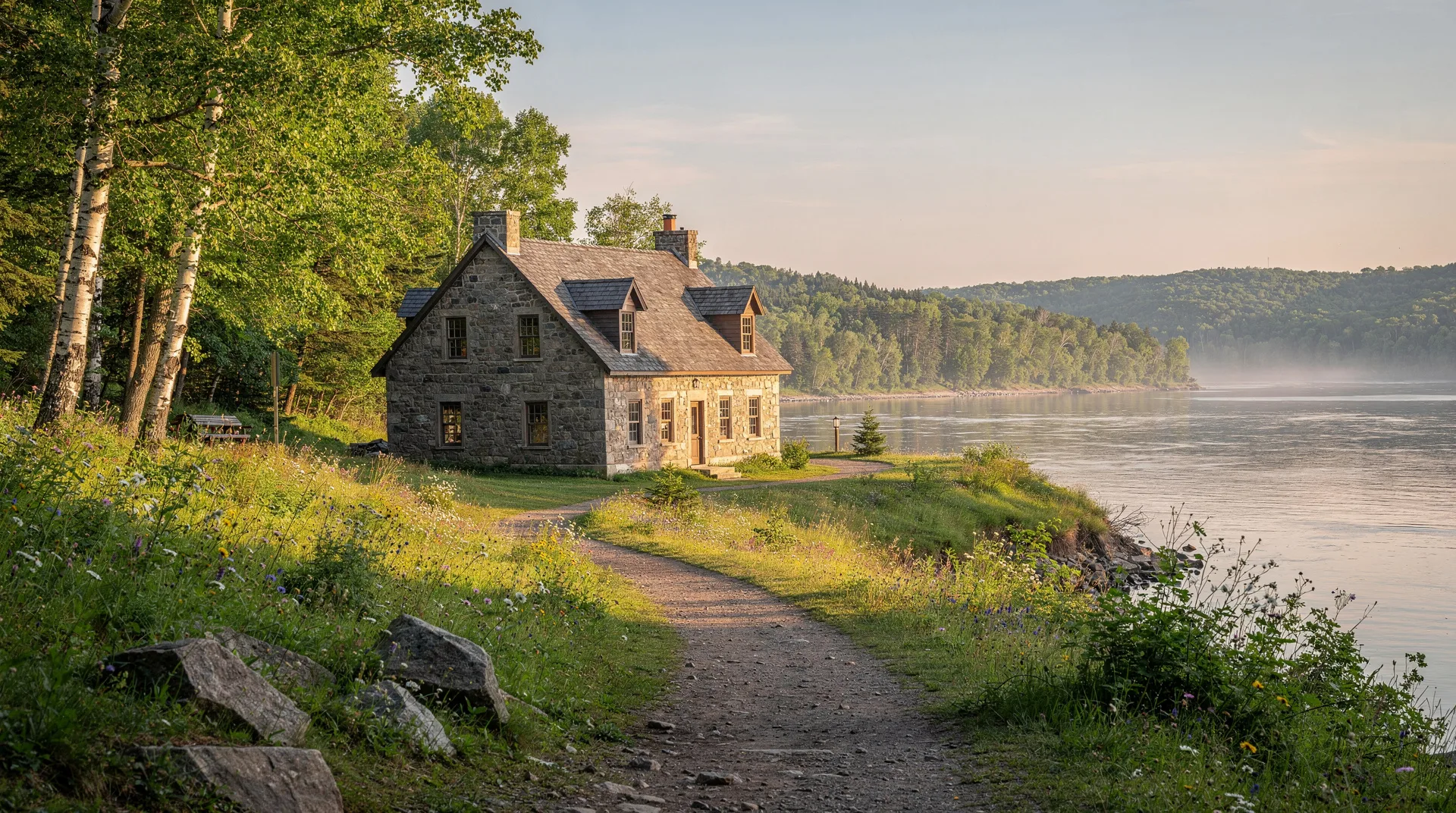
New France heritage: 400 years of French Canadian history in place
Where can I experience New France history in Quebec?
Old Quebec City is the most intact French colonial city in North America, with the citadel, fortifications, and Vieux-Québec's stone streets. Place Royale (Lower Town), the Plains of Abraham, and the Basilique Notre-Dame-de-Québec are the essential sites.
| Details | |
|---|---|
| Where | Old Quebec City (core sites), Old Montreal, Île d’Orléans, Charlevoix |
| Cost | most sites and streets are free to walk; museums and the Citadel typically run around CAD 15-30 per ticket |
| Time needed | 3-4 days for Quebec City heritage, 2 days for Montreal, longer with a regional drive |
| Getting there | Quebec City and Montreal both have airports and VIA Rail service; Île d’Orléans and Charlevoix require a car |
| Best time | May-October for full opening hours and outdoor walking comfort; winter visits are atmospheric but some sites reduce hours |
The longest French-speaking society in North America
In 1608, Samuel de Champlain landed at a narrow point where the St. Lawrence River was closely flanked by cliffs, a natural defensive position that the Indigenous Algonquin people called “Kebec” — “where the river narrows.” He built a wooden trading post — the Habitation de Champlain — at the base of the cliffs, marking the beginning of what would become the city of Quebec, the capital of New France, and the oldest continually inhabited city in Canada.
The French Canadian civilization that grew from that habitation over the following four centuries is one of North America’s great cultural achievements — a linguistic and cultural community that survived the British Conquest of 1759, the political subordination of the following two centuries, and the economic marginalisation that persisted until the Quiet Revolution of the 1960s, to emerge as a confident, creative, and distinctly modern society while maintaining its historical roots.
The physical evidence of that survival — the stone streets of Old Quebec, the parish churches of the St. Lawrence Valley, the remains of the fortifications and the battlefields — is visible and accessible to visitors in a way that few other North American historical landscapes can match.
This guide walks through the key periods of New France and French Canadian history, identifies the essential heritage sites where that history can be encountered in person, and suggests how to combine historical understanding with travel planning for the most meaningful visit.
The founding: Champlain and the first settlements
Samuel de Champlain’s Habitation of 1608 is the origin point of European Quebec, but the French presence in the St. Lawrence Valley preceded him. Jacques Cartier had reached the mouth of the St. Lawrence in 1534 and sailed upriver to the sites of modern Quebec City and Montreal (where the large Iroquoian village of Hochelaga stood, population perhaps 1,500) in 1535.
Cartier’s expeditions established French claims to the territory but produced no permanent settlement. It was Champlain who transformed the claim into a colony — building the Habitation at the base of Cap Diamant, establishing relationships with the Montagnais (Innu), Algonquin, and Huron-Wendat nations as trading and military allies (against the Iroquois Confederacy), and beginning the settlement that would grow into New France.
Where to encounter this history:
Place Royale, Lower Town, Quebec City: The site of Champlain’s original Habitation and the commercial heart of early Quebec City. The Maison Chevalier, Maison Lambert-Dumont, and the reconstructed stone buildings of Place Royale create one of the most coherent surviving colonial streetscapes in North America. The Centre d’interprétation de Place-Royale provides excellent context for the site’s role as the commercial hub of New France.
Lieu historique national du Parc-de-l’Artillerie, Quebec City: The 18th-century artillery park that defended the northern entrance to the Old City. The site includes an extraordinary large-scale model (maquette) of Quebec City as it appeared in 1808, produced at the time as a military planning tool and now one of the most detailed historical representations of any North American city.
Book a Quebec City heritage and Old Town guided tour on GetYourGuideThe colony matures: 17th and 18th century New France
New France at its greatest extent was an enormous territory — stretching from Newfoundland to the Rocky Mountains and from Hudson Bay to the Gulf of Mexico, encompassing the Great Lakes, the Mississippi Valley, and the vast interior that European settlers called the pays d’en haut (the upper country). The colony’s actual settled population was always modest — roughly 70,000 French-born and Canadian-born settlers at the time of the British Conquest in 1763 — but its trade networks and military alliances shaped the entire continent.
The economy of New France ran primarily on the fur trade, which required maintaining relationships with Indigenous nations across an enormous territory. The coureurs de bois — unlicensed fur traders who ventured into Indigenous territories, learned Indigenous languages, and often formed families with Indigenous women — were the shock troops of this economy, and their cultural legacy is evident in Quebec’s Métis communities and in family names that recur across Quebec’s history.
The Church played a central role in New France — the Catholic faith was both personal religion and social infrastructure. The parish church was the centre of every settlement; the Jesuits and Sulpicians maintained missions into Indigenous territories; and the clergy’s control over education and social services continued long after the Conquest.
Key heritage sites:
Basilique Notre-Dame de Québec: The oldest parish church in North America north of Mexico, with origins in 1647 (the current structure is largely 19th century after fire damage). The burial vaults beneath the basilica contain the remains of Samuel de Champlain (controversially lost in the 19th century), colonial governors, and numerous New France figures. A significant religious and historical site.
Séminaire de Québec: Founded in 1663 by Bishop Laval — the first Catholic bishop of New France — the Séminaire is the oldest institution of higher education in Canada (later becoming Université Laval). The historic compound adjacent to the basilica is one of Quebec City’s finest architectural ensembles.
Île d’Orléans: The large island in the St. Lawrence immediately downstream from Quebec City was one of the first areas of the St. Lawrence Valley settled by French colonists in the 1640s and 1650s. The island retains its rural character — the strip parishes (rangs) of Quebec’s distinctive agricultural system are visible in the landscape — and several of its 17th and 18th century parish churches and historic properties survive. See the Île d’Orléans vs Île aux Coudres comparison guide for a full visit guide.
Old Montreal — Vieux-Montréal: Montreal was founded by a religious mission in 1642 — the Société Notre-Dame de Montréal — and grew into the commercial capital of New France. Old Montreal retains substantial 17th, 18th, and 19th century architecture. The Musée Pointe-à-Callière — built over the archaeological remains of the original Montreal settlement — is the most important archaeological museum in Quebec. See Montreal destinations for the full city guide.
The Conquest and its aftermath: 1759–1867
The Battle of the Plains of Abraham on September 13, 1759, is one of the most consequential fifteen minutes in North American history. British forces under General James Wolfe, who had spent the summer of 1759 bombarding Quebec City from across the St. Lawrence, found an unguarded path up the cliffs west of the city. In the early morning, they assembled approximately 4,500 soldiers on the plateau west of the walls.
The French commander Montcalm, surprised and uncertain of the British numbers, chose to sortie from the city rather than wait for reinforcements. The battle on the open field lasted perhaps fifteen minutes; both Wolfe and Montcalm received fatal wounds; the French line broke. Quebec City surrendered September 18. Montreal fell in 1760. New France was over.
The consequences of the Conquest shaped Quebec’s history for the following 200 years: a French-Catholic population of roughly 70,000 suddenly subject to British Protestant rule, maintaining their language and faith through a combination of the Quebec Act of 1774 (which restored French civil law and protected Catholic religious practice) and sheer demographic persistence.
The Plains of Abraham, Quebec City: The battlefield itself is now a park — the Battlefields Park — west of the Old City walls. The Musée des plaines d’Abraham provides extensive context for the 1759 battle and for the park’s subsequent history. Walking the terrain where the battle was fought is one of the most historically resonant experiences in Canada. See Quebec City destinations for visiting logistics.
Fortifications of Quebec City: The walls, gates, and citadel that define Quebec City’s skyline were built and improved by both French and British engineers over two centuries. The star-shaped Citadel — a British-built fortification of the 1820s–1850s, garrisoned today by the Royal 22e Régiment — offers guided tours that cover both the military history and the architecture.
The parish Quebec: rural francophone culture
Between the Conquest and the Quiet Revolution, the survival strategy of French Canada was built around the Catholic parish system and the land. The Catholic Church maintained control over education, hospitals, and social services; the parish was the social unit; the land — the distinctive strip-farm system of the rang — was the economic base. The population grew remarkably: from 70,000 at the Conquest to over four million by the early 20th century, almost entirely by natural increase among the same French Catholic families.
This demographic and institutional success came at a cost: French Canadians remained concentrated in agriculture and the Church while the industrial economy — the factories, the railways, the finance sector — was controlled by English-speaking capital. The phrase “speak white” — an injunction to speak English in economic contexts — reflected the linguistic power dynamics of the period.
Heritage of this period:
The rang landscape of the St. Lawrence Valley: Driving through the Quebec countryside — particularly in Chaudière-Appalaches, Lanaudière, or the South Shore — you see the strip-farm landscape that defines traditional rural Quebec. Long, narrow strips of farmland extending back from a road, each with a farmhouse close to the road and the land extending to the forest behind. This is the rang system of land allocation, brought from France but adapted to the St. Lawrence Valley. The parish churches — a grey stone church with a tin roof at every village, often the most significant architectural statement in the community — complete the landscape.
The Musée de la civilisation, Quebec City: The most important museum of Quebec history and culture, housed in a Paul Croce-designed building in the Lower Town adjacent to Place Royale. The permanent exhibitions cover Quebec society from Indigenous prehistory through the present — including the most thoughtful treatment of the Conquest, the Church’s role, the economic subordination of the francophone majority, and the Quiet Revolution available anywhere. Essential context for any serious visit to Quebec.
Explore Montreal history and culture with a guided tourThe Quiet Revolution and modern Quebec
The Quiet Revolution (Révolution tranquille) of the 1960s transformed Quebec more rapidly and fundamentally than any event since the Conquest. Under Liberal Premier Jean Lesage (elected 1960), the Quebec government took control of education and social services from the Church, nationalised the province’s electrical utilities (creating Hydro-Québec), and launched an ambitious program of economic and cultural modernisation.
The Church’s authority collapsed with astonishing speed — church attendance in Quebec, among the highest in North America in the 1950s, fell to among the lowest within a decade. The fertility rate — which had sustained French Canada’s population growth through high birth rates — dropped sharply. The culture changed: Quebec cinema, theatre, literature, and music emerged as confident modern expressions rather than folk survivals.
The political consequence was a debate about Quebec’s constitutional future that continues to this day. The FLQ (Front de libération du Québec) terrorist campaign of the 1960s–70s, the October Crisis of 1970 (when Prime Minister Trudeau invoked the War Measures Act), and the rise of the Parti Québécois under René Lévesque (elected 1976, holding the first sovereignty referendum in 1980 — defeated 50.4%–49.6% in 1995) are chapters in a political story that remains unresolved.
Engaging with this history:
The Musée de la civilisation covers the Quiet Revolution extensively. For a more personal engagement, the Plateau-Mont-Royal neighbourhood of Montreal — associated with the literary and artistic generation of the Quiet Revolution — retains much of its character from this period. The work of Michel Tremblay (playwright, novelist) is the most accessible literary entry point to the lived experience of this transformation.
Charlevoix and the French Canadian landscape
The Charlevoix region northeast of Quebec City — one of the most scenic and food-celebrated regions of the province — retains one of the most intact French Canadian rural landscapes in Quebec. The parish churches at Les Éboulements, Saint-Irénée, and Baie-Saint-Paul, the farming villages on the plateau above the St. Lawrence, and the historic manors of the seigneurial system all survive in a landscape of extraordinary beauty.
Charlevoix was designated a UNESCO World Biosphere Reserve in 1988, partly for its ecological diversity and partly for the cultural landscape it preserves. See Charlevoix destinations for the full regional guide and Charlevoix vs Gaspésie for a comparison with the province’s other great scenic region.
Planning a heritage-focused Quebec visit
Quebec City (3–4 days): The Old City is the essential heritage experience. Cover Place Royale and the Musée de la civilisation in day one; the Citadel, fortifications, and Plains of Abraham on day two; the basilica and Séminaire on day three; Île d’Orléans as a day excursion from day four.
Montreal heritage (2 days): Musée Pointe-à-Callière, Old Montreal’s architecture, the Musée des beaux-arts (Quebec art collection), and the Plateau-Mont-Royal for Quiet Revolution-era cultural context.
Regional heritage driving: A three-day drive along the south shore of the St. Lawrence — through Chaudière-Appalaches, stopping at historic parishes, manor houses, and heritage sites — provides the rural French Canadian landscape context that the cities alone do not give.
Language and etiquette for a heritage-focused visit
Quebec is officially French-speaking, and the heritage sites described above are staffed and interpreted primarily in French, with English signage and tours widely available in tourist-facing venues. A few French pleasantries go a long way, even among the many staff who speak fluent English — see the speaking French in Quebec guide for the specific phrases that matter most and for a clearer picture of the English-French reality travellers actually encounter day to day. Understanding the Conquest, the Church’s historical role, and the Quiet Revolution (all covered above) also makes conversations with Quebecers about identity and politics much easier to navigate respectfully.
Combining heritage with Quebec’s Indigenous history
New France’s history is inseparable from its relationships — sometimes cooperative, sometimes violent — with the Indigenous nations who were there first and remain present today: the Huron-Wendat, Innu, Mi’kmaq, Abenaki, and others. A heritage-focused trip is more complete when it includes Indigenous perspectives directly rather than only the colonial narrative told at Place Royale and the Plains of Abraham. The Indigenous tourism Quebec guide lists nations, cultural centres, and guided experiences that add this dimension.
Related pages
- Indigenous tourism Quebec: a complete guide to nations and experiences
- Speaking French in Quebec: what anglophones need to know
- Quebec music festivals: Jazz Fest, Osheaga, Festival d’été and beyond
- Île d’Orléans vs Île aux Coudres: two Quebec islands compared
- Charlevoix vs Gaspésie: which Quebec coast for your trip?
- Quebec City destinations
- Charlevoix destinations
Frequently asked questions about New France heritage
Is Old Quebec City worth visiting if I have already seen European old towns?
Yes — it is a genuinely different thing: the only walled city north of Mexico with intact fortifications, and a living French-speaking North American city rather than a museum piece. Most visitors familiar with Europe still find it distinctive.
Do I need to speak French to visit New France heritage sites?
No. Major sites (the Citadel, Musée de la civilisation, Musée Pointe-à-Callière) offer English tours, signage, or audio guides. Basic French phrases help in smaller regional sites and are always appreciated.