Charlevoix vs Gaspésie: which Quebec coast for your trip?
Should I visit Charlevoix or Gaspésie?
Charlevoix is closer to Quebec City, more culinarily polished, and better for a 2–3 day coastal trip. Gaspésie requires a week minimum, rewards it with dramatic alpine scenery, wilder landscapes, and the iconic Rocher Percé.
Two great coasts, two very different journeys
Quebec has two major coastal regions that draw visitors for landscape, wildlife, and food: Charlevoix, on the north shore of the St. Lawrence between Quebec City and the Saguenay Fjord, and Gaspésie, the dramatic peninsula that juts into the Gulf of St. Lawrence at the province’s eastern end. Both offer the St. Lawrence River or Gulf as a backdrop, both have excellent whale watching, both have their own food cultures and outdoor activities. But they are fundamentally different experiences, and choosing between them — or planning which to visit first on a multi-trip Quebec itinerary — requires understanding what each does best.
This guide makes that comparison directly: distance and effort to reach, landscape and scenery, food and culinary culture, outdoor activities, wildlife, accommodation, and who each region suits best.
At a glance
| Charlevoix | Gaspésie | |
|---|---|---|
| Where | North shore of the St. Lawrence, 90 km northeast of Quebec City | Peninsula at Quebec’s eastern tip, 600 km from Quebec City |
| Time needed | Around 2-4 days | A week minimum, 10-14 days ideal |
| Getting there | Car (roughly 90 min-2 hrs from Quebec City) or Intercar bus | Car (roughly 6-7 hrs to Gaspé town) or Orléans Express bus |
| Typical cost feel | Higher (fine dining, boutique hotels) | Moderate (motels, seafood shacks, camping) |
| Best time | Late spring to early fall; peak in summer | July-September for full road access and whale/gannet activity |
Comparison at a glance
| Factor | Charlevoix | Gaspésie |
|---|---|---|
| Landscape | Intimate river valleys, meteor-crater terrain | Expansive coastal mountains, Rocher Percé |
| Food scene | Quebec’s top regional fine-dining destination | Fresh seafood, less polished dining infrastructure |
| Wildlife | Beluga, minke and fin whales (Saguenay/Tadoussac) | Northern gannets, whales, boreal caribou |
| Accommodation | Consistently high quality, all price points | Variable; strong camping, patchy hotels |
| Effort required | Low — easy weekend or long-weekend trip | High — needs a full week and a car |
Distance and logistics
Charlevoix
Charlevoix begins approximately 90 km northeast of Quebec City along the north shore of the St. Lawrence — the dramatic scenery starts almost immediately once you leave the capital region. The hub town of Baie-Saint-Paul is 100 km from Quebec City (about 90 minutes); La Malbaie is 145 km (2 hours). The region is accessible by car (most practical), by Intercar bus from Quebec City, or — seasonally — by boat from the south shore.
The proximity to Quebec City means that Charlevoix can be visited as a long day trip from the capital (though this is not recommended — the region rewards two to three nights at minimum). It can also be combined efficiently with a Quebec City base.
Verdict: Charlevoix is easy. No advanced planning required beyond accommodation; accessible in a rental car directly from Quebec City.
Gaspésie
Gaspésie requires commitment. The Gaspé Peninsula extends 600 km from the Quebec City region to Gaspé town and a further 250 km around its southern coast back to Rimouski. Driving around the full Gaspé Peninsula — the most satisfying way to experience the region — covers approximately 1,100 km of coastal and inland roads. From Quebec City, the drive to Gaspé town (at the tip of the peninsula) is approximately 600 km — 6–7 hours non-stop.
The logistics of Gaspésie require a week minimum for a meaningful visit; ten days to two weeks is better. There are bus connections (Orléans Express from Quebec City to Gaspé, stopping at multiple peninsula towns), but the regional distances make a car essentially necessary for exploring beyond the main coastal highway.
Verdict: Gaspésie demands planning and time. It rewards both generously, but it is not a casual visit.
Landscape and scenery
Charlevoix
Charlevoix’s landscape is the result of an extraordinary geological event: approximately 350 million years ago, a meteor impact created the Charlevoix astrobleme — one of the world’s most clearly defined impact craters. The crater shaped the region’s topography into a dramatic bowl form, with the St. Lawrence cutting through one edge. The terrain combines dramatic river valley scenery, the high Laurentian plateau to the north, and the coastal strip of the St. Lawrence.
The aesthetic of Charlevoix is painterly — actually painterly, in the sense that the region has drawn artists since the 19th century and the light quality, the combination of sky and river and mountain, is genuinely extraordinary. Baie-Saint-Paul has been an arts colony since the late 1800s; the galleries in town reflect this heritage.
The Parc national des Hautes-Gorges-de-la-Rivière-Malbaie — with its 800-metre canyon cliffs — is Charlevoix’s most dramatic inland landscape. The Manoir Richelieu in Pointe-au-Pic, perched above the St. Lawrence, provides a grand hotel backdrop that has made Charlevoix a destination since the Edwardian era.
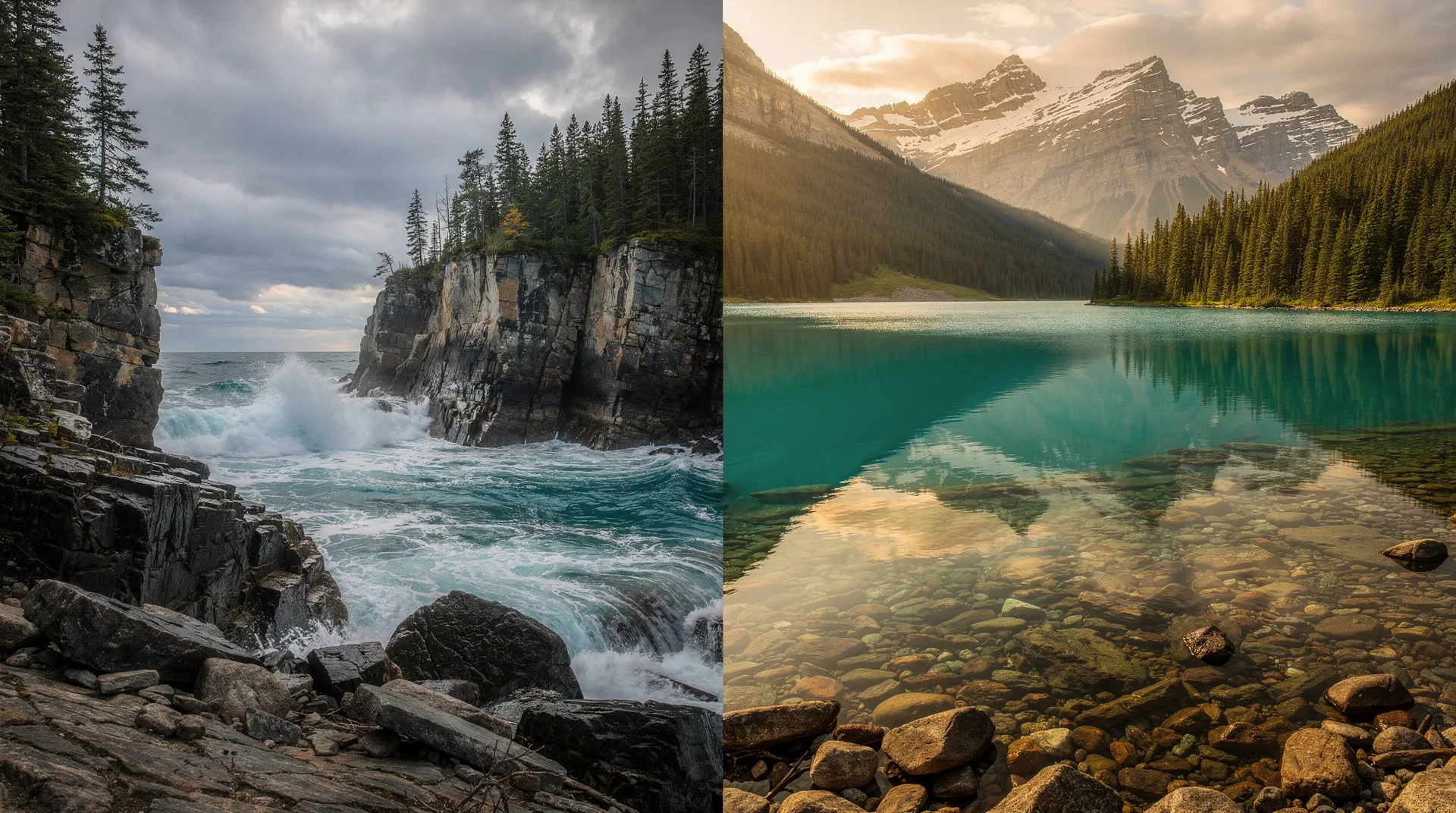
Charlevoix scenery: Intimate, beautiful, artistic. The St. Lawrence at its widest point before becoming the Gulf, painted in the light of Atlantic weather.
Gaspésie
Gaspésie is larger in every sense. The landscape is wilder, more dramatic, and — at its best — comparable to anywhere in the world for scenic impact.
The north coast of the Gaspé Peninsula (Route 132 from Sainte-Flavie to Gaspé) is a series of fishing villages beneath the Chic-Choc mountains, with the St. Lawrence widening from river to gulf. The mountains rise directly from the coast — there is no gradual transition — and their scale and the quality of light over the Gulf creates continuously evolving drama.
The Rocher Percé — the massive offshore rock stack at the village of Percé — is one of the iconic images of eastern Canada. The rock (88 metres high, 438 metres long, with a natural arch at its eastern end) is visible from the village and from Île Bonaventure, accessible by short boat trip. The Île Bonaventure is one of the world’s most important northern gannet colonies, with approximately 60,000 nesting pairs visible from close range during breeding season.
Forillon National Park at the tip of the peninsula combines coastal cliffs, forest, and marine wildlife in a compact national park that is among the most beautiful in eastern Canada.
Gaspésie scenery: Expansive, wild, occasionally overwhelming. The scale of sea, mountain, and sky is different from anything in the more accessible parts of Quebec.
Verdict: Both are magnificent. Charlevoix is beautiful and contained; Gaspésie is epic and open. Visitors who respond strongly to scale and wildness belong in Gaspésie; those who want beauty with comfort and culinary sophistication in a smaller format belong in Charlevoix.
Food and culinary culture
Charlevoix
Charlevoix is the most celebrated culinary region outside of Montreal in Quebec — and makes a strong argument for being Quebec’s most exciting regional food destination. The combination of exceptional raw ingredients (Charlevoix veal, local cheese, Île aux Coudres lamb, St. Lawrence fish, cultivated local vegetables), skilled chefs, and an audience of sophisticated visitors has produced a restaurant ecosystem unmatched in provincial Quebec.
Auberge des 3 Canards (La Malbaie): Long-running fine dining establishment using Charlevoix ingredients in classic Quebec preparations.
Chez Truchon (Baie-Saint-Paul): The most celebrated restaurant in Baie-Saint-Paul, with a wine list and menu that draws food tourists specifically.
La Ferme (Baie-Saint-Paul): Multi-use hospitality complex with restaurant, market, and event space focused on Charlevoix regional production.
Charlevoix is also home to essential cheese producers (Laiterie Charlevoix, the Maurice Dufour affinage house — see the Quebec cheese trail guide) and some of the province’s finest art galleries (Centre d’exposition de Baie-Saint-Paul, Galerie d’art Iris).
Gaspésie
Gaspésie’s food culture is genuine but less developed for visitors. The sea provides: Gaspésie is one of the best regions in Quebec for fresh fish and shellfish — particularly shrimp (crevettes de Matane are celebrated), Atlantic salmon, cod, mackerel, and snow crab. The fishing culture is deeply embedded.
Restaurant La Maison du Pêcheur (Percé): The landmark restaurant of the Percé area, with fresh fish and shellfish in a setting overlooking the Rocher Percé. The boiled lobster and the shrimp cocktails are as fresh as they get.
Fumoirs et marchés: Roadside smoke shacks and fish markets throughout the Gaspé coast sell smoked salmon, smoked mackerel, and smoked shrimp that make excellent picnic meals while driving.
The Gaspésie is not a dining destination in the Charlevoix sense, but the quality of its seafood is unbeatable.
Verdict: Charlevoix for gastronomy. Gaspésie for the freshest seafood you will eat in Quebec.
Wildlife
Both regions offer exceptional wildlife, but of different kinds.
Charlevoix/Saguenay: Beluga whales are the headline species — resident year-round in the Saguenay and lower St. Lawrence. Minke and fin whales are summer visitors. Whale watching boat tours operate from Tadoussac (at the Saguenay mouth, technically just beyond Charlevoix) and from Baie-Sainte-Catherine. The whale watching here is among the best in eastern North America.
Gaspésie: The northern gannet colony on Île Bonaventure (60,000+ pairs — one of the world’s largest accessible gannet colonies) is the standout wildlife experience. Minke and fin whales are visible from shore and by boat along the north coast. Harbour seals are common at Forillon. The boreal caribou of Parc national de la Gaspésie (the southernmost woodland caribou in eastern Canada) are visible with patience on the alpine plateau.
Book Quebec City and region tours on GetYourGuideAccommodation
Charlevoix: Excellent accommodation across all price points. The Fairmont Le Manoir Richelieu in Pointe-au-Pic is the grandest hotel in the region — a historic resort hotel with golf course, spa, and St. Lawrence views. Auberge des Peupliers and multiple B&Bs in Baie-Saint-Paul and Les Éboulements. The region’s accommodation quality is consistently high.
Gaspésie: More variable. Percé and Gaspé town have reasonable hotel and B&B options; the coastal towns between Matane and Gaspé are served primarily by motels and small inns of highly variable quality. Camping (including at Forillon National Park) is excellent. The accommodation situation in Gaspésie requires more research than Charlevoix.
Who should choose Charlevoix
- Visitors with 2–4 days available for the region
- Food and wine-focused travellers
- Couples seeking a romantic weekend within reach of Quebec City
- Visitors combining with the Saguenay kayaking experience
- Those who want excellent scenery without a long drive
- First-time Quebec visitors who want to understand the province’s geography and culture efficiently
Who should choose Gaspésie
- Visitors with a week or more who want an adventure
- Hikers willing to tackle the Chic-Choc mountains (see Quebec hiking guide)
- Wildlife enthusiasts, particularly for northern gannets
- Road trip lovers who enjoy the rhythm of coastal driving
- Cyclists tackling the Route Verte Gaspésie section
- Visitors seeking a less-travelled, wilder Quebec experience
Can you do both?
A Quebec road trip that includes both Charlevoix and Gaspésie is entirely possible and represents one of the great Quebec journeys. The logical route: Quebec City → Charlevoix (2–3 nights) → Saguenay Fjord (1–2 nights) → continue east along the north shore to Rivière-du-Loup → cross to the Gaspé Peninsula → drive the full Gaspé circuit (5–7 nights). Total: 10–14 days, covering the best of both coastal regions.
Find Canada coastal and regional tours on GetYourGuideBudget and pacing tips
Charlevoix on a budget: Skip the Fairmont Le Manoir Richelieu and stay in a Baie-Saint-Paul B&B instead — you get the same dramatic scenery for roughly a third of the price. A 2-night trip with one tasting-menu dinner and one casual meal is a realistic mid-range budget approach.
Gaspésie on a budget: Camping (including at Forillon National Park) plus roadside smoked-fish picnics keeps costs low across the full loop. Motels along Route 132 vary widely in quality — book ahead in July and August rather than arriving without a reservation, since options thin out fast in small coastal towns. Drivers coming from Quebec City often route through the Bas-Saint-Laurent to Gaspésie itinerary rather than driving straight through.
Pacing warning: The single biggest planning mistake with Gaspésie is underestimating driving time. The coastal road hugs the shoreline and passes through village after village at reduced speed — budget more hours per 100 km than a highway map suggests, especially with stops for photos, gannets, and seafood.
Weather and seasonality
Both regions are best from June through September, when the Route 132 loop and Charlevoix’s coastal roads are fully open and whale activity peaks — see the Quebec whale watching guide for season specifics. Late September into October brings excellent fall colour to both, with fewer crowds — a strong option for travellers who can be flexible. Winter closes most Gaspésie tourism infrastructure outside the towns; Charlevoix stays more accessible year-round, with nearby ski options like Mont-Tremblant within reach of a combined Quebec winter trip.
Frequently asked questions about Charlevoix vs Gaspésie
Which region has better whale watching, Charlevoix or Gaspésie?
Both are excellent but different: Charlevoix/Tadoussac is known for resident beluga whales year-round plus summer minke and fin whales in the Saguenay Fjord area, while Gaspésie offers whale sightings from shore and by boat along the north coast alongside its standout northern gannet colony. If beluga whales specifically are the priority, Charlevoix/Saguenay wins.
Can I visit Charlevoix and Gaspésie without a car?
Charlevoix is manageable without a car using Intercar buses from Quebec City, though a car gives far more flexibility for exploring smaller villages. Gaspésie is much harder without a car — Orléans Express buses connect the main towns, but the regional distances and rural nature of the peninsula make a rental car close to essential for a satisfying visit.
Related pages
- Sea kayaking the Saguenay Fjord: operators, seasons and routes
- Quebec hiking guide: top trails across all regions
- Quebec dark sky preserves: astronomy tourism and night photography
- Quebec cheese trail: artisan cheese tour by region
- Île d’Orléans vs Île aux Coudres: two Quebec islands compared
- Charlevoix destinations
- Saguenay–Lac-Saint-Jean destinations
- Quebec City destinations