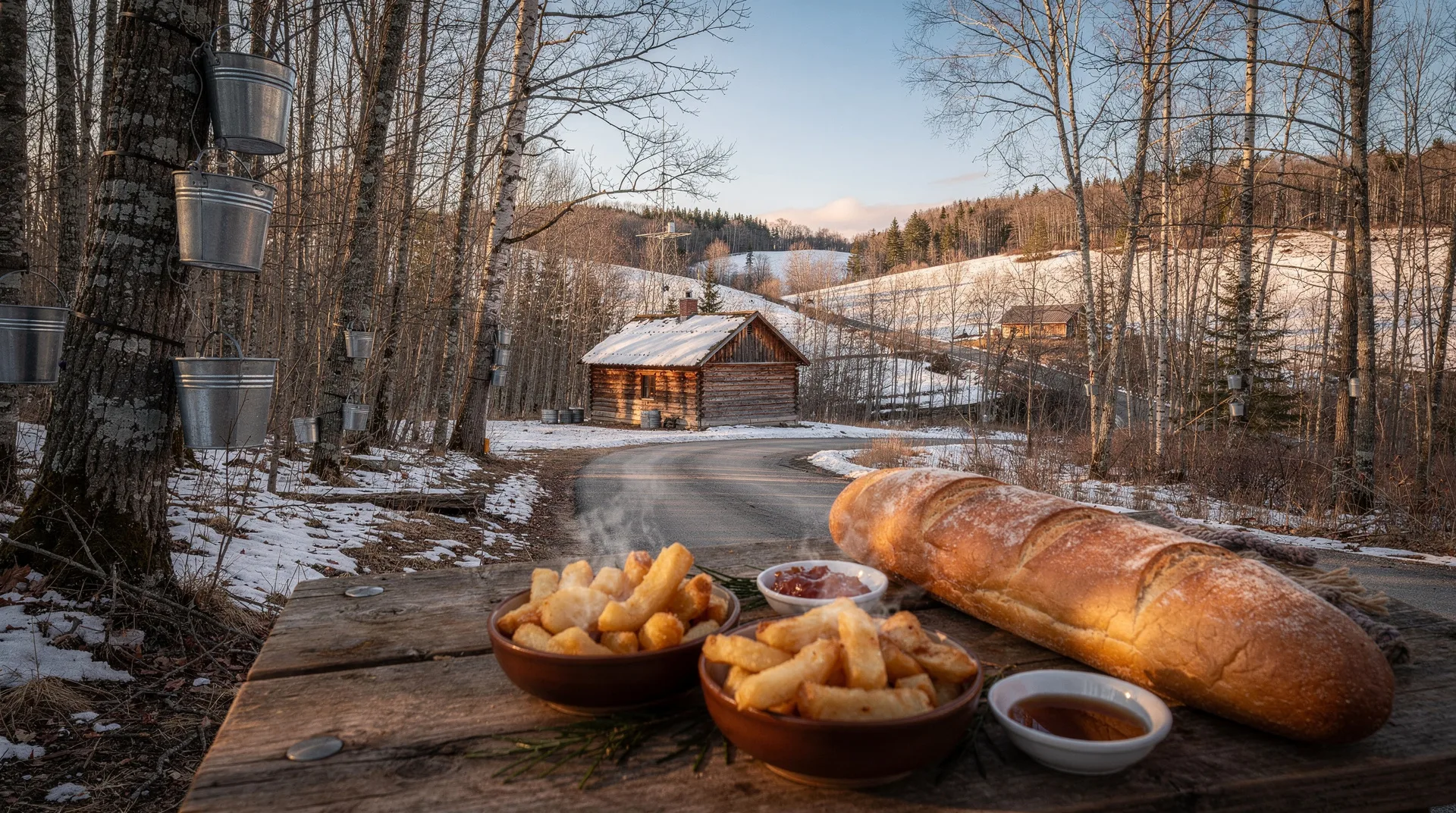
French Canadian cuisine: 15 dishes every visitor must try
What is French Canadian cuisine?
French Canadian (Québécois) cuisine is a distinct North American tradition rooted in rural 17th-19th century habitant cooking — hearty, pork-and-dairy heavy, maple-sweetened, built on local produce. Poutine, tourtière, cretons and pouding chômeur are the best-known dishes.
Quebec has a genuinely distinct cuisine — not a regional variant of French cooking, not a version of broader Canadian food, but a tradition that evolved independently over nearly four centuries in a specific climate, with specific ingredients, and under specific cultural pressure. For visitors, this is one of the most rewarding reasons to spend time in Quebec: the food is good, the traditions are strong, and almost every dish has a story.
This guide covers the 15 dishes you should actively seek out during any Quebec visit. Some are ubiquitous (poutine); others require a bit of hunting (cipaille, oreilles de Christ). All are worth tasting. If you prefer a guide, you can browse food tours across Canada before you go.
| At a glance | |
|---|---|
| Where | Montreal and Quebec City primarily; sugar shacks (cabanes à sucre) for the maple dishes, best reached from either city |
| Cost | A sit-down Quebec meal runs around CAD 20-35 per person; a sugar shack meal is typically a fixed menu around CAD 30-45 |
| Time needed | A single focused food day covers the essentials in either city; a proper deep dive (see the food trip below) wants 3-4 days |
| Getting there | Both Montreal and Quebec City are walkable food cities; sugar shacks generally need a car or an organised tour |
| Best time | Year-round for most dishes; maple season (roughly March-April) is the only genuinely time-limited window, for tire sur la neige and sugar shack meals |
The foundations of Quebec cuisine
Before the dishes themselves, a few principles shape all of Quebec cooking:
- Pork and dairy: the habitant (rural colonist) diet was built on pigs, cows, chickens, and their products. Butter, lard, cream, cheese and pork appear in almost every traditional dish.
- Maple: the only large-scale local sweetener before cane sugar became affordable. Still central to Quebec desserts and some savoury dishes.
- Preservation: long winters meant heavy reliance on smoked, salted, pickled, and preserved foods. Tourtière and meat pies come from this preservation tradition.
- Root vegetables: potatoes, turnips, carrots, cabbage, onions — the winter vegetables Quebec can reliably store.
- Cold-water fish: salmon, trout, cod, smelt, eel.
The 15 dishes
1. Poutine
Fries, fresh cheese curds, brown gravy. Quebec’s most famous dish and the subject of endless origin debate. Eat it at La Banquise in Montreal or Chez Ashton in Quebec City — see our poutine guide for the full treatment.
2. Tourtière
The classic Quebec meat pie. Traditionally pork (sometimes with veal or beef), seasoned with cinnamon, cloves, and allspice, baked in a double crust. Served particularly at Christmas and New Year’s. The Saguenay-Lac-Saint-Jean region produces a larger version called cipaille or sea pie, with game and multiple layers of meat.
Where to eat: any Quebec grandmother’s kitchen, or La Bête à Pain (Montreal), Aux Anciens Canadiens (Quebec City), or any pâtisserie in the tourist zones in December.
3. Cretons
A cold pork spread — ground pork slow-cooked with onions, milk, and spices, served on toast as breakfast or apéritif. Every Quebec grocery store has cretons in the refrigerator section. Chez ma tante on Atwater Market and Boucherie Lawrence make excellent versions.
4. Pouding chômeur (“unemployment pudding”)
A 1930s Depression-era dessert: simple batter poured into a pan, covered with hot maple syrup or brown sugar syrup, baked. The batter rises and the syrup sinks, creating a cake with sauce. Sweet, rich, and genuinely delicious. Served with cream or vanilla ice cream. Any traditional Quebec restaurant has it.
5. Pâté chinois
A layered dish: ground beef on the bottom, corn in the middle, mashed potatoes on top. Despite the name (“Chinese pie”), it’s entirely Québécois — probably named for the town of China in Maine where Quebec migrant workers lived. Comfort food in every sense.
6. Soupe aux pois (yellow pea soup)
Yellow pea soup with salt pork and herbs. Simple, hearty, and a standard opener at sugar shacks. Habitant ingredients, long tradition. Best in late winter.
7. Fèves au lard
Pork and beans Quebec-style: white beans baked slowly with salt pork, molasses, onions and sometimes maple. Breakfast or sugar shack staple.
8. Smoked meat (Montreal)
Not strictly “French Canadian” — smoked meat came with Eastern European Jewish immigrants to Montreal’s Plateau in the late 19th century — but it is now unmistakably Montréalais. Brisket cured with Montreal-specific spice blend, smoked, then steamed and hand-sliced. Schwartz’s Deli is the institution. See our Montreal smoked meat guide.
9. Bagels (Montreal)
Again, Jewish-immigrant origin, now Quebec food. Hand-rolled, boiled in honey water, wood-fired. Smaller, denser, sweeter than New York bagels. See our Montreal vs NY bagels comparison.
10. Quebec cheeses
Quebec has over 500 distinct cheese products — more than any other region of Canada. Standouts:
- Migneron de Charlevoix (semi-soft)
- Bleu d’Élizabeth (Townships blue)
- Louis d’Or (aged raw-milk, Bois-Francs)
- Pied-De-Vent (Îles-de-la-Madeleine, salt-marsh milk)
- Oka (classic monastery cheese, originally from Oka abbey)
See our Quebec cheese trail guide.
11. Tarte au sucre
Sugar pie. Brown sugar, maple syrup, butter, eggs, flour — baked into a pastry shell. Intensely sweet, typically served in small portions with cream. The Quebec dessert most requested by homesick expats.
12. Tire sur la neige
Maple taffy on snow. Hot maple syrup poured on clean snow, rolled on a stick, eaten immediately. Essential sugar shack experience. See our maple season guide.
13. Cipaille (sea pie)
A Saguenay specialty: a giant multi-layer meat pie with alternating layers of meat (pork, venison, game birds, beef), potato, pastry, and seasoning. Cooked for many hours. Christmas tradition. Worth hunting for on a Saguenay trip.
14. Oreilles de Christ (“Christ’s ears”)
Fried pork rinds served at sugar shacks. Crispy, salty, eaten as an appetiser before the main meal. Don’t skip them at a cabane à sucre.
15. Pudding au chômeur vs. grand-pères au sirop
Grand-pères (grandfathers) are dumplings cooked in maple syrup — a second maple dessert to try alongside pouding chômeur. Often served at sugar shacks.
Eating Quebec food in Montreal
For a focused Quebec food day in Montreal:
- Morning: bagel at Fairmount or St-Viateur.
- Late morning: browse Atwater Market or Jean-Talon Market — buy cretons, tourtière, Quebec cheeses.
- Lunch: smoked meat at Schwartz’s.
- Afternoon: coffee and tarte au sucre at a Plateau café.
- Dinner: La Binerie Mont-Royal (classic Quebec comfort food), or Toqué! (upscale Québécois tasting menu), or Au Pied de Cochon (legendary excess).
See our Montreal food guide for a broader treatment.
Eating Quebec food in Quebec City
Quebec City keeps traditions more visibly than Montreal in some ways:
- Aux Anciens Canadiens: the definitive traditional Quebec restaurant, housed in a 1675 building. Touristy but genuinely good tourtière, pea soup, cipaille, pouding chômeur.
- Chez Ashton: regional fast-food poutine.
- Le Clocher Penché: Quebec produce-focused bistro.
- Marché du Vieux-Port: artisan producers from Île d’Orléans and beyond.
See our Quebec City food guide.
A Quebec food trip
For travellers who want to dig deeper, the Quebec food road trip is genuine and well-developed. Consider combining:
- Île d’Orléans (farms, cideries, strawberries in season)
- Charlevoix Route des Saveurs (40+ producers)
- Eastern Townships (wine, ice cider, cheese)
- Montérégie (apples, cideries)
- A sugar shack in the appropriate season
See our broader Quebec food deep dive for itinerary-style planning.
Sugar shacks: the fullest expression of the cuisine
A cabane à sucre (sugar shack) meal is the single best way to taste this cuisine in one sitting. Traditional cabanes serve a fixed, family-style menu — pea soup, ham, meatballs in gravy, cretons, fèves au lard, omelette, and pancakes drenched in maple syrup, followed by pouding chômeur or tarte au sucre and finished with tire sur la neige outside. Most cabanes operate seasonally around the maple harvest, roughly March into April, though a handful now run modernised menus into other seasons.
See our maple season guide and the dedicated sugar shacks guide for which producers welcome day visitors and how to book. Many sugar shacks sit within an easy loop from Montreal, and you can compare guided tours and day trips in Canada if you would rather not drive. They are a natural add-on to a Quebec food trip or a Quebec 7-day itinerary.
Regional food beyond Montreal and Quebec City
The two big cities get most of the attention, but the cuisine is rooted in the regions. Charlevoix, reachable from Quebec City, is Quebec’s most developed food-tourism region — dozens of small producers along the Route des Saveurs make it one of the best places in the province to taste cheese, cider, and charcuterie directly from the people making it; see Charlevoix.
The Saguenay-Lac-Saint-Jean region, home of cipaille and the giant tourtière du Saguenay, rewards a detour for travellers doing a Saguenay fjord trip. Îles-de-la-Madeleine seafood and Pied-de-Vent cheese are a reason on their own to add the islands to a longer Quebec itinerary. If maple is the priority, the Quebec maple regions guide breaks down which areas produce which grades and styles.
Frequently asked questions about French Canadian cuisine
Is Quebec food the same as Cajun or Acadian food?
No. All three trace back to French colonial roots but diverged for centuries in different environments. Quebec (Québécois) cuisine developed in the St. Lawrence valley around pork, dairy, and maple. Acadian cuisine, from New Brunswick, Nova Scotia and PEI, developed around fishing and different preservation traditions — see our Acadian heritage guide. Cajun food is the Louisiana descendant of deported Acadians, shaped by a subtropical climate and Creole influence. All are distinct.
Can vegetarians eat well in Quebec?
Yes, especially in Montreal and Quebec City, where the restaurant scenes are internationally diverse. The classic habitant dishes are mostly pork- and dairy-based, but markets like Jean-Talon and Atwater sell excellent produce, cheese and bread, and both cities have strong vegetarian and vegan restaurant options outside the traditional-cuisine restaurants.
A note on terminology
“French Canadian” as a demonym is used less often in Quebec itself than in English-speaking contexts; in Quebec, people more often say “québécois(e)” or specify the region. “French Canadian cuisine” is understood but “cuisine québécoise” is what you’ll see on menus. For travellers, either works.
Quebec food culture is alive, evolving, and proud. The 15 dishes above are the core — but the living cuisine extends much further, into specialty cheeses, microbreweries, ice ciders, and the inventiveness of a new generation of Québécois chefs. Start with the classics, then explore.