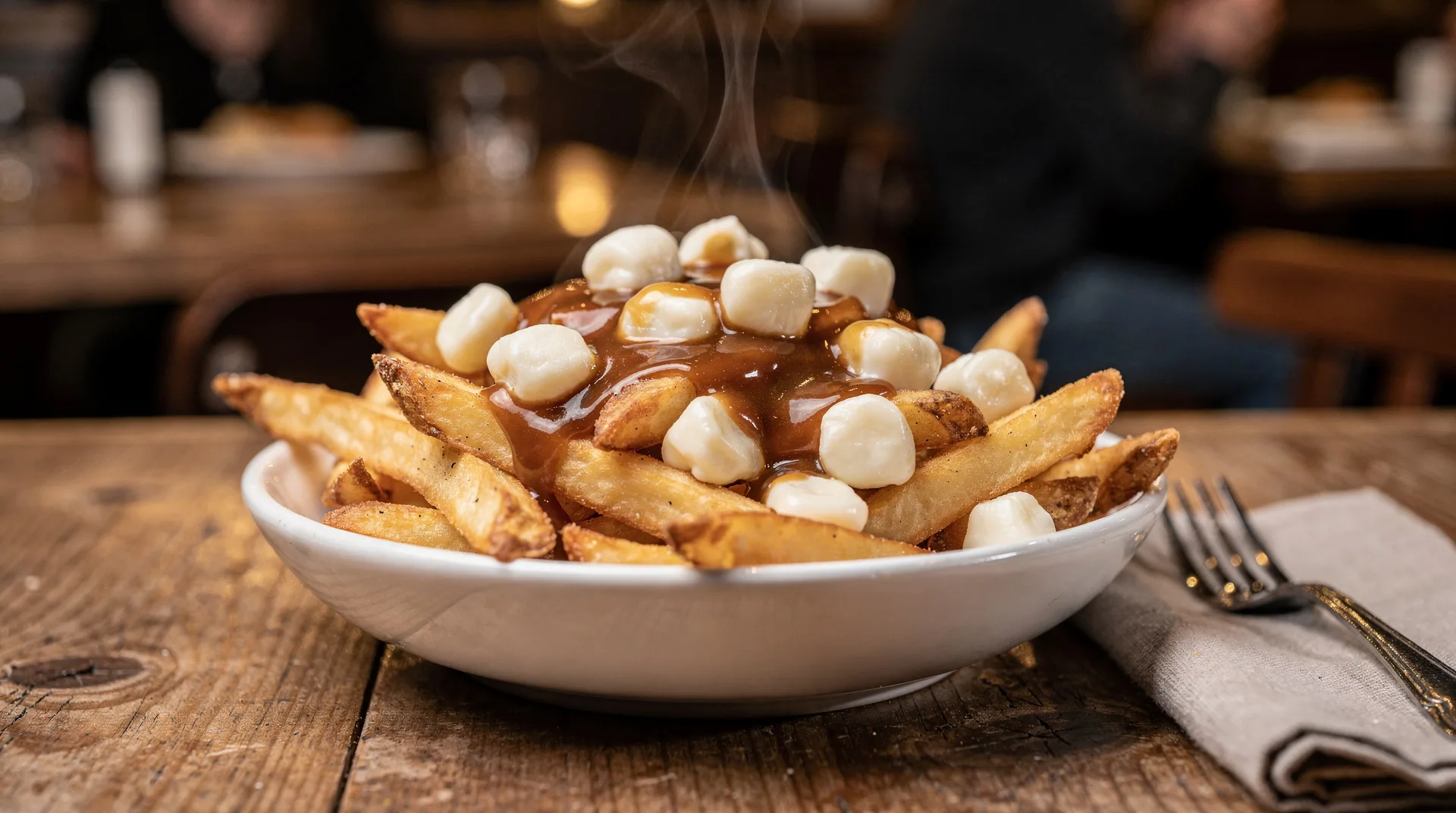
Where was poutine invented? The great Quebec debate
Where was poutine invented?
Poutine was invented in rural Quebec in the late 1950s. Warwick, Drummondville and Princeville all claim paternity. The most accepted story places its creation at Le Lutin Qui Rit in Warwick in 1957, with the gravy added a few years later.
Poutine — fries, cheese curds, brown gravy — is the most argued-about dish in Canada, and the argument starts at the very beginning: where was it invented? The answer is not simple, and rural Quebec has produced three separate towns with three separate claims, each backed by dates, witnesses, and (in two cases) surviving snack bars that still serve the dish they insist they created. For a visitor interested in Quebec food culture, the story is worth understanding before you sit down to your first plate.
This guide walks through the three main claims, the likely truth behind the debate, and the small towns in Centre-du-Québec you can actually visit if you want to taste poutine at the source.
| At a glance | |
|---|---|
| Where | Centre-du-Québec region — Warwick, Drummondville, Princeville, roughly midway between Montreal and Quebec City |
| Cost | a plate of poutine at a casse-croûte typically runs around $8-14 CAD |
| Time needed | a detour of around 2 extra hours if driving Montreal to Quebec City |
| Getting there | a rental car is the practical option — see Canada car rental — these towns are not well served by transit |
| Best time | year-round; Warwick’s Festival de la Poutine runs each August |
The three claims
All three origin claims come from the Centre-du-Québec region, a rural area between Montreal and Quebec City. All three stories are set in the late 1950s. All three were, at the time, completely unremarkable roadside snack bars (casse-croûtes) serving truckers, farmers, and factory workers.
Warwick, 1957 — the most accepted story
The most widely accepted origin places poutine at Le Café Idéal (later Le Lutin Qui Rit) in Warwick. The story goes that in 1957, Eddy Lainesse, a regular customer, asked owner Fernand Lachance to add cheese curds to his fries in the same bag. Lachance reportedly responded “ça va faire une maudite poutine” — “that’s going to make a damn mess” — and the name stuck.
Critically, this first version had no gravy. It was just fries and curds. The gravy came later.
Drummondville, 1964 — the gravy claim
Jean-Paul Roy at Le Roy Jucep in Drummondville claims to have added the gravy around 1964, giving poutine its modern form. Le Roy Jucep registered “Poutine” as a trademark in 2007, which officially recognised them as the inventors of poutine “as we know it today” — fries, curds, and gravy combined.
Le Roy Jucep is still open on Boulevard Saint-Joseph in Drummondville and remains one of the most interesting pilgrimage sites for poutine-curious travellers.
Princeville, late 1950s — the parallel claim
Princeville’s Le Roy Jucep of Princeville (a different restaurant, confusingly similar name) claims an earlier combination of all three elements. The town has been less successful at pressing its case, but locals in Princeville are adamant.
Why the debate will never be fully resolved
Three structural problems make a definitive answer impossible:
- No one documented it at the time. Poutine was unglamorous food invented in unglamorous places. Nobody wrote it down or photographed it until the dish became culturally significant decades later.
- Multiple independent inventions are plausible. Fries, cheese curds from local cheesemakers, and canned or homemade gravy were all common in rural Quebec snack bars. Combining them was not a leap of genius — it was a small step that several cooks may have made independently.
- The claims evolved backwards. As poutine became culturally valuable, towns began to sharpen their origin stories. Memories of elderly witnesses, written down in the 1990s and 2000s, are not reliable evidence of events in 1957.
The consensus among Quebec food historians is that poutine emerged in Centre-du-Québec somewhere between 1957 and 1964, probably in several places nearly simultaneously, and that Warwick’s claim to the fries-and-curds combination and Drummondville’s claim to adding gravy are both probably true — they were just different stages of the dish’s evolution.
How to read the claims as a visitor
The most useful way to approach the three stories is not to pick a winner but to treat each town as a chapter. Warwick is the chapter about the idea: fries and curds sharing a bag. Drummondville is the chapter about the recipe: the moment the sauce turned a snack into a meal. Princeville is the chapter about local memory, a reminder that food history in small towns is mostly oral and rarely tidy.
Reading it that way also makes the trip more enjoyable. You are no longer hunting for a verdict, you are collecting versions of the same dish and comparing them. Ask the person at the counter how they make their sauce, where the curds come from, and what their parents ate. Those answers are usually more interesting than any plaque on the wall.
A little French goes a long way in these towns, where English is less common than in Montreal. Our guides to speaking French in Quebec and French in Quebec cover the polite basics, and the reality of English in Quebec explains what to expect outside the big cities. Even a simple “bonjour” and “une poutine, s’il vous plaît” changes the tone of the exchange.
Visiting poutine’s heartland
If you want to taste poutine at the source, Centre-du-Québec is an easy detour from the Montreal-Quebec City corridor.
Le Roy Jucep — Drummondville
The most visitable of the original sites. Still operating, retro atmosphere, full menu of poutines. Boulevard Saint-Joseph. Open daily; plan a lunch stop if you’re driving between Montreal and Quebec City — it’s barely off Autoroute 20.
Le Lutin Qui Rit — Warwick
The Warwick site has changed hands and format over the years but the tradition persists. The town of Warwick takes its claim seriously — there’s a “Festival de la Poutine” each August that draws thousands.
Princeville
Princeville is harder to visit as a tourist — fewer current businesses emphasise the heritage — but the town has its partisans.
Poutine today: what the original would taste like
The original Warwick poutine of 1957 had just two elements: fresh, hand-cut fries from Quebec potatoes, and fresh cheese curds from a local cheesemaker (Warwick had its own fromagerie at the time). These curds would have been a few hours to a day old — squeaky, springy, not yet melted down into uniform texture.
The later Drummondville version added a simple brown gravy — typically a chicken-based sauce, sometimes with a small amount of veal stock, seasoned with pepper and possibly a bay leaf. Nothing elaborate.
If you want to taste as close to the original as possible today, look for a rural casse-croûte in Centre-du-Québec or the Bois-Francs region, order “poutine régulière” (not gourmet, not loaded), and expect fresh squeaky curds and a relatively simple sauce. The closer to a dairy farm you are, the better the curds will be.
What to look for on the plate
Whatever town you end up in, a few details separate a good poutine from a forgettable one. Judge it the way locals do, and you will understand why the debate matters so much to them.
- The curds. They should squeak against your teeth and hold their shape, softening from the heat of the gravy without dissolving into a stringy mass. Shredded cheese that melts into a sheet is the clearest sign of a shortcut.
- The fries. Sturdy, not too thin, with enough bite to survive the sauce for the length of a meal. Limp fries are forgiven only when the curds are exceptional.
- The gravy. Hot, peppery and light enough to let the other two elements speak. A heavy, floury sauce hides the curds, while a thin one leaves everything cold.
- The order of assembly. Curds go on the fries first and the gravy goes over the top, so the heat reaches the cheese. A plate built the other way round eats very differently.
Eat it fast, with a fork, while it is still hot. Poutine does not improve while you take photographs, and the last third of a plate left to cool is a sad thing.
Making a day of it
The origin towns pair naturally with other food stops in the same part of the province. A poutine lunch can sit alongside a visit to a cheesemaker, a market or a producer of local cider; see the Quebec ice cider guide and the Quebec microbreweries guide for ideas that suit a driving day. If your trip falls in the right season, the Quebec cranberry harvest is another agricultural experience worth working into the same route.
For the wider picture of how the dish fits into the regional table, the Canadian cuisine guide places poutine next to maple, game and seafood traditions, and the maple dishes beyond syrup guide shows how far Quebec cooks take a single local ingredient. For the mechanics of paying and tipping at a casse-croûte, see tipping in Canada.
Where poutine is today
Within Quebec, poutine has spread from rural snack bars to haute cuisine (La Banquise in Montreal is the most famous poutinerie; see our poutine restaurant guide for the best addresses). Outside Quebec, poutine has travelled — sometimes well, sometimes very badly. The widespread international use of shredded mozzarella instead of fresh curds is a minor culinary tragedy in Quebec’s view.
The protection of the name has been partial. There is no formal designation of origin (as there is for Quebec ice cider), but Quebec producers and restaurateurs have pushed hard for poutine to be recognised as Quebec cultural heritage.
Planning a poutine-themed road trip
A Centre-du-Québec poutine detour fits easily into a Montreal–Quebec City drive:
- Montreal to Drummondville: 1 hr 15 min (Autoroute 20). Lunch at Le Roy Jucep.
- Drummondville to Warwick: 35 min via Victoriaville. Afternoon snack at Le Lutin Qui Rit.
- Warwick to Quebec City: 1 hr 30 min. Continue east on Autoroute 20.
Total detour adds maybe two hours to the Montreal–Quebec City drive. You’ll have eaten too much poutine. That’s the point. If you would rather leave the driving to someone else, you can compare guided tours in Quebec that include local food stops.
For a broader food context, see our French Canadian cuisine guide, the Montreal food guide, and our Quebec food deep dive. Centre-du-Québec itself is covered in the broader regional content (cranberry harvest, fromageries).
Beyond the origin towns: tasting poutine elsewhere in Quebec
Centre-du-Québec is the origin, but it is far from the only place to eat well. Montreal’s poutine scene ranges from late-night casse-croûtes to gourmet versions loaded with duck confit or foie gras; see the Montreal food guide and, for the other pillar of Montreal’s food identity, Montreal smoked meat.
If cheese curds are the part of the dish that interests you most, the Quebec cheese trail covers the fromageries producing them, and the Quebec food markets guide is useful for finding local curds outside a restaurant setting. For a food-first trip built around this kind of detour, the Quebec 7-day foodie itinerary works the Centre-du-Québec stop into a wider loop, and Montreal to Quebec City covers the driving route these towns sit along.
Frequently asked questions about Where was poutine invented? The great Quebec debate
Can you still eat at the original poutine restaurant? Le Roy Jucep in Drummondville is still open and operating, serving a full poutine menu on Boulevard Saint-Joseph. The original Warwick site has changed hands and format over the years, but Le Lutin Qui Rit continues the tradition and the town still holds its August poutine festival.
Is poutine cheaper or more authentic in its origin towns than in Montreal? Prices are similar to a casual Montreal casse-croûte, generally cheaper than a gourmet or restaurant poutine. Authenticity is more about the curds and the simple gravy recipe than the town itself — a fresh, unfussy “poutine régulière” close to a dairy producer is the closest experience to the original.
Fitting the detour into a longer Quebec trip
Most visitors meet poutine in a city first and only later wonder about its roots. If you are building a broader itinerary, the origin towns work best as a half-day pause rather than a destination of their own. They sit comfortably between the two big cities, so a traveller deciding between them can read Quebec City vs Montreal and then use the drive as a chance to taste the dish at the source.
In Quebec City, the historic quarter is covered in the Old Quebec guide, and in Montreal the Vieux-Montréal guide does the same for the old port district. Both are good places to compare a city poutine with the roadside version you ate on the way. To add more to the trip, browse tours and activities across Canada. For a longer loop through the province, the Quebec 7-day itinerary and the wider Quebec destination page give more context.
Summer suits the festival and the terraces of the snack bars, which is why Quebec in summer is a good companion read. In autumn the drive itself becomes part of the pleasure, and Quebec in fall explains why. For event timing across the year, the Quebec festivals calendar lists what else might be on while you are passing through.
A final note on the debate
The question of who invented poutine is, in Quebec, treated with the affectionate seriousness you’d expect from a region that cares deeply about its food. Don’t take sides in a rural casse-croûte — listen, ask, eat, and enjoy that the debate continues. It’s the most Québécois thing about the dish.