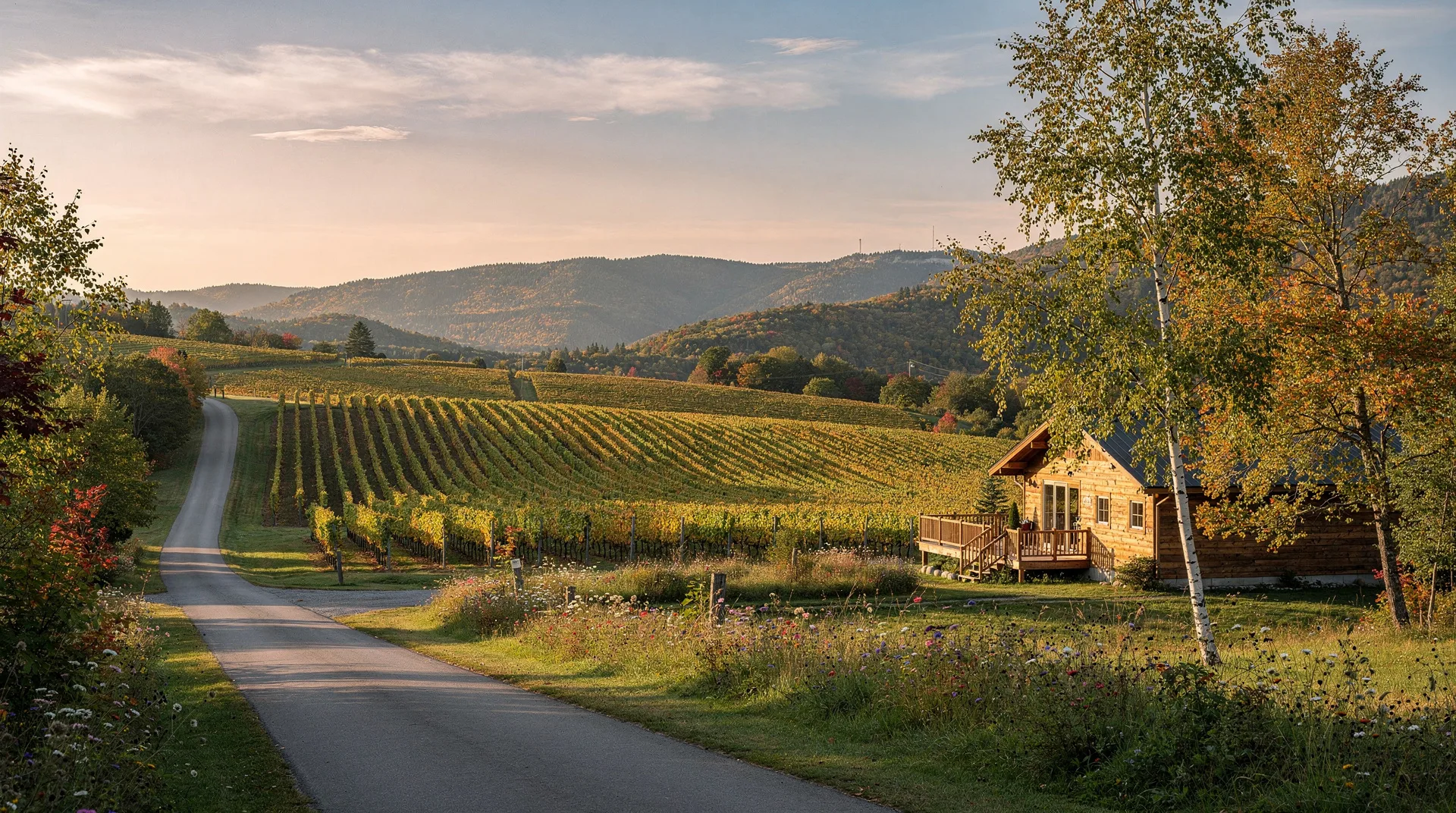
Eastern Townships wine route: Quebec's best-kept wine secret
Where is Quebec's Route des Vins and when is the best time to visit?
The Route des Vins de Brome-Missisquoi runs through the southern Eastern Townships — Dunham, Frelighsburg, Stanbridge East. About 22 wineries, open year-round but best from June to October, with grape harvest festivals in September.
Quebec has a wine industry. That sentence still surprises most visitors — and even many Canadians from other provinces — but the Eastern Townships, tucked against the Vermont border southeast of Montreal, have been producing wine commercially since the early 1980s and seriously since the 2000s. The Route des Vins de Brome-Missisquoi links roughly 22 wineries across a compact rural corridor, and it is, quietly, one of the most rewarding food-and-drink day trips in eastern Canada.
| Details | |
|---|---|
| Where | Brome-Missisquoi MRC, Eastern Townships (Estrie), around Dunham, Frelighsburg and Stanbridge East |
| Getting there | Around 90 minutes’ drive from Montreal via Autoroute 10 East; a car is essential |
| Cost | Tastings around C$10-25 per flight; a two-day weekend for a couple runs roughly C$1,000-1,500 |
| Time needed | A day trip covers 3 wineries comfortably; a weekend (1-2 nights) is the better pace |
| Best time | June for quiet tastings, September for harvest festivals, early October for wine plus foliage |
This is not Niagara. There are no 500,000-case wineries, no tour buses in the morning parking lot, no five-course tasting menus under glass. What you find instead is a network of family-run domaines, most of them selling predominantly at their own door, most of them planted with cold-climate hybrids that nobody in Bordeaux has ever heard of, and most of them pouring wine that would genuinely surprise you if you arrived expecting the worst. That, combined with cidre de glace country overlapping the same roads, makes the Townships a unique Quebec tasting region.
Where the route actually is
The Route des Vins de Brome-Missisquoi is a signposted driving circuit across the Brome-Missisquoi MRC in Estrie (the Eastern Townships). The anchor villages are:
- Dunham — the epicentre, more wineries per square kilometre than anywhere else in Quebec
- Frelighsburg — a postcard village close to the US border, strong for ice cider as well as wine
- Stanbridge East — the southern flank, with several historic properties
- Farnham, Cowansville, Sutton — surrounding towns with additional wineries and cideries
Driving time from central Montreal is about 90 minutes via Autoroute 10 East and Route 139. From Quebec City it is roughly 3 hours. Most visitors base themselves in Dunham, Cowansville, or Sutton for one or two nights; attempting the full route as a same-day round trip from Montreal is possible but rushed.
The wineries are generally open from May through October, with reduced hours in winter (many only on weekends November to April). Summer Saturdays and autumn weekends are genuinely busy — book tastings ahead at the larger producers between mid-September and mid-October.
Why Quebec wine exists
The short version: hybrids and snow.
Quebec’s winters routinely kill Vitis vinifera vines — the cabernets, chardonnays, and pinots that dominate most of the wine world. To grow grapes here, the Townships rely on cold-hardy hybrid varieties developed originally in Minnesota, Cornell, and at Quebec’s own research stations. The names are unfamiliar: Vidal, Seyval Blanc, Frontenac, Marquette, Sainte-Croix, L’Acadie Blanc. These vines survive -30°C, ripen in short seasons, and — when the producer is good — make genuine, interesting wine.
The second survival trick is winter burial (buttage). Several Townships wineries still earth up their vines in October to protect the trunks under snow, then uncover them in April. It is a Canadian winegrowing practice that would appear deeply strange in most of the world, and it is part of why Quebec wine tastes — and costs — the way it does.
The results are mostly white and rosé, with some reds and a deep bench of sparkling and ice wine. A few producers work in vinifera (chardonnay, pinot noir) in the most sheltered sites, using aggressive winter protection. Expect whites with cool acidity, floral and citrus notes, and reds that sit more towards Loire or Jura weight than Napa.
What the route looks like on the ground
A winery day on the Route des Vins typically opens around 11:00 and closes around 17:00 or 18:00. Tastings are paid — C$10–25 per flight is standard in 2026, often redeemable against bottle purchases. Many wineries have a terrace with light food (charcuterie boards, local cheese, sandwiches). A few have full restaurants, usually with opening hours that require reservation.
A realistic plan is three wineries in a day. More than that and the tastings blur; less and you wonder why you came so far. If you would rather skip the driving, you can also compare guided tours in Quebec that include tastings. Build in lunch at one winery, a coffee break somewhere along the route, and early dinner back in Cowansville, Sutton, or Dunham village.
Suggested one-day loop from Dunham
| Time | Stop | What to taste |
|---|---|---|
| 11:00 | Dunham winery #1 (flagship producer) | Whites: Vidal, Seyval Blanc |
| 13:00 | Winery #2 with kitchen, lunch stop | Reds + lunch flight |
| 15:30 | Frelighsburg cidery/winery | Ice cider, fortified ice wine |
| 17:30 | Return to Dunham or Sutton | Dinner in village |
Wineries worth targeting
Without naming every domaine on the route, these are categories of producer you should look for:
- Long-established flagship wineries around Dunham, with full tasting room, guided tours, and 20+ year track records — these are the safe, impressive entry points for first-time visitors.
- Smaller artisan growers making single-parcel hybrids — often open weekends only, worth seeking out for the unusual grape varieties (Frontenac Gris, Marquette) done with real intent.
- Sparkling specialists — traditional method sparkling on Seyval and Vidal, very competitive with entry-level Champagne at a fraction of the price.
- Ice cider and ice wine producers — see the next section.
- Mixed domaines producing wine, cider, fortified wine, and sometimes spirits — the Quebec artisan model at its most interesting.
Rather than work from a ranking, the best approach is to check the Route des Vins Brome-Missisquoi official website (laroutedesvins.ca) ahead of travel, pick three or four producers clustered geographically, call or email to confirm opening hours, and build the day around those bookings.
The cider dimension — and what’s separate
The Eastern Townships are cider country as much as wine country. Several Route des Vins wineries also produce cidre — still cider, sparkling cider, and particularly cidre de glace (ice cider). Frelighsburg and the villages along the 213 and 237 roads have some of Quebec’s most decorated ice cider producers, and a cidery afternoon fits naturally into a wine day.
Be aware of a frequently confused distinction:
- The Route des Vins Brome-Missisquoi is the southern Townships circuit covered here. It is wine-led, with several cider producers on the same roads.
- The Chemin de la Cidre traditionally refers to the Montérégie apple belt around Rougemont and Saint-Paul-d’Abbotsford — west of the Townships, closer to Montreal, cider-focused.
- The Île d’Orléans cider route near Quebec City is a third and entirely separate circuit — also worth visiting, not part of either of the above.
For a wine-plus-ice-cider weekend, the Townships give you both in the same afternoon. For cider alone, Montérégie or Île d’Orléans have denser concentrations. See the Quebec ice cider guide for the wider picture.
When to go
June — vines in full leaf, warm weather, quieter than peak summer. Best month for a calm tasting experience.
July–August — peak terrace season. Warm, busy on weekends, a genuine hum along the road. Book tastings ahead.
September — the standout month. Harvest is happening, several wineries host Fêtes des Vendanges (harvest festivals), the light on the vineyards is extraordinary. The Magog Fête des Vendanges and smaller on-property events draw serious crowds mid-September.
October — foliage peaks in the first half of the month. Wineries are still open and active; ice cider producers begin the buildup to their winter press. Possibly the best single window of the year for a Townships visit, combining wine, cider, and peak colour.
November–April — much quieter. Some wineries close, others open weekends only. Winter tastings exist (and some producers release their latest ice ciders and ice wines in January or February) but require more planning.
What to budget
Rough guide, per couple, for a two-day Townships wine trip in 2026:
- Tastings: C$20–40 per winery per pair
- Lunch at a winery: C$80–120 for two
- Dinner in a Townships village restaurant: C$100–180 for two, wine included
- Bottle purchases: average C$20–45 per bottle, with ice wines and ice ciders C$35–70 per 375 ml
- Accommodation: Townships B&B C$180–280, boutique auberge C$280–450
A weekend driving trip for two, including decent eating and a case of wine to take home, lands naturally at C$1,000–1,500.
Practical logistics
Getting there — you need a car. There is no public transport along the route. Car rental from Montreal-Trudeau airport is the standard. The drive from downtown Montreal to Dunham is uncomplicated, mostly Autoroute 10.
Designated driver and SAAQ — Quebec drink-driving enforcement is serious. Tastings along the Route des Vins are small (roughly 30–50 ml per pour, 3–5 wines per flight), and most visitors handle two producers before lunch without concern. A third afternoon tasting, lunch wine, and driving afterwards puts you at or over the limit. Designate a driver, split couples across tastings, or base yourself within walking distance of a village restaurant for dinner.
Language — Brome-Missisquoi is Francophone. Most tasting rooms handle English well; a basic bonjour and merci is always appreciated. See the French in Quebec guide if you want a few useful phrases.
Bringing wine home — Quebec wineries will ship to other Canadian provinces and, in many cases, internationally, but the logistics vary by domaine and by destination province. Within Canada, a case tucked in the car boot crosses provincial borders freely for personal use.
Browse Quebec regional and food tours on GetYourGuidePairing the wine route with the rest of the Townships
The Route des Vins fits naturally into a broader Eastern Townships itinerary. Obvious combinations:
- Cheese trail — the Townships have several of Quebec’s best fromageries, many walking distance from wineries.
- Sutton — small resort village with good restaurants, hiking in Mont-Sutton, spa options. Natural base for a wine weekend.
- Knowlton (Lac-Brome) — the lake, the duck farms, and a tight village centre worth an afternoon.
- Magog and Lac Memphrémagog — larger resort town, Abbaye de Saint-Benoît-du-Lac (with the monastery’s own cider and cheese), further east from the wine route but worth the detour.
For a broader regional read see the Montreal to Eastern Townships guide and Laurentians vs Eastern Townships.
How it compares to other Quebec wine and cider circuits
Visitors weighing whether the Route des Vins is worth a dedicated trip often ask how it stacks up against Quebec’s other tasting regions.
| Region | Focus | Distance from Montreal | Best for |
|---|---|---|---|
| Route des Vins (Brome-Missisquoi) | Wine, some ice cider | Around 90 minutes | A dedicated wine weekend with village charm |
| Montérégie (Rougemont area) | Cider, orchards | Around 45-60 minutes | A shorter, cider-focused half-day |
| Île d’Orléans | Cider, cheese, produce | Around 20 minutes past Quebec City | Pairing with a Quebec City stay |
| Niagara (Ontario, for comparison) | Large-scale wine | Not applicable — different province | Bigger producers, more polish, less intimacy |
None of these directly compete — they suit different trip shapes. A Quebec City-based traveller is better served by Île d’Orléans; a Montreal weekender with wine as the goal is better served by the Townships.
First-timer logistics that catch people out
A few practicalities are worth knowing before setting out. Most wineries along the route do not accept walk-ins without at least a phone call or online booking during peak weekends (mid-September to mid-October) — arriving unannounced on a Saturday in foliage season risks being turned away or facing a long wait. Cell signal is patchy in stretches of the Townships countryside, so download or screenshot addresses and confirmations before leaving Montreal rather than relying on live data.
Payment is generally by card, but a handful of the smallest family producers are cash-preferred for tastings under C$20 — carrying some cash avoids an awkward moment. Most tasting rooms close between lunch and early afternoon on quieter weekdays outside the June-October season, so a shoulder-season visit benefits from calling ahead even more than a summer one.
Frequently asked questions about Eastern Townships wine route
Do I need to book Route des Vins tastings in advance?
Not always for a quiet June weekday, but yes for anything from mid-September through mid-October and for any Saturday in summer. The larger flagship producers around Dunham can handle walk-ins outside peak periods, but smaller family wineries are frequently weekends-only or by appointment, so a quick call or email ahead saves a wasted stop.
Is the Eastern Townships wine route worth it if I’ve been to Niagara?
Yes, but for a different reason. Niagara offers scale and polish; the Townships offer discovery — cold-climate hybrid grapes nobody outside Quebec has heard of, family producers pouring their own wine, and a rural Quebec setting rather than a tourist-dense wine strip. Go in expecting intimacy rather than grandeur.
Related reading
- Quebec ice cider: invention, producers, tastings
- Quebec cheese trail
- Montreal to Eastern Townships driving guide
- Laurentians vs Eastern Townships: which Quebec region for you?
- Eastern Townships destination overview
- Quebec destination overview
Quebec wine will probably never be France or California. It does not need to be. Two days on the Route des Vins, tasting cold-climate hybrids in converted barns with the producer pouring, eating charcuterie on a terrace above the vines, and driving back with a few bottles of sparkling Vidal and a half of ice wine, is one of those specific regional pleasures that justifies the journey on its own terms.