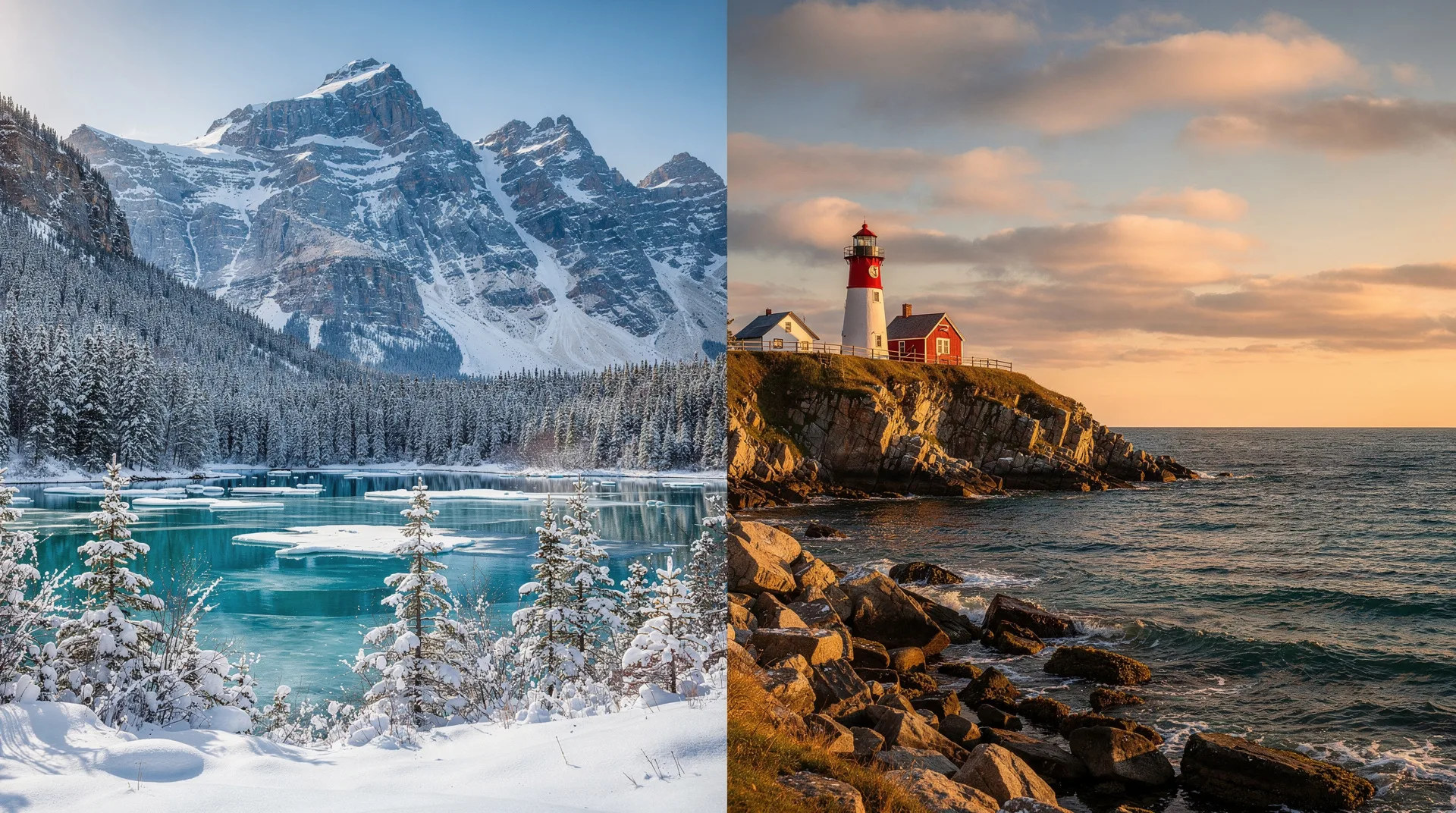
Laurentians vs Eastern Townships: which Quebec region for you?
Should I visit the Laurentians or the Eastern Townships from Montreal?
The Laurentians are closer to Montreal, have the best ski resort (Mont-Tremblant) and the P'tit Train du Nord trail. The Eastern Townships have better food tourism (cheese, ice cider, wine), and more English spoken. Both reward 2–3 nights.
Montreal’s two great escape regions
Every major North American city has its escape regions — the countryside within a comfortable drive that city residents use for weekends, seasonal retreats, and outdoor activities. For Montreal, two regions fill this role more than any others: the Laurentians to the north and the Eastern Townships to the southeast.
Both are within a two-hour drive of central Montreal. Both have ski resorts, cycling trails, lakes, and forests. Both have growing food and artisan beverage cultures. Both are beautiful in different ways and across different seasons. Yet they are fundamentally different landscapes, different cultural histories, and different travel experiences — choosing between them, or understanding which to prioritise on a limited-time Quebec visit, requires knowing those differences.
This guide compares the two regions across terrain, history and culture, food and drink, outdoor activities, season by season, accommodation, and who each region suits best.
| At a glance | Laurentians | Eastern Townships |
|---|---|---|
| Distance from Montreal | Around 65-145 km, 50-90 min | Around 80-130 km, 55-90 min |
| Cost level | Higher in peak ski season | Generally more affordable |
| Best for | Skiing, lakes, cycling trail | Wine, cheese, cider, culture |
| Getting there | Own car or shuttle from Montreal | Own car recommended |
| Best time | Winter (skiing), October (colour) | Fall harvest, May-October wine season |
Basic orientation
The Laurentians (Laurentides)
The Laurentians — Laurentides in French, giving its name to the administrative region — is the ancient Precambrian shield country north of Montreal. The Shield forms a plateau of rounded hills, lakes, and boreal-transition forest, geologically among the oldest rocks on earth (over 1 billion years old), worn smooth by repeated glaciations.
The main corridor runs along Route 117 from Saint-Jérôme (50 km north of Montreal) through Saint-Sauveur, Sainte-Adèle, Sainte-Agathe-des-Monts, and Mont-Tremblant. The Laurentian ski resorts developed along this corridor beginning in the 1930s, and the region has been Montreal’s primary winter escape destination for nearly a century. The P’tit Train du Nord rail trail follows the former railway line through this same corridor.
Distance from Montreal: Saint-Sauveur (closest resort area) is 65 km, about 50 minutes. Mont-Tremblant is 145 km, about 90 minutes.
Eastern Townships (Cantons-de-l’Est)
The Eastern Townships — officially Cantons-de-l’Est, colloquially les Cantons — occupy the rolling Appalachian hill country southeast of Montreal, bordering Vermont, New Hampshire, and Maine. The geology here is different from the Laurentians: the Appalachian chain’s northern end, with older-folded mountains, fertile valleys, and a climate slightly moderated by the lower elevation and southerly position.
The Eastern Townships were settled primarily by Loyalist refugees after the American Revolution — British colonists loyal to the Crown who fled the new United States and were granted land in Quebec. This English-speaking origin left a cultural mark that persists: the Eastern Townships are Quebec’s most bilingual rural region, with a long tradition of English-language community life even as French has become the dominant language over the past century.
Distance from Montreal: Granby (nearest major town) is 80 km, about 55 minutes. Magog and Orford area is 130 km, about 90 minutes. Sutton and Dunham (cider country) is 110 km, about 75 minutes.
Terrain and scenery
Laurentians
The Laurentians landscape is quintessential Canadian Shield: rounded hills (elevations reaching 900+ metres at Mont-Tremblant), hundreds of lakes, boreal forest of mixed conifer and deciduous trees. The visual character changes dramatically by season: lush green in summer with lakes everywhere; an extraordinary patchwork of red, orange, and yellow in October during leaf season; clean white ski country in winter.
The scenery is not dramatically alpine — these are old, worn mountains, not young jagged peaks — but the combination of lake, forest, and sky is genuinely beautiful, particularly in fall colour and in the snow.
The lakes are the Laurentians’ defining landscape feature. Lac Tremblant (adjacent to the resort), Lac des Sables in Sainte-Agathe-des-Monts, and hundreds of smaller private and public lakes provide water access, canoe routes, and summer swimming throughout the region.
Eastern Townships
The Eastern Townships’ topography is somewhat more varied than the Laurentians — the Appalachian terrain creates narrower valleys, steeper hillsides, and a more agricultural character in the lowlands (the region is Quebec’s primary wine and apple-growing country). The summits — Mont Orford (853 m), Mont Sutton (968 m), Mont Mégantic (1,105 m) — are not dramatically higher than the Laurentians but feel different due to the underlying geology and vegetation.
The pastoral quality of the Eastern Townships is one of its distinguishing visual features. The rolling farmland of the Dunham and Sutton valleys, apple orchards in fruit-scented rows, vineyards on south-facing slopes, and the historic Loyalist-era farmhouses and churches create a landscape that feels more European in character than the wilder Laurentian Shield. The region is sometimes described as Quebec’s answer to Vermont — and the comparison is apt.
Verdict on terrain: The Laurentians for lakes and wilderness; the Eastern Townships for rolling agricultural beauty and a landscape that feels more humanised and European.
Culture and history
Laurentians
The Laurentians’ cultural character is primarily that of Montrealers-escaping-the-city. The resort towns — Saint-Sauveur, Sainte-Adèle, Mont-Tremblant — developed primarily as leisure destinations for Montreal families, and the region’s character reflects this: ski lodges, chalet rentals, family restaurants, and outdoor outfitters outnumber other cultural institutions.
The region has a deep French Canadian character — the old villages of the Laurentians, many founded by the 19th century colonisation missions that sent settlers north to populate the Shield, retain traditional Quebec rural architecture and culture. But the overlay of resort development since the 1930s has significantly shaped the contemporary landscape.
Craft brewing and music: The Laurentians have a growing microbrewery culture — see the Quebec microbreweries guide for specific producers — and the region’s music festival scene (Festival de Musique Émergente in Rouyn-Noranda, Joliette music events) reflects its cultural vibrancy.
Eastern Townships
The Eastern Townships have the most complex and interesting cultural history of any Quebec rural region. The original Loyalist English settlement left a heritage of Protestant churches (Anglican, Methodist, Presbyterian), covered bridges (the region has a disproportionate number of covered wooden bridges), and English place names that persist in the landscape — Waterloo, Ayer’s Cliff, Hatley, Knowlton — alongside the French names that arrived with subsequent waves of francophone settlement.
The region’s artistic life reflects this complexity: the Eastern Townships have attracted artists and writers for over a century, and the cultural institutions — the Musée des beaux-arts de Sherbrooke, the Festival de Cinéma de Trois-Rivières (edge of the region), and numerous summer theatre and music events — are more developed than in the Laurentians.
The region’s bilingualism makes it the most comfortable region in Quebec for anglophone visitors who are not comfortable in French. English is routinely spoken in the Dunham-Sutton-Magog corridor.
Verdict on culture: The Eastern Townships offer a richer and more layered cultural experience. The Laurentians offer stronger resort infrastructure.
Food and drink
Laurentians
The Laurentians’ food culture has developed alongside its resort culture — many ski resort restaurants are excellent, and the region’s population of wealthy Montreal weekenders has driven the development of good restaurants in Saint-Sauveur, Sainte-Adèle, and Mont-Tremblant village. But the region does not have the diversity of artisan food producers that the Eastern Townships can offer.
Microbreweries: The Laurentians’ clearest culinary strength. Multiple excellent craft breweries — including Dieu du Ciel!‘s production facility in Saint-Jérôme and numerous others — are concentrated in the region. See the Quebec microbreweries guide.
Sugar shacks: The Laurentians have several excellent cabanes à sucre accessible during March–April maple season. The combination of a Laurentian weekend (skiing one day, sugar shack the next) is a near-perfect spring Quebec experience. See the cabane à sucre guide.
Eastern Townships
The Eastern Townships have the richest artisan food and drink ecosystem of any Quebec rural region outside of Charlevoix.
Ice cider: The Eastern Townships — particularly the Dunham area — is one of the two primary ice cider production regions in Quebec. Brasserie Dunham, Cidrerie La Face Cachée de la Pomme, and multiple orchard cideries make the Dunham valley a destination for ice cider tourism. See the Quebec ice cider guide.
Cheese: Several significant fromageries operate in the Eastern Townships — Fromagerie La Station (Compton), Fromagerie Tournevent (goat’s milk), and Abbaye Saint-Benoît-du-Lac on Lac Memphrémagog. See the Quebec cheese trail guide.
Wine: Quebec’s most developed wine region is in the Eastern Townships — the Dunham and Brome Lake area has a dozen or more vineyards producing cold-climate wines, primarily white and sparkling. The wines are improving year on year and are worth discovering; the best producers make wines comparable to Ontario VQA products.
Apple orchards and u-pick: The Montérégie-Eastern Townships apple belt is one of the largest in Canada. September and October u-pick apple season draws huge numbers from Montreal. Apple pastry, fresh-pressed juice, and artisan cider are everywhere in fall.
Verdict on food: The Eastern Townships win decisively on diversity and artisan quality. The Laurentians win on craft beer specifically.
Book a Montreal day trip or regional Quebec experience on GetYourGuideOutdoor activities by season
Winter
Laurentians: Mont-Tremblant is the dominant ski resort — see the Mont-Tremblant vs Mont-Sainte-Anne comparison guide for the full ski resort analysis. Smaller Laurentian resorts (Saint-Sauveur, Sommet Saint-Sauveur, Mont-Blanc) provide alternative skiing for day trips. Dog sledding, snowshoeing, and winter hiking are excellent. The P’tit Train du Nord trail converts to a cross-country ski trail — at 232 km, one of the longest groomed cross-country networks in eastern Canada.
Eastern Townships: Mont-Sutton and Bromont are the primary ski resorts. Both are excellent day-trip mountains from Montreal; neither has the resort infrastructure of Tremblant. Mont-Orford is a provincial park with skiing. Sutton in particular is beloved by expert skiers for its off-piste terrain and tree-skiing reputation.
Winter verdict: Laurentians for overall ski resort infrastructure and experience; Eastern Townships for expert terrain at Sutton.
Spring and Summer
Laurentians: Lake swimming and canoe camping from late May. P’tit Train du Nord cycling from June. White water rafting on the Rouge River (Organisation La Vallée de la Rouge). Golf courses opening across the region.
Eastern Townships: Wine tasting and vineyard visits from May through October. Hiking Parc national du Mont-Orford. Water activities on Lac Memphrémagog. Festival season — Bromont outdoor festival, Orford classical music festival.
Fall
Both regions produce spectacular fall colour (typically late September through mid-October). The Laurentians’ maple-dominated forest tends toward red and orange; the Eastern Townships’ more mixed forest — with more birch, oak, and ash — produces a broader colour spectrum.
The Eastern Townships’ fall apple harvest and cranberry harvest tourism (the cranberry fields of Centre-du-Québec, covered in the Quebec cranberry harvest guide, are on the western edge of the Eastern Townships) add food tourism dimensions to the fall season.
Fall verdict: Effectively equal. Both are extraordinary in October. The Eastern Townships’ food tourism adds an edge for food-focused visitors.
Accommodation comparison
Laurentians: Strong resort accommodation infrastructure — Fairmont Tremblant, multiple ski-in/ski-out condos, chalet rentals, and B&Bs throughout the corridor. Peak season pricing is high; off-season (spring, fall) rates are more reasonable.
Eastern Townships: More variety in accommodation type — historic inns, farm stays, golf resort hotels (Club de golf Owl’s Head), and B&Bs in converted heritage buildings. Pricing is lower than the Laurentians. The auberge tradition is strong — several excellent small inns offer full-board options that make for self-contained stay experiences.
Find Quebec regional and Canada outdoor tours on GetYourGuideWho should choose the Laurentians
- Visitors coming specifically for skiing (Mont-Tremblant)
- Those who want a resort-style experience with village atmosphere
- Visitors prioritising cycling (P’tit Train du Nord)
- Winter visitors wanting dog sledding, snowshoeing, or winter camping
- Families who want resort infrastructure and organised activities
- Visitors who want to combine with a cabane à sucre visit in March–April
Who should choose the Eastern Townships
- Food and wine-focused visitors
- Those interested in ice cider and artisan cheese (see ice cider and cheese trail guides)
- Visitors who value cultural complexity and history (Loyalist heritage, bilingualism)
- Expert skiers who want tree skiing at Sutton
- Fall foliage and apple harvest visitors
- Anglophones who want to minimise language friction in rural Quebec
- Astronomy enthusiasts (Mont-Mégantic dark sky reserve — see the Quebec dark sky preserves guide)
Getting there without a car
Neither region has strong public transit for tourists. Limited intercity bus service reaches larger towns (Saint-Jérôme, Sainte-Agathe, Magog, Sherbrooke) but does not serve the trailheads, wineries, or resort villages that make each region worthwhile. A rental car is close to essential for a proper visit to either region — see the Canada car rental guide for booking tips. Organized day tours from Montreal exist for both regions in peak season (ski shuttles to Tremblant in winter, wine-tour vans to the Townships in summer/fall) and are a reasonable option for visitors without a car who only want a single day trip.
Combining both regions in one trip
Visitors with 5+ days in Quebec sometimes ask whether they can do both regions rather than choosing. It’s feasible but requires returning to Montreal (or nearby) between legs, since the regions are on opposite sides of the city and there is no direct road linking them. A workable pattern: 2 nights in the Laurentians (Tremblant or Saint-Sauveur) followed by a return through Montreal and 2 nights in the Eastern Townships (Magog or Dunham), rather than trying to link them directly. This works especially well in fall, when both regions are near-simultaneously at peak colour.
Frequently asked questions about Laurentians vs Eastern Townships
Can I visit both the Laurentians and the Eastern Townships on a first trip to Quebec?
Yes, but not in a single day — the regions sit on opposite sides of Montreal with no direct connecting road. Most first-time visitors with limited time choose one based on priorities (skiing and lakes vs. wine and cheese); those with 5+ days can do both as separate legs of the trip, returning through Montreal in between.
Which region is better for a winter weekend without skiing?
The Eastern Townships generally work better for a non-ski winter weekend — the inns, cheese and cider producers, and Mont-Orford’s snowshoe trails offer a quieter pace than the Laurentians, where the whole regional economy is built around the ski season and non-skiers can feel like an afterthought in peak weeks.
Related pages
- Mont-Tremblant vs Mont-Sainte-Anne: best Quebec ski resort comparison
- Quebec ice cider: the invention, producers and tastings
- Quebec cheese trail: artisan cheese tour by region
- Quebec microbreweries: best breweries by region
- Quebec dark sky preserves: astronomy tourism and night photography
- Cabane à sucre guide: Quebec’s maple sugar shack experience
- Quebec cycling routes: Route Verte Canada’s longest cycling network
- Montreal destinations