Aurora Photography: Complete Guide for Canadian Northern Lights
What camera settings should I use for aurora photography?
Start with ISO 1600–3200, aperture f/2.8 (or wider), shutter 3–10 seconds. Shorter exposures (2–4s) preserve structure in active aurora; longer exposures (8–15s) suit quiet displays. Manual focus set to infinity. RAW format essential.
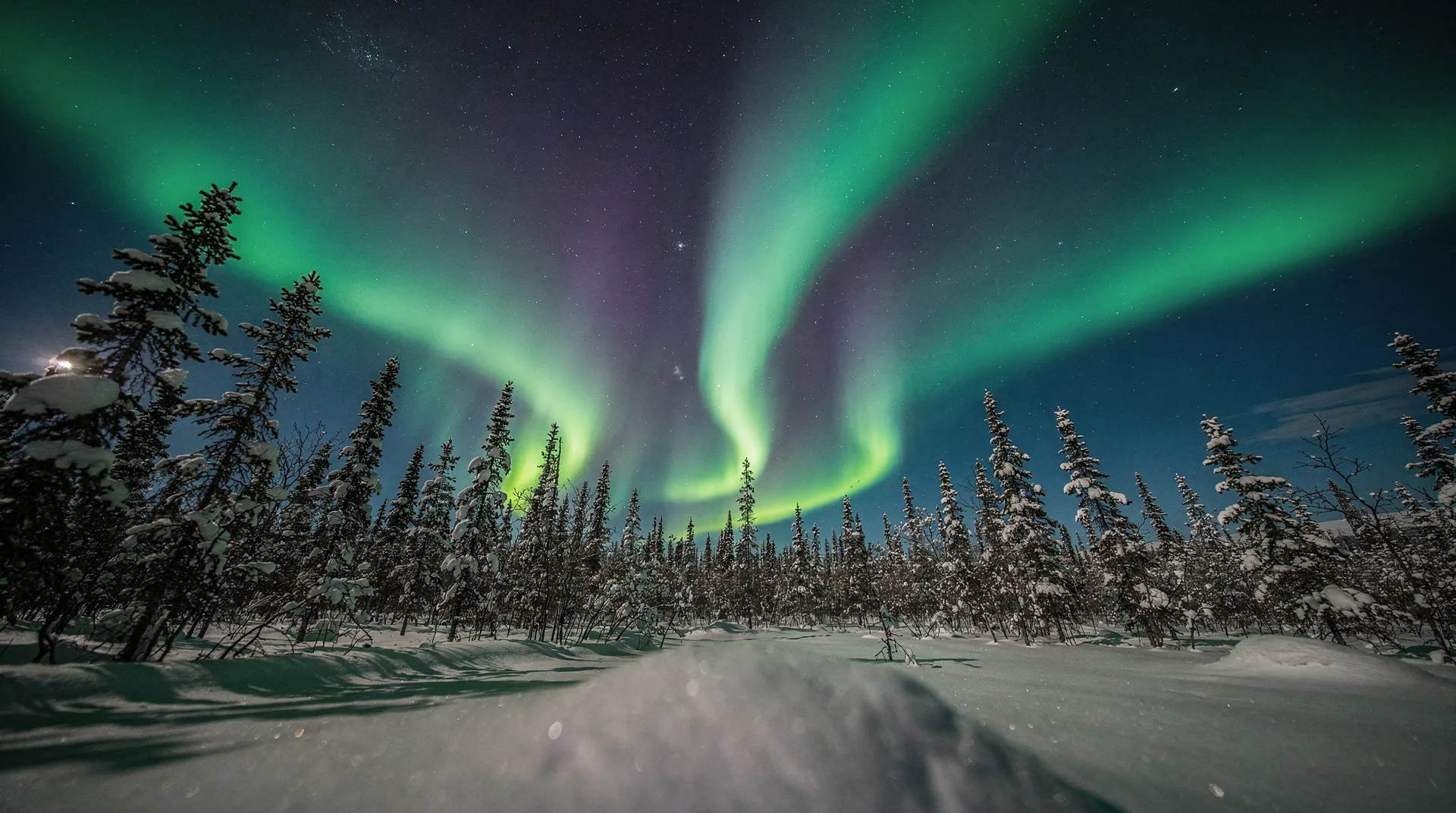
Aurora photography is the most common reason travellers pursue the Canadian Northern Lights, and — with the right equipment and preparation — among the most rewarding types of photography available anywhere. This guide covers the full technical approach: gear, camera settings, cold-weather protection, composition, location selection, and post-processing. It is written for photographers at the intermediate level who already understand manual camera settings and want specific advice for aurora.
At a glance
| Where | Yellowknife, Whitehorse, Churchill and Dawson City/Dempster Highway are the main northern Canada photography bases |
| Best months | Late February and March for peak displays; September for milder shoulder-season conditions |
| Core gear | Full-frame or crop mirrorless/DSLR, fast wide-angle lens, cold-tolerant tripod, 4+ spare batteries |
| Cost | Gear aside, guided aurora photography evenings typically run around CAD 100–180 per person |
| Time needed | Plan 2–4 hours per outing, across several nights, for a realistic shot at an active display |
| What to expect | -20°C to -45°C in peak season; standing still in the cold is harder than moving winter activities |
Gear
Camera body
Full-frame is preferred but not essential. Full-frame sensors gather more light and perform better at high ISO. Aurora photographs often require ISO 1600–6400, where full-frame has a clear advantage over crop sensors.
Recommended bodies. Sony A7R III/IV/V, Sony A7S series (exceptional low-light), Nikon Z6II/Z7II, Nikon Z8/Z9, Canon R5/R6II, Canon R8. Any modern mirrorless with strong high-ISO performance will work well.
Older DSLRs. Canon 6D (remarkable aurora camera), Nikon D750/D780, and similar full-frame DSLRs remain excellent aurora cameras despite their age.
Crop sensor cameras. Fully usable but less forgiving. Expect more noise at high ISO; manage by shooting at the lowest ISO that still captures the display.
Lens
Fast wide-angle is essential. Aurora often fills the sky overhead; wide fields of view capture more of the structure.
Recommended focal lengths.
- 14–24mm f/2.8 — classic aurora lens, wide enough for substorms
- 20mm f/1.8 — prime, excellent light gathering
- 24mm f/1.4 — very fast, excellent for quiet aurora
- 16–35mm f/2.8/f/4 — versatile zoom
Budget options. Samyang/Rokinon 14mm f/2.8 and 24mm f/1.4 offer outstanding aurora performance at lower cost.
Avoid. f/4 and slower lenses — they work but require higher ISO to compensate, with more noise.
Tripod
Sturdy and cold-tolerant. Aluminium tripods get painfully cold to touch. Carbon fibre tripods are lighter and feel less cold.
Head. Ball head for quick framing changes. Arca-Swiss compatibility recommended for easy lens plate changes.
Weight rating. The tripod should comfortably support camera + heaviest lens.
Accessories
- Remote shutter release or intervalometer. Eliminates vibration at shutter release. Cable release is more reliable in cold than wireless.
- Headlamp with red-light mode. Preserves night vision. Essential.
- 4+ spare batteries. Kept inside clothing near body heat.
- Microfibre cloths. For condensation management.
- Lens hood. Reduces stray light and moisture accumulation on the front element.
- Lens warmer or chemical hand warmers. Taped to the lens barrel prevents dew and frost formation on the front element.
Camera settings
Mode
Manual mode. Aurora’s variable brightness means autoexposure is unreliable. Manual control is essential.
Focus
Manual focus, set to infinity. Autofocus does not work in low light. Set focus before dark using distant streetlights or a bright star (Polaris, Jupiter, or Venus work well). Tape the focus ring to prevent drift.
Modern mirrorless cameras with focus peaking or magnification make setting focus simpler; use these features.
Aperture
Wide open (f/1.4 to f/2.8). Always. Aurora photography is light-limited; wider apertures gather more light.
ISO
ISO 1600 starting point. Adjust based on aurora brightness:
- Quiet aurora: ISO 2500–3200
- Active aurora: ISO 1600–2000
- Very strong/bright aurora: ISO 800–1250
Higher ISO produces more noise. Modern cameras handle ISO 3200 cleanly; ISO 6400+ becomes noticeably noisy. Err low — noise reduction in post-processing recovers better from a dark image than highlight recovery can rescue overexposed aurora.
Shutter speed
Match the aurora’s motion.
- Rapidly moving, active aurora: 1–4 seconds. Preserves structure and “curtain” detail.
- Moderate activity: 5–8 seconds.
- Quiet aurora (diffuse glow or slow arc): 10–20 seconds.
Longer exposures smear fast-moving aurora into blobs. Shorter exposures preserve the sharp, curtain-like structure that defines the best aurora images.
White balance
Daylight or 3500–4000K. Auto white balance can produce unusual casts with aurora colours. Manual white balance in the 3500–4000K range typically produces neutral aurora with slightly warm landscapes.
File format
RAW. Non-negotiable. RAW files allow dramatic exposure and colour recovery in post-processing that JPEG cannot match.
Other settings
- Long exposure noise reduction: OFF. It doubles your effective exposure time, reducing the number of aurora images you can capture.
- High ISO noise reduction: OFF or minimum. Do noise reduction in post-processing for better results.
- Image stabilisation: OFF when tripod-mounted. Stabilisation systems produce artefacts on tripods.
Cold-weather protection
Aurora photography in Canada happens at -20°C to -45°C in peak season. Proper cold-weather protocols are essential.
Camera protection
Keep the camera cold. Do not bring a cold camera into a warm space and then back out — condensation forms inside the lens and body, sometimes permanently damaging optics. When finished shooting for the night, seal the camera in a Ziploc bag before entering a warm space; let it warm to room temperature before removing from the bag.
Battery management. Lithium batteries lose capacity rapidly in cold. A battery that lasts 400 shots at 20°C may last 60–100 shots at -30°C. Rotation strategy: keep 4+ spares warm in inner pockets; swap batteries every 30–60 minutes; re-warm the used battery to restore charge.
Moisture. Your breath forms ice crystals on the camera body, viewfinder, and lens. Breathe away from the camera. Keep a microfibre cloth handy.
Photographer protection
Hours of standing still in extreme cold for aurora photography is harder on the body than active winter activities. Over-dress rather than under-dress:
- Base layers: Merino wool, two layers.
- Mid-layer: Heavy fleece or down.
- Outer shell: Wind- and water-proof parka rated to -40°C.
- Legs: Insulated snow pants or ski bibs.
- Feet: Boots rated -40°C minimum; heated insoles highly recommended.
- Hands: Liner gloves (for camera operation) + over-mitts (for warmth between shots).
- Face and neck: Balaclava or neck gaiter + hat.
- Hand warmers: Multiple packets; keep in mittens, in pockets near the battery.
Composition
Technically correct aurora images are common; memorable aurora images have compelling composition. Key principles:
Include foreground
Pure sky images of aurora are often less effective than images that include recognisable foreground elements — trees, cabins, ice, lakes, mountain silhouettes. Foreground provides scale and sense of place.
Strong foregrounds are often dark silhouettes against the lit sky. Shoot wide enough to include meaningful foreground without making the aurora too small in the frame.
Reflections
Calm water, frozen lakes, and wet pavement can produce stunning reflections of aurora. Pre-identify reflective foreground locations.
Lead the eye
Rivers, fences, tree lines, and roads can serve as leading lines bringing the viewer’s eye toward aurora activity.
Watch the horizon
Tilted horizons ruin otherwise strong aurora images. Use a level on the tripod; check images on screen; re-frame as needed.
Shoot many frames
Aurora moves and changes constantly. Shoot continuously through a display — the best images come from minutes of continuous shooting, not single triggered shots. Conservatively, expect 20+ frames per memorable display; 100+ for genuinely strong substorms.
Location selection
The best Canadian aurora photography locations combine three factors: reliable aurora activity, clear-sky frequency, and compelling foreground.
Yellowknife, NWT. Under the auroral oval. Reliable activity. If you would rather have a local guide handle transport and sky-watching, you can browse guided tours in Canada. Good foreground options include Great Slave Lake, houseboat reflections, teepee structures at aurora villages. See Yellowknife aurora.
Whitehorse, Yukon. Slightly lower latitude than Yellowknife. Good for combined aurora + landscape with mountain foregrounds. See Whitehorse aurora viewing.
Churchill, Manitoba. 58°N — closer to the subarctic treeline. Flat tundra and frozen Hudson Bay provide unusual foregrounds. See Churchill aurora.
Dawson City and Dempster Highway, Yukon. More remote; less infrastructure. Dramatic foregrounds including mountains and the Yukon River. See Dawson City and Dempster Highway.
Location comparison
| Location | Foreground strength | Access | Best paired with |
|---|---|---|---|
| Yellowknife, NWT | Lake reflections, boreal silhouettes | Daily flights from Edmonton/Calgary | Best overall clear-sky reliability; see the best time to see the aurora guide |
| Whitehorse, YT | Mountain silhouettes, road foregrounds | Daily flights from Vancouver | Yukon road-trip country and the Dempster Highway |
| Churchill, MB | Flat tundra, frozen bay, near-total horizon | Fly from Winnipeg; no road access | Polar bears — see the Churchill aurora guide |
| Dawson City/Dempster | Mountains, Yukon River, zero light pollution | Long drive from Whitehorse | Remote, dramatic terrain for experienced winter drivers |
Planning around the practicalities
Photography-focused aurora trips benefit from the same trip-length logic as any aurora trip: because neither cloud cover nor geomagnetic activity can be forecast more than a few days out, spreading your attempts across 4–5 nights rather than 1–2 meaningfully improves your odds of a genuinely photogenic display. For destination-by-destination probability and month-by-month detail, the best time to see the aurora in northern Canada guide is the companion resource to this one.
Before any night shoot away from town — on tundra, lake ice, or backcountry pullouts — review Canada wildlife safety basics, particularly in and around Churchill where polar bears are present. If you’re also weighing camera settings and cold-weather technique in more depth, the aurora photography guide focused on the North covers additional Yukon- and NWT-specific detail, including a quick settings-by-activity-level reference table.
Timing
September. The most popular shoulder month. Activity around the equinox. Dark skies returning. Moderate cold.
October to mid-November. Dark hours long; weather cold; aurora frequent. Bear season overlap adds complications in Churchill.
Late February and March. Peak winter viewing. Dark hours still long; sky clarity often excellent. Significant cold.
Avoid full moon periods. Bright moon washes out aurora colour and structure. New moon and crescent moon periods are optimal.
Post-processing
Aurora RAW files benefit substantially from thoughtful post-processing.
Adobe Lightroom, Capture One, or similar RAW editor:
- White balance. Fine-tune to taste. Aurora greens often benefit from slight colour correction.
- Exposure. Raise exposure if image is dark; clip highlights carefully to preserve aurora colour.
- Shadows and blacks. Open shadows to reveal foreground detail; deepen blacks selectively for contrast.
- Dehaze. Modest dehaze can emphasise aurora structure without causing artefacts.
- Noise reduction. Apply moderate luminance noise reduction (25–40). Keep colour noise reduction higher.
- Sharpening. Apply standard sharpening to foreground; avoid heavy sharpening of the aurora itself.
- Local adjustments. Use gradient filters or radial masks to enhance aurora brightness locally without overexposing.
Advanced workflow: Focus stacking (for landscape foreground) and exposure blending (for aurora + dark foreground) combine multiple exposures for images that single RAW captures cannot achieve. These techniques require more time but produce genuinely superior results.
Common mistakes
- Overexposing aurora and losing colour and structure
- Shooting too long an exposure with active aurora (smearing)
- Underexposing foreground so it becomes pure black
- Tilted horizons
- Not focusing precisely at infinity
- Running out of battery in cold conditions
- Single-shot mindset instead of continuous shooting through a display
- Forgetting to sealed-bag the camera when returning indoors (condensation damage)
Frequently asked questions about Aurora Photography
Do I need a full-frame camera for aurora photography? No — modern crop-sensor (APS-C) cameras with a fast wide-angle lens produce very good aurora images. Full-frame’s advantage is cleaner performance at very high ISO, which helps but isn’t essential for a satisfying result.
What’s the difference between this guide and the aurora photography guide focused on the North? This guide covers the full technical process — gear, settings, composition and post-processing — for aurora photography across Canada generally. The aurora photography guide with a north focus goes deeper on Yukon- and NWT-specific locations and includes a quick settings-by-activity-level reference table; the two are complementary.
Related reading
- Yellowknife aurora
- Whitehorse aurora viewing
- Churchill aurora viewing
- Aurora photography guide — north focus
- Aurora best time north
- Canada in February
Aurora photography rewards patience, preparation, and willingness to stand outside in extreme cold for hours. The technical barriers are real but surmountable. The result — a well-executed image of a substorm over the Canadian subarctic — is one of the most compelling images in any travel photographer’s portfolio.