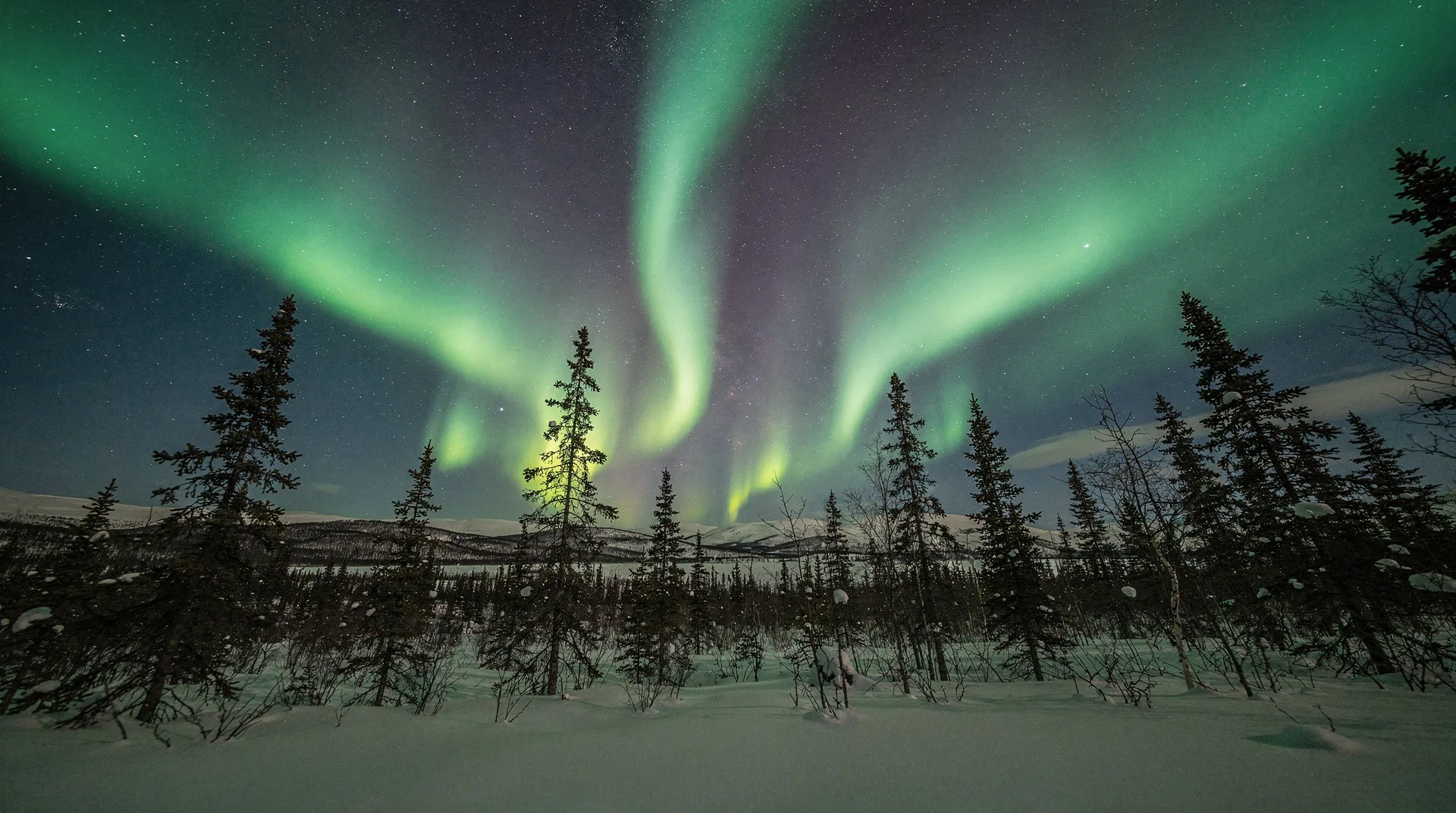
Best Time to See the Aurora in Northern Canada
What is the best time to see the aurora in northern Canada?
The peak aurora months in northern Canada are February and March for the combination of longest dark periods, high clear-sky frequency, and the statistical enhancement of geomagnetic activity near the spring equinox. Yellowknife in February–March is the highest-probability destination. The aurora season runs from late August through April across most northern Canadian destinations.
The aurora borealis is visible in northern Canada from late August through April — roughly eight months of the year across most destinations. Within this window, the probability of seeing a strong display on any given night varies with three factors: sky clarity (whether it’s cloudy), geomagnetic activity (whether solar wind is producing aurora), and darkness (whether the night is long enough for the aurora to be clearly visible against a dark sky).
Planning your northern Canada trip for maximum aurora probability means understanding how these three factors combine across the months and across the different destinations. This guide covers each major northern Canada aurora destination, comparing conditions month by month and providing practical guidance for trip planning.
At a glance
| Where | Yellowknife (NWT), Whitehorse (Yukon), Inuvik/Tuktoyaktuk (NWT), Iqaluit/Pond Inlet (Nunavut) |
| Best months | February–March (peak); late August–April is the full season |
| Cost | Guided aurora evenings typically run around CAD 100–160 per person; multi-night aurora packages often start around CAD 1,000–1,500 |
| Time needed | 4–5 nights minimum to have a realistic chance of at least one strong display |
| Getting there | Daily flights to Yellowknife from Edmonton/Calgary, to Whitehorse from Vancouver; Inuvik and Nunavut communities connect via smaller regional flights |
| What to expect | Deep cold in midwinter (-25°C to -40°C) — proper gear is not optional |
How aurora probability works
Geomagnetic activity: the solar factor
Aurora is produced by interactions between charged particles from the sun and Earth’s magnetic field. This activity follows the approximately 11-year solar cycle, with aurora intensity peaking near solar maximum. We are currently in Solar Cycle 25, which reached maximum around 2025 — meaning the 2024–2026 period is among the best aurora years in a decade.
Within any given year, geomagnetic activity is statistically elevated near the equinoxes (March 20 and September 22). The Russell-McPherron effect — a consequence of the orientation of Earth’s magnetosphere relative to the solar wind during equinox periods — produces more frequent and stronger geomagnetic disturbances in March and September than in other months. This is the main reason February–March is consistently cited as the prime aurora window: long dark nights combined with equinox-enhanced geomagnetic activity.
Sky clarity: the cloud factor
Cloud cover is the most common reason aurora is missed on any given night. Geomagnetic activity can be producing excellent aurora, but if the sky is cloudy, you see nothing. This makes sky clarity statistics one of the most important criteria for choosing an aurora destination.
Yellowknife (NWT): 240+ clear nights per year — by far the clearest sky of any major Canadian aurora destination. The continental position on the Canadian Shield and the dominance of Arctic high-pressure systems in winter produce exceptional sky clarity.
Whitehorse (Yukon): 150–180 clear nights per year — good but less consistent than Yellowknife. The Pacific weather systems that reach the Yukon occasionally produce multi-day cloud cover.
Inuvik (NWT): Variable — the Mackenzie Delta location produces periodic cloud but also extended clear periods. Slightly cloudier than Yellowknife on average but dramatically better than maritime aurora destinations.
Nunavut communities: Highly variable by location. Iqaluit has significant cloud influence from Hudson Strait weather; northern Baffin Island communities can be very clear. Generally less consistent than Yellowknife.
Darkness: the night length factor
Aurora requires darkness to be visible — which means your latitude and the time of year determine when aurora viewing becomes feasible. In June, there is no darkness in Yellowknife (midnight sun). By late August, nights are dark enough. The darkest period is December–January; by late March, dawn arrives early enough that viewing windows shorten.
Month-by-month guide: northern Canada aurora
August: the beginning of aurora season
Sky conditions: Good — summer weather is stable across most northern destinations.
Geomagnetic activity: Moderate — the autumn equinox approach begins to enhance activity in late August.
Darkness: Limited in August but improving rapidly. By late August, Yellowknife has 5–6 hours of genuine darkness. Northern Baffin communities see earlier darkness.
Best destinations: Yellowknife for the combination of beginning aurora season plus late-summer warmth and activities. Churchill (Manitoba) for polar bears plus early aurora.
Experience: August aurora in Yellowknife has a specific quality — the nights are not cold (-5 to +15°C), summer activities are still running, and the first aurora of the season, seen against a sky still transitioning from midnight twilight, has a different character from mid-winter displays.
Probability rating: 3/5 — Good, but limited viewing windows and lower overall activity than winter.
September: the equinox month
Sky conditions: Good to variable. September weather across northern Canada is transitional — more frontal systems than summer, but still significant clear periods.
Geomagnetic activity: High — the autumn equinox (September 22) is the first statistical peak of the aurora year. September frequently produces strong displays.
Darkness: Excellent — nights are now properly dark across all northern Canada destinations. Viewing windows of 10+ hours are common.
Best destinations: Yellowknife for the clear-sky advantage combined with equinox activity. Whitehorse for aurora plus autumn tundra colour.
Probability rating: 4/5 — Excellent geomagnetic activity probability with good darkness, balanced against transitional weather.
October: deepening aurora season
Sky conditions: Variable — October is a transitional month across northern Canada. Arctic high-pressure systems begin dominating in Yellowknife, improving sky clarity; coastal influences still affect Whitehorse and Nunavut communities.
Geomagnetic activity: Moderate — activity has decreased from the September equinox peak but remains elevated.
Darkness: Excellent — nights are now 12–14 hours at Yellowknife’s latitude.
Best destinations: Yellowknife, where the clear-sky advantage becomes most apparent as winter weather patterns establish.
Probability rating: 3.5/5 — Good conditions in Yellowknife; more uncertain elsewhere.
November–December: deep winter begins
Sky conditions: Yellowknife enters its most reliably clear period — the Arctic high-pressure dominance produces long runs of clear winter nights. Whitehorse is less consistent.
Geomagnetic activity: Moderate — not an equinox month, but longer nights mean more total viewing time for any given level of activity.
Darkness: Extraordinary — Yellowknife has 17+ hours of darkness in December. The sun rises around 9:30 AM and sets around 3:15 PM.
Best destinations: Yellowknife is the undisputed leader in this period. The combination of clear skies and long dark nights provides the highest total viewing opportunity of the year.
Challenges: December is cold (-25 to -35°C average) and Christmas period flights to Yellowknife are expensive. Pre-Christmas (early to mid-December) is an underrated time for clear skies and less crowding.
Probability rating: 4/5 for Yellowknife. 3/5 for Whitehorse.
January: peak season
Sky conditions: The clearest month in Yellowknife. Arctic high pressure dominates; multi-day clear-sky stretches are common. Very cold (-30 to -40°C) but extraordinarily clear.
Geomagnetic activity: Moderate — not an equinox month, but consistent.
Darkness: Maximum — nights of 17+ hours in Yellowknife; similar across NWT and northern Yukon.
Best destinations: Yellowknife absolutely. Tour operators are at maximum capacity; book well in advance. Whitehorse also very good.
Probability rating: 4.5/5 — The highest probability per night of the year in Yellowknife, driven by sky clarity.
Browse Canada northern lights tours and aurora viewing experiencesFebruary: the sweet spot
Sky conditions: Excellent — comparable to January with slightly improving temperatures.
Geomagnetic activity: Beginning to increase as the spring equinox approaches. February aurora can be spectacular.
Darkness: Still substantial — nights of 14–16 hours in Yellowknife, with manageable daylight for other activities.
Temperature: Average -25°C in Yellowknife (slightly warmer than January). Still cold enough to require full winter gear.
Best destinations: Yellowknife and Whitehorse are both excellent. The Yukon Quest sled dog race in February adds a major cultural event to a Whitehorse visit.
Probability rating: 5/5 — The highest overall probability month combining sky clarity, geomagnetic activity, and practical visiting conditions.
March: the equinox peak
Sky conditions: Good and improving. Late March sees the first signs of spring weather, but arctic air still dominates.
Geomagnetic activity: Peaks near the spring equinox (March 20). March statistically produces the highest geomagnetic activity of the year. Strong aurora displays in March are more frequent than any other month.
Darkness: Decreasing but still substantial — 12–14 hours in Yellowknife in early March, dropping to 10–11 hours by late March.
Temperature: Improving — average highs in Yellowknife rise from -17°C in early March to -10°C by late March. The coldest deep-winter conditions are past.
Best destinations: Both Yellowknife and Whitehorse are excellent. Whitehorse’s March conditions are comfortable enough for day hiking and outdoor activity alongside aurora viewing. Inuvik in March has extraordinary aurora conditions with the Mackenzie Delta landscape.
Probability rating: 5/5 — The best month for strong aurora displays. The combination of equinox geomagnetic enhancement, still-long nights, and improving temperatures makes March the prime month for serious aurora photographers.
April: late season
Sky conditions: Variable — spring weather begins breaking down the Arctic high-pressure dominance. More mixed sky conditions than February–March.
Geomagnetic activity: Declining from the March equinox peak but still elevated.
Darkness: Shortened nights, particularly in the second half of April. By late April in Yellowknife, useful viewing windows are down to 8–9 hours.
Best destinations: Yellowknife still leads. April is a good choice for visitors who find January and February temperatures intimidating.
Probability rating: 3.5/5 — Good conditions but declining from the March peak.
Aurora probability by month, at a glance
| Month | Darkness | Sky clarity (Yellowknife) | Geomagnetic activity | Probability rating |
|---|---|---|---|---|
| August | Limited (5–6 hrs) | Good | Moderate | 3/5 |
| September | Excellent | Good to variable | High (equinox) | 4/5 |
| October | Excellent | Variable | Moderate | 3.5/5 |
| Nov–Dec | Extraordinary | Improving to excellent | Moderate | 4/5 |
| January | Maximum | Clearest of the year | Moderate | 4.5/5 |
| February | Very long | Excellent | Increasing | 5/5 |
| March | Long | Good, improving | High (equinox) | 5/5 |
| April | Shortening | Variable | Declining | 3.5/5 |
Planning your trip: nights, budget and what else to do
Aurora trips are a numbers game — no single night can be guaranteed, so the itinerary matters more than any individual forecast. A dedicated Yellowknife aurora itinerary built around 4–5 nights gives you several independent chances at clear, active skies rather than betting everything on one evening.
Because northern Canada’s distances are enormous, most visitors pair aurora viewing with one other regional draw rather than trying to cover the whole North in a single trip. Options worth building a trip around:
- Wildlife: Combine a Churchill visit with aurora and polar bears — see the Churchill aurora guide and general Canada wildlife safety advice before any tundra or backcountry walk.
- The Dempster Highway: A drive north from Whitehorse toward Dawson City and beyond on the Dempster Highway adds dramatic, light-pollution-free terrain to an aurora trip, though winter driving here requires real preparation.
- Tuktoyaktuk: For visitors already in Inuvik, an extension to Tuktoyaktuk on the Arctic coast is one of the most remote, darkest-sky add-ons available in Canada.
- Season stacking: If February–March cold is a deterrent, Canada in February covers what to expect and how to dress for the coldest reliable aurora window.
Comparing the major destinations
| Destination | Clear nights/yr | Latitude | Best months | Accessibility |
|---|---|---|---|---|
| Yellowknife, NWT | 240+ | 62.5°N | Feb–March | Daily flights from Edmonton, Calgary |
| Whitehorse, Yukon | 150–180 | 60.7°N | Jan–March | Daily flights from Vancouver |
| Inuvik, NWT | 180–200 | 68.3°N | Jan–March | Flights from Yellowknife, Edmonton |
| Tuk (NWT) | Very dark | 69.4°N | Jan–March | Drive from Inuvik; charter flights |
| Iqaluit (Nunavut) | Variable | 63.7°N | Sept–March | Flights from Ottawa |
| Pond Inlet (Nunavut) | Good | 72.7°N | Sept–March | Flights from Iqaluit |
Specific aurora destination guides
For detailed planning information for each destination:
- Yellowknife: Yellowknife aurora guide — the complete guide to Yellowknife’s aurora including tour operators, dark-sky sites, and photography.
- Whitehorse: Whitehorse aurora viewing guide — Whitehorse-specific aurora planning including Takhini Hot Springs and dark-sky locations.
- Inuvik: Inuvik guide — the Mackenzie Delta city’s aurora season and winter activities.
- Photography: Aurora photography guide — camera settings, gear, and technique for aurora photography.
Frequently asked questions about Best Time to See the Aurora in Northern Canada
Is Yellowknife or Whitehorse better for aurora? Yellowknife has the statistical advantage in sky clarity — 240+ clear nights per year versus 150–180 in Whitehorse. Both are under the auroral oval; aurora intensity on clear nights is comparable. For maximum probability, choose Yellowknife. For better surrounding activities (Kluane country, Dawson City, the Dempster Highway), Whitehorse provides a broader trip.
Can I see the aurora in September? Yes — September is an underrated aurora month. The autumn equinox produces statistically elevated geomagnetic activity, nights are properly dark, and temperatures are much more manageable than mid-winter. The tradeoff is more variable sky conditions than deep winter.
What is the single best night for aurora viewing in northern Canada? There is no single best night — aurora forecasting cannot reliably predict more than 1–3 days ahead, and even the best forecast carries significant uncertainty. The strategy is to maximise the number of dark, clear nights in your trip by choosing the right destination (Yellowknife for clear skies), the right month (February–March for the best combination), and staying long enough (4–5 nights minimum) to encounter at least one good display.
Does solar cycle phase matter? Yes, significantly. Solar maximum years (we are near solar maximum in 2025–2026) produce more frequent and stronger geomagnetic disturbances, which translates directly to more aurora and stronger displays. Visiting during a solar maximum period like the current one is meaningfully better than visiting during solar minimum years.
How many nights should I book for a realistic chance of seeing the aurora? Most experienced operators recommend 4–5 nights minimum. Because both cloud cover and geomagnetic activity vary night to night and can’t be forecast reliably more than a few days out, a single-night stop has a real chance of missing a display entirely, while 4–5 nights in a high clear-sky destination like Yellowknife gives the odds time to work in your favour.
Is it worth combining aurora viewing with Churchill’s polar bears? Yes, if your travel dates align — Churchill’s aurora season overlaps with polar bear season (October–November) and, later, with polar bear denning in Wapusk National Park (late February–March). See the Churchill aurora guide for the specifics of that combination; it’s a genuinely unique pairing not available at Yellowknife or Whitehorse.