Quick facts
- Population
- 1,500
- Best time
- June–August (midnight sun) / September (aurora)
- Languages
- English
- Days needed
- 2-3 days
In 1898, Dawson City was the largest city west of Winnipeg and north of Seattle. At the height of the Klondike Gold Rush, over 30,000 people crowded into this confluence of the Yukon and Klondike Rivers, living in tents and hastily built boardwalk towns, searching for gold in the gravel creeks of the surrounding hills. The bonanza lasted barely five years before the rush moved on, but it left behind a town of remarkable heritage buildings, a permanent sense of frontier drama, and a story that remains one of the most extraordinary episodes in Canadian history.
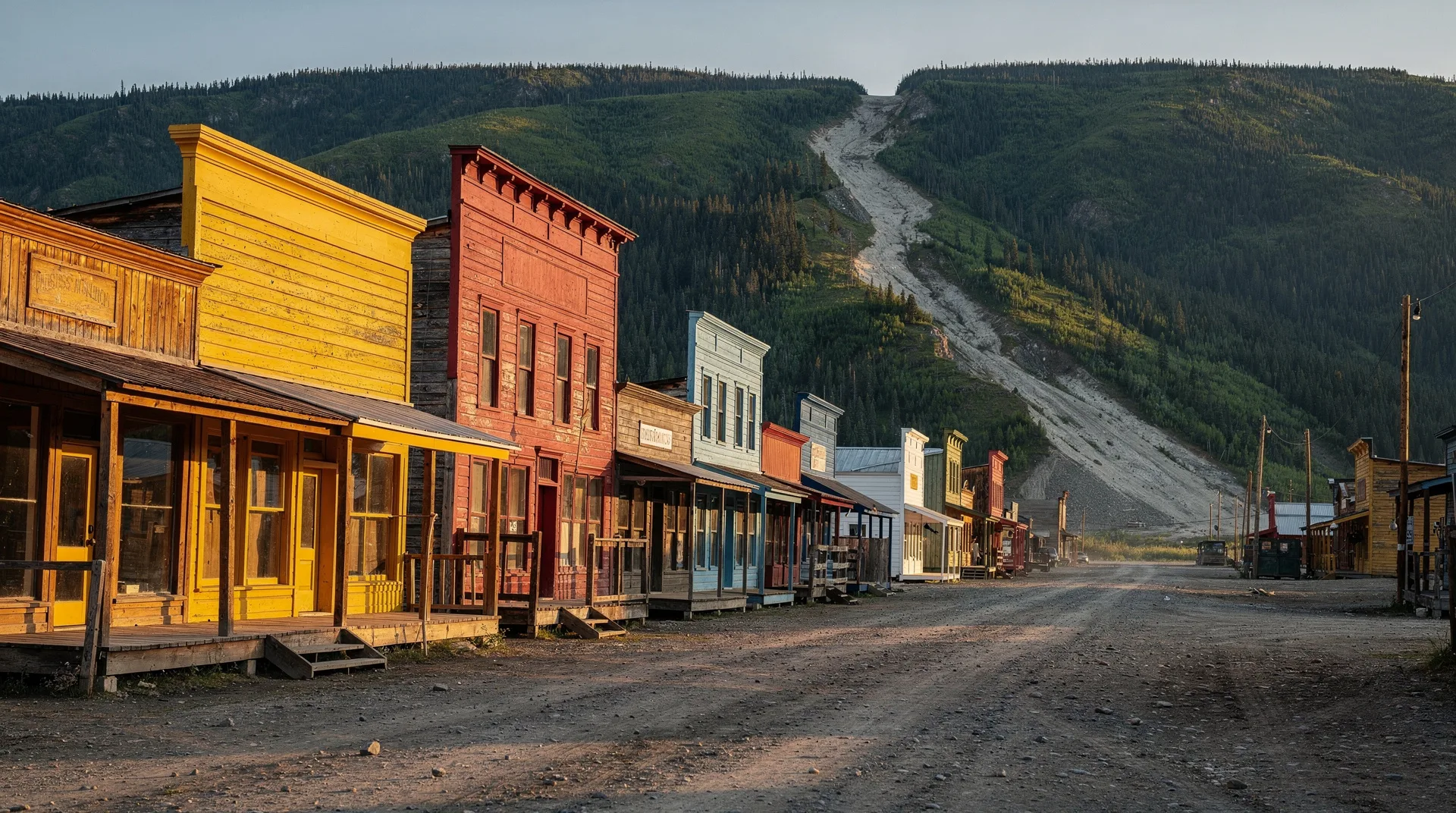
Today Dawson City has a population of around 1,500. The streets are still unpaved dirt and gravel. The wooden boardwalks creak in the same places they did a century ago. Parks Canada has preserved and restored dozens of heritage buildings. And in summer, under the midnight sun, the town has a strange vitality — a mix of gold rush nostalgia, First Nations Tr’ondëk Hwëch’in culture, artists and writers drawn north by the creative community, and travellers who have made the pilgrimage up the 520-kilometre highway from Whitehorse.
Why Dawson City is unlike anywhere else in Canada
Most Canadian heritage towns have been polished into tourist prettiness. Dawson City has not. The unpaved streets turn to mud in spring and dust in summer. Buildings lean at slight angles on their permafrost foundations. The old hotels still serve drinks to locals and travellers at the same bar. The gold rush is not a theme here — it is a residue, still tangible in the landscape where dredge tailings pile in serpentine mounds across the valley floor, in the old mining claims still active in the surrounding creeks, and in the Klondike River that continues to carry its cargo of fine gold dust to the Yukon River.
The Tr’ondëk Hwëch’in First Nation, whose traditional territory encompasses the Klondike region, has maintained cultural continuity through the gold rush disruption and subsequent decades of change. Their cultural centre, Dänojà Zho, is one of the finest First Nations interpretive centres in northern Canada and an essential part of understanding Dawson City in full context.
Top things to do in Dawson City
Diamond Tooth Gertie’s
Diamond Tooth Gertie’s is North America’s oldest legally operating casino, established in Dawson City in 1971 in a building that preserves the spirit (and some of the original materials) of the gold rush dance halls. Three cancan shows per evening run throughout the summer season, with costumed performers, period music, and the kind of theatrical exuberance that suits the midnight-sun atmosphere.
The gambling is real — slots, poker, blackjack — but for most visitors the draw is the atmosphere: elaborate Victorian decor, a long bar, and the genuine sense of being in a place that exists nowhere else quite like this.
Midnight Dome
The Midnight Dome is the hill directly north of Dawson City that the town’s early residents climbed on the summer solstice to watch the sun circle the horizon without setting. At just under 900 metres, it is accessible by a steep 8-kilometre road from the town, and the panoramic view from the top is the defining visual of the Yukon: the Yukon River sweeping in a great bend through the valley below, the Klondike River joining it at the town, the forested mountains extending to every horizon, and Dawson City itself reduced to a cluster of colourful rooftops on the gravel bar.
Go at midnight in June and you will watch the sun hover above the northern horizon in a sky that never darkens. Go at sunset in September and the valley below will glow amber in the low light while the first aurora traces appear overhead.
Dänojà Zho Cultural Centre
The Tr’ondëk Hwëch’in’s cultural centre on the Yukon River waterfront is among the most thoughtfully designed First Nations cultural facilities in Canada. Exhibits trace the Tr’ondëk Hwëch’in’s history on this land from time immemorial through the gold rush disruption and the complex history of self-government recovery in the 20th century.
The centre provides the essential Indigenous context for the Klondike: before the stampeders arrived, the Han people had fished the Klondike River for thousands of years. The gold rush drove them from their village of Tr’ochëk — at the confluence of the rivers where Dawson City was built — to a reserve at Moosehide, 5 kilometres downriver. Visits to Moosehide Village are offered periodically through Dänojà Zho.
Gold panning on Bonanza Creek
Bonanza Creek, 13 kilometres from Dawson City via Bonanza Creek Road, is where it all began. On August 17, 1896, George Carmack, Skookum Jim Mason, and Dawson Charlie found gold in the creek gravels — a discovery that triggered the Klondike stampede within months.
Parks Canada operates the Bonanza Creek Discovery Claim, where visitors can pan for real gold in the historic ground. Actual traces of gold are common; meaningful quantities require more industrial methods, as the large operators have long since processed the most productive ground. But the experience of panning at the exact discovery site, with the creek rushing past and the wooded valley walls rising on both sides, is something that transcends the modest yield.
Several active small mining operations along Bonanza Creek welcome visitors to watch modern placer mining in operation — the contrast between a gold pan in your hand and the enormous equipment moving tonnes of gravel per hour is instructive.
Klondike goldfields driving tour
The road from Dawson City up Bonanza Creek and onto the Hunker Summit connects several of the most historic and visually remarkable mining areas. Dredge No. 4, Parks Canada’s preserved gold dredge — the largest of its type in North America — sits in its final position on Bonanza Creek, still surrounded by the gravel tailings it deposited over decades of operation from 1913 to 1959. The machine is massive and eerie: five storeys of rusting steel in a quiet creek valley, with a ladder of bucket scoops still hanging in place.
The tailings piles themselves — those serpentine ridges of rounded river gravel — stretch for kilometres in every direction, a testament to the scale of industrial mining that followed the initial gold rush. From Hunker Summit, the view over the tailings-covered valley floor with the town beyond is one of the most distinctive landscapes in the Yukon.
The Dempster Highway
Dawson City is the southern terminus of the Dempster Highway, one of the great wilderness roads in the world. The Dempster runs 736 kilometres north from Dawson City to Inuvik in the Northwest Territories, crossing the Ogilvie Mountains, the Peel Plateau, and eventually the Mackenzie Delta before reaching the Arctic coast at Tuktoyaktuk (an additional 140 km of all-season road).
You do not need to drive the full highway to experience it. Even a morning’s drive north from Dawson City puts you into the Tombstone Territorial Park — a landscape of dramatic quartzite peaks and tundra plateaus that has been called “the Patagonia of the north.” The Tombstone Mountain viewpoint at Kilometre 72 provides an outlook over this extraordinary terrain that justifies the drive even on a half-day excursion.
For those with more time, driving the full Dempster is a serious undertaking requiring a prepared vehicle (two spare tyres, emergency supplies) but offers an unmatched wilderness driving experience in North America.
Robert Service’s cabin
Robert Service arrived in Dawson City in 1908 as a bank teller and departed a famous poet. His log cabin on Eighth Avenue is preserved as a national historic site and interpretive facility. Parks Canada staff perform dramatic readings of Service’s Klondike poems — “The Shooting of Dan McGrew,” “The Cremation of Sam McGee” — in a small outdoor amphitheatre beside the cabin.
Service’s verse is unfashionable in contemporary literary circles but captures the gold rush mythos with a vividness that no academic history can match. Standing in the same cabin where the poems were written, listening to them performed in the northern summer evening, is a particular experience.
Jack London’s cabin
Jack London spent the winter of 1897–98 in the Klondike and drew heavily on his experience in the Yukon wilderness for his most famous novels and stories, including “The Call of the Wild” and “White Fang.” A cabin believed to be his winter quarters has been relocated to Dawson City. The site includes an interpretive display on London’s time in the Yukon and the literary works it produced.
Dawson City’s arts and literary scene
It seems improbable for a town this remote and this small, but Dawson City has a genuine arts community. The Dawson City Music Festival in late July brings performers from across Canada for a three-day outdoor festival that draws visitors from as far as Whitehorse and Alaska. The Klondike Institute of Art and Culture runs the KIAC Arts Centre, supporting a rotation of residencies that bring artists north every summer.
The town’s unusual light — the flat, clear light of the subarctic under the midnight sun — attracts painters and photographers from across the country, and the community of creative residents who have chosen to live here year-round gives Dawson City a cultural density that belies its size.
When to visit Dawson City
June to August: The prime season. The midnight sun, warm temperatures (average highs 20–24°C in July), and full operation of all attractions. This is when Dawson City is fully alive and when the gold rush heritage is most easily absorbed. Mosquitoes can be intense in June and early July — bring repellent and a head net.
September: A quieter and in some ways more atmospheric month. Autumn colours ignite across the boreal forest and tundra. The aurora becomes visible again. Temperatures drop (average highs 10°C by mid-September) and the crowds are minimal. Many travellers who have been in summer find September Dawson City more evocative.
Winter is quiet but not without appeal for the committed northern traveller. The aurora is extraordinary in the subarctic darkness. Temperatures routinely reach -40°C — this is genuinely extreme cold that requires serious preparation. Dog mushing and snowshoeing are possible. Most tourist facilities are closed.
Where to stay in Dawson City
Klondike Kate’s Cabins and Hotel: The most Dawson City option — a collection of cabins and rooms with full gold rush atmosphere and excellent home-style food in the attached restaurant. Very popular in summer; book several months ahead.
Westminster Hotel: One of the authentic heritage buildings still operating as a hotel, with the bar downstairs that has been serving Dawson City for over a century. Atmospheric, basic, and unreservedly genuine.
Aurora Inn: A newer property offering comfortable motel-style rooms with modern amenities — the practical choice for those who want reliability in addition to atmosphere.
Getting to Dawson City
By road from Whitehorse: The Klondike Highway (Highway 2) runs 520 kilometres north from Whitehorse to Dawson City. The drive takes approximately 5–6 hours and passes through some exceptional scenery, including the Five Finger Rapids viewpoint where the Yukon River is divided by quartzite columns.
By air: Air North operates scheduled service between Whitehorse and Dawson City (approximately 1 hour). Seasonal service from Whitehorse or Fairbanks may also be available through regional carriers.
By the Yukon River: A number of paddlers complete multi-week canoe journeys from Whitehorse to Dawson City along the Yukon River — the same route the stampeders used in 1898. This requires full backcountry competence and planning but is among the great canoe journeys in North America.
Day trips from Dawson City
Tombstone Territorial Park: Drive the Dempster Highway north to the park for tundra hiking, extraordinary mountain scenery, and wildlife (grizzly bears, Dall sheep, caribou). The Interpretive Centre at Kilometre 5 on the Dempster provides orientation.
Top of the World Highway: The unpaved Top of the World Highway runs west from Dawson City across the Yukon plateau to the Alaska border, following ridge crests and hilltops the entire way. The views are panoramic. The road continues to Chicken, Alaska — a round trip makes for a full day. The Dawson City–Tok ferry across the Yukon River is the starting point.
Frequently asked questions about Dawson City
Is Dawson City connected by paved road? Most of the Klondike Highway between Whitehorse and Dawson City is paved, with short unpaved sections. Dawson City’s streets are unpaved dirt and gravel. The Dempster Highway north of Dawson City is entirely unpaved.
Can I pan for gold and keep what I find? At the Parks Canada Discovery Claim site on Bonanza Creek, visitors pan for gold and keep whatever they find. In practice, panning in the historic gravel typically yields small flakes or fine “flour gold” — not nuggets, but real. More productive ground requires purchasing a temporary prospecting licence.
Is there cell service in Dawson City? Limited cell service is available in town. Beyond Dawson City on the Dempster Highway or other remote roads, there is effectively no cell coverage. Satellite communication devices are recommended for backcountry travel.
When do the tourist facilities close? Most Dawson City attractions, restaurants, and accommodations operate from late May through late September. Winter operations are minimal. Diamond Tooth Gertie’s, Robert Service’s cabin, and most guided tours operate on summer schedules only.