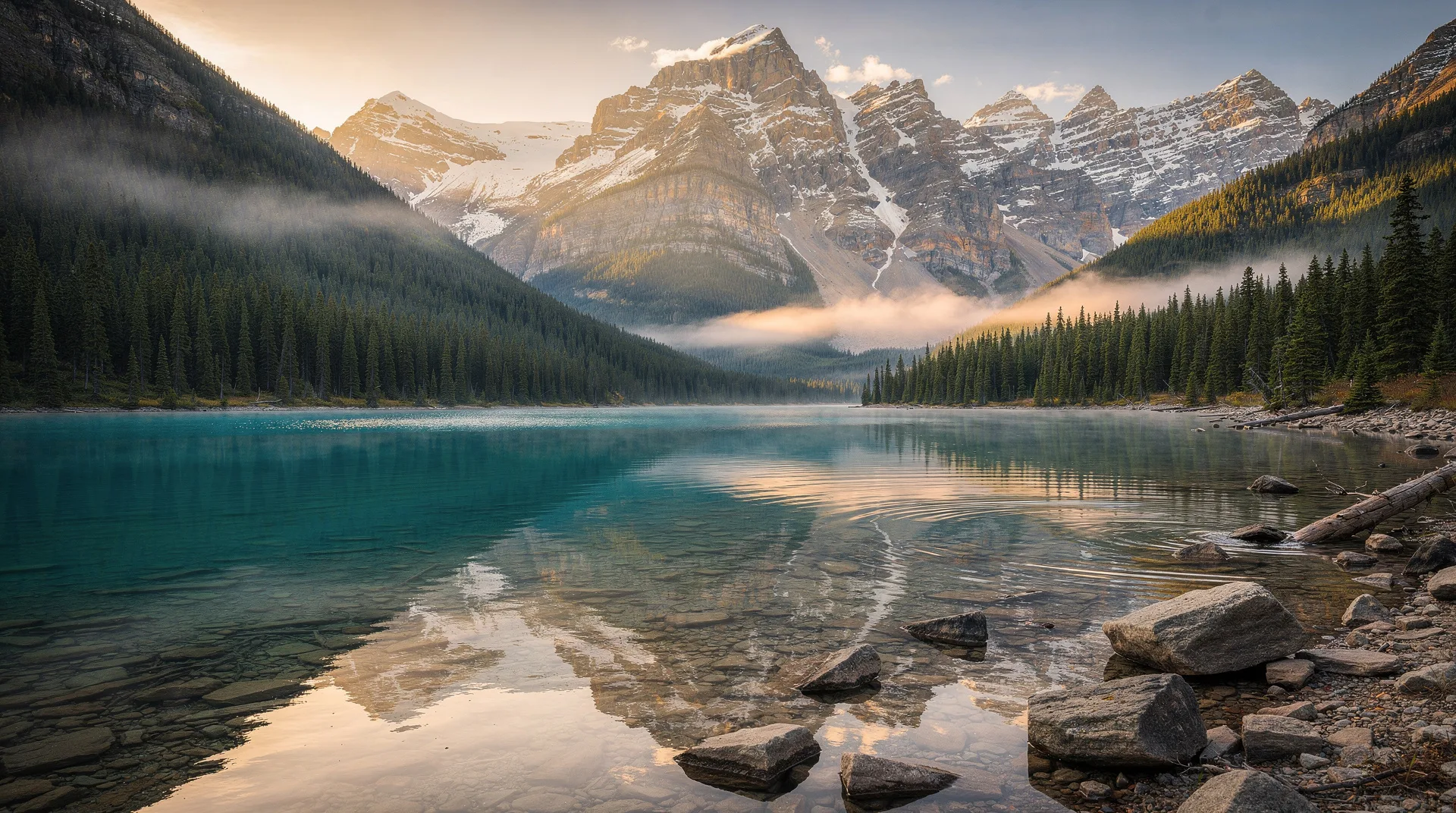
Quick facts
- Located in
- Banff National Park
- Best time
- June to October for most day trips
- Getting there
- 130 km east of Calgary Airport
- Days needed
- 4-6 days in Banff, plus day trips
Banff’s position at the geographic heart of the Canadian Rockies makes it an ideal base for day trips in multiple directions. To the north, the Icefields Parkway leads through 230 kilometres of mountain wilderness to Jasper. To the west, Yoho National Park contains some of the most extraordinary scenery in BC. To the east, Canmore offers a refreshingly local mountain-town experience. Even the Columbia Icefield — one of the great natural spectacles in North America — is reachable in a long day from Banff town.
This guide covers the best day trips from Banff in practical terms: what to see, how long to allow, and what to know before you go.
| At a glance | |
|---|---|
| Where | Banff townsite, radiating to Jasper, Yoho, Canmore, Kootenay and Calgary |
| Cost | Parks Canada Discovery Pass required for any park-based day trip (around CAD $12.25/adult/day); Columbia Icefield Skywalk and Ice Explorer are separately ticketed |
| Time needed | Half a day (Canmore) to a full 8-9 hour day (Jasper via the full Parkway) |
| Getting there | A car is the practical baseline; a few routes work by guided tour or seasonal shuttle |
| Best time | June to September, when the Icefields Parkway, Yoho roads, and hiking trails are fully open |
Choosing a day trip: what actually fits in a day
Not every option above suits every visitor, and trying to combine two in one day usually backfires. A useful way to think about it: the Columbia Icefield out-and-back is the single best full-day trip for most first-time visitors, because it packs Bow Lake, Peyto Lake and the icefield itself into one manageable loop that starts and ends in Banff. Yoho rewards a slower pace and works best as a dedicated day rather than a rushed add-on. Canmore and Kootenay are the two genuine half-day options — pair either with a relaxed morning in Banff town itself, or with a Banff National Park overview visit if it’s your first time in the area.
| Day trip | Round-trip time from Banff | Best for | Car needed? |
|---|---|---|---|
| Columbia Icefield (Bow/Peyto Lake) | Full day (8-10 hrs incl. stops) | First-timers, classic Rockies scenery | Yes, or guided tour |
| Jasper (full Parkway) | Full day one-way, 8-9 hrs driving, or overnight | Photographers, serious drivers | Yes, or Brewster shuttle |
| Yoho National Park | Full day, or half day for the highlights | Waterfalls, fewer crowds | Yes |
| Canmore | Half day, 4-6 hrs | Food, an easy hike, a break from park crowds | Yes, or ROAM Route 2 |
| Kootenay National Park | Half day, 5-7 hrs | Hot springs, canyon scenery, a change of ecosystem | Yes |
| Calgary | Full day, ~3 hrs driving | Stampede (July), city break, Glenbow Museum | Yes, or shuttle |
Day trip 1: The Icefields Parkway (south section to the Columbia Icefield)
The Icefields Parkway (Highway 93 North) begins at the Trans-Canada junction at Lake Louise and runs 230 kilometres north to Jasper. Driving the full length in a day is possible but rushed. The southern section — from Lake Louise to the Columbia Icefield and back — is one of the finest half-day or full-day drives in North America and is the essential Banff day trip.
Bow Lake (40 kilometres north of Lake Louise): The first major stop on the Parkway, a large turquoise lake fed by the Bow Glacier. Pull off the highway and walk down to the lakeside — the views improve significantly from the shore. The Bow Glacier Falls trail (4.6 kilometres return) is worth adding if time allows.
Peyto Lake (44 kilometres north): The viewpoint above Peyto Lake is one of the finest mountain lake panoramas in Canada. A short uphill walk from the parking area leads to a platform overlooking the wolf-shaped lake in its spectacular glacial valley. The colour — an intense aquamarine blue-green — is the result of suspended glacial flour in the water.
Mistaya Canyon (72 kilometres north): A short 10-minute walk from the parking lot to a narrow limestone canyon carved by the Mistaya River — surprisingly dramatic for such an accessible detour.
Saskatchewan River Crossing (at the junction of Highway 11): A roadside stop with a cafeteria, fuel, and views of the three river valleys converging. Basic fuel and food here if needed.
Columbia Icefield (100 kilometres north of Lake Louise): North America’s largest non-polar ice mass. The Icefield Centre on the highway below the Athabasca Glacier provides orientation. The glacier can be walked to from the parking lot (a 1.5-kilometre trail across the glacial moraine) or explored by Ice Explorer snowcoach on the ice surface. The glacier has receded significantly since the 1970s and interpretive markers along the trail show the historical extent of the ice.
The Columbia Icefield Skywalk — a glass-floored cantilevered platform 280 metres above the Sunwapta Valley — is 5 kilometres south of the Icefield Centre and tickets can be combined with an Ice Explorer tour.
Allow a full day for the Lake Louise to Columbia Icefield return journey with meaningful stops. Depart Banff by 8am to reach Lake Louise and the start of the Parkway before 9am.
Book the Columbia Icefield and Icefields Parkway tour from BanffDay trip 2: Jasper via the full Icefields Parkway
For visitors with a full day and the stamina for one of the world’s great drives, continuing the Icefields Parkway all the way to Jasper town (230 kilometres from Lake Louise, approximately 3.5 hours of driving without stops) turns the drive into a one-way journey requiring either an overnight stay in Jasper or a shuttle or guided tour return.
Key additional stops beyond the Columbia Icefield:
Sunwapta Falls (55 kilometres south of Jasper): The Sunwapta River drops through a narrow canyon in a series of dramatic falls. Two viewpoints — upper and lower — are accessible via a short loop trail.
Athabasca Falls (32 kilometres south of Jasper): The Athabasca River channels through a narrow quartzite gorge and falls 23 metres — one of the most powerful waterfalls in the Rockies despite the modest height. The spray and volume are considerable. A system of walkways and platforms provides multiple viewing angles.
Allow a minimum of 8–9 hours for the full Banff to Jasper Parkway drive with meaningful stops.
Day trip 3: Yoho National Park
Yoho National Park, immediately west of Banff in British Columbia, is one of the most scenically spectacular parks in Canada and one of the most overlooked — its fame is overshadowed by its famous neighbours. The park’s total area is smaller than Banff, but the concentration of extraordinary features is remarkable.
Field is the small town within the park (population around 200), 80 kilometres west of Banff on the Trans-Canada. It takes about 55 minutes to drive from Banff town.
Takakkaw Falls: 15 kilometres north of Field on a scenic road (not suitable for long vehicles), Takakkaw Falls drops 373 metres from a hanging valley above the Yoho Valley — one of the highest waterfalls in Canada and visible from kilometres away. The road to the falls is not accessible in winter. The short walk from the parking lot to the falls base is spectacular.
Natural Bridge: A few kilometres from Field, the Kicking Horse River has carved directly through a limestone outcrop, forming a natural bridge over the river. Easy access from the roadside parking.
Emerald Lake: 10 kilometres north of Field on a separate road, Emerald Lake is a smaller and less well-known alternative to Lake Louise and Moraine Lake — with extraordinary turquoise-green water, a classic CPR-era lodge on the shore, and a 5.2-kilometre loop trail around the lake that reveals multiple perspectives. Canoe rentals available in summer.
Lake O’Hara: One of the most protected and celebrated alpine environments in the Rockies, accessible only by a Parks Canada reservation bus (no private vehicles on the access road) or an 11-kilometre walk from the highway. Day visitor spots are allocated by lottery months in advance. If you secure a reservation, it is the finest high-alpine landscape day accessible in the region.
Allow a full day for Yoho, or a half day if prioritising Takakkaw Falls and Natural Bridge only.
Day trip 4: Canmore
Canmore, 25 kilometres east of Banff on the Trans-Canada, has transformed over the past 20 years from a coal-mining town into a sophisticated mountain community with a character distinctly different from its national park neighbour. It sits just outside the national park boundary (so no Parks Canada pass required once you leave Banff) and has developed an excellent restaurant, cafe, and artisan scene.
The Three Sisters: The landmark triple peaks above Canmore define the town’s silhouette and are best viewed from the Policeman’s Creek boardwalk or the Stewart Creek area to the south.
The Canmore Nordic Centre: Built for the 1988 Calgary Olympics, the Nordic Centre has over 65 kilometres of trails used for cross-country skiing in winter and mountain biking in summer. The trail network is of a quality and extent that rivals purpose-built destinations.
Policeman’s Creek Boardwalk: A flat 1-kilometre walk along the creek through the town centre, with views of the Three Sisters and the Fairholme Range — the most accessible wildlife and scenery walk in Canmore.
Downtown Canmore: Main Street and 8th Avenue have developed a genuinely good selection of independent restaurants, bakeries, and shops — notably more local and less tourist-formula than Banff Avenue. The Saturday Farmers’ Market (June to October) is a destination in itself.
Grassi Lakes: A 3.7-kilometre return trail from the southern edge of Canmore to two small turquoise alpine lakes above the town — an easy and visually rewarding half-day hike with excellent views of Canmore below and the Bow Valley.
Allow 4–6 hours for Canmore as a half-day complement to a morning in Banff, or make it a full day with a hike.
Day trip 5: Kootenay National Park
Less than an hour’s drive south from Banff on Highway 93 South, Kootenay National Park in British Columbia offers hot springs, a striking red-ochre canyon, and a different ecosystem from the alpine focus of the other Rockies parks.
Radium Hot Springs: At the southern end of the Kootenay Valley, the Radium Hot Springs pools operate as a public hot springs facility with warm mineral water. They are less well-positioned than the Banff Upper Hot Springs (surrounded by canyon walls rather than open mountain views) but are a reasonable addition to a Kootenay day trip.
Marble Canyon: 17 kilometres from the Banff-Kootenay boundary, Marble Canyon is a narrow dolomite gorge carved by Tokumm Creek, accessible via a 1.6-kilometre loop trail bridging the canyon at multiple points. An excellent, quick, and impressive stop.
The Paint Pots: 3 kilometres south of Marble Canyon, the Paint Pots are ochre-coloured cold mineral springs that stain the surrounding earth in vivid red, orange, and yellow. The short trail from the parking lot is flat and rewarding.
Allow 5–7 hours for a Kootenay day trip including Radium Hot Springs, Marble Canyon, and the Paint Pots.
Day trip 6: Calgary
Calgary is 130 kilometres east of Banff — a 90-minute drive on the Trans-Canada — and makes an easy day trip for visitors curious about Western Canada’s most dynamic city. The city is most worth visiting in July during the Calgary Stampede (usually the first or second week of July), when the city’s cowboy heritage takes over the downtown with rodeo events, concerts, and fair food.
Outside of Stampede, Calgary’s downtown Stephen Avenue Walk, the National Music Centre (Studio Bell), and the revitalised East Village area along the Bow River make for a worthwhile urban day. The Glenbow Museum is one of Canada’s finest western history museums (check current status as it undergoes renovation).
The drive east through the foothills and onto the prairies is itself interesting — the Rockies receding in the rear-view mirror as the horizon opens is a memorable perspective on the landscape.
Browse Calgary tours and experiencesPlanning your day trips: practical notes
Car essential: Most day trips from Banff require a car. The Icefields Parkway is theoretically accessible by Brewster Express shuttle to Jasper, but many stops are only accessible with your own vehicle.
Start early: Summer days in the Rockies start beautiful and often develop afternoon cloud cover and afternoon thunderstorms above treeline. Departing by 7:30–8am for Icefields Parkway and Yoho day trips gives you the best light and beats the traffic.
Fuel: Fill up in Banff before driving the Parkway or heading to Yoho. Fuel stations are scarce and expensive on the Parkway.
Moraine Lake logistics: If including Moraine Lake in an Icefields Parkway day, the shuttle reservations (through Parks Canada) are separate from any Parkway activities and must be booked in advance.
Bear safety: Carry bear spray on any day trip that includes getting out of the car in the national parks. Trail conditions and wildlife closures are updated on the Parks Canada website.
Frequently asked questions about Best Day Trips from Banff Town
Can I do the Columbia Icefield and Yoho in the same day? Not comfortably. Both deserve a full day on their own, and the driving alone (Icefield return is around 200 km, Yoho return is around 160 km) makes combining them a rushed, exhausting day rather than an enjoyable one. Pick one.
Do I need a car for these day trips, or can I book a tour instead? A car gives you the most flexibility, but guided day tours cover the Columbia Icefield, Jasper, and Kootenay routes well if you’d rather not drive mountain roads — see the guide to getting around Banff without a car for the realistic car-free options and their limits.
Related pages
- Best things to do in Banff — activities within the park
- Jasper National Park — the full northern Rockies guide
- Getting around Banff without a car — for car-free visitors
- How to get to Banff from Calgary Airport — arrival logistics
- Canmore — the full guide to Banff’s eastern neighbour
- Yoho National Park — the full Yoho guide
- Kootenay National Park — hot springs and canyon detail
- Driving from Banff to Jasper — the full Parkway route guide