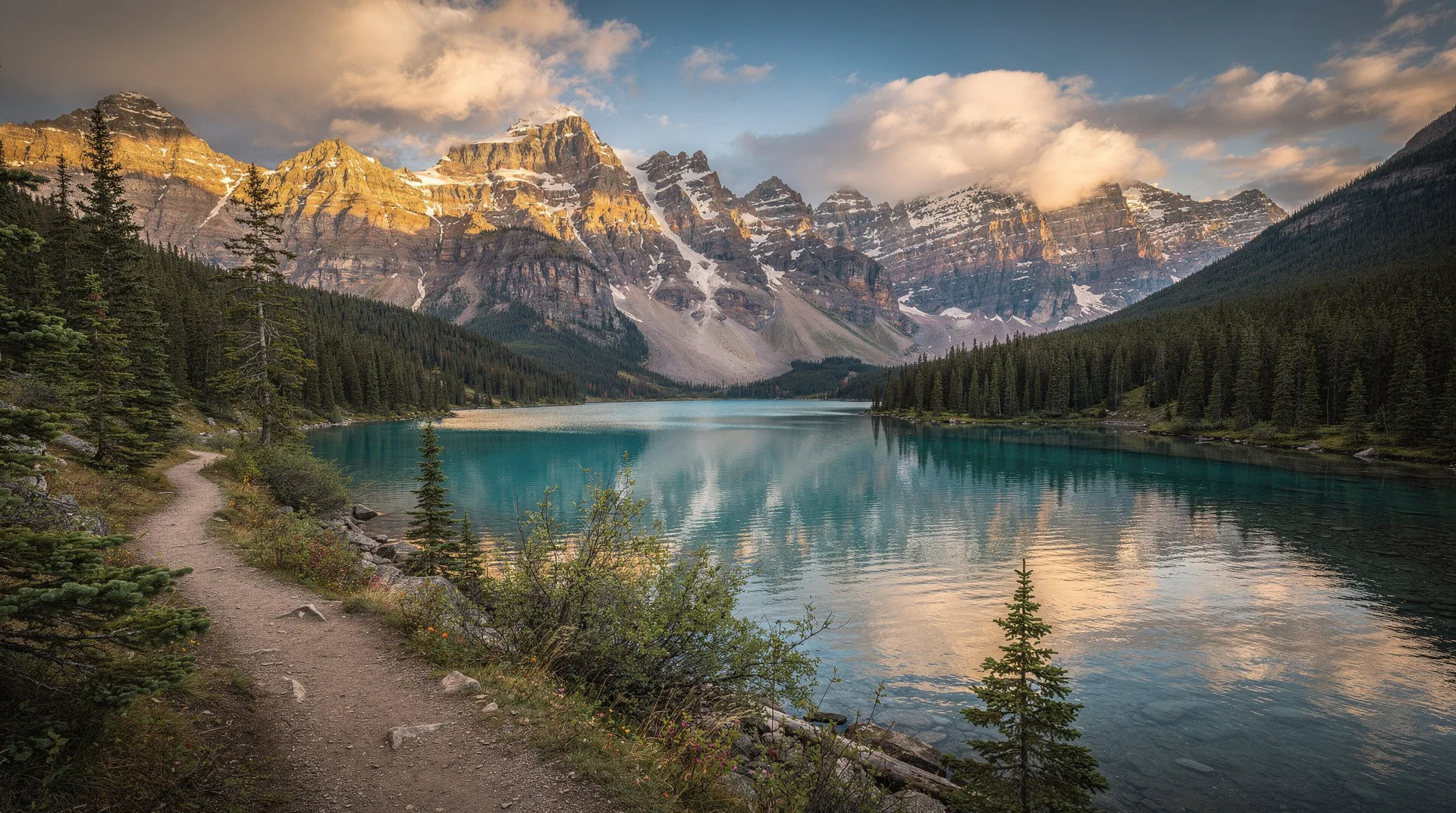
Quick facts
- Located in
- Banff National Park
- Best time
- Summer for full transit coverage; year-round in town
- Getting there
- 130 km east of Calgary Airport
- Days needed
- 4-6 days
One of the more encouraging developments in Banff National Park over recent years is the serious improvement in car-free transport options. A combination of ecological pressure (too many cars on park roads), infrastructure limits (Moraine Lake Road), and deliberate investment in public transit has made it genuinely possible to visit Banff town and reach many of the major sites without a personal vehicle.
The result is not perfect — some of the park’s most compelling destinations remain effectively inaccessible without a car or a guided tour — but for visitors who plan their transport as carefully as they plan their itinerary, a car-free Banff visit is now a realistic and rewarding option.
| At a glance | |
|---|---|
| Where | Banff townsite, with ROAM routes extending to Canmore and (summer) Lake Louise |
| Cost | Single ROAM fares around CAD $2-6; a day pass around CAD $10; Moraine Lake shuttles booked separately through Parks Canada |
| Time needed | Town itself is fully walkable in under 30 minutes end to end |
| Getting there | ROAM Route 1 covers the townsite; Route 2 reaches Canmore; summer Routes 6/8 reach Lake Louise |
| Best time | June to September for the fullest transit and shuttle schedule |
How the pieces fit together for a car-free trip
The practical approach for a car-free Banff visit is to treat ROAM Transit, the Parks Canada shuttle system, and guided tours as three separate layers rather than one system. ROAM handles the townsite and the Canmore/Lake Louise corridor. Parks Canada shuttles handle Moraine Lake specifically, and only during peak season. Guided tours fill every remaining gap — Johnston Canyon, the Icefields Parkway, and the Columbia Icefield — where no scheduled public transit exists at all. Visitors who plan around this three-layer structure, rather than expecting one bus network to cover everything, tend to have a much smoother car-free trip than those who discover the gaps on arrival.
For a longer stay, pairing this guide with the best day trips from Banff is useful — it flags which of those trips are realistic without a car and which genuinely require one.: the backbone of car-free Banff
ROAM Transit is Banff’s public bus service, operated by the Town of Banff and connecting the townsite, its immediate surroundings, and the town of Canmore 25 kilometres to the east. It is the most practical transport tool for visitors staying within Banff town.
Route 1: Banff town loop
The core local route circulates through the Banff townsite, connecting major stops including the Banff train station (Greyhound and shuttle drop-off point), the Banff Avenue commercial strip, the Banff Springs Hotel, the Banff Upper Hot Springs and gondola base station, and the Cave and Basin National Historic Site.
This route runs year-round, typically every 30 minutes, and covers the main pedestrian and visitor areas of town efficiently. For visitors staying at hotels on the south side of town near the Springs, it removes the need to drive into the town centre.
Route 2: Banff to Canmore
The inter-town route connects Banff to the Canmore transit terminal via the Trans-Canada Highway and the Legacy Trail corridor. It runs multiple times daily and is used both by commuters and by visitors based in Canmore who want to access Banff without driving. Journey time is approximately 30–40 minutes.
Route 3 and Route 4: Tunnel Mountain campgrounds and Cave and Basin
Routes serving the Tunnel Mountain campground area and the Cave and Basin National Historic Site west of town. Useful for campers who want to access town without moving their vehicle, and for visitors making a specific trip to the Cave and Basin.
Route 6 and 8: Banff to Lake Louise (summer only)
In summer, ROAM operates a service north to Lake Louise village on the Trans-Canada, with stops en route including the Massive transfer point. This is one of the most useful routes for car-free visitors — it connects Banff town to the Lake Louise area where the Moraine Lake shuttle system begins.
The summer Lake Louise route typically runs several times daily from late June to early September. Check current timetables on the ROAM Transit website before planning your trip.
Fares and day passes
ROAM fares are reasonable — single-ride fares in the range of CAD $2–$6 depending on route length, with a day pass offering unlimited travel on all routes for around CAD $10. Multi-day passes are also available. Children under 12 typically travel free with a paying adult.
Exact fare information changes seasonally; check the official ROAM Transit website for current pricing. Payment is by cash, credit card, or a transit card.
Moraine Lake: the mandatory shuttle system
Moraine Lake is the one major Banff site where the car-free question becomes most practically important, because private vehicles have effectively been banned from the access road during peak season. The Parks Canada shuttle system that replaced vehicle access is the only realistic way to reach the lake for most visitors.
The shuttle system operates from the Lake Louise Park and Ride (a large overflow parking lot on the Trans-Canada near the Lake Louise ski resort turnoff) during the peak season (approximately late May to mid-October). Shuttles depart regularly throughout the day, with most traffic heading to the lake in the morning and returning in the afternoon.
Booking: Moraine Lake shuttle reservations must be made in advance through the Parks Canada reservation system. Spots open in late March or early April for the upcoming summer season and fill within minutes to hours of release. If you cannot secure a reservation through Parks Canada, some private shuttle operators (Banff Airporter, for example) offer paid Moraine Lake-specific shuttle packages — these are more expensive but more reliably available. Check current options at the time of your visit.
Getting to the Lake Louise Park and Ride without a car: Take ROAM Route 6/8 from Banff to Lake Louise village, then transfer to the Parks Canada shuttle system. The logistics work but require planning — confirm connection times before committing to this approach.
Johnston Canyon: access without a car
Johnston Canyon (26 kilometres west of Banff on the Bow Valley Parkway) is one of the park’s most popular sites and one of the more difficult to reach without a car, as the Bow Valley Parkway is not served by ROAM Transit in its standard configuration.
Options for car-free access include:
- Guided tours: Many half-day and full-day guided tours from Banff include Johnston Canyon. This is the simplest option and removes the transport logistics entirely
- Cycling: The Bow Valley Parkway is a beautiful cycling road (note the night closure restrictions between March 1 and June 25). Cycling the 26 kilometres to Johnston Canyon from Banff is very achievable as a half-day round trip for a reasonably fit cyclist
Cycling in Banff
The Legacy Trail is a 26-kilometre paved multi-use path connecting Banff town to Canmore, running through the Bow Valley with mountain views and designated wildlife undercrossings where you may see deer or wolves passing beneath the trail. It is one of the finest paved cycling routes in the Canadian Rockies and accessible to all fitness levels — the elevation change is minimal.
Within Banff town, cycling is practical for reaching the Cave and Basin, the Fenlands trail loop along the Bow River, the Vermilion Lakes, and the Tunnel Mountain campground area. Distances in the townsite are short.
The Bow Valley Parkway (Highway 1A) between Banff and Lake Louise is a popular cycling route — 51 kilometres one-way, mostly flat to gently rolling, through excellent wildlife habitat. Note the night closure restrictions (8pm–8am, March 1 to June 25). The parkway has a good shoulder and lower traffic volume than the Trans-Canada.
Bike rentals are available from several operators in Banff town including Snowtips-Bactrax and Soul Ski & Bike. Standard hybrid bikes, e-bikes (which take the effort out of the valley cycling), and mountain bikes are available by the hour or day.
Mountain biking: The Banff trail network has limited designated mountain biking compared to the Canmore Nordic Centre (an exceptional trail network 25 km east). However, the Rundle Riverside trail and some of the lower terrain trails allow bikes. Check with the Parks Canada visitor centre for current permitted bike routes.
Walking within Banff town
The town of Banff is refreshingly walkable for a mountain destination. Banff Avenue, the main commercial street, is about 800 metres long. The walk from the central Banff Avenue area to:
- The Bow River and Bow Falls: 10–15 minutes
- The Cave and Basin: 20–25 minutes
- The Banff Springs Hotel: 20–25 minutes
- The Fairmont Banff Springs hot springs: 35 minutes (uphill)
- The Banff Gondola base: 25–30 minutes (uphill)
The Fenlands loop (2 kilometres, flat) along the Forty Mile Creek and Bow River is the most accessible urban-style walking trail, excellent for wildlife spotting and an easy morning or evening walk from town.
The Sundance Canyon trail (3.7 kilometres one-way from the Cave and Basin) follows the Bow River through the forest to the cave canyon above — car-free, beautiful, and rarely crowded early in the morning.
Guided tours as transport
For several of Banff’s most important destinations — Moraine Lake (if shuttle reservations are sold out), Johnston Canyon, the Icefields Parkway, the Columbia Icefield — guided tours that include transport from Banff town are the most practical car-free solution. If you are combining Banff with other regions, you can also browse guided tours across Canada to compare options.
Day tours from Banff town typically include:
- Lake Louise and Moraine Lake (with guaranteed access)
- The full Icefields Parkway to Jasper (one-way or return)
- Banff town highlights including the gondola and hot springs
Shuttles to and from Calgary and Jasper
Calgary Airport to Banff: Banff Airporter and Brewster Express run scheduled shuttles multiple times daily. See the full guide on getting to Banff from Calgary.
Banff to Jasper: Brewster Express operates a scheduled service along the Icefields Parkway between Banff and Jasper (one-way, approximately 5–6 hours with stops). This is a practical way to travel between the two parks without driving if you’re completing a one-way Rockies itinerary — fly into Calgary, travel to Banff, shuttle to Jasper, fly out of Edmonton.
Banff to Canmore: ROAM Route 2 covers this connection on a regular schedule. The Canmore regional bus connections can then continue toward Calgary.
Car-free Banff: a realistic assessment
Being honest about the limitations is important. Without a car, your Banff experience will centre on:
- The Banff townsite (entirely walkable and served by ROAM)
- The gondola and hot springs (reachable by ROAM Route 1 or a short walk)
- Lake Louise (by ROAM summer route + Moraine Lake shuttle, with advance reservations)
- Johnston Canyon (by guided tour or cycling)
- The Icefields Parkway (by guided tour or Brewster shuttle)
What a car-free visitor effectively loses easy access to:
- The Bow Valley Parkway’s full length (except by bike)
- Most backcountry trailheads beyond the above options
- Spontaneous wildlife-spotting drives
For visitors focused on the iconic highlights and comfortable with booking logistics in advance, a car-free Banff visit works well. For visitors wanting maximum flexibility to follow bears down the Bow Valley Parkway at 5am, a car remains the better tool.
Frequently asked questions about Getting Around Banff Without a Car
Is it realistic to visit Banff for a week without renting a car? Yes, if your priorities are the townsite, the gondola, hot springs, Lake Louise, and Moraine Lake (all reachable by ROAM plus the Parks Canada shuttle). It’s less realistic if the Icefields Parkway, the Bow Valley Parkway’s full length, or spontaneous wildlife drives matter to you — those need a car or a guided tour.
Does ROAM Transit reach Moraine Lake directly? No. ROAM’s summer route reaches Lake Louise village; from there you transfer to the separate Parks Canada shuttle, which is the only way to reach Moraine Lake since private vehicles were restricted from the access road.
Related pages
- How to get to Banff from Calgary Airport — transport to the park
- Best things to do in Banff — planning your days
- Best day trips from Banff — beyond the townsite
- Where to stay in Banff — accommodation guide
- Banff National Park — full park overview
- Moraine Lake shuttle guide — booking details
- Best tours in Banff — guided options that cover the car-free gaps