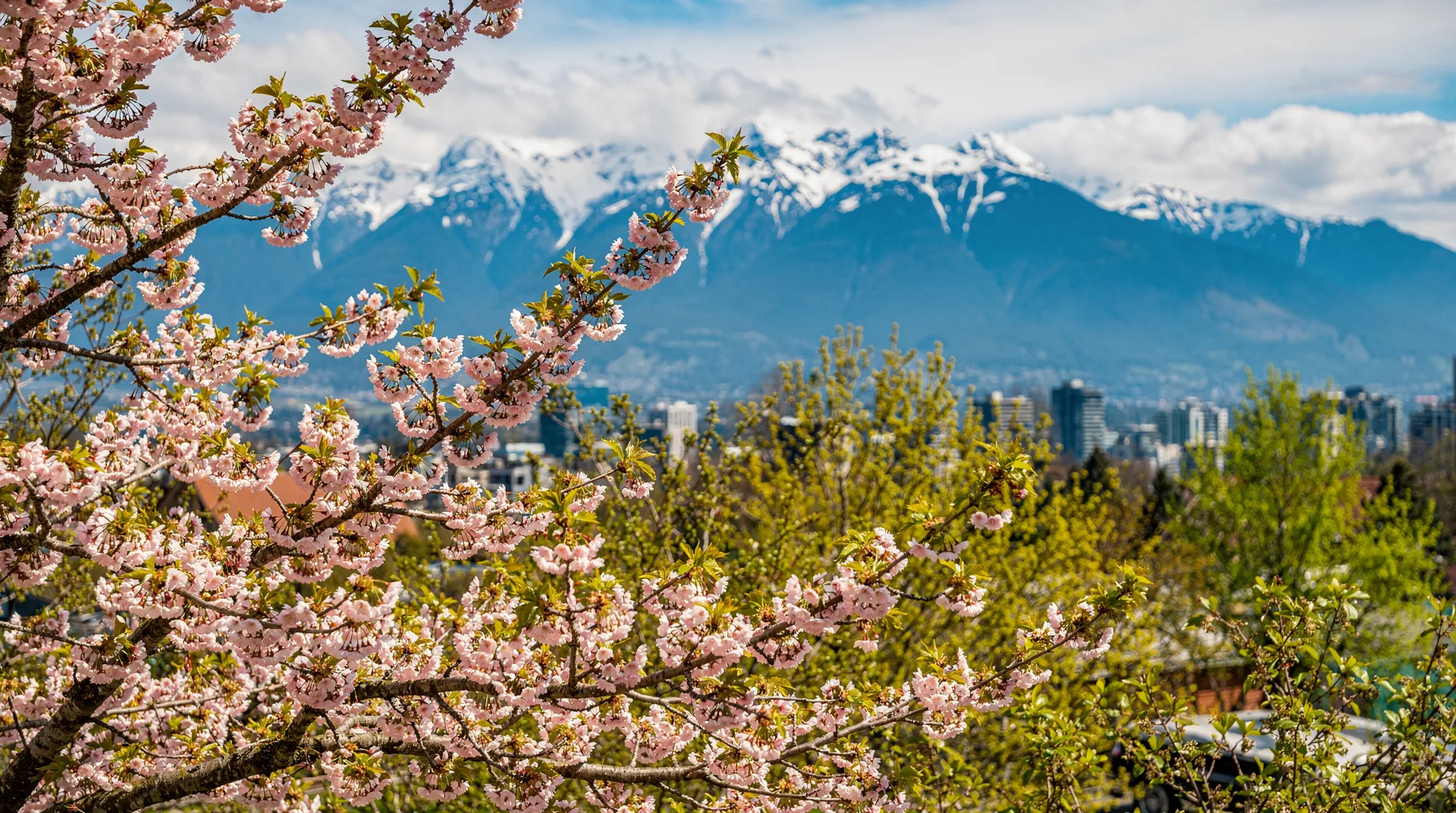
Spring in Canada: cherry blossoms to icefields
Spring comes to Canada unevenly, arriving in Vancouver while Montreal is still under snow, revealing the Icefields Parkway’s frozen waterfalls while PEI’s red soil is just beginning to show. This staggered, continent-crossing thaw is one of the most interesting things about spring travel in Canada — the country is large enough that you can follow the season north and east for weeks, always arriving somewhere at the precise moment when something extraordinary is just beginning.
The case for spring travel in Canada is partly about specific things — cherry blossoms, calving wildlife, ice waterfalls, opening season at mountain lodges — and partly about what’s absent. The summer crowds haven’t arrived. Accommodation in national parks is bookable at reasonable notice. The iconic viewpoints at Moraine Lake and Lake Louise are accessible without fighting shuttle queues. The light in May and June is extraordinary — long golden hours at the beginning and end of days that are already long.
| At a glance | |
|---|---|
| When | March (Vancouver blossoms) through late May-June (Rockies snowmelt, Point Pelee migration) |
| Where | Vancouver, Quebec sugar shacks, the Rockies, Point Pelee/Algonquin, the Maritimes and PEI |
| Cost | Generally lower than summer; shoulder-season accommodation rates |
| Getting around | Fly into the relevant regional hub; check road conditions before mountain driving |
| Watch for | Some park facilities, lodges and shuttles don’t open until late May or June |
Vancouver’s cherry blossom season: March and April
Vancouver has the most celebrated spring event in Canada — the annual cherry blossom season that runs from mid-March through mid-April and transforms significant portions of the city. The combination of Vancouver’s mild Pacific climate and the city’s extensive Japanese cherry plantings (a legacy of the large Japanese-Canadian community and civic beautification programs dating to the early twentieth century) produces a display that draws visitors from across North America.
The Vancouver Cherry Blossom Festival is a formal event around this season, but the blossoms don’t require a festival to be worthwhile. The streets of the West End neighbourhood, the paths through Queen Elizabeth Park, the corridor along Commercial Drive, and the campus of UBC all have significant cherry plantings. The Vancouver Park Board maintains a blossom map and forecast, updated annually, showing which areas are at peak bloom.
The timing is weather-dependent and changes year to year — warm Februaries produce early blooms; cold springs delay the season. March is the typical start for the earliest varieties; the Kanzan cherry (the most dramatic, double-blossomed variety) typically peaks in mid-April.
Spring weather in Vancouver is mild but variable — temperatures from 10–17°C, with rain common. The blossoms photograph beautifully in overcast light; the wet streets and pink petals produce a specific aesthetic that feels appropriate to the season.
Vancouver tours and walking experiences in spring can build in the blossom routes alongside the city’s other highlights — the combination of Stanley Park in early April, the cherry-lined streets, and the mountain views on clear days is one of Canada’s most photogenic seasonal moments.
The Rockies: spring snowmelt and wildlife emergence
Spring in the Canadian Rockies is complex. April and May see the transition from winter conditions to summer access, and the mountains in this period have a character entirely different from either winter or summer — ice conditions on some trails, spring runoff swelling the rivers, bear emergence from hibernation, and a quality of light that the summer crowding sometimes obscures.
The Icefields Parkway between Banff and Jasper is particularly spectacular in May — the frozen waterfalls of mid-winter are beginning to break up, the meltwater is running at maximum volume, and the snowfields on the peaks are bright against a blue sky that the dusty summer haze hasn’t reached yet. The parkway is fully open by May with significantly fewer visitors than June onward.
Wildlife activity peaks in spring. Bears emerge from dens from March through May — first the males, then females with cubs. The Bow Valley Parkway is a reliable spring wildlife corridor: bears visible from the road, elk with calves in late May and June, deer everywhere. The combination of long evenings (daylight extends past 9pm by June) and active wildlife produces wildlife viewing that rivals any season.
The caveat: some facilities (certain lodges, trail-access shuttles, interpretive programs) don’t open until late May or June. Check what’s operational before building a detailed itinerary around services that may not yet be running.
Quebec: maple syrup season and mud
Spring in Quebec is locally known as sugar season and mud season — sometimes simultaneously, because the sugar maple sap runs when days are above 0°C and nights are below, which typically coincides with the period when the province’s unpaved roads are least passable.
The sugar shack (cabane à sucre) season runs from late February through April, concentrated in the Laurentians, the Eastern Townships, and rural areas south of Quebec City. Sugar shack culture is one of Quebec’s great food and social institutions: families and groups gather at working maple operations for enormous meals built around maple products — maple taffy poured over snow, maple syrup over baked beans, sugar pie — in a celebration of winter’s end that is genuinely distinctive.
Many sugar shacks welcome visitors by reservation; some of the best have been operating for generations in the same family. This is not a tourist reconstruction — it’s an actual seasonal industry during an actual annual event that Quebecers have been celebrating for four centuries.
Quebec City in spring, as the snow retreats from the Plains of Abraham and the fortification walls and the old city’s stone streets dry out, is one of Canada’s more atmospheric transitions. The city is emptier than summer, the light is excellent, and the restaurant scene operates at full quality without peak-season waits.
Ontario and the Great Lakes: spring migration
The spring bird migration through the Great Lakes basin is one of North America’s great wildlife events, largely invisible to visitors who don’t know to look for it. Point Pelee National Park in southern Ontario — the southernmost point of mainland Canada — acts as a funnelling point for birds crossing Lake Erie in May. Warblers in particular concentrate at Point Pelee in numbers that are astonishing: forty or more species in a single morning during peak migration, visible at eye level in the shoreline trees as exhausted birds refuel after the lake crossing.
The last two weeks of May are peak migration at Point Pelee. The park runs early morning guided walks during this period; even without a guide, walking the Tip and Marsh Boardwalk trails with binoculars in mid-May morning light is one of the best birdwatching experiences on the continent.
Algonquin Provincial Park in May has excellent conditions for paddling — the rivers are full, the deciduous trees are in early leaf, and the early-morning light on the lakes is exceptional. Moose are highly active in May and June, particularly in the marshes and lake edges accessible by canoe.
Atlantic Canada: before the crowds arrive
The Maritimes in May and June are excellent travel timing — the summer tourists haven’t arrived, accommodation is available without advance booking weeks in advance, and the landscape is in full spring mode. The Cabot Trail in May, before the summer traffic, is a genuinely different experience from the July-August peak.
Cape Breton in May has early wildflowers — trilliums, trout lily, spring ephemerals — along the Cabot Trail’s forested sections, and the Cape Breton Highlands are still in the dramatic bare-branch stage that makes the ridge shapes visible before leaf cover. The coastal views are clear; the road is relatively empty.
PEI in spring has the red soil freshly exposed from snowmelt and the fields beginning to show the vivid green that summer makes famous. The lobster season opens in late April, and May is actually an excellent time to eat PEI lobster — the early-season catch has a particular quality that the summer abundance sometimes dilutes.
PEI tours and experiences in spring are available without the summer competition for bookings and often with operators who are genuinely glad to share their island with the first visitors of the season.
Spring photography in Canada
Spring is the most underrated season for landscape photography in Canada. The quality of light — the low sun angles of a northern spring, the clarity of air before summer haze, the combination of snow and new growth at higher elevations — produces conditions that are genuinely different from the summer and autumn seasons that attract most photography-oriented travellers.
The Icefields Parkway at first light in May, when the frozen waterfalls of Weeping Wall are still partially intact but the snow has begun to retreat from the valley floor: this is a photograph that exists in a narrow seasonal window. The cherry blossoms in Vancouver photographed in grey-sky Pacific rain: another. The Cabot Trail’s bare-branch coastal views in April: a third.
For photographers who have done summer and autumn Canada and want something different, spring is the obvious next season to explore.
Practical spring planning
Mountain road access: The Icefields Parkway is open year-round but may have chain requirements and occasional closures in late spring snowstorms. Check Alberta 511 for current road conditions before driving.
Trail conditions: High-elevation trails in the Rockies may have snow well into June. Carry microspikes and be prepared for variable conditions on any trail above 1,800 metres before mid-June.
Opening dates: Some seasonal facilities (Parks Canada campgrounds, certain lodges, shuttle services) don’t open until late May or June. Verify what’s operational before making reservations dependent on those services.
Bugs: Late May and June in many parts of Canada — particularly northern Ontario, Quebec, and the Maritimes — coincide with the black fly and mosquito seasons. Insect repellent is non-optional for outdoor activities in these regions during this period.
Spring month by month
| Month | Regions at their best | Conditions |
|---|---|---|
| March | Vancouver (early blossoms), Quebec sugar shacks | Vancouver mild and wet; Quebec still cold with sap season underway |
| April | Vancouver (peak blossoms), Cabot Trail bare-branch views | Rockies mostly still winter; sugar shack season winding down |
| May | Icefields Parkway snowmelt, Point Pelee migration, bear emergence | Warmer but variable; some park facilities not yet open |
| Late May-June | Algonquin paddling, PEI early lobster, Atlantic Canada before crowds | Long daylight, black fly and mosquito season begins in the east |
Packing and planning for a multi-region spring trip
Because spring in Canada moves geographically — west to east, coast to mountains — a longer trip chasing the season needs flexible packing more than any other time of year. Layers matter everywhere: Vancouver’s 10-17°C damp spring, the Rockies’ genuine winter-to-summer transition at altitude, and Quebec’s freeze-thaw days can all show up on the same itinerary within a week. Waterproof footwear is worth it for sugar shack mud season and for coastal Atlantic Canada in May. If the trip includes both the Icefields Parkway and lower-elevation stops, check road and trail conditions for each leg separately rather than assuming one weather picture applies across the whole route.
Final thoughts
Spring in Canada is the season that rewards knowing where to be and when. It is not a single event but a progression — Vancouver’s cherry blossoms in March leading to Quebec’s sugar shacks in April leading to the Rockies’ bear emergence in May leading to Point Pelee’s warblers and PEI’s lobster season in late May.
Following that progression, moving through the country as the season advances, is one of the more creative ways to experience Canada — a journey through time as much as through geography.
Frequently asked questions about Spring in Canada: cherry blossoms to icefields
When exactly do Vancouver’s cherry blossoms peak?
Peak timing varies by year depending on winter and spring temperatures. Generally, the earliest varieties begin blooming in mid-March and the main varieties peak in late March through mid-April. The Vancouver Cherry Blossom Festival website maintains an annual forecast and blossom map based on current-year conditions.
Can I visit the Icefields Parkway in April?
Yes. The parkway is open year-round but may have chain requirements in spring snowstorms. April is an excellent time to drive it — the winter crowds are gone, the spring snowmelt is beginning, and the waterfalls are at maximum flow. Some services along the parkway (the Glacier Discovery Centre, certain lodges) don’t open until late April or May.
Is spring a good time to see bears in the Rockies?
Excellent. Bears emerge from dens from March through May and are highly active in spring as they rebuild fat reserves after winter. The Bow Valley Parkway in Banff and the roadsides around Jasper townsite are reliable spring bear-viewing locations. Maintain distance (minimum 100 metres) and never approach or feed wildlife.
Are the Atlantic provinces worth visiting in spring?
Yes — May and early June are genuinely good in Nova Scotia and PEI, with lower costs, fewer crowds, early wildflowers, and the opening of lobster season. The weather is variable but increasingly pleasant from May onward. The Cabot Trail in May has specific visual qualities (clear coastal views, dramatic bare-branch ridgelines) that differ from the summer experience.
How does spring in Canada compare to fall for travel?
Both are shoulder seasons with reduced crowds and good conditions. Fall has more predictable weather and the specific draw of autumn colour; spring has more dramatic landscape transitions (snowmelt, wildlife emergence, blossoms) and lower accommodation costs in many areas. Experienced Canada travellers often rate both seasons above peak summer.
Is May a good month to visit the Canadian Rockies?
Yes, with caveats. May brings dramatic snowmelt scenery, active wildlife and much lighter crowds than summer, and the Icefields Parkway is fully accessible. The trade-off is that some lodges, shuttles and interpretive programs haven’t opened yet, and trails above roughly 1,800 metres can still hold snow. It rewards travellers who check what’s operational before booking rather than assuming full summer services.