Icefields Parkway: the complete driving guide
How long does it take to drive the Icefields Parkway?
The 232-km drive takes about 3.5 hours non-stop. Realistically, allow a full day with stops. Starting early from Banff and arriving in Jasper by late afternoon is ideal, giving time for the major stops at Peyto Lake, Bow Lake, the Columbia Icefield and Athabasca Falls.
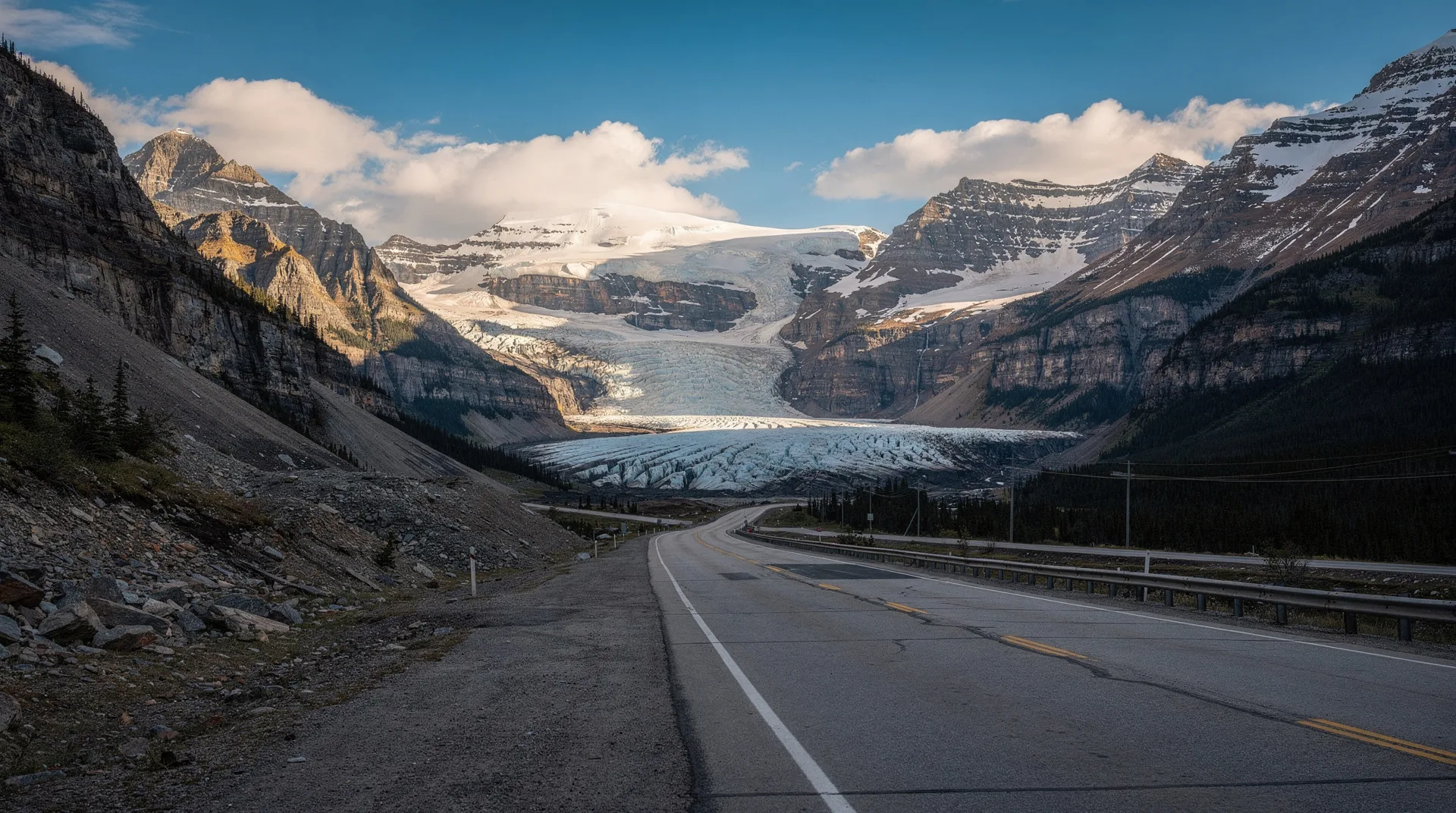
On any list of the world’s great drives, the Icefields Parkway belongs in the top five. Highway 93 North runs 232 kilometres through the heart of the Canadian Rockies, connecting the town of Lake Louise in Banff National Park with the town of Jasper in Jasper National Park. The route passes through two UNESCO World Heritage national parks, skirts the edge of the Columbia Icefield (the largest sub-polar ice mass in North America), and delivers an essentially continuous panorama of peaks, glaciers, waterfalls, and turquoise lakes.
At a glance
| Where | Highway 93 North, between Lake Louise (Banff National Park) and Jasper (Jasper National Park), Alberta |
| Distance | 232 km one-way |
| Cost | Parks Canada day pass required (around CAD 12.25/adult; family/group CAD 24.50/vehicle) or a Discovery Pass; fuel only at Saskatchewan River Crossing |
| Time needed | A full day (8-10 hours with stops); 2-3 days if combined with the Banff-Jasper 7-day itinerary |
| Getting there | Self-drive from Banff/Calgary, or a guided one-way Banff to Jasper tour |
| Best time | Late June to September for full access; see the seasonality table below |
The name comes from the Columbia Icefield, which sits at the road’s midpoint at an elevation of 2,088 metres. Glaciers flowing from this icefield are visible for much of the drive’s northern half. The highway itself was built between 1931 and 1939 as a Depression-era public works project, largely by hand, through some of the most inhospitable terrain in Canada. The engineering is invisible from the road; what you see is mountain scenery of relentless grandeur.
Planning the drive: Banff to Jasper or Jasper to Banff?
The conventional direction is north from Lake Louise (Banff) to Jasper — this puts the driver’s side closer to the major viewpoints and parking areas on the outbound journey. Most tours operate in this direction. If you are driving independently and plan to return to Calgary, driving south (Jasper to Banff) is equally valid and puts Peyto Lake’s famous viewpoint conveniently on your right.
Driving as a one-way trip, positioning a rental car return at Jasper and a pickup at Calgary, requires a one-way rental fee but eliminates backtracking. For visitors spending multiple nights in the Rockies, this is often the most efficient route.
Allow a full day — 8 to 10 hours including stops — for a proper Icefields Parkway experience. Rushing the drive in 3–4 hours is possible but involves driving past viewpoints you will later regret missing.
Book a guided one-way Banff to Jasper tour on the Icefields ParkwayStop-by-stop guide from Lake Louise
Crowfoot Glacier viewpoint (33 km from Lake Louise)
The first major stop, this pullout offers views of the Crowfoot Glacier, named for its three-toed resemblance to a bird’s footprint. One “toe” has retreated significantly in recent decades, and the comparison to historical photographs is a vivid illustration of glacial retreat. The viewpoint requires a 2-minute walk from the parking area.
Bow Lake (36 km from Lake Louise)
Bow Lake is the headwaters of the Bow River (which flows through Banff and ultimately into the South Saskatchewan River system). The lake is fed directly by the Bow Glacier above and has the extraordinary turquoise colour produced by glacial rock flour. The historic Num-Ti-Jah Lodge on the lakeshore, built in 1937 by legendary mountain guide Jimmy Simpson, is one of the most charming buildings in the Rockies and operates as a hotel and restaurant.
A trail from the parking area (6.4 km return) leads to the base of Bow Glacier Falls, where meltwater from the glacier above plunges down a cliff face. The hike passes along the lake’s north shore through moraine and leads to a dramatic cirque below the ice. It is one of the most straightforward and rewarding hikes accessible directly from the parkway.
Peyto Lake viewpoint (77 km from Lake Louise)
The most photographed viewpoint on the Icefields Parkway, and one of the most visited in the Canadian Rockies. Peyto Lake sits in the Mistaya Valley below Bow Summit (2,069 metres, the highest point on the parkway), and from the viewpoint above the north shore the lake’s extraordinary shape and colour are revealed in full.
The lake is shaped like a wolf’s head — or a cartoon hand, depending on your imagination — and its colour shifts between vivid turquoise and deep emerald depending on the light and the time of year. The Waputik Icefield above feeds it constantly; in high summer the rock flour concentration is at its peak and the colour is most intense.
The viewpoint requires a 2.5-km return walk (45–60 minutes, easy terrain) from Bow Summit parking. The parking area fills early on summer mornings; arrive before 8:30 am or expect to queue. An upper platform and lower platform both offer outstanding views; the lower platform trail continues to the lake’s shoreline (11 km return from the parking area) for those wanting a longer excursion.
Mistaya Canyon (100 km from Lake Louise)
A 500-metre trail from the parkway descends to Mistaya Canyon, where the Mistaya River has carved an extraordinary slot into the limestone bedrock. The canyon is narrow, deep, and sculpted into swirling patterns by millennia of water action. The river squeezes through apertures of less than a metre and disappears into darkness. It takes 15 minutes from the car and is among the most visually dramatic short stops on the entire drive.
Saskatchewan River Crossing (108 km from Lake Louise)
The Crossing is the only fuel and food stop between Lake Louise and Jasper — fill up here if needed. The landscape opens dramatically at this point, with views of the North Saskatchewan River valley stretching toward the plains to the east. The convergence of three river valleys creates a wide flat floodplain, often visible with elk grazing in late afternoon.
Parker Ridge (118 km from Lake Louise)
Parker Ridge trail (4.8 km return, 250 m elevation gain, 1.5–2 hours) climbs to a ridge directly above the Saskatchewan Glacier — the longest and most visible arm of the Columbia Icefield. The glacier is displayed from a bird’s-eye perspective, filling the valley below the ridge with its slow, crevassed bulk. This is one of the finest viewpoints accessible from the parkway without a full hiking day; the ascent is steep but short and the panorama is extraordinary.
Columbia Icefield Discovery Centre (126 km from Lake Louise)
The centre sits directly opposite the Athabasca Glacier, the most accessible arm of the Columbia Icefield. From the parking area, you can walk to the glacier’s toe on a 1.5-km trail — informative marker posts along the route show the glacier’s position in past decades, graphically illustrating its retreat.
The Ice Explorer tour boards large all-terrain vehicles and drives directly onto the glacier’s surface. You can step out and walk on the ice, drink from a meltwater stream, and see the crevasses and moraines up close. The glacier is retreating visibly from year to year; a trip onto it is also a form of environmental witness. Book in advance; the centre is very busy in summer.
The Glacier Skywalk, 6 km north of the Discovery Centre along the parkway, is a glass-floored observation platform built over the Sunwapta Valley at 280 metres elevation. The experience of standing on glass above a canyon while listening to interpretation about the icefield’s ecology is unusual and widely enjoyed. Separate ticket; combine with the Ice Explorer tour for the full Icefield package.
Sunwapta Falls (175 km from Lake Louise)
The Sunwapta River drops over a series of rock ledges into a canyon of grey limestone — the upper falls are the most dramatic, reached by a 5-minute walk from the parking area. The lower falls (1.7 km one-way) are less visited and equally impressive. Worth 30–45 minutes total.
Athabasca Falls (198 km from Lake Louise)
Athabasca Falls is the most powerful waterfall in the Canadian Rockies. The Athabasca River concentrates all its force through a narrow quartzite canyon, producing a roaring, spray-heavy cascade that is impressive even at low water. A network of viewpoints and bridges allows views from multiple angles; the most dramatic is directly above the canyon from the south side. Plan for 30–45 minutes.
The falls is the final major stop before Jasper town, 30 km to the north.
Mount Edith Cavell (detour, 27 km from Jasper)
Not directly on the parkway but accessible via a side road from the Athabasca Valley, Mount Edith Cavell is Jasper’s most dramatic peak. The road to the mountain base is closed to vehicles over 9 metres and runs through a steep, narrow canyon. At the parking area, a 3.8-km return trail leads to the Angel Glacier, which hangs from the mountain’s north face above a turquoise meltwater lake. The detour adds 2 hours to your day but delivers scenery that rivals anything on the main highway.
When to drive the Icefields Parkway
June: Road fully open. Waterfalls at maximum volume from snowmelt. High alpine areas still snowy. Fewer crowds than peak season. Some services not yet operating.
July–August: Peak season. Excellent weather, all stops accessible, all services operating. Very busy, particularly at Peyto Lake and the Columbia Icefield. Expect significant crowds and limited parking at major stops.
September: The best month for most experienced visitors. Larches turning gold in late September add extraordinary colour. Crowds diminishing after Labour Day. Weather still generally good with some chance of early snow at elevation.
October: Significant snowfall possible. High stops like Parker Ridge may be snow-covered and icy. Icefield services closing by mid-October. Beautiful autumn light and minimal crowds.
November–March: Parkway remains open but conditions vary. Black ice and blowing snow are genuine hazards. Ice driving experience and winter tyres essential. Wildlife (particularly wolves) easier to see against snow.
| Month | Conditions | Crowds |
|---|---|---|
| June | Waterfalls at peak, high alpine still snowy | Moderate |
| July-August | All stops and services open, best weather | Very high |
| September | Larches turning gold late in the month | Moderate, easing after Labour Day |
| October | Early snow possible at elevation, services closing | Low |
| November-March | Genuinely wintry, black ice, wolves visible | Very low |
Parking and crowd strategy
The single biggest frustration on the Icefields Parkway in summer is a full parking lot at Peyto Lake or the Columbia Icefield Discovery Centre. Both fill by mid-morning from roughly the last week of June through Labour Day. Arriving before 8:30 am, or after 4 pm for a late-light drive, avoids the worst of it. If Peyto Lake’s lot is full, the Bow Summit overflow area a short walk further along is usually the fallback used by locals.
For a shorter, less crowded alternative viewpoint with a similar turquoise-glacier-lake profile, Johnston Canyon or Moraine Lake (reached only by shuttle) can be paired with a Parkway day if time allows, though they sit outside the corridor itself.
Guided tours vs. self-driving
Self-driving gives complete flexibility to linger at favourite stops, detour to Mount Edith Cavell, and time the drive for the best light. It requires a reliable vehicle (AWD recommended for spring and autumn), confidence on mountain roads, and the ability to navigate independently.
Guided tours from Banff, Calgary, or Canmore offer the advantage of an expert guide pointing out wildlife, providing geological and cultural context, and handling all logistics. Particularly valuable for the Columbia Icefield, where guide knowledge substantially enhances the experience. You can compare guided tours across Canada before choosing a departure point.
Costs (in CAD)
| Item | Cost |
|---|---|
| Parks Canada Discovery Pass (annual, adult) | $83.50 |
| Daily pass | $12.25 per adult ($24.50 per vehicle for family/group) |
| Ice Explorer tour (Athabasca Glacier) | $69–$89 adult |
| Glacier Skywalk | $32 adult |
| Ice Explorer + Skywalk combo | $88–$109 adult |
| One-way guided tour (Banff to Jasper) | $130–$200 per person |
| Fuel (one-way driving, mid-size vehicle) | ~$30–$45 |
Note: fuel between Lake Louise and Jasper is only available at Saskatchewan River Crossing (midpoint). Fill up before departing.
Practical tips
- Start early (leave Lake Louise by 7–8 am) to beat crowds at Peyto Lake and arrive at the Columbia Icefield before the tour bus rush
- Book Ice Explorer tickets online in advance; they frequently sell out in July and August
- Download offline maps (Google Maps offline or Maps.me) as mobile coverage is intermittent along the highway
- Bring food and water; options along the route are limited outside Saskatchewan River Crossing
- Wildlife (bears, elk, bighorn sheep) frequently appear on or near the road — slow down, never brake suddenly, never stop in the middle of the road
- Bear spray should be accessible if planning any trail stops
- The road is paved and well-maintained; any standard car can drive it in summer conditions
Where to stay en route
Num-Ti-Jah Lodge (Bow Lake, km 36): The most characterful accommodation option directly on the parkway. Historic log building, limited rooms, book months ahead. Restaurant on-site.
Columbia Icefield Glacier View Lodge (km 127): Hotel directly at the icefield, operated by Pursuit. Unique location but basic amenities for the price. Waking to the glacier visible from your window is worth something.
Beauty Creek Hostel (km 158): HI wilderness hostel, very basic, excellent budget option for those wanting to break the drive.
Sunwapta Falls Rocky Mountain Lodge (km 175): Mid-range cabins adjacent to the falls. Good restaurant.
For most visitors, the parkway is driven as a day trip from Banff or as a one-way drive ending in Jasper. Overnight stops on the parkway are limited and should be reserved far in advance.
Frequently asked questions about Icefields Parkway: the complete driving guide
Is the Icefields Parkway worth it in bad weather?
Partially. The scale of the mountains is visible even in cloud; waterfalls are more dramatic after rain. The Columbia Icefield and glacier tour are less rewarding in heavy rain or thick cloud. Peyto Lake’s famous colour is most vivid in sunshine. Worth driving in mixed conditions, but not in complete whiteout.
Can I cycle the Icefields Parkway?
Yes, and it is a classic multi-day cycling route. The road shoulder is adequate; traffic is generally courteous to cyclists. Camping at several campgrounds along the route breaks the journey over 2–4 days. Best avoided in peak summer season when traffic is heaviest; May and September are popular cycling months.
Is there mobile phone coverage on the parkway?
Intermittently. Rogers and Telus have sporadic coverage near the Discovery Centre and Lake Louise. Much of the route has no signal. Download offline maps and share your itinerary before departing.
Can I do the parkway as a day trip from Calgary?
Technically possible (Calgary to Jasper and back is about 740 km) but not recommended. A much better option is to drive the parkway one-way from Banff to Jasper, taking the shuttle or Brewster Express bus back — or arranging a one-way car rental.
Are bears common along the parkway?
Yes. Bears (both grizzly and black) are regularly seen along the highway, particularly in spring and autumn when they forage on open slopes. Slow down when you see a cluster of pulled-over cars; this often indicates a wildlife sighting. Maintain a 30-metre minimum distance and never approach bears.
What is the best single stop on the parkway?
Peyto Lake viewpoint offers the most dramatic and photogenic single viewpoint. The Columbia Icefield is the most unique experience. If forced to choose just one, Peyto Lake wins for visual impact; the Icefield wins for scientific and experiential depth.
Do I need a rental car with all-wheel drive?
Not for a summer drive on the paved highway — any standard rental car is fine June through September. For late autumn or winter driving, AWD and winter tyres are strongly recommended given black ice and sudden snow at elevation.
How does the Icefields Parkway compare to driving Banff to Jasper on the alternate highway?
There is no faster alternate route between Banff and Jasper — Highway 93 (the Icefields Parkway) is the only direct road link, so comparisons are really about pacing the same route, covered in the Banff to Jasper driving guide and the Banff vs Jasper comparison for those still deciding where to base themselves.