Why Canada should be your next big trip
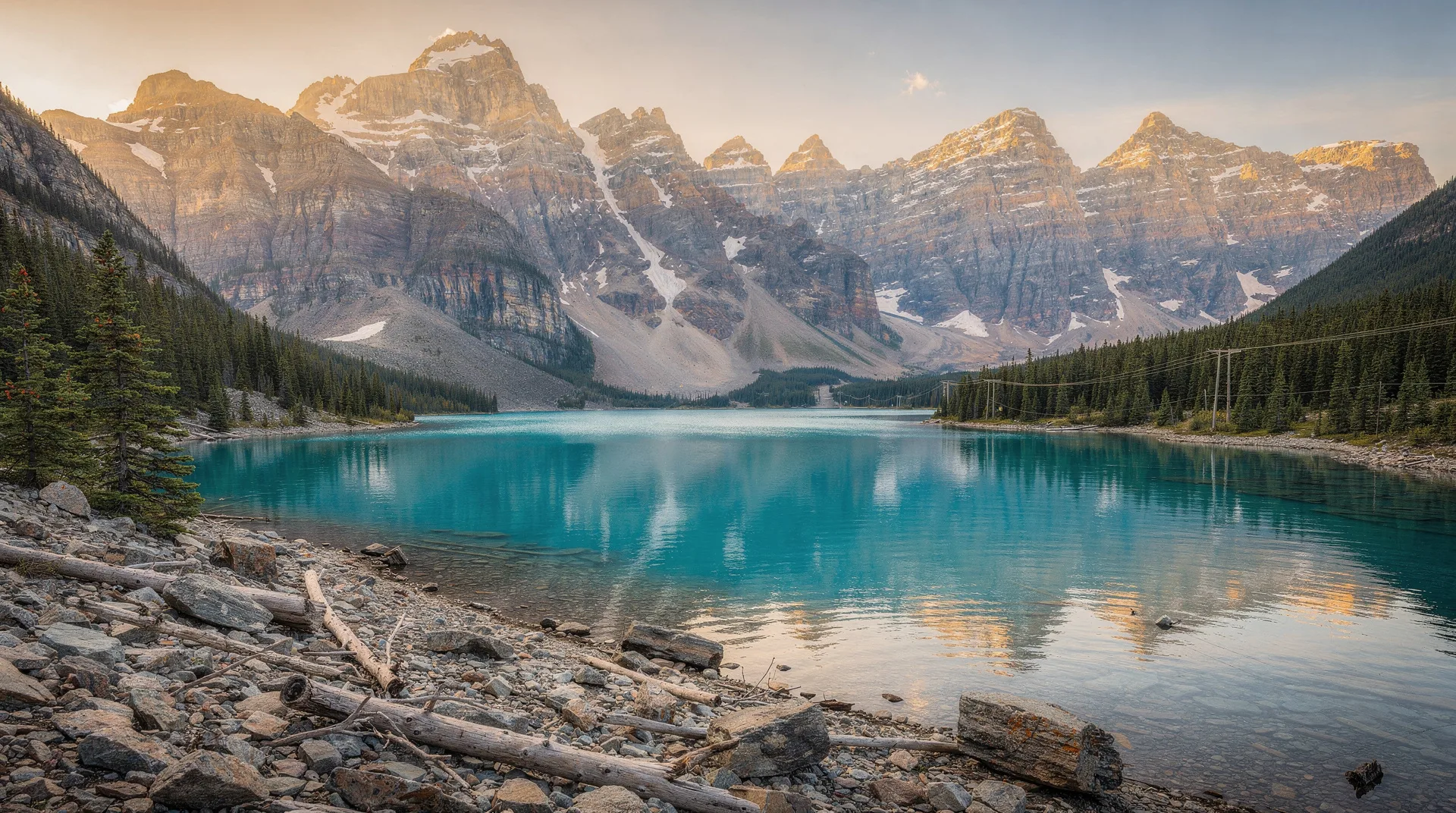
I had been postponing Canada for years. It was always “next year” — too expensive, too far, too similar to home in ways I couldn’t quite articulate. Then a friend showed me a photograph she’d taken at Moraine Lake at dawn, the water that particular shade of turquoise that looks digitally altered but isn’t, the peaks above still holding snow in August. I booked my flight the same evening.
That was five years ago. I have been back three times since, and I am already planning a fourth trip. Canada is not a country that reveals itself easily — it is vast, it requires choices, it punishes underprepared itineraries — but for travellers willing to engage with its scale and its silences, it delivers experiences that accumulate into something close to a life-changing journey.
Here is why I think Canada should be near the top of your list, and what makes it genuinely different from the other “big trips” people chase.
| At a glance | |
|---|---|
| Where to start | Pick one region — Rockies, Atlantic Canada, or Quebec/Ontario — rather than the whole country |
| Cost | Mid-to-high; roughly CAD $150-400+ per day depending on style |
| Time needed | Two weeks minimum for one region done properly, three weeks-plus to combine two |
| Entry requirement | eTA for most visa-exempt air travellers, a full visa for some nationalities |
| Best first-timer season | Summer (Jun-Aug) for access and weather; September-October for foliage and fewer crowds |
The scale changes how you travel
Canada is the second-largest country on earth. Its ten provinces and three territories span six time zones, five distinct climate bands, and landscapes that have essentially nothing in common with each other. The boreal forest of Ontario bears no resemblance to the Pacific rainforest of British Columbia. The Maritime coast of Nova Scotia looks nothing like the prairie of Saskatchewan. The Canadian Arctic is a different planet entirely.
This scale has a practical consequence that takes most first-time visitors by surprise: you cannot see Canada. You can see parts of it, and those parts will take your full attention. The most common mistake I see travellers make is building itineraries that try to cover too much ground — Vancouver to Montreal in two weeks, hitting everything in between. The result is a highlights reel experienced from a series of airports, and Canada’s best experiences require time to settle into.
The better approach is to pick a region, go deep, and let the country come to you. The Canadian Rockies alone can absorb three weeks without repetition. Newfoundland rewards ten days spent barely leaving the Avalon Peninsula. Cape Breton Island, one of the most beautiful places in North America, deserves more than the two days most itineraries assign it.
National parks that actually deserve the name
Canada has 48 national parks and national park reserves, and several of them are genuinely among the finest protected landscapes on earth. Banff National Park is the most visited and still manages to feel wild — partly because it is large enough (6,641 square kilometres) to absorb its crowds, and partly because the landscape is so overwhelming that even a car park full of tourists cannot diminish it.
Jasper National Park is Banff’s quieter, larger sibling to the north: more wildlife, fewer crowds, and a sense of genuine remoteness that Banff’s proximity to Calgary dilutes slightly. Gros Morne National Park in Newfoundland is a UNESCO World Heritage Site where the earth’s mantle has been exposed at the surface — a geological spectacle that has no real equivalent elsewhere. Pacific Rim National Park Reserve on Vancouver Island puts you in old-growth temperate rainforest beside some of North America’s finest surf beaches.
The national parks pass (Parks Canada Discovery Pass) is worth buying if you’re visiting more than two parks in a season. It covers entry to all national parks, national historic sites, and national marine conservation areas for a year.
Wildlife encounters that feel genuinely wild
Canada’s wildlife is not curated for tourists. In Churchill, Manitoba, polar bears congregate along the Hudson Bay shore in October and November, waiting for the sea ice to form — and the viewing involves tundra vehicles heading directly into the landscape where the bears live and hunt. There are no fences. The bears approach the vehicles on their own terms.
In the Rockies, elk wander the streets of Jasper townsite in autumn, and the rut in September is one of the most dramatic wildlife spectacles on the continent. Black bears are common along the Icefields Parkway. Grizzlies appear occasionally, particularly in the more remote valleys of Jasper. In British Columbia’s Great Bear Rainforest, spirit bears — a rare white colour phase of the black bear — are encountered on guided tours that operate with serious ecological standards.
On the Atlantic coast, whale watching off the St Lawrence estuary near Tadoussac is among the best in the world. Blue whales, fin whales, belugas, and humpbacks share these cold, nutrient-rich waters from June through October. The sheer size of a blue whale — the largest animal that has ever existed on earth — registers as something close to shock when you’re standing on a boat a hundred metres away.
Food and culture that reward curiosity
Canada’s food culture has improved dramatically over the past decade, and it is most interesting not in the obvious places but in the regional specialities that don’t travel well. Prince Edward Island oysters eaten at a shack on the waterfront. Tourtière in a Quebec sugar shack during maple season. Bison burgers in Banff. Smoked meat sandwiches at Schwartz’s in Montreal, which has been serving essentially the same thing since 1928.
Montreal deserves its reputation as one of North America’s great food cities — a French-inflected culinary tradition given a North American energy and a diverse immigrant population that has added layers of complexity. Quebec City is perhaps the most European city in North America, with a walled historic district and a café culture that operates on a different clock from the rest of the continent.
Explore Montreal food tours and experiences on GetYourGuide — the guided food walks in the Plateau and Mile End neighbourhoods are an excellent introduction to the city’s neighbourhood character.
Four seasons, four completely different countries
Canada in summer is lakes and forests and long evenings that last until 10 pm. Canada in winter is a transformation — the same landscape under snow, the cities pulling inward, the cold a presence you negotiate with rather than ignore. Spring brings the maple syrup season in Quebec and Ontario, the wildflowers emerging in the Rockies, the bears leaving their dens. Autumn turns the entire east coast — from Ontario through Quebec, New Brunswick, Nova Scotia, and Prince Edward Island — into a colour spectacle that the New England fall foliage tourists haven’t quite discovered yet.
The Canadian Rockies are extraordinary in winter: frozen lakes, snow-loaded trees, far fewer crowds, and the possibility of seeing the northern lights on clear nights. Québec’s Winter Carnival in February is one of the world’s great winter festivals. And skiing in Whistler, British Columbia — perhaps the finest ski resort in North America — is a reason to come in January or February that has nothing to do with culture or wildlife.
The practical argument: it’s more accessible than you think
Canada requires a visa for citizens of most countries, but the eTA (Electronic Travel Authorization) process is quick, inexpensive, and almost universally granted for tourism purposes. The country is genuinely safe. English is widely spoken everywhere; French is the primary language in Quebec but English-speaking visitors navigate it without real difficulty.
Direct flights from Europe reach Toronto, Montreal, Vancouver, and Calgary. Connections to most other destinations are straightforward. The internal flight network is good, though expensive — the range of organised tours and experiences across Canada means you can reach extraordinary places without necessarily having a car, though a rental car transforms what’s possible in most regions.
The expense is real — Canada is not a budget destination, and I won’t pretend otherwise. But it delivers commensurate value, and the experiences available at the top end of the price range — a night at the Fairmont Banff Springs, a tundra buggy in Churchill, a floatplane into the British Columbia wilderness — are among the most memorable I have encountered anywhere.
Which region should you pick first?
| Region | Best for | Realistic minimum |
|---|---|---|
| Canadian Rockies | Mountains, wildlife, lakes, classic postcard Canada | 7-10 days |
| Atlantic Canada | Coastline, seafood, small towns, slower pace | 7-10 days |
| Ontario/Quebec cities | Culture, food, history, easier logistics without a car | 7-10 days |
| Newfoundland | Remoteness, icebergs, Gros Morne geology | 7 days minimum |
| Yukon/Northwest Territories | Northern lights, true wilderness, very few crowds | 5-7 days |
None of these is objectively “best” — they answer different questions about what you want from the trip. First-timers who want the classic Canada experience with the least logistical friction tend to do best in the Rockies. Travellers who’ve already done a mountain trip somewhere else in the world often get more out of Atlantic Canada or the north.
What a first Canada trip actually costs
Flights are usually the single biggest line item from Europe or elsewhere overseas, followed by car rental and accommodation in the Rockies specifically, where lodging inside or near the parks commands a real premium in July and August. Ontario and Quebec cities are comparatively affordable if you use trains and transit rather than renting a car. Building in a couple of splurges — a night at a lodge with a lake view, one proper tasting menu in Montreal — tends to matter more for how the trip feels than shaving a few dollars off every meal.
A Canadian road trip is the format that suits Canada best precisely because so much of the value is in the landscape between destinations, not just the destinations themselves. If you’d rather not drive, Via Rail covers some of the same ground at a slower, car-free pace.
Where to start planning
The most useful first decision is region. If this is your first visit and you want the classic Canada experience — mountains, lakes, wildlife — the Canadian Rockies anchored in Banff and Jasper is the obvious answer. If you want cities and culture alongside nature, a Toronto/Quebec City/Montreal triangle covers an enormous amount of ground. If you want something more off-the-beaten-path from the start, Newfoundland or Cape Breton will repay the extra effort to get there.
I have written detailed itineraries for most of the major regions, and the guides section covers specific parks, cities, and experiences in depth. Start there, then use the internal links to build something that fits your actual interests rather than a generic greatest-hits circuit.
Canada will meet you at whatever level you bring to it. Come with curiosity and a willingness to let the country set the pace, and it will give you more than you came looking for.
Final thoughts
The photograph my friend showed me — the one that eventually got me on a plane — was taken at 6 am after she’d spent the night at a campsite nearby specifically to be there at dawn before the tour buses arrived. That kind of effort is what Canada rewards. It is not a country that performs for passive observers; it requires a certain amount of active engagement, a willingness to get up early or drive the extra hour or sleep somewhere cold.
In return, it offers landscapes and wildlife encounters and moments of genuine remoteness that are harder and harder to find in an increasingly accessible world. For a certain kind of traveller, that trade-off is not a sacrifice at all. It is exactly the point.
Frequently asked questions about Why Canada should be your next big trip
When is the best time to visit Canada?
It depends entirely on what you want to do. Summer (June–August) is the most popular season for national parks and outdoor activities. Autumn (September–October) brings spectacular foliage and excellent wildlife viewing. Winter (December–March) is ideal for skiing, winter festivals, and aurora viewing. Spring (April–May) is quieter and less expensive, with the bonus of maple syrup season in Ontario and Quebec.
Do I need a visa to visit Canada?
Citizens of many countries need an eTA (Electronic Travel Authorization) rather than a full visa — this applies to most European countries, Australia, and others. The eTA is applied for online, costs CAD $7, and is almost always approved within minutes. US citizens need only a valid passport. Check the Immigration, Refugees and Citizenship Canada website for your specific country.
How much does a trip to Canada cost?
Canada is a mid-to-high cost destination. Budget travellers can manage on CAD $100–150 per day using hostels and cooking some meals. A mid-range trip with hotels and restaurants runs CAD $250–400 per day. Activities, car rental, and flights add significantly. The Rockies and Atlantic provinces are slightly more expensive than the prairies or northern regions.
How long should I spend in Canada?
Two weeks is the minimum for a meaningful trip that covers one or two regions properly. Three weeks allows you to combine regions — Rockies plus Pacific coast, or Quebec plus Maritime provinces. A month begins to feel like you’re actually engaging with the country’s scale rather than fighting it.
Is Canada safe for tourists?
Canada consistently ranks among the world’s safest countries for travellers. Violent crime against tourists is extremely rare. The main practical hazards are wilderness-related — wildlife encounters, weather, and getting genuinely lost in remote areas — all of which are manageable with standard preparation and common sense.
Do I need a car to see Canada?
It depends on the region. A car is close to essential for the Rockies, Atlantic Canada, and anywhere off the main rail corridors. In the Toronto-Montreal-Quebec City corridor, Via Rail and city transit cover most of what a typical trip needs without a rental, and driving there mainly adds parking cost and stress rather than convenience.