Quick facts
- Population
- 900
- Best time
- October–November (bears) / July–August (belugas)
- Languages
- English
- Days needed
- 3-5 days
There is no place in the world quite like Churchill. A remote town of fewer than a thousand people on the western shore of Hudson Bay, it sits at the convergence of three of the most extraordinary wildlife spectacles on earth: the autumn polar bear migration, the summer beluga whale gathering, and winter displays of the aurora borealis over frozen tundra. For wildlife photographers and nature travellers, Churchill is not a destination — it is a pilgrimage.
Getting here is neither cheap nor easy. Churchill has no road connection to the rest of Canada’s highway system. Visitors arrive by train — a 36-hour journey on Via Rail’s Hudson Bay from Winnipeg — or by one of the regional flights from Winnipeg. But the logistical challenge is precisely part of what preserves Churchill’s character. This is not a polished resort. It is a genuine subarctic community that happens to be one of the most remarkable places on the planet to watch wild animals in their natural habitat.
| At a glance | |
|---|---|
| Where | Hudson Bay coast, northern Manitoba, no road access |
| Cost | Tundra Buggy day trips around CAD 400-600; multi-day lodge packages run well into the thousands |
| Time needed | 3-5 days for one season (bears, belugas or aurora) |
| Getting there | Flight from Winnipeg (around 2 hours) or the Via Rail Hudson Bay train (36-46 hours) |
| Best time | Mid-October to mid-November for polar bears; July-August for belugas; February-March for aurora |
For a shorter, structured version of a bear trip, see our Churchill polar bear 5-day itinerary, and for pure aurora planning, the aurora photography guide.
The three seasons of Churchill
Churchill’s appeal shifts dramatically with the calendar, and most visitors choose their timing based on which wildlife spectacle they most want to witness.
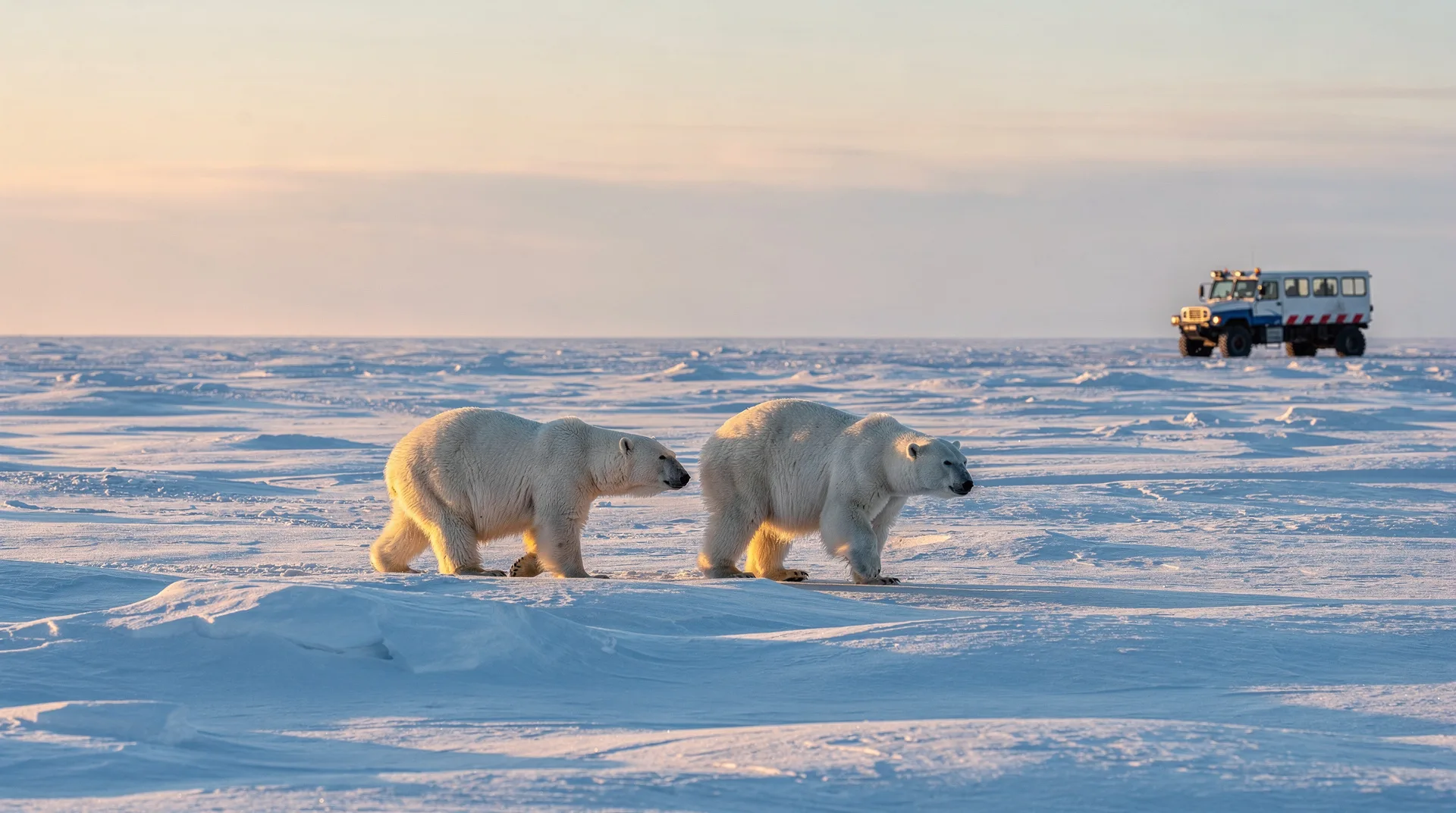
Polar bear season (October–November) draws the largest number of visitors. As Hudson Bay freezes in late autumn, polar bears congregate on the coast near Churchill, waiting for the ice to solidify enough to support their winter hunt for ringed seals. This waiting period — typically from mid-October through mid-November — brings as many as a thousand bears within reach of the town. The world-famous Tundra Buggy tours venture out onto the rocky coastal terrain in specially designed vehicles, putting guests within metres of the bears without either party being endangered.
Beluga whale season (July–August) is arguably the most magical of the three. Every summer, the Churchill River estuary and the adjacent waters of Hudson Bay receive an estimated 57,000 beluga whales — one of the largest seasonal gatherings of cetaceans on earth. The whales are intensely curious and social. Visitors snorkel or kayak alongside them; the belugas often approach of their own accord, their white forms circling just below the surface, their vocal chatter audible both underwater and above. There is nothing quite like floating in a drysuit in Hudson Bay with a pod of belugas rising around you.
Aurora season (March–April) offers a different kind of spectacle. Churchill’s position at approximately 58° North means it sits within the auroral oval, and the long, dark nights of late winter combined with frequent clear skies on the tundra produce some of the most reliable aurora viewing in Canada. The landscape adds a particular drama: frozen Hudson Bay stretching to the horizon, the tundra’s bare willows catching the green light from above, and complete silence except for the wind.
Top things to do in Churchill
Tundra Buggy polar bear tours
The Tundra Buggy is Churchill’s signature experience — a purpose-built high-clearance vehicle with an outdoor observation deck, warm interior, and the ability to traverse the rocky coastal tundra that bears use as staging ground before the ice forms. Tours venture 20–30 kilometres from town along roads and tracks through the Churchill Wildlife Management Area. You will see bears — often many of them. Young males wrestle. Mothers keep close watch over cubs. Mature males rest, their cream-coloured fur blending with the frost-bleached tundra grass.
Book a Churchill exclusive Tundra Buggy day tripBooking these tours well in advance is not optional — it is mandatory. The best tour slots fill months ahead of peak season (late October through mid-November). Multiple operators run Tundra Buggy tours; Frontiers North Adventures and Natural Habitat Adventures are among the most reputable.
Snorkelling with beluga whales
The beluga experience in summer is intimate in a way that surprises first-time visitors. Wearing a drysuit (water temperatures hover around 12–15°C), you enter the Churchill River estuary at high tide and wait. Within minutes, the belugas arrive. They circle, approach, and often hover beneath snorkellers, making eye contact with a curiosity that feels genuinely reciprocal. These are wild animals in their natural environment, but belugas have a social nature that makes encounters feel collaborative rather than accidental.
Tour operators provide full drysuit equipment and guide briefings. No swimming experience is required beyond basic comfort in water. The activity operates from mid-July through mid-August, timed to the whale aggregation in the estuary.
Kayaking on Hudson Bay
Sea kayaking in Hudson Bay during beluga season is a more active version of the same encounter. With experienced guides, visitors paddle among the whales in stable, well-equipped sea kayaks. The perspective from the water’s surface — belugas surfacing to breathe just metres from your paddle — is unlike anything available from a boat deck. The bay’s weather is changeable and cold even in summer; proper preparation is handled by the tour operators. You can compare guided tours around Churchill before choosing a departure date.
Aurora viewing on the tundra
Churchill’s aurora season runs from late August through April, but the optimal window for dark, clear nights combined with frequent activity is February through March. Tour operators offer evening aurora excursions by vehicle out onto the tundra away from Churchill’s minimal light pollution. The low, flat landscape of the frozen bay and surrounding tundra provides an unobstructed 360-degree sky view — ideal for photography and the full visual impact of the lights.
Churchill Northern Studies Centre
The Churchill Northern Studies Centre, 23 kilometres east of town, is a genuine research station that also operates public programming. The centre’s evening lectures on polar bear ecology, climate change on the tundra, and Indigenous land use are excellent context for any Churchill visit. It also operates aurora-viewing programs and winter ecology workshops.
Cape Merry and the Churchill River estuary
Cape Merry, a short walk from town, is a rocky headland at the mouth of the Churchill River. The ruins of a 17th-century stone fort — Prince of Wales Fort, accessible by boat across the river — sit on the opposite bank. From Cape Merry itself, the estuary spreads out below: beluga territory in summer, sea ice habitat in winter. It is one of Churchill’s most accessible viewpoints and free to visit at any time.
Dog sledding
Winter visitors can arrange dog sledding excursions through local operators. Churchill’s dog-sledding tradition predates the tourist industry — dogs were working animals here for generations, used by Cree and Dene hunters as well as by Hudson’s Bay Company traders. Modern sled dog tours range from short introductory runs to half-day wilderness excursions. The experience of running a team across the frozen tundra with the aurora potentially overhead is an appropriate summary of why people make the journey to this remote town.
Wildlife you can expect to see
Churchill’s wildlife extends well beyond polar bears and belugas. The tundra and boreal forest transition zone that surrounds the town supports an unusually rich diversity of species.
Arctic foxes become more visible in autumn as they follow the polar bears along the coast, scavenging scraps from bear kills. In their white winter coats they are surprisingly hard to spot against snow but strikingly beautiful when found.
Snowy owls appear from October onward, perching on tundra hummocks and utility poles with an imperious stillness. Churchill is among the most reliable locations in North America for this species.
Arctic and willow ptarmigan remain through winter in their white plumage, appearing in willow thickets in flocks of dozens or occasionally hundreds.
Caribou pass through the Churchill area during their seasonal migrations, most reliably in autumn. Encounters are not guaranteed but not uncommon.
Beluga whales are joined in summer by occasional bowhead whales and killer whales (orcas), which enter Hudson Bay following the belugas in some years.
Arctic terns breed on the coast and islands around Churchill and are regularly visible in summer, performing their dramatic plunge-diving for fish in the bay.
When to visit Churchill
October 15 to November 15 is peak polar bear season. This is when the majority of the bear population is concentrated near town. Early October can be good but the bears are more dispersed. After mid-November the ice typically forms and the bears disperse onto the bay to hunt.
July 1 to August 20 is beluga season. The whales arrive reliably in the Churchill River estuary from early July and depart by late August as water temperatures begin to cool.
February 15 to April 15 is the optimal aurora window: maximum darkness, high probability of clear skies, and access to frozen-tundra landscapes for photography. Temperatures can reach -40°C in February — preparation is serious.
June is a pleasant shoulder season: migratory birds are breeding, the tundra plants are in bloom, and beluga advance scouts are often visible. Fewer crowds than peak periods.
Where to stay in Churchill
Accommodation in Churchill is limited by the town’s small size. The main options are a handful of lodges and hotels in town, plus multi-night expedition-style lodge programs that include meals, guiding, and tours as a package.
Polar Bear Lodge (Frontiers North): The purpose-built lodge associated with the premier bear-watching operator. Package programs include accommodation, meals, and Tundra Buggy access — the most seamless option for first-time visitors.
Churchill Wild lodges: For beluga season, Churchill Wild operates remote lodges directly on Hudson Bay where polar bears, belugas, and wolverines are all regular visitors. These wilderness lodges are among the most atmospheric and expensive accommodations in Manitoba.
Iceberg Inn and Tundra Inn: In-town hotels that work well as independent bases for those booking individual activities. Both are simple, comfortable, and welcoming.
Getting around Churchill
Churchill has no public transport and very limited options for independent vehicle rental. The standard approach is to book organised tours for all wildlife activities — the operators provide transportation as part of the package. For moving around town itself, everything is within comfortable walking distance.
A rental vehicle, if one can be arranged, is useful for birding and exploring the network of tracks around town on your own schedule. The roads accessible by regular vehicle include the Cape Merry area, the bird sanctuary near the airport, and the launch area for beluga snorkelling.
Getting to Churchill
By air: Calm Air and Perimeter Aviation operate scheduled flights from Winnipeg (approximately 2 hours). Flights from Winnipeg connect to Churchill via Thompson or direct depending on the service. This is the fastest option and the only practical one if you are visiting for just a few days.
By rail: Via Rail’s Hudson Bay train runs from Winnipeg to Churchill in approximately 36–46 hours (weather dependent). The journey through boreal forest, muskeg, and eventually the tundra is an experience in its own right — a gradual introduction to the north. The train is the way Churchillians themselves travel and gives a genuine sense of the landscape.
If you are weighing the two options, our guide to getting to Churchill compares them side by side, and the Hudson Bay train guide explains what to expect on board. Most journeys start in Winnipeg, so it is worth allowing a night there before you head north rather than rushing the connection.
Day trips from Churchill
Given Churchill’s remote location, day trips in the conventional sense are limited. However, some operators offer excursions beyond the immediate Churchill area:
Prince of Wales Fort National Historic Site across the Churchill River is accessible by boat in summer. The stone fort, built by the Hudson’s Bay Company between 1731 and 1771, was the largest stone fortification in North America at the time of its surrender to French forces in 1782 without a shot being fired.
Bird Cove and the coastline east of town are productive birding areas accessible by tour vehicle. Breeding colonies of common eiders, black-legged kittiwakes, and thick-billed murres operate on islands and headlands within reach of a half-day excursion.
Wapusk National Park is accessible from Churchill by licensed tour operators. The park is the world’s most important polar bear denning habitat — in late February and March, females emerge from maternity dens in the park with cubs. Access requires permitted guides and is more expensive than standard Tundra Buggy tours, but the experience of watching a polar bear family emerge from a snow den is among the rarest wildlife encounters on earth.
Planning around the seasons
Each season rewards a slightly different kind of preparation. For autumn, our Churchill polar bears guide and the notes on Churchill in November explain how the light, the cold and the bear movements shape a day in the field. For the northern lights, the Churchill aurora guide covers what to expect on long winter nights.
Whatever the season, pack with care. Our packing list is a useful starting point, and the advice in the wildlife safety guide is worth reading before you arrive in bear country. Those who want to go deeper into the wilderness beyond the town can read about Wapusk National Park, the denning grounds mentioned above.
What a Churchill trip actually costs
Churchill is one of the most expensive wildlife trips in Canada, and it is worth planning around real numbers rather than the base tour price alone. Flights from Winnipeg are typically the single biggest line item after the tours themselves, since Churchill has no road and demand is seasonal. A single-day Tundra Buggy tour is a meaningful spend on its own; multi-night packages that bundle the lodge, meals, and several tours cost considerably more but remove most of the logistics.
Beluga snorkelling and kayaking trips in summer are cheaper than the bear season packages but still priced as specialist wildlife tourism rather than a standard excursion. For a full breakdown by season, see our Churchill cost guide and, for the specific bear-watching vehicle experience, the tundra buggy guide.
A good travel insurance policy belongs in that budget, and the best tours in Churchill roundup helps you compare options before you commit.
Budgeting real contingency for weather delays matters too — flights out of Churchill are occasionally disrupted by fog or storms, and a rigid onward connection the same day is a common source of stress for first-time visitors.
Frequently asked questions about Churchill
Is Churchill safe given the polar bears? The town operates under a polar bear safety protocol that has made serious incidents rare. The local Polar Bear Alert Program patrols the town, deters bears away from the townsite, and temporarily holds problem bears at a “polar bear jail” facility before relocating them. Churchill residents take bear safety seriously and visitors are briefed on protocols on arrival. Following the guidelines — not walking alone at night, paying attention to bear warnings — makes the experience safe.
What should I wear? October to November requires serious cold-weather gear: base layers, mid-layer insulation, windproof outer shell, insulated waterproof boots rated to at least -30°C, warm hat, and mittens rather than gloves. The Tundra Buggies are heated inside but you will spend time on the outdoor observation deck. In summer, layering is still important — July temperatures range from 5°C to 20°C and can change rapidly.
How far in advance should I book? For October–November polar bear season, 6–12 months in advance is realistic for the most popular Tundra Buggy tours. For July–August beluga season, 3–6 months is usually sufficient. Accommodation fills up quickly in peak bear season.
Can I see polar bears and belugas in the same trip? They occupy different seasons (bears in autumn, belugas in summer), so combining both in a single trip is not possible. Some multi-week visits have combined the late beluga season (mid-August) with very early bear sightings (late August to early September), but this is exceptional.
Is Churchill worth the expense? Churchill is among the most expensive wildlife destinations in Canada, when travel, accommodation, and tours are combined. For serious wildlife and nature travellers, the answer is consistently yes — the encounters available here are simply not available anywhere else on the same terms.
Do I need a park pass to visit Churchill? Churchill itself is not inside a Parks Canada national park, so no park pass is required for the town or the standard Tundra Buggy routes in the Churchill Wildlife Management Area. Wapusk National Park, reached only with licensed guides, is a separate Parks Canada unit with its own permit arrangements handled by the tour operator.
Is Churchill better than a zoo or aquarium for seeing polar bears? For anyone who can afford the trip, seeing wild polar bears on their own tundra is not comparable to a captive setting — the behaviour, scale, and context are entirely different. Budget-conscious travellers who cannot manage the cost or logistics of Churchill can look at the polar bear tundra buggy guide to understand exactly what the experience involves before committing to it.