Quick facts
- Population
- 88,000 (city)
- Best time
- June to September
- Languages
- English
- Days needed
- 2-3 days
Standing at the railing above Horseshoe Falls and feeling the mist hit your face, hearing the roar that fills the air for a kilometre in every direction — it does something to you. Niagara Falls is one of those places that earns its reputation in the first five minutes. The falls themselves are not the tallest in the world, but they are arguably the most powerful: more than 2,800 cubic metres of water per second thunder over the 57-metre drop of Horseshoe Falls, making it the highest flow rate of any waterfall in the world.
| At a glance | |
|---|---|
| Where | Ontario, Canadian bank of the Niagara River, about 130 km from Toronto |
| Cost | Viewing the falls from the promenade is free; individual attractions (boat tour, Journey Behind the Falls, Skylon Tower) each cost separately, typically around CAD 25-40 |
| Time needed | 2-3 days, or a long day trip from Toronto |
| Getting there | Around 90 minutes by car or GO Transit bus from Toronto |
| Best time | June to September for warm weather; winter for smaller crowds and ice formations |
The Canadian side offers something the American side simply cannot match: the full frontal view of Horseshoe Falls, the complete arc of the cataract spreading across your entire field of vision. Combined with a compact tourist strip, excellent boat access right into the mist, the ability to walk behind the falls themselves, and the bonus of Ontario wine country a short drive away, the Canadian side deserves its reputation as the better vantage point.
Why the Canadian side of Niagara Falls wins
The geography of Niagara Falls is inherently asymmetrical, and the asymmetry favours Canada. Horseshoe Falls, which carries roughly 90 percent of the total flow, bends in a U-shape that points squarely toward the Canadian bank. From the Ontario side, you see the full width of the falls. From the American side, you look along the edge.
Clifton Hill — Niagara Falls, Ontario’s main tourist street — is loud, commercial, and entirely unapologetic about it. Beyond this carnival strip, however, is the Queen Victoria Park promenade running directly along the falls, the Journey Behind the Falls tunnel system drilled through the rock, and the iconic Skylon Tower rising 236 metres above the gorge. The town of Niagara-on-the-Lake, 15 kilometres north, provides a graceful counterpoint: quiet Georgian streets, award-winning wineries, and the Shaw Festival theatre.
For visitors combining Niagara Falls with a broader Ontario itinerary or arriving from Toronto, this is one of the most logistically straightforward major attractions in Canada.
If you are still weighing which bank of the river to base yourself on, the comparison in Niagara Falls Canada vs US side walks through the trade-offs in more detail. And if you are deciding between sleeping in the city of Toronto and sleeping near the falls, Toronto vs Niagara as a base helps you choose before you book anything.
Top things to do in Niagara Falls
Horseshoe Falls viewpoints
The promenade along the Canadian side gives direct, unobstructed access to the full sweep of Horseshoe Falls. Table Rock — the viewing platform right at the crest of the falls — is the closest point, where the water slides over the lip just metres away. The mist is relentless here in warm weather; bring a rain jacket or embrace getting soaked. The illumination of the falls each evening is spectacular, particularly in the summer light-and-fireworks season.
Journey Behind the Falls
Tunnels drilled through the bedrock in the 1880s descend behind the curtain of Horseshoe Falls, emerging at two observation decks and a portal directly behind the water. The roar inside the tunnel is extraordinary — conversation becomes shouting — and the view through the wall of water is unlike anything above. The experience takes about 45 minutes. Buy tickets in advance during summer to avoid long queues at the Table Rock Welcome Centre. If you would rather compare several bundled options before paying for each attraction separately, our roundup of the best tours in Niagara Falls lays out how the main experiences fit together.
Hornblower Niagara Cruises (formerly Maid of the Mist equivalent)
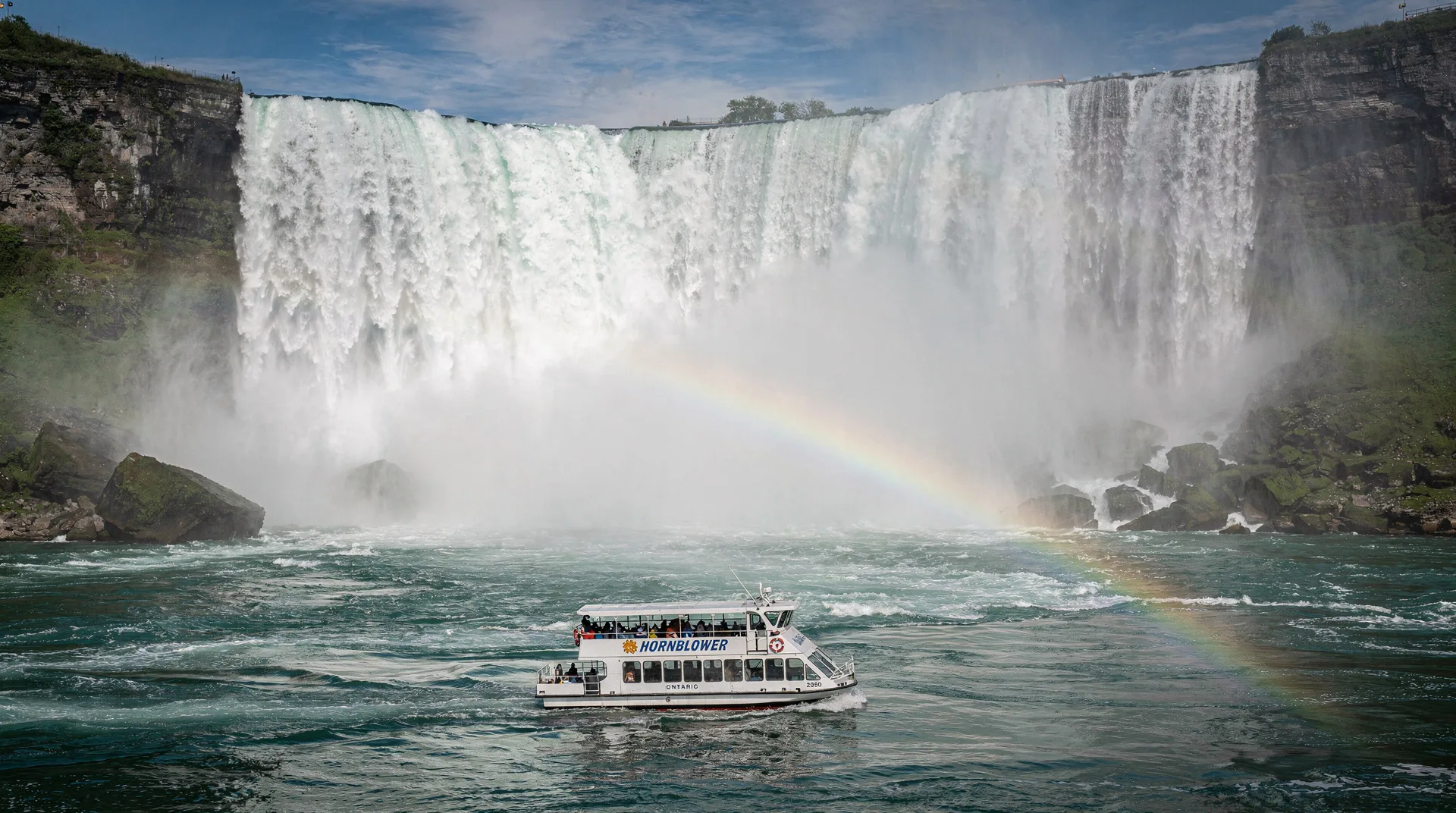
The Canadian boat tour — operated by Hornblower Niagara Cruises — departs from the base of the Niagara Gorge and drives directly into the spray basin at the foot of Horseshoe Falls. Blue ponchos are provided. Within minutes of boarding, the boat enters a white world of spray and thunder. The 20-minute experience is the single most visceral way to experience the falls. Book ahead in July and August.
Book the Niagara Falls boat tour experienceSkylon Tower
At 236 metres, the Skylon Tower’s observation deck gives you the overview that ground-level viewpoints cannot. The full arc of both falls — Horseshoe and American — unfolds below, along with the Niagara River gorge stretching north toward Lake Ontario. The revolving restaurant at the top completes a classic Niagara experience. Sunset and evening visits, when the falls are illuminated, are particularly memorable.
Book the Niagara Falls tour with Skylon, Journey Behind the Falls and boat rideWhirlpool Aero Car
Three kilometres north of the falls, the Niagara River makes a sharp bend and creates a massive whirlpool where the current corkscrews perpetually. The Spanish Aero Car — an antique cable car operating since 1916 — crosses the gorge on a curved 549-metre cable, carrying passengers across the whirlpool below. It is a peculiar, wonderful, slightly nerve-wracking experience.
Niagara Parks Butterfly Conservatory
One kilometre north of the falls, the butterfly conservatory is a welcome change of pace from the crowds and noise of the falls area. A massive tropical greenhouse contains over 2,000 free-flying butterflies representing 45 species, landing on visitors without hesitation. The gardens surrounding the conservatory are among the most beautifully maintained in Ontario.
Helicopter tour over the falls
For those who want the full aerial perspective, helicopter tours operate year-round from the Niagara Helicopters base north of the falls. The 12-minute flight covers both falls, the Niagara Gorge, the whirlpool, and the river downstream to Lake Ontario. The cost is considerable but the perspective is unique.
Best areas in Niagara Falls
Queen Victoria Park is the heart of the falls experience — the promenade running along the Canadian bank from Table Rock south, with direct views of Horseshoe Falls and the best photography positions. The Niagara Parks Commission maintains these grounds immaculately.
Clifton Hill is the tourist entertainment district a short walk from the falls: wax museums, haunted houses, IMAX theatre, arcades, and restaurants. It is brash and unashamed and certain visitors love it; others prefer to stay on the riverside promenade.
The Falls Avenue Resort area has the greatest concentration of hotels directly near the falls, including the Marriott, Sheraton, and Embassy Suites towers, many with falls-view rooms that justify their premium prices.
Niagara-on-the-Lake is 15 kilometres north — a different world entirely, with one of the best-preserved nineteenth-century streetscapes in Canada and the surrounding Niagara Peninsula wine region.
Food and drink in Niagara Falls
Niagara Falls the city skews toward tourist dining, but the surrounding region is genuinely excellent for food.
AG Inspired Cuisine at Sterling Inn is the most celebrated table in the city proper, with farm-to-table cooking that makes use of the remarkable produce from the Niagara region — the same microclimate that makes Ontario wine country possible also produces exceptional peaches, cherries, and tender fruit.
The Tide and Vine Oyster House serves straightforward seafood in a relaxed atmosphere — a useful counterpoint to the theme-park restaurants of Clifton Hill.
Niagara-on-the-Lake has several excellent dining destinations aligned with the wine estates: Treadwell Farm-to-Table Cuisine is consistently one of Ontario’s best restaurants, pairing local ingredients with Niagara wines in an understated room.
The Niagara Peninsula wine region produces excellent Riesling, Cabernet Franc, and the unique ice wine for which it is internationally known. The Inniskillin Winery on Niagara Parkway is the most famous producer and offers excellent tours. The Wine Route along Niagara Stone Road passes dozens of estates.
If wine is a real part of your plan rather than a side stop, read Niagara wineries guide and the broader Niagara wine overview to choose where to taste. Anyone curious about the frozen-grape specialty can go deeper in the ice wine guide or the Niagara Icewine Festival write-up, which fit naturally into a winter visit.
When to visit Niagara Falls
Summer (June to August) is peak season for good reason. Warm temperatures, the falls at full flow from spring snowmelt, illuminated waterfall shows at night, and fireworks on Fridays and Sundays make this the most spectacular time to visit. The trade-off is significant crowds; book accommodation well in advance.
Fall (September to October) offers a beautiful compromise. The crowds thin after Labour Day, prices drop, and the fall foliage in the gorge and wine country turns spectacular. Wine harvest season in the Niagara Peninsula — September through October — is a particularly good time to visit the surrounding wineries.
Winter (November to March) is Niagara’s underrated season. The falls do not freeze entirely (too much flow), but ice formations build up in the spray basin and on the cliffs, creating a hauntingly beautiful winter spectacle. The Winter Festival of Lights runs from November to January. Prices are at their lowest. For a closer look at what the cold months feel like on the ground, see Niagara Falls in winter and the more specific Niagara Falls in December, both of which help you decide how to dress and what to prioritise when the mist freezes on the railings.
Spring (April to May) sees the falls running at their highest flow from snowmelt upstream and is an excellent time to visit before the summer crowds arrive.
Where to stay in Niagara Falls
Falls-view hotels line the Canadian bank above the gorge and many offer direct views of Horseshoe Falls from higher floors. The Marriott on the Falls and Sheraton on the Falls are the premier options; spending more for a falls-view room is unambiguously worth it for one night.
Niagara-on-the-Lake offers a completely different style of accommodation: historic inns, B&Bs, and small luxury properties in a quiet town. The Prince of Wales Hotel is the landmark property, an 1864 Victorian inn in the centre of the old town.
For value-focused visitors, the outlying areas of Niagara Falls have dozens of motels and chain hotels at much lower prices than the falls-front properties.
Getting around Niagara Falls
Walking is the best way to experience the falls area. The Queen Victoria Park promenade, Clifton Hill, Journey Behind the Falls, and the Hornblower departure point are all within a 15-minute walk of each other.
WEGO Bus is the Niagara Parks shuttle system running frequent loops between the main attractions — useful for reaching the Butterfly Conservatory, Whirlpool Aero Car, and Niagara-on-the-Lake without a car.
Car is most useful for reaching Niagara-on-the-Lake and the wine route, which are not well served by transit. The Niagara Parkway road itself, running along the river from the falls to Niagara-on-the-Lake, is a beautiful 15-kilometre drive.
From Toronto, GO Transit and private bus companies run direct services to Niagara Falls (about 2 hours). Many visitors prefer a day trip from Toronto rather than staying overnight. The step-by-step options are laid out in Toronto to Niagara Falls, and if you want a ready-made plan, the Niagara weekend itinerary and the Toronto and Niagara weekend both show how to pace the trip.
Free versus ticketed at Niagara Falls
Niagara Falls the destination mixes genuinely free experiences with a large number of paid attractions, and it is easy to arrive expecting more of the former than actually exists.
| Attraction | Free or ticketed |
|---|---|
| Queen Victoria Park promenade and falls viewing | Free |
| Illuminations each evening | Free to view from the promenade |
| Journey Behind the Falls | Ticketed, around CAD 25-30 |
| Hornblower Niagara Cruises boat tour | Ticketed, around CAD 30-35 |
| Skylon Tower observation deck | Ticketed, around CAD 25-30 |
| Whirlpool Aero Car | Ticketed, around CAD 20-25 |
| Butterfly Conservatory | Ticketed, around CAD 20 |
| Niagara Parks Adventure Pass (bundles several attractions) | Ticketed, discounted versus buying separately |
Budgeting for at least two or three ticketed attractions on top of the free promenade experience gives a realistic sense of what a Niagara Falls day actually costs.
For first-time visitors: how much time you actually need
A single long day covers the essentials: the Queen Victoria Park promenade, one boat tour or Journey Behind the Falls, and the Skylon Tower at sunset. That pace works well as a day trip from Toronto, and many visitors do exactly that rather than book an overnight stay.
Two days allows a more relaxed pace plus a half-day in Niagara-on-the-Lake for wine touring, and three days adds the Butterfly Conservatory, the Whirlpool Aero Car, and deeper exploration of the wine route. Families with young children should budget extra time around the ticketed attractions, since queues build quickly in the middle of summer days — early morning or evening visits to Table Rock avoid the worst of it.
Day trips from Niagara Falls
Toronto is the natural extension — 130 kilometres northwest, about 90 minutes by highway. The CN Tower, Kensington Market, and waterfront make for an easy contrast. Many visitors do Niagara as a day trip from Toronto rather than the reverse.
Niagara-on-the-Lake and the Wine Route is the obvious half-day excursion from the falls. Drive the Niagara Parkway north to the old town, visit one or two wineries on Niagara Stone Road, and return via the QEW.
Hamilton is 75 kilometres west and contains an impressive cluster of waterfalls in its escarpment parks — a quieter, less commercial version of waterfall tourism that surprises most visitors. See Hamilton for what the city offers beyond its cascades, and Niagara Escarpment and the Bruce Trail if you want to walk along the same limestone ridge that shapes the falls.
Buffalo, New York is directly across the river on the American side — a 20-minute drive from the Canadian falls via the Rainbow Bridge. The American side of Niagara Falls State Park and Goat Island offer a different perspective on the same falls.
Frequently asked questions about Niagara Falls
Is the Canadian side better than the American side?
For most visitors, yes. The Canadian side faces the full horseshoe arc of Horseshoe Falls, which carries 90 percent of the total flow. The American side looks along the edge of the American Falls — a less dramatic perspective. The Canadian infrastructure — boat tours, Journey Behind the Falls, Skylon Tower — is also more developed. The American side does offer a unique experience at Goat Island, and the two are easily combined if crossing the border is logistically simple for you.
How long do you need in Niagara Falls?
One long day is enough to see the main attractions: Journey Behind the Falls, the boat tour, Skylon Tower, and the promenade. Two days allows you to add Niagara-on-the-Lake and the wine region plus a more leisurely pace. A third day covers the Butterfly Conservatory, Whirlpool Aero Car, and more extensive wine country exploration.
Do the Niagara Falls ever freeze?
Not completely. The flow is too great for the falls themselves to freeze solid. However, in cold winters, impressive ice formations — called the ice bridge — build up in the spray basin and on the cliff faces. The sight of the falls surrounded by ice is dramatic and worth visiting for in itself. The last complete freeze was in 1848.
When are the falls illuminated?
The falls are illuminated every evening of the year, from dusk until midnight. During summer (May to October), the light shows are extended and enhanced, with fireworks displays on Friday and Sunday evenings. The winter illumination during the Festival of Lights (November through January) features colourful light displays across the falls and surrounding parks.
Can you visit Niagara Falls from Toronto as a day trip?
Yes, easily. Niagara Falls is about 130 kilometres from downtown Toronto — roughly 90 minutes by car or GO Transit bus. Many visitors do the falls as a long day trip. However, staying overnight allows you to see the evening illuminations, which are significantly more dramatic than the daytime falls.
What is ice wine and where can you try it?
Ice wine is a sweet dessert wine made from grapes that have naturally frozen on the vine. The Niagara Peninsula is one of the world’s leading ice wine regions, with the cold winters and the moderating effect of Lake Ontario creating ideal conditions. Inniskillin, Jackson-Triggs, and Peller Estates are among the best-known producers. Most wineries on the Niagara Wine Route offer tastings year-round.
Is there a Parks pass needed for Niagara Falls?
No national park pass is needed — Niagara Falls is administered by the Niagara Parks Commission, which is a provincial agency, not Parks Canada. Queen Victoria Park is free to walk through. Individual attractions — Journey Behind the Falls, Hornblower boat tours, the Butterfly Conservatory — each charge separate admission. The Niagara Parks Adventure Pass bundles the main attractions at a discounted rate.
Is Niagara Falls worth visiting if you only have one day in Toronto to spare?
Yes, if you are willing to spend most of it travelling. It is roughly 90 minutes each way from downtown Toronto, so a single day trip leaves around 4-5 hours at the falls once transit time is accounted for — enough for the promenade, one ticketed attraction, and a meal, but not a leisurely pace. If your schedule allows, an overnight stay lets you see the evening illuminations without rushing back.
Is it better to visit Niagara Falls in summer or winter?
Both have real merits. Summer delivers the fullest flow, illuminated evening shows, fireworks, and every attraction open, but also the largest crowds and highest prices. Winter is Niagara’s underrated season: dramatic ice formations, the Winter Festival of Lights, far smaller crowds, and the lowest prices — worth considering for visitors who prioritise atmosphere over warm weather.