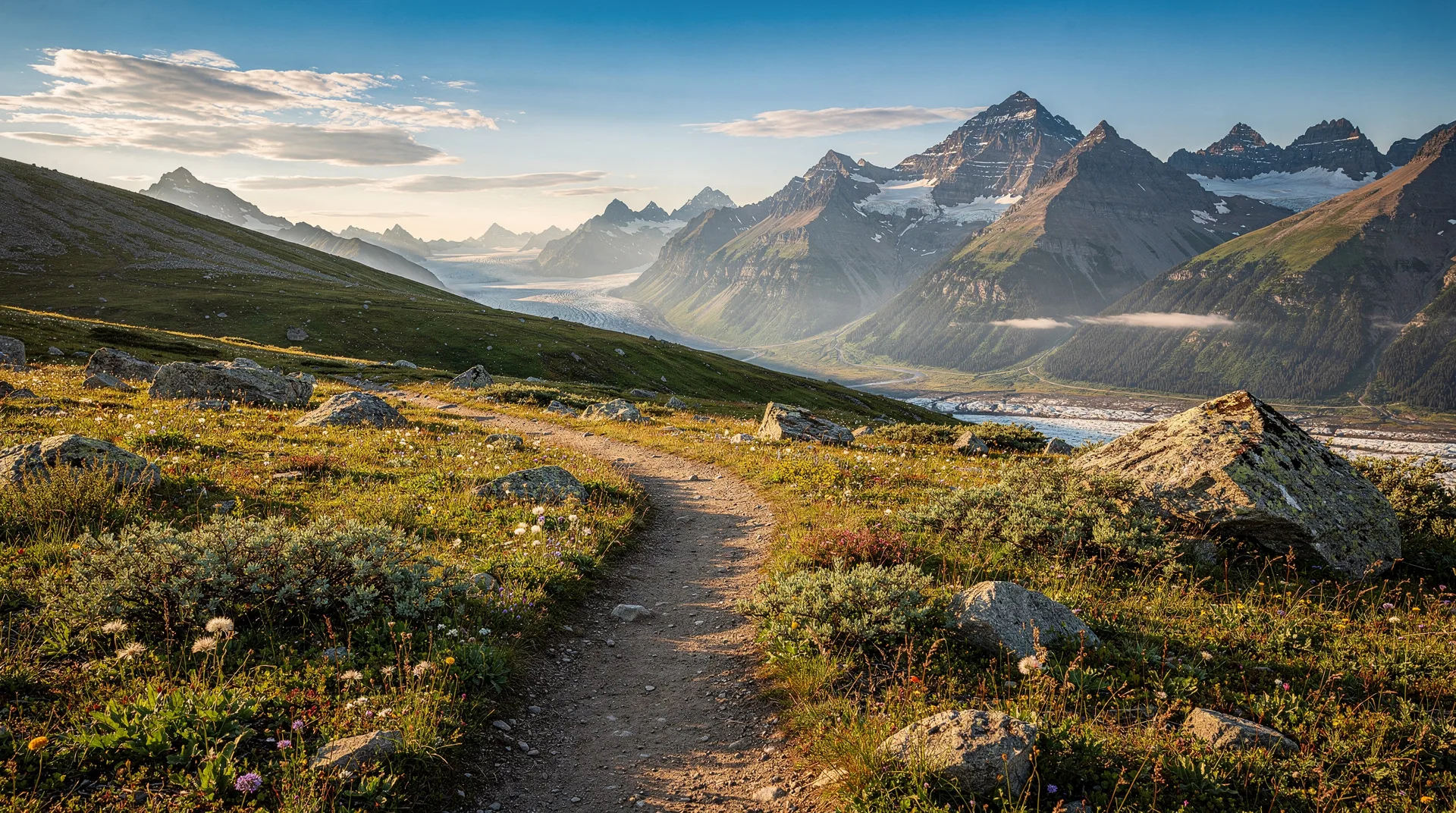
Wilcox Pass hike: best viewpoint on the Icefields Parkway
How hard is the Wilcox Pass hike?
Wilcox Pass is a moderate hike: 8 km return with 335 m elevation gain. Most hikers complete the round trip in 3–4 hours. The trail is well-maintained and the views from the pass — directly opposite the Columbia Icefield — are among the most dramatic on the Icefields Parkway.
Most visitors to the Columbia Icefield area spend their time on the valley floor — at the Glacier Discovery Centre, on the Athabasca Glacier toe, or on the Icefield Skywalk. All of these are worthwhile, but none provides the perspective that the Wilcox Pass hike delivers. From the pass at 2,360 metres, you are looking directly across the valley at the Columbia Icefield from above valley level — the Athabasca Glacier flows down from the ice cap, the surrounding peaks stretch in both directions along the Icefields Parkway, and you are standing at an elevation that gives you the big picture rather than the ground-level view.
Wilcox Pass is consistently recommended by experienced Rockies hikers as the best-value moderate hike along the Icefields Parkway: short enough to do in half a day, visually extraordinary, and with the added possibility of caribou sightings in the alpine meadows above the pass.
At a glance
| Where | Wilcox Creek Campground, Icefields Parkway, 3 km south of the Columbia Icefield Discovery Centre |
| Cost | Free hike; a Parks Canada Discovery Pass (day pass or annual) is required for park entry |
| Time needed | Around 3-4 hours return |
| Getting there | Self-drive on the Icefields Parkway; no shuttle service to this trailhead |
| Best time | July-August most reliable; September for fewer crowds and possible early snow |
Trail overview
Trailhead: Wilcox Creek Campground, 3 km south of the Columbia Icefield Discovery Centre on Highway 93 (Icefields Parkway) Distance: 8 km return to the pass Elevation gain: 335 m Difficulty: Moderate Duration: 3–4 hours return Trail surface: Forest trail transitioning to open rock and meadow above treeline Dogs: Permitted on leash
The trailhead is directly off the Icefields Parkway, 3 km south of the Columbia Icefield Glacier Discovery Centre. Parking is available at Wilcox Creek Campground — visitors not staying at the campground may park in the day use area near the trailhead.
The first 1.5 km climbs steeply through Engelmann spruce forest — this is the most demanding section, but it is relatively short. Above treeline the gradient eases and the trail crosses open tundra and rocky benches, the view expanding with every 50 metres of elevation gain.
By 3 km, the full panorama of the Athabasca Glacier and Columbia Icefield opens to the northwest across the valley. The trail continues across rolling alpine terrain to the pass at 4 km, where the view extends south down the Icefields Parkway and north toward the Sunwapta River valley.
What you see from Wilcox Pass
The view from the pass is geologically and scenically extraordinary. The Columbia Icefield — the largest ice body in the Rocky Mountains of Canada — sits directly across the valley. From the road level, the icefield appears as a field of white above a rock cliff. From Wilcox Pass at 2,360 m, you are looking at it almost straight across, with the Athabasca Glacier (the most accessible tongue of the icefield) flowing down in full profile and the Dome Glacier visible to the right.
The scale is difficult to convey: the glacier tongue is approximately 6 km long from the icefield margin to the current terminus. The rate of retreat is visible in the signposted markers in the valley — the glacier has retreated several hundred metres since visitor monitoring began.
To the south, the Icefields Parkway disappears into the Sunwapta Pass area. To the north, the valley curves toward the Columbia Icefield centre and beyond. The combination of spatial scale and the near-silence of the alpine pass (only wind and birds) makes this one of those viewpoints where visitors routinely stay far longer than planned.
Caribou sightings
The Wilcox Pass area is one of the more reliable locations in Jasper National Park for woodland caribou sightings. The Banff-Jasper caribou herds use the high alpine meadows around the pass as part of their seasonal range. Sightings are not guaranteed — the herds are mobile and the population is under significant pressure — but encounters in the meadows above the pass happen with enough frequency that the possibility should be part of your experience.
If you see caribou: Maintain a minimum 30-metre distance. Do not approach, feed, or make noise that causes them to move. Report sightings to Parks Canada — the data is used for herd monitoring. Caribou in this region are listed as threatened under Canada’s Species at Risk Act.
The presence of caribou means dogs must be leashed at all times and it is worth considering whether to bring a dog to this trail at all — dog scent can displace caribou from critical habitat.
The Columbia Icefield context
The Columbia Icefield straddles the Continental Divide between Alberta and British Columbia at an elevation of 2,300–3,700 metres. It covers approximately 325 km² and feeds eight major glaciers, including the Athabasca (visible from Wilcox Pass), the Saskatchewan (flows east), and the Columbia (flows northwest). Water draining from the icefield reaches three oceans — the Pacific, Arctic, and Atlantic (via Hudson Bay) — making it one of the most hydrologically significant points on the continent.
The Icefields Parkway was completed in 1940 and is consistently ranked among the world’s great scenic drives. The Columbia Icefield is its centrepiece. Most visitors stop at the Discovery Centre and take the Athabasca Glacier Ice Explorer bus tour — both worthwhile but both ground-level experiences. Wilcox Pass provides the aerial perspective that changes your understanding of the scale.
For more on the valley-level icefield experience, see our Columbia Icefield Skywalk guide.
Practical information
Getting to the trailhead
Wilcox Creek Campground is on the Icefields Parkway (Highway 93), 3 km south of the Columbia Icefield Glacier Discovery Centre:
- From Banff: 230 km north on the Icefields Parkway (2.5–3 hours)
- From Jasper: 103 km south (1.5 hours)
- From the Discovery Centre: 3 km south on Highway 93
There is no shuttle service to this trailhead. A car is required. The Icefields Parkway itself is one of the world’s finest road trips — factor in the journey as part of the experience.
Best time to hike
July and August: The most reliable window. The pass is snow-free, the meadows are in flower, and the weather is warmest. Afternoon thunderstorms can develop quickly; start early.
Late June: Some snow may remain near the pass. The wildflower season is just beginning. Ice on the upper trail may require microspikes.
September: Excellent conditions. Cooler temperatures, fewer visitors, possible early snow on the pass adding drama to the views. Caribou movement patterns shift with the season — sightings in September as herds move to lower elevation are possible.
Winter: The Icefields Parkway is maintained year-round but can close temporarily in extreme conditions. The trail to Wilcox Pass is not maintained for winter use; experienced snowshoers can access the lower sections with appropriate equipment, but the upper meadows carry avalanche risk in winter.
What to bring
- Waterproof hiking boots (the meadow sections hold moisture; early season sections may have snow)
- Warm layers — the pass is consistently windy and cold even in summer
- Rain jacket
- 2 litres of water per person
- Sunscreen (UV intensity at 2,360 m is high)
- Bear spray
- Binoculars (for caribou watching and glacier detail)
- Trekking poles (helpful on the steep initial section)
- Camera with telephoto capability for wildlife
Wildlife beyond caribou
The Wilcox Pass area also supports grizzly and black bears (carry bear spray), golden eagles that soar above the ridges, and large populations of pikas and hoary marmots on the rocky terrain. The forest sections at the trail base are productive for birding — Clark’s nutcrackers, pine grosbeaks, and various mountain sparrows are regulars.
Combining with other Icefields Parkway stops
The Wilcox Pass hike fits naturally into a one- or two-day Icefields Parkway drive. Recommended combinations:
- Columbia Icefield Skywalk — 3 km north of the trailhead at the Discovery Centre; combine in a single day
- Athabasca Glacier Ice Explorer tour — valley-level glacier experience that contrasts with the aerial perspective from the pass
- Jasper National Park guide — planning a full Jasper visit including the Icefields Parkway
- Cavell Meadows hike — best day hike from Jasper townsite, 1.5 hours north
- Skyline Trail — the premier multi-day trail in Jasper for more ambitious plans
Frequently asked questions about Wilcox Pass hike: best viewpoint on the Icefields Parkway
Is Wilcox Pass better than the Columbia Icefield Skywalk?
Different experiences. The Skywalk is a constructed glass walkway providing a dramatic valley-floor perspective; the walk is short (15 minutes each way) and the views are impressive but passive. Wilcox Pass is a hike that earns its view; the perspective from the pass is more expansive and the experience more active. For visitors who hike, the pass is substantially more rewarding. For visitors who want an accessible viewpoint without significant hiking, the Skywalk is the better choice.
Can I see the Athabasca Glacier from the trail before reaching the pass?
Yes. Clear views of the Athabasca Glacier open from approximately 2 km into the trail as you emerge above treeline. The views improve progressively with each metre of elevation gain. The full panorama from the pass is the best, but partial glacier views are available well before the summit.
Is Wilcox Pass suitable for children?
Children with hiking experience can handle the 8 km return distance and 335 m elevation gain. The steep initial forest section (first 1.5 km) is the most demanding part. The upper meadow section is easier and the scenery motivates most children. Bring snacks and layer up for the wind at the pass.
Do I need a permit to hike Wilcox Pass?
No backcountry permit is required for a day hike to Wilcox Pass. A valid Parks Canada Discovery Pass (for park entry) is required. This is a straightforward day hike with no quota system. See our Banff park pass guide for how the pass system works across the Rockies parks.
Should I stop here on a Banff-to-Jasper drive?
Yes — Wilcox Pass sits roughly midway along the Icefields Parkway between Banff National Park and Jasper, making it a natural stop on the drive between the two. Pair it with a stop at the Athabasca Glacier viewpoint below the trailhead.
Bear and wildlife awareness
Bear spray is essential gear on this trail, not an optional extra — both grizzly and black bears use the forest and meadow habitat around Wilcox Pass. Carry it accessible (not buried in your pack), know how to use it before you need it, and make noise on the forested lower section where visibility is limited. For the broader picture on bear safety and where sightings are common across the Rockies, see our bear watching in Canada guide.
Book Banff and Icefields Parkway guided experiences