Via ferrata at Mt Norquay: everything you need to know
What is via ferrata and how hard is it at Mt Norquay?
Via ferrata is a protected climbing route with iron rungs, cables, and ladders bolted into rock — no climbing experience required. Mt Norquay has four routes from Explorer (beginner) to Ridgeline (experienced). All routes include a guide, harness, and helmet. Duration ranges from 2.5 to 5 hours.
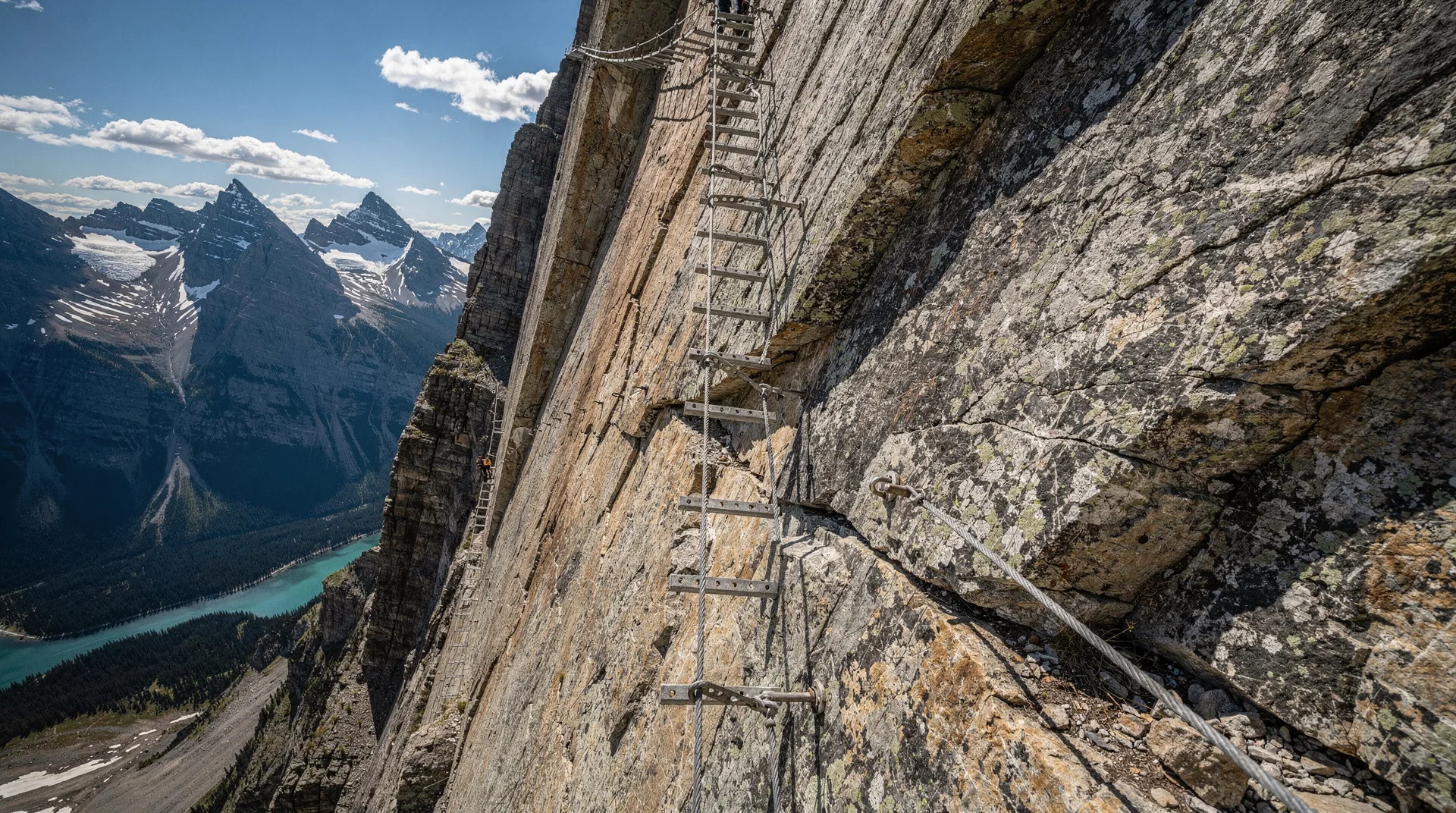
Via ferrata — Italian for “iron road” — is climbing made accessible. A network of iron rungs, steel cables, ladders, and bridges is permanently fixed into a rock face, allowing hikers without technical climbing skills to ascend terrain that would otherwise require ropes, gear, and training. The experience is vertical, physical, and genuinely thrilling; the views from the route sections are dramatic; and the entire time you are clipped to a steel cable that prevents a fall of more than a metre or two.
Mount Norquay’s via ferrata, operating on the ski resort’s cliffs directly above the Bow Valley, is one of the premier via ferrata experiences in Canada. Four routes of varying difficulty — the only via ferrata in the Banff National Park area — make this one of the most accessible ways to experience Rockies terrain from a vertical rather than horizontal perspective. You do not need prior climbing experience. You do need a reasonable level of fitness and comfort with heights.
| At a glance | |
|---|---|
| Where | Mount Norquay ski area, 6 km / around 15 min from Banff townsite |
| Cost | Guided tours are priced per route; expect a premium for the longer Skyline and Iron Horse routes over the Explorer |
| Time needed | 2.5 hours (Explorer) up to 5 hours (Skyline/Iron Horse) |
| Getting there | Own vehicle or taxi from Banff; free parking at the lodge |
| Best time | Mid-June to mid-October, weather permitting |
Routes at Mt Norquay
Mount Norquay offers four via ferrata routes, ranging from an introductory experience to a challenging full-day commitment. All routes require a guide (the via ferrata is not open for unguided climbing) and include a harness, helmet, and via ferrata lanyards.
Explorer route
Duration: 2.5 hours | Difficulty: Beginner | Minimum age: 12 years
The Explorer is the introductory route — the ideal choice for first-timers, families with older children, and anyone who wants to understand what via ferrata involves before committing to longer routes. The route covers a selection of iron rungs and cable sections on the lower cliff band, with good views over the Bow Valley and Banff townsite below.
The Explorer involves real vertical climbing — this is not a scramble. Rungs are bolted into vertical rock faces; some sections require climbing ladders above significant exposure. But the fixed protection is solid, the guide is in constant proximity, and the consequence of a slip is limited to a short pendulum on the cable.
Ridgeline route
Duration: 3.5–4 hours | Difficulty: Intermediate | Minimum age: 14 years
The Ridgeline is the most popular route and the one that provides the full character of via ferrata on Mount Norquay. The route traverses the cliff band at the top of the ski area, combining iron rung sections, cable traverses, and a spectacular bridge crossing above a rocky gully.
The bridge — a suspended steel walkway crossing a gap in the cliff — is the route’s psychological crux for most participants. Physically it is not the hardest section; the exposure of being suspended over open air on a swaying cable bridge is where visitors most frequently confront their relationship with heights. The views from the bridge over the Bow Valley are extraordinary.
Skyline route
Duration: 4–5 hours | Difficulty: Intermediate–strenuous | Minimum age: 14 years
The Skyline extends above the Ridgeline to higher terrain with longer sections of exposed climbing and a summit section that provides the most comprehensive panoramic view on any of the routes. The route is more physically demanding — arms and legs are involved throughout — and the sustained nature of the exposure is greater than the Ridgeline.
This is the route for fit, height-comfortable participants who want a full mountain experience without the multi-day commitment of a Rockies backpacking trip.
Iron Horse route
Duration: 5 hours | Difficulty: Strenuous | Minimum age: 16 years | Limited availability
The Iron Horse is the full mountain experience — a long, committing route that covers the complete span of accessible via ferrata terrain on Norquay’s cliff bands. Physical fitness requirements are high. The route is offered to small groups and has the most limited availability.
Route comparison at a glance
| Route | Duration | Difficulty | Min. age | Best for |
|---|---|---|---|---|
| Explorer | 2.5 hours | Beginner | 12 | First-timers, families |
| Ridgeline | 3.5-4 hours | Intermediate | 14 | Most popular, includes the bridge crossing |
| Skyline | 4-5 hours | Intermediate-strenuous | 14 | Fit visitors wanting a full mountain day |
| Iron Horse | 5 hours | Strenuous | 16 | Committed climbers, limited availability |
Practical information
Booking
Via ferrata at Mount Norquay must be booked in advance. Routes sell out, particularly on weekends in July and August. Same-day booking is rarely possible for popular routes in peak season. If the routes are full on your dates, browse guided tours across Canada for other adventure options.
How to book: Through the Mount Norquay website or via their Banff ski area reservation system. Cancellation policies apply — verify before booking.
Group sizes: Maximum 8 participants per route (guides typically manage 4–8 depending on route). Small group sizes ensure individual attention and a manageable pace.
Season: Via ferrata operates from mid-June through mid-October, weather-permitting. Cold, wet, or icy conditions can result in cancellation or rescheduling — the rock becomes significantly more dangerous when slippery.
What is included
All via ferrata tours at Mount Norquay include:
- Certified professional guide
- Harness
- Helmet
- Via ferrata lanyards (the Y-shaped leash system that keeps you connected to the cable)
- Route briefing and technique instruction
Not included: Transportation to the ski area (arrange your own), personal food and water, appropriate footwear and clothing.
What to wear and bring
- Sturdy, closed-toe shoes with good grip: Trail runners or light hiking boots are ideal. Running shoes are acceptable. Do not wear sandals, flip flops, or casual footwear. The rock surface is rough and grip matters significantly on the rung sections.
- Comfortable athletic clothing: Full range of motion is important. Avoid jeans (restrictive) or loose, flowing clothing that can catch on hardware.
- Warm layer: The cliff sections are exposed and temperatures drop significantly above the valley. Even on warm days, bring a fleece or light insulating layer.
- Rain jacket: Weather can change; a packable shell is worth carrying.
- 2 litres of water: The physical exertion is significant; hydration is important throughout the route.
- Snacks: Energy bars or similar for multi-hour routes.
- Sunscreen and sunglasses: Exposed sections offer no shade.
No experience required: Bring only these items and the guide handles everything else.
Getting to Mount Norquay
Mount Norquay ski area is 6 km north of Banff townsite on Mount Norquay Road. The drive takes approximately 15 minutes from downtown Banff. The parking area at the ski lodge is free. Via ferrata participants meet at the lodge and are briefed before heading to the route start.
Parks Canada Discovery Pass is required for park entry (for visitors not already holding one).
Book guided Banff adventure activities including via ferrataWhat to expect on the route
At the start: Your guide will fit your harness and helmet, demonstrate the via ferrata lanyard system, and explain how to clip and unclip at bolt stations. This instruction is thorough and takes approximately 20–30 minutes before climbing begins.
On the route: You clip one of the two lanyard arms to the fixed cable before unclipping the other — this system ensures you are always connected. On vertical rung sections, this is intuitive once explained. On traverses and bridges, the clipping sequence requires more attention.
Physical demands: Arms are used significantly more than in regular hiking. The grip required on iron rungs, combined with sustained vertical movement, produces muscle fatigue that is unfamiliar for hikers unused to climbing. Taking breaks on the cable (the system holds you securely while you rest) is normal and expected.
Height exposure: Via ferrata is inherently exposed. On the Ridgeline and Skyline routes, you are regularly looking down at steep or vertical terrain below. This is manageable with the fixed protection system, but visitors with a severe fear of heights (not the typical mild discomfort most people feel) should consider whether via ferrata is the right activity.
Safety
Mount Norquay’s via ferrata is one of the safest ways to access exposed mountain terrain. The fixed hardware — cables, rungs, ladders — is inspected and maintained seasonally. The via ferrata lanyard system limits any fall to a short pendulum swing. Professional guides are trained in rope rescue techniques.
The primary risks are:
- Wet or icy rock: Via ferrata is significantly more dangerous on slick surfaces. Routes close in inclement weather for this reason.
- Fatigue: Tired climbers make mistakes on rung placement and clipping sequences. Guides monitor group energy and pace accordingly.
- Rockfall: Natural rockfall can occur on cliff environments. Routes are designed to minimize exposure to overhead hazards; helmets are mandatory for this reason.
How via ferrata compares to other Banff adventure activities
Via ferrata sits at a specific point on the Banff adventure spectrum: more vertical and adrenaline-focused than a hike, but far less technical or committing than roped rock climbing. For those weighing options, the Ha Ling Peak hike delivers a comparable payoff of summit views and physical effort without any exposure to cliff-face climbing, while helicopter tours of the Rockies give an aerial version of the same scenery for those who would rather not clip into a cable at all.
Combined with a soak at Banff Upper Hot Springs afterwards, via ferrata makes a strong single-day Banff itinerary for visitors who want more than sightseeing but less than a multi-day mountaineering trip. For general park logistics — entry fees, when to go, how to get around — see the Banff National Park guide and the Banff park pass guide.
Related guides
- Banff National Park guide — full Banff planning guide
- Ha Ling Peak hike — a demanding summit day hike for those who prefer hiking to climbing
- Helicopter tours of the Rockies — aerial perspective on the same peaks
- Canoeing on Rockies lakes — a contrast activity from the water level
- Banff Upper Hot Springs — recovery soak post-route
Frequently asked questions about Via ferrata at Mt Norquay: everything you need to know
Do I need prior climbing experience?
No. The via ferrata system is specifically designed for people without climbing experience. The guide provides full instruction and the fixed hardware does the work that would otherwise require rope skills. What you need is reasonable fitness, a willingness to move in vertical terrain, and comfort with moderate heights.
Is via ferrata safe?
Via ferrata is extremely safe when conducted by certified operators with properly maintained hardware. The fixed cable system limits falls to a short pendulum. The primary safety factors are weather (wet rock is dangerous — tours are cancelled in inclement conditions), fatigue management, and following guide instructions.
What is the minimum age?
The Explorer route accepts participants from age 12. The Ridgeline and Skyline require age 14+. The Iron Horse route requires age 16+. Children must be accompanied by a parent or guardian. All participants must be able to understand and follow safety instructions.
Can I do via ferrata if I’m afraid of heights?
A mild fear of heights is common and most people find it manageable with the security of the cable system. Severe acrophobia (panic response to height exposure) makes via ferrata genuinely difficult. If you are uncertain, start with the Explorer route — the shorter commitment and presence of the guide makes it the best way to test your response to exposure. Do not push beyond your genuine comfort level on a cliff face.
How does via ferrata compare to rock climbing?
Via ferrata uses fixed iron rungs, cables, and ladders that are already bolted into the rock, so you climb using your own strength but without placing or managing protection yourself — that’s the guide’s job via the pre-installed hardware. Traditional rock climbing requires learning rope systems, belaying, and gear placement. Via ferrata is far more accessible for a single day out and requires no prior training.
What should I do in Banff after via ferrata?
A soak at Banff Upper Hot Springs is the classic recovery activity — arms and legs both get a real workout on the route. For a lower-key alternative activity the same trip, canoeing on Rockies lakes offers a contrasting, flat-water perspective on the same mountains.