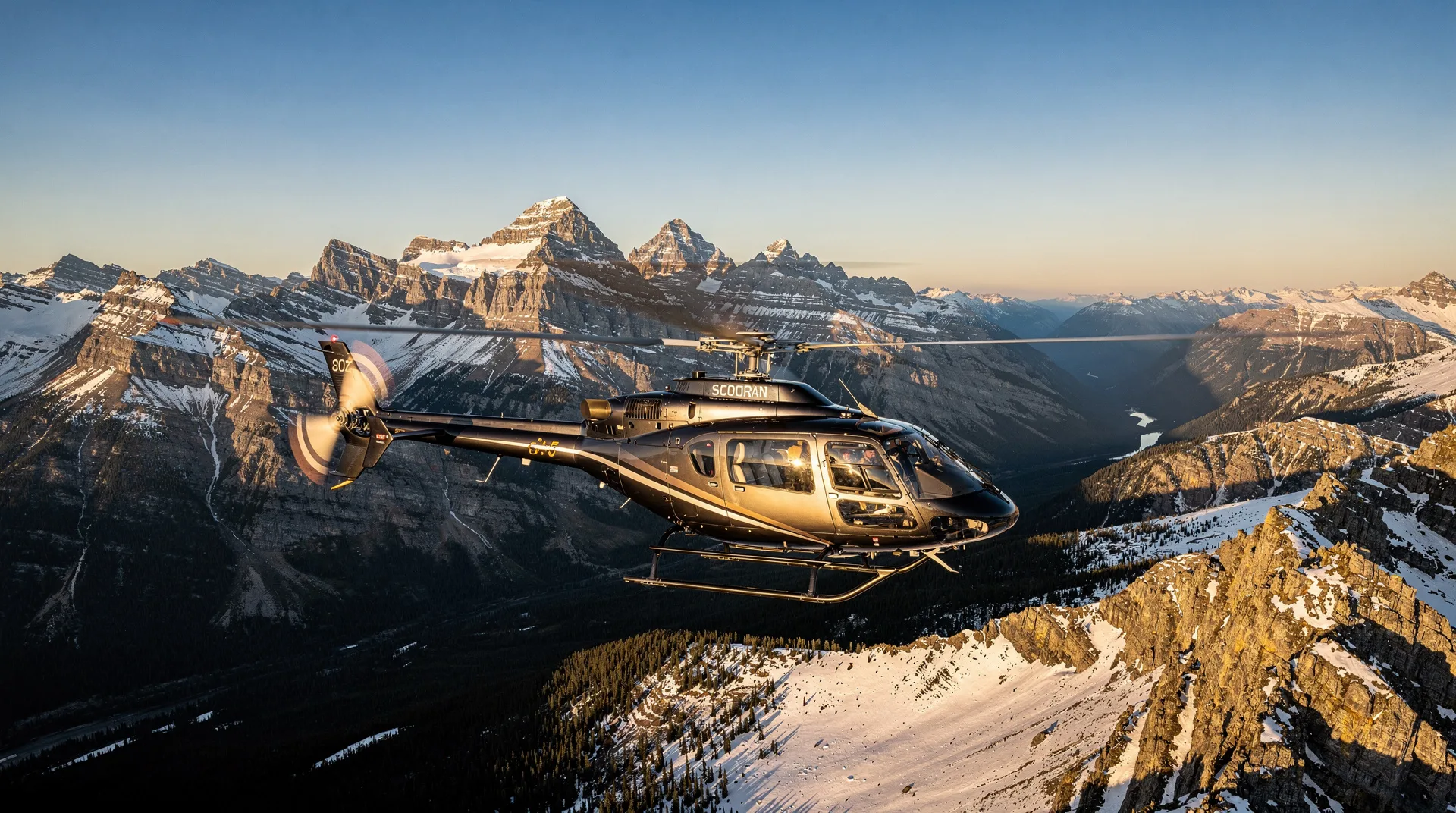
Helicopter tours over the Canadian Rockies: Banff, Jasper, and Whistler
Are helicopter tours in the Canadian Rockies worth it?
Yes — a helicopter tour over Banff or Jasper gives you perspectives on the Rockies that are simply impossible from any trail or viewpoint. The combination of glaciers, turquoise lakes, and mountain ranges stretching to the horizon in every direction makes even a 20-minute flight one of the most memorable experiences in the Canadian Rockies.
The Canadian Rockies look extraordinary from the valley floors. From a helicopter, they look otherworldly. The transformation in perspective that happens when you lift off from a Banff or Jasper helipad and rise above the treeline reveals a landscape that no photograph — and certainly no road trip — can adequately convey. Glaciers that appear as distant white smudges from the Icefields Parkway fill the entire window. Mountain ranges stack up to the horizon in every direction. The lakes — Moraine, Peyto, Bow — glow in those impossible blues because you can now see the suspended glacier flour from directly above rather than from the shore below.
Helicopter tours over the Canadian Rockies have operated for decades, and the combination of experienced pilots, modern turbine helicopters, and genuinely spectacular terrain has made them one of the most sought-after experiences in the region. Options range from 15-minute introductory circuits over the Bow Valley to 90-minute glacier landing expeditions that set down on the Wapta Icefield at 2,800 metres. Understanding what each tour type delivers helps calibrate expectations and budget.
| At a glance | |
|---|---|
| Where | Helipads near Canmore, Golden BC, Jasper, and Whistler |
| Cost | Around CAD 200–750 per person depending on flight length and glacier landing |
| Time needed | 20 minutes airtime for scenic circuits; 90 minutes for glacier expeditions (add 20–30 min ground time) |
| Getting there | Own vehicle or airport transfer; tours cannot operate from within Banff townsite itself |
| Best time | June to September, mornings for the calmest air |
What to expect on a Rocky Mountain helicopter flight
Typical flight experience
Most Rockies helicopter tours run in light turbine helicopters carrying 3–6 passengers in addition to the pilot. The standard configuration is either a Bell 206 (4 passengers) or an Airbus H125 (5–6 passengers), both of which offer large windows and excellent visibility in all directions. Tours operate from helipads at or near the major resort towns — Banff, Canmore, Lake Louise, Jasper, and Whistler on the BC side.
Pilots provide commentary throughout the flight, identifying peaks, glaciers, and geographic features. The commentary quality varies between operators; the best pilots are both technically expert and genuinely knowledgeable about the geology and ecology below.
Flight durations are quoted as airtime, not total time — ground time for briefing, boarding, and disembarking adds 20–30 minutes to the published flight duration. A 20-minute flight will take about 50 minutes from arrival at the helipad to departure.
Glacier landing flights
The most exclusive helicopter tour category in the Rockies is the glacier landing flight. These tours — typically 45–90 minutes — include a landing on a glacier surface, usually on the Wapta Icefield, the Columbia Icefield, or the Illecillewaet Glacier near Revelstoke. Walking on a glacier accessed by helicopter feels remote and pristine in a way that the Athabasca Glacier (accessible by Brewster snowcoach from the highway) does not.
Some glacier landing tours include a guided walk of 30–60 minutes on the ice surface with crampons provided. The combination of the flight and the glacier walk is a legitimate wilderness experience despite the mechanised access.
Best helicopter tour operators in the Rockies
Canadian Rockies Helicopters (Banff and Canmore)
Canadian Rockies Helicopters is the most prominent operator for the Banff corridor, with helipads at Canmore (the practical headquarters for Banff-area flights, as commercial helicopter tours cannot operate from within the national park townsite itself). Their tours range from 20-minute Bow Valley circuits to 60-minute multi-glacier flights over the Waputik and Wapta icefields.
Their Glacier Discovery tour (approximately 50 minutes airtime) is the most popular — it includes a landing on a glacier and ranks among the most-reviewed helicopter experiences in the entire Rockies region. The flight path typically crosses Lake Louise, Moraine Lake, and the Valley of the Ten Peaks en route to the glacier landing, meaning you see three of the most iconic landscapes in Banff from above in a single flight.
Browse Banff helicopter tours and mountain experiences on GetYourGuide for day-of or advance bookings with flexible cancellation.
Rockies Heli Canada (Golden, BC)
Golden, British Columbia — located between Banff and Revelstoke on the Trans-Canada Highway — is home to Rockies Heli Canada, which offers helicopter tours with a unique perspective on the Selkirk and Purcell ranges in addition to the main Rockies. Their glacier landing tours on the Bugaboo Glacier are particularly dramatic — the Bugaboos are granite spires in the Purcell Range that have no equivalent in the main Rockies range and are genuinely world-famous among mountaineers.
Alpine Helicopters (Canmore)
Alpine Helicopters, operating from Canmore, is one of the longest-established operators in the region with a reputation for pilot quality and aircraft maintenance. Their tours are similar in structure to Canadian Rockies Helicopters and the choice between them often comes down to availability on your preferred date.
Compare helicopter and air tours across Canada on GetYourGuide for options in Banff, Jasper, and other regions.
Yellowhead Helicopters (Jasper)
Jasper’s helicopter tour offering is focused on the Columbia Icefield corridor and the peaks surrounding Jasper townsite — Pyramid Mountain, Mount Edith Cavell, and the Tonquin Valley. Yellowhead Helicopters operates from a helipad just outside Jasper National Park boundaries, with tour routes offering views that are visually different from the Banff tours — the northern Rockies are somewhat less dramatic in relief but have a wilder, less-visited feel.
The Skyline Tour (approximately 30 minutes) covering the Jasper valley and surrounding peaks is the entry-level option; the Columbia Icefield Adventure (60+ minutes) reaches the icefield and offers a glacier landing.
Blackcomb Aviation (Whistler, BC)
Whistler’s helicopter touring is operated primarily by Blackcomb Aviation, which offers flights from the Whistler airport (a short drive from the village) over Whistler and Blackcomb peaks, the Garibaldi Provincial Park wilderness, and the Coast Mountains glaciers. The scenery is different from the Rockies — the Coast Mountains are steeper, more heavily glaciated, and separated from the Sea-to-Sky corridor by dramatic vertical relief.
The Glacier Discovery flight (30 minutes) from Whistler lands on a glacier in the Pemberton Icecap or adjacent icefield, with excellent views of Mount Garibaldi and the peaks of Garibaldi Provincial Park.
For the broader Whistler experience, see the Whistler skiing guide and the Vancouver to Whistler guide.
Best locations compared
Banff/Canmore: The most iconic Rocky Mountain scenery, including Moraine Lake and Lake Louise from above. Easiest access from Calgary International Airport (1.5 hours). Most operators and tour variety. Highest demand — book ahead.
Jasper: Wilder and less crowded, with Columbia Icefield access. Longer drive from Calgary (4 hours) or fly to Edmonton (4.5 hours to Jasper). Fewer operators means more personalized experience.
Golden/Bugaboos: Unique granite spire scenery of the Purcells and Selkirks, different from the Rockies’ sedimentary layering. Best for experienced mountain travellers wanting something off the standard tourist route.
Whistler: Accessible from Vancouver (2 hours). Coast Mountain glaciers and the Garibaldi backcountry. Good option for visitors combining Vancouver and Whistler without a Rockies trip.
Whichever base you choose, a flight works best as one highlight inside a wider plan. If you are still deciding between the two main bases, the Banff vs Jasper comparison lays out how the towns differ, and the Jasper National Park guide covers what to do on the ground after you land. Travellers heading north can pair a flight with the Icefields Parkway, and anyone who wants to see the Columbia Icefield from the ground as well can read about the Columbia Icefield Skywalk. For a full trip around the flight, the Canadian Rockies in 10 days itinerary and the Banff and Jasper 7-day itinerary show where a scenic flight fits comfortably.
Best time of year
June–September: The primary operating season for helicopter tours across the Rockies. Clear mornings are common, and visibility from altitude is typically excellent. July and August are peak demand.
July (optimal): Longest days, least snow on approach routes, most stable mountain weather. The glaciers show crevasse detail clearly at this time of year as seasonal snow has melted.
September: Outstanding light quality as the sun lowers, early snow on the upper peaks, and fewer tourists. September is often preferred by photographers for the warm-toned light on the Rockies.
Winter: A small number of operators run scenic flights in winter, but glacier landing tours are largely suspended December through April due to snow conditions that make landing unpredictable. Check directly with operators for winter availability.
Morning flights: The mountain atmosphere is most stable in the morning before convective heating develops. Book the earliest available slot for the smoothest flight and best chance of clear skies around the summits.
How to book and what to bring
Booking: Book glacier landing flights 2–4 weeks ahead in July and August. Day-of booking is sometimes possible for shorter scenic circuits, but the popular glacier tours fill quickly on good-weather days. Operators often have weather cancellation clauses that make advance booking lower-risk than it might appear.
Weather policies: Most operators will not fly in low cloud, poor visibility, or high winds. They offer rescheduling or refunds when weather prevents flying. Build flexibility into your schedule if possible — mountain weather is most predictable in the morning, and tours sometimes run in the afternoon when morning clouds clear.
What to bring:
- Warm layers — glacier elevations are 2,500–3,000 m and temperatures are 10–15°C colder than the valley even in summer
- Secure-fit shoes appropriate for walking on uneven terrain (for glacier landing tours)
- Camera — bring it charged, and use a wrist strap
- Sunglasses and sunscreen — UV intensity at glacier elevation is significantly higher than at valley level
- Small secure bag for personal items
Leave behind: Loose hats (they will blow off during boarding/disembarking), large backpacks (not permitted in small helicopters), and items that could become dangerous if dropped.
Costs in Canadian dollars
20–25 minute scenic circuit (Banff area): CAD 200–280 per person 30–35 minute extended scenic tour: CAD 280–380 per person 45–50 minute glacier landing tour: CAD 420–550 per person 60–90 minute extended glacier expedition: CAD 550–750 per person Private charter (full helicopter, 4 passengers, 30 min): CAD 1,200–1,600 total Whistler glacier flight (30 min): CAD 250–320 per person
Private charters offer value for groups of 4 as the per-person cost approaches or matches shared tour pricing while allowing complete schedule flexibility.
If the flight is a one-off treat, pair it with free or low-cost days elsewhere. The Moraine Lake guide and the Lake Louise vs Moraine Lake comparison help you decide which of the lakes you saw from above deserves a visit from the shore, and the Banff Gondola gives a far cheaper high-viewpoint option for a second day.
Safety and tips
Helicopter tours in Canada are operated under Transport Canada aviation regulations and are statistically among the safest forms of aviation. The risks are low and professionally managed, but a few preparation points apply.
Motion sickness: Helicopter flight, particularly in mountain conditions, involves more motion than fixed-wing aircraft. If you are susceptible to motion sickness, take medication (Dramamine/Gravol) at least one hour before the flight, choose a front seat, fix your gaze on the horizon when possible, and avoid heavy meals beforehand.
Ear pressure: Helicopters descend and ascend quickly. Swallowing, yawning, or chewing gum manages ear pressure during altitude changes.
Noise: Helicopter cabins are noisy despite noise-cancelling headsets. The headsets are essential both for comfort and to hear the pilot’s commentary — keep them on throughout the flight.
Boarding and disembarking: Always approach and leave the helicopter from the front, in view of the pilot, and only when signalled. Never walk toward the tail rotor. The crew will guide you, but this rule is absolute.
Helicopter tours vs hiking to the same viewpoints
A helicopter tour and a hiking trip aren’t really substitutes — they show different things. A summit hike like Ha Ling Peak near Canmore gives an earned, ground-level perspective and costs nothing beyond your own effort and time; a helicopter flight over the same Bow Valley terrain shows the scale and pattern of the mountain ranges that no trail can reveal, at real cost and with none of the physical demand.
Longer trails like Healy Pass reach wildflower meadows and larch forests a helicopter simply flies over without landing (unless you book a glacier landing tour specifically). For travellers who want both, a common pattern is a hiking-focused trip in Banff National Park with a single helicopter flight booked as the trip’s signature splurge rather than a daily activity.
Comparing tour lengths and what you actually see
| Tour type | Typical airtime | What’s included |
|---|---|---|
| Scenic circuit | 15–25 minutes | Bow Valley or local peaks, no landing |
| Extended scenic tour | 30–35 minutes | Wider valley views, multiple ranges |
| Glacier landing tour | 45–50 minutes | Landing on ice, short walk, crampons provided |
| Extended glacier expedition | 60–90 minutes | Longer glacier walk, multiple icefields overflown |
Where to stay nearby
Banff: The full range from Tunnel Mountain Campground (CAD 29–38/night) to Fairmont Banff Springs (CAD 500–900/night). Mid-range options include Elk + Avenue Hotel and Moose Hotel and Suites. See the Banff National Park guide for comprehensive accommodation guidance.
Canmore: Many Banff visitors stay in Canmore (15 minutes east of Banff on the Trans-Canada), where prices are lower and the restaurant scene is excellent. Falcon Crest Lodge and Banff Boundary Lodge are solid mid-range options.
Jasper: Fairmont Jasper Park Lodge is the iconic luxury option; Lobstick Lodge and various downtown motels provide budget-friendly alternatives.
Whistler: See the Vancouver to Whistler guide for detailed accommodation options.
Frequently asked questions about Helicopter tours over the Canadian Rockies: Banff, Jasper, and Whistler
Do I need to book helicopter tours in advance?
For glacier landing tours in July and August, yes — book 2–4 weeks ahead. Shorter scenic circuits have more daily capacity and can sometimes be booked same-day, but weather-good days fill quickly. If your trip has fixed dates, book as soon as your travel is confirmed.
Can children go on helicopter tours?
Most operators accept children as young as 2–3 years old on scenic flights. Glacier landing tours may have a minimum age of 5–8 due to the need to walk on the ice surface. Very young children may not need a separate seat if they sit on a parent’s lap — check with the specific operator.
What if I’m nervous about flying?
Helicopter flights in calm mountain air are typically smooth. Turbulence is uncommon on morning flights and operators routinely take passengers who are anxious about flying. Tell the pilot or ground staff if you’re nervous — they will explain what to expect and choose routes or altitudes that minimize discomfort.
How is the experience different between Banff and Jasper?
Banff/Canmore tours typically showcase more iconic recognizable scenery — Moraine Lake, the Valley of the Ten Peaks, and Lake Louise are world-famous. Jasper tours feel wilder and less commercially developed, with access to the Columbia Icefield’s vast expanse. Both are spectacular; the choice depends on where you’re based.
Are helicopter tours affected by wildfire smoke?
Wildfire smoke is an increasing presence in the Rockies during August, particularly in dry years. Heavy smoke reduces visibility and operators may adjust routes or cancel flights. July and early August are generally clearer than late August in smoke-affected years.
Is there a weight limit?
Most operators have a maximum passenger weight of 113–120 kg and require accurate weight disclosure at booking. Weight affects fuel calculations and centre-of-gravity — operators take this seriously. Private charters have more flexibility.
Is a helicopter tour a good alternative to hiking for less mobile travellers?
Yes — a scenic circuit requires no walking beyond boarding the aircraft, making it one of the few ways to see Rockies glacier and lake scenery up close without hiking. Glacier landing tours do require walking on uneven ice, so travellers with mobility concerns should book a scenic-only flight rather than a landing tour.