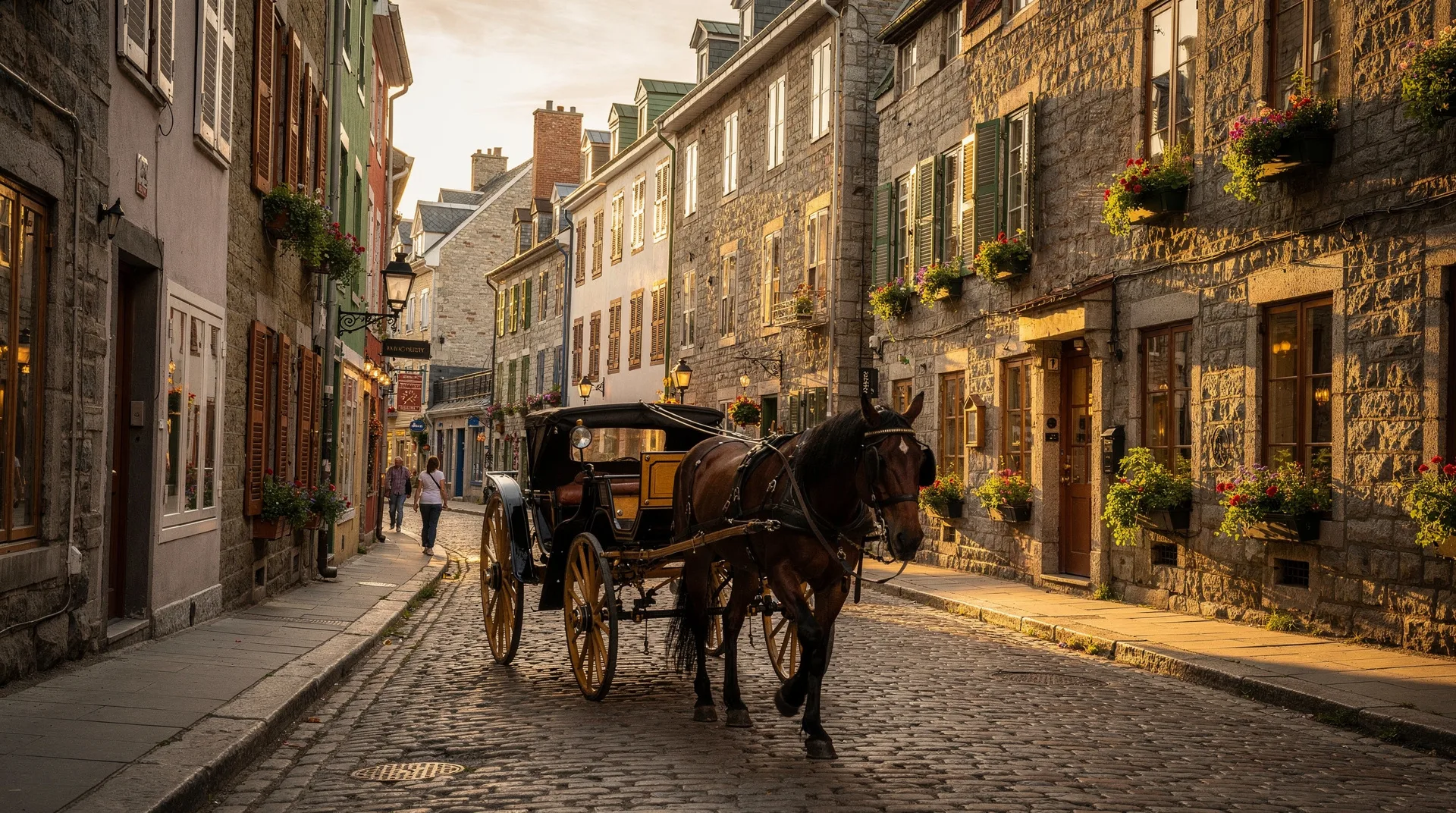
Vieux-Montréal: cobblestones, basilicas and waterfront life
What is Vieux-Montréal known for?
Vieux-Montréal (Old Montreal) is the historic heart of the city — a district of 17th to 19th-century stone buildings, cobblestone streets, and public squares along the St. Lawrence River. Key highlights include Notre-Dame Basilica, Place Jacques-Cartier, the Old Port, and the Pointe-à-Callière archaeology museum.
At a glance
| Where | Along the St. Lawrence River, downtown Montreal, around Square-Victoria and Champ-de-Mars metro stations |
| Cost | Free to walk; Notre-Dame Basilica around CAD $10, AURA show around CAD $35-45, Pointe-a-Calliere around CAD $20-25 |
| Time needed | Half a day for the highlights, a full day to eat well and linger |
| Getting there | Metro (Square-Victoria-OACI or Champ-de-Mars) or a short walk from downtown |
| Best time | June-August for terrasse life and festivals; September-October for calmer, still-warm days |
The city’s historic heart beside the river
Montreal is a vast, vibrant, multi-layered metropolis of 2 million people, but its soul lives in a 90-hectare district along the St. Lawrence River that has been inhabited continuously since 1642. Vieux-Montréal (Old Montreal) is where the city began, where the Société de Notre-Dame built their mission settlement on the banks of the river, where fur traders and merchants built the stone warehouses that still stand today, and where Montreal transformed from a colonial outpost to a commercial capital.
Walking Vieux-Montréal today means navigating the layers of that history — Amerindian occupation stretching back thousands of years (revealed in spectacular detail at the Pointe-à-Callière museum), French colonial architecture from the 17th and 18th centuries, British-era commercial expansion in the 19th century, early 20th-century civic grandeur, and a contemporary neighbourhood that has successfully reinvented itself as one of North America’s most charming urban districts.
The streets here are actual cobblestones — unevenly set and ankle-twisting in heels, but authentic in a way that polished tourist districts rarely are. The buildings are limestone, many with thick walls built to withstand Montreal winters. The Old Port waterfront, once lined with grain elevators and cargo cranes, is now a lively recreational area. Notre-Dame Basilica’s twin towers still anchor the skyline.
Notre-Dame Basilica: an extraordinary interior
The Basilica of Notre-Dame of Montreal is the jewel of Vieux-Montréal and one of the most stunning church interiors in North America. The exterior, designed by Irish-American architect James O’Donnell and completed in 1829, is impressive in its Gothic Revival grandeur. But it is the interior that takes your breath away.
The nave is a breathtaking composition in cobalt blue, gold, and indigo — the vaulted ceiling decorated with thousands of gilded stars, the altar carved from maple, basswood, walnut, and pine in intricate relief, the stained glass windows depicting scenes from early Montreal history rather than biblical narrative. Every surface is richly worked. The acoustics are cathedral-perfect.
The Sacré-Coeur Chapel at the rear of the basilica, originally built in 1891 and rebuilt after a fire in 1978, features a spectacular contemporary bronze altarpiece by Quebec sculptor Charles Daudelin — a remarkable fusion of tradition and modernity.
AURA: In the evenings, Notre-Dame hosts the AURA immersive sound-and-light experience, which transforms the interior into a spectacular multimedia installation. This is a ticketed event separate from daytime admission and has become enormously popular. Tickets run CAD $35–$45 per person and must be booked well in advance.
Practical: Admission to the basilica during the day costs CAD $10. Guided tours run approximately 45 minutes. Dress modestly (shoulders and knees covered). Photography is permitted but flash is not.
Book Old Montreal walking tours and Notre-Dame visits on GetYourGuidePlace Jacques-Cartier: the living square
Place Jacques-Cartier is Vieux-Montréal’s main public square — a long, sloping plaza that descends from the hill toward the Old Port, lined on both sides with historic buildings containing restaurants, cafes, and tourist shops. A column bearing a statue of Admiral Horatio Nelson stands at the top of the square.
In summer, the square is alive with street performers, flower vendors, outdoor restaurant terrasses, and the constant flow of visitors and locals. It is theatrical, occasionally chaotic, and completely entertaining. Grab a coffee at one of the terrasses and watch the parade.
In winter, the square takes on a different character — quieter, blanketed in snow, with a Christmas market in December and the magical visual effect of snow against the stone buildings.
The Old Port (Vieux-Port) and waterfront
The Old Port of Montreal stretches for 2.5 kilometres along the St. Lawrence River and was the engine of Montreal’s commercial power through the 19th and early 20th centuries. The transformation from working port to recreational waterfront is one of Canada’s great urban success stories.
Pointe-à-Callière Museum is built directly over the archaeological site of the city’s first settlement. Excavations beneath the building revealed thousands of years of artifacts — Indigenous occupation, French colonial settlement, the original public cemetery, the earliest commercial infrastructure. The museum’s underground sections walk visitors through these layers of time, with original artifacts in situ and thoughtful interpretive displays. This is one of Canada’s best archaeology museums. Allow 2 hours.
The Old Port promenade runs along the river, with cycling paths, outdoor skating in winter (the outdoor rink is one of the largest in the world), and views across the St. Lawrence to the South Shore. The Clock Tower at the foot of Place Jacques-Cartier is a 1922 landmark commemorating merchant seamen.
Science Centre and IMAX: The Montreal Science Centre on the Quay de King Edward has interactive science exhibitions and an IMAX cinema, excellent for families.
Cirque du Soleil’s base is nearby in Saint-Michel, but many Cirque shows perform under the big top at the Old Port site — check the current touring schedule.
Exploring the cobblestone streets
Vieux-Montréal rewards unhurried exploration. The best streets and corners:
Rue Saint-Paul is the longest and busiest heritage street, running the length of Vieux-Montréal parallel to the waterfront. Lined with galleries, restaurants, boutiques, and some of the finest 19th-century commercial buildings in Canada.
Rue Saint-Sulpice runs through the quiet southern section of the district, past the Séminaire de Saint-Sulpice — the oldest surviving building complex in Montreal (1685), still occupied by the Sulpician order.
Place d’Armes is the historic central square of Old Montreal, dominated by the Notre-Dame Basilica and surrounded by some of the city’s most significant heritage buildings: the Banque de Montréal (1847) with its neoclassical exterior and magnificent banking hall, and the New York Life Building (1888), Montreal’s first skyscraper.
The underground city connection: Vieux-Montréal is the starting point of Montreal’s famous underground city (RÉSO) — a 33-kilometre network of tunnels connecting metro stations, hotels, office towers, and shopping centres. During winter, this is not merely convenient but genuinely useful for navigating in extreme cold.
Where to eat in Vieux-Montréal
The neighbourhood is dense with restaurants ranging from tourist-oriented to genuinely excellent. Rue Saint-Paul has the highest concentration; for better value and fewer tourists, venture to parallel streets.
DNA Restaurant — contemporary Québécois cuisine in a beautifully restored space, focusing on local ingredients and an exceptional natural wine list.
Garde Manger — celebrity chef Chuck Hughes’ beloved seafood-focused restaurant on Rue Saint-François-Xavier. Inventive, lively, excellent.
Crew Collective & Café — housed in the former Royal Bank of Canada headquarters (1928), with a spectacular banking hall ceiling. Best for coffee and seeing one of the most beautiful interiors in the neighbourhood.
L’Original — another focus on Québécois cuisine with a strong Quebec wine and beer program.
Satay Brothers — not obvious in Vieux-Montréal, but this Southeast Asian street food counter near the Old Port is beloved by locals for outstanding satay and laksa.
Best time to visit Vieux-Montréal
June–August is peak season with warm weather, the terrase Dufferin equivalent of Place Jacques-Cartier fully alive, the Old Port promenade busy, and every restaurant running at full capacity. The Montreal Jazz Festival in late June/early July draws 2 million visitors; some free outdoor stages are in and around Vieux-Montréal.
December transforms the neighbourhood into a magical Christmas market landscape. The Marché de Noël du Vieux-Port is charming.
February coincides with Montréal en Lumière, a winter festival with outdoor installations, light shows, and special restaurant events.
Fall (September–October) is arguably the best time for comfort and crowd levels — still warm enough for terrasse dining, but much calmer than summer.
Getting to and around Vieux-Montréal
Metro: Square-Victoria–OACI (Green Line) and Champ-de-Mars (Orange Line) are the most convenient metro stations. A short walk from either brings you to the centre of the neighbourhood.
Cycling: BIXI bike share (Montreal’s docking bike system) has stations throughout Vieux-Montréal and the Old Port. Cycling the waterfront promenade is one of the great Montreal urban experiences.
Walking: The entire district is compact and best explored on foot. Cobblestones are uneven; sensible footwear is important.
Car: Parking in Vieux-Montréal is available but expensive in summer. Taking transit or cycling is more practical.
Vieux-Montréal at night and after dark
Beyond the AURA show, the district changes character after dinner: Place Jacques-Cartier’s terrasses stay busy into the evening in summer, and the cobblestone streets around Rue Saint-Paul are quieter and atmospheric with the stone buildings lit up. The Clock Tower and Old Port promenade are pleasant for an evening walk with river views, and several rooftop bars (including at Hotel William Gray) make the most of the skyline. Winter evenings are colder but the Christmas market lighting and snow on the stone facades give the district a genuinely different, magical feel from its summer self. If you would rather have a local guide, you can compare Montreal guided tours and activities for evening and daytime outings.
Day trip pairing: Vieux-Montréal and Quebec City
Many visitors combine Vieux-Montréal with a Quebec City stop, using VIA Rail’s corridor service (see our VIA Rail within Quebec guide) to connect the two in about 3h20m. If Old Montreal is your first stop on a wider Quebec trip, our Montreal to Quebec City guide and the Quebec City vs Montreal comparison help decide how to split your time.
For broader Montreal trip planning, see the Montreal destinations guide, the Quebec City guide, the craft beer guide for Montreal’s breweries, and the Montreal food guide for restaurants beyond the Old Port.
Frequently asked questions about Vieux-Montréal: cobblestones, basilicas and waterfront life
How long should I spend in Vieux-Montréal?
A half-day covers the highlights at a brisk pace: Notre-Dame, Place Jacques-Cartier, a walk along the Old Port, Pointe-à-Callière. A full day allows you to slow down and eat well. If you are staying in Montreal for several days, Vieux-Montréal warrants a full day plus an evening visit for the AURA show or dinner.
Is Vieux-Montréal safe?
Yes, it is one of Montreal’s safest and most policed areas. Normal urban precautions apply (watch your belongings in crowds, especially in summer). The neighbourhood is busy with tourists and residents until late at night.
Do I need a car to visit Vieux-Montréal?
No. It is easily accessible by metro (Green Line or Orange Line) and entirely walkable once there. The Old Port cycling path connects to Montreal’s extensive cycling network.
Is Notre-Dame Basilica worth the admission?
The interior is extraordinary and widely considered one of the most beautiful in North America — well worth the CAD $10 admission for any visitor with an interest in architecture, art, or history. The AURA evening experience is separately priced and highly recommended for those interested in immersive art.
What is the best photography spot in Vieux-Montréal?
The view along Rue Notre-Dame toward the twin towers of the Basilica is the classic shot. The rooftop bar at Hotel William Gray has panoramic views over Place Jacques-Cartier and the waterfront. The Old Port Clock Tower area at sunset offers spectacular river views.
Can I walk from Vieux-Montréal to Plateau-Mont-Royal?
It’s a long walk (about 3.5 km north), but possible in good weather. Most visitors take the metro (Champ-de-Mars to Mont-Royal or Laurier). A BIXI bike is a pleasant option.
What languages are spoken in Vieux-Montréal?
French is the first language of the neighbourhood and the city, but English is widely spoken in tourist-facing contexts. Restaurant staff, hotel employees, and tour guides are generally bilingual. Some institutions and shops are French-only.
Can I day-trip to Vieux-Montréal from Quebec City?
Yes, using VIA Rail’s corridor service — about 3h20m each way, so it’s a long but doable day if you leave early, though an overnight is more comfortable. See our VIA Rail within Quebec guide for schedules and fares.
Is Vieux-Montréal worth visiting in winter?
Yes, if you dress for the cold. The Christmas market, Montréal en Lumière festival, and the visual contrast of snow against the stone buildings make it worthwhile, and the underground RÉSO network (accessible from the district) offers relief from the cold when needed.