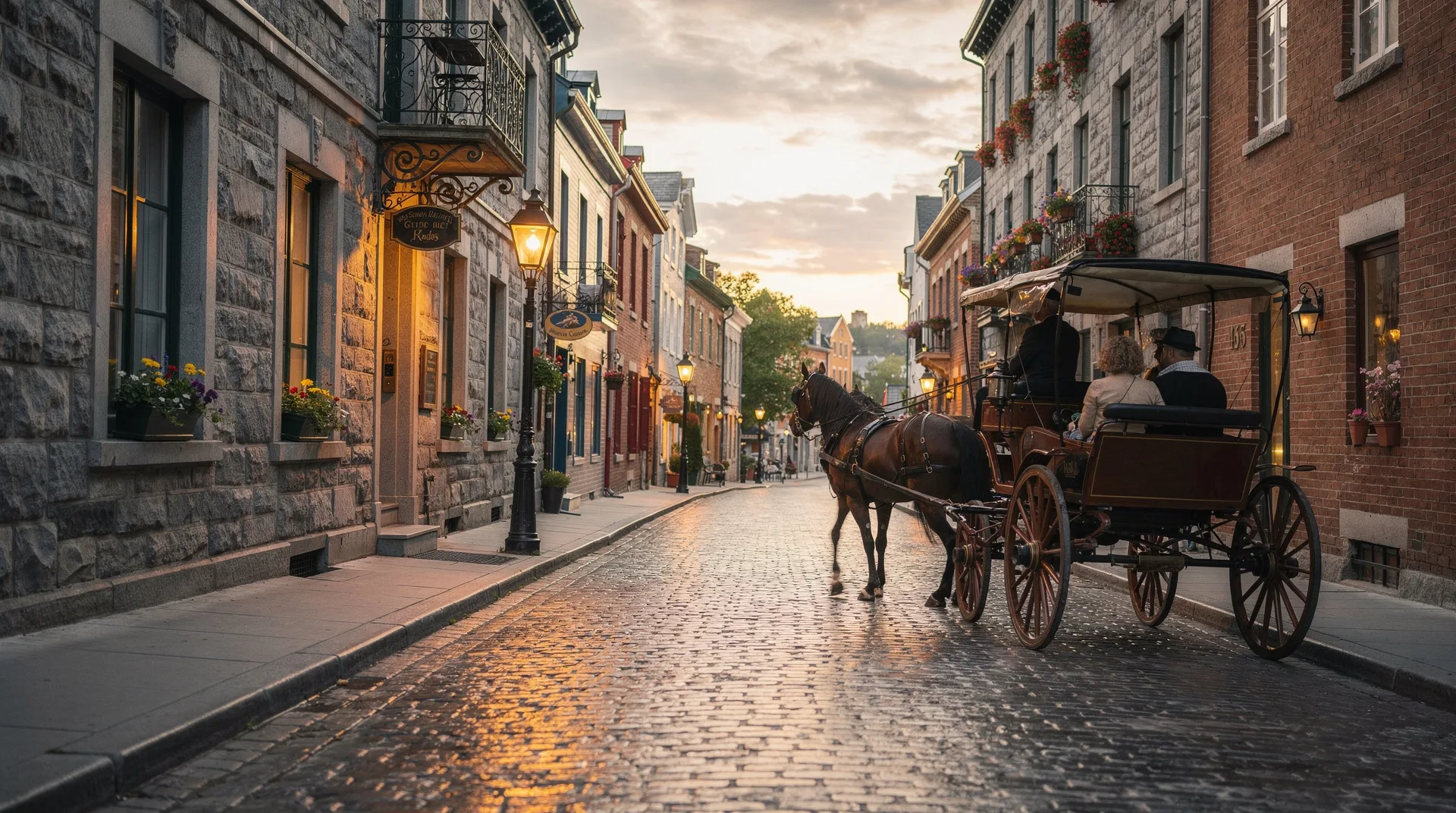
Old Quebec city walking guide: UNESCO walls, Château Frontenac and beyond
What makes Old Quebec a UNESCO World Heritage Site?
Old Quebec (Vieux-Québec) is the only fortified city north of Mexico with intact city walls, and the only North American city outside Mexico to retain its 17th and 18th century urban fabric largely intact. It was inscribed on the UNESCO World Heritage List in 1985 for its exceptional colonial architecture, fortifications, and historical significance as the heart of New France.
North America’s most historic city
Standing on the walls of Quebec City as dusk falls over the St. Lawrence River, the Château Frontenac glowing in the last light above the Lower Town, the smell of wood smoke and poutine drifting from the cobblestone streets below — it is easy to forget you are in Canada. The scale, the architecture, the language overhead, the church bells marking the hour: it all feels more like Brittany than British Columbia.
Old Quebec (Vieux-Québec) is unlike anywhere else in North America. It is the continent’s only fortified city north of Mexico still enclosed within its original walls. Its stone streets and 17th and 18th-century buildings are not reconstructions — they are the genuine article, standing exactly where French settlers built them. The city was founded by Samuel de Champlain in 1608, and the layers of history — French colonial, British conquest, 19th-century military engineering, the birth of Canadian confederation — are visible at every turn.
This walking guide covers the essential sights of Old Quebec, the best routes to explore both the Upper and Lower Towns, practical visiting information, and everything you need to make the most of one of Canada’s most remarkable cities.
| At a glance | |
|---|---|
| Where | Old Quebec (Vieux-Québec), on Cap Diamant above the St. Lawrence River, Quebec City |
| Cost | Free to walk the streets and walls; individual sights (Citadelle, Musée de la civilisation, funicular) charge around CAD $15-25 |
| Time needed | A rushed day for the highlights, 2-3 days to see it properly |
| Getting there | Via Rail from Montreal (around 3 hours) or a roughly 2.5-hour drive; Jean Lesage International Airport has direct flights from Toronto and Montreal |
| Best time | Summer for festivals and full opening hours, winter for the Carnaval and toboggan slide — see the seasonal breakdown below |
The Upper Town: the fortified heart
The Upper Town (Haute-Ville) sits atop Cap Diamant, the promontory that made Quebec City strategically impregnable and architecturally distinctive. Start here.
Château Frontenac is Quebec City’s most recognisable landmark — a magnificent castle-hotel built by the Canadian Pacific Railway in 1893, designed by American architect Bruce Price in a French château style that has become the city’s defining visual. It now operates as a Fairmont hotel and is best appreciated from outside (the terrasse Dufferin) or from a guided tour. The building’s crenellated towers and copper rooflines command the promontory above the St. Lawrence like a theatrical backdrop.
Terrasse Dufferin is the wide wooden boardwalk extending along the cliff face beneath Château Frontenac, with sweeping views over the St. Lawrence River and the Lower Town. In winter, the toboggan slide (glissade) that has operated here since the 1880s sends riders careening down the icy track — an unmissable Quebec winter experience. In summer the terrasse fills with street performers, families, and visitors taking photographs.
The City Walls are the defining physical fact of Old Quebec. The 4.6-kilometre fortification circuit, rebuilt and reinforced through the late 18th and early 19th centuries under British military engineers, is the only remaining fortified city wall in North America north of Mexico. Walking the walls provides a complete circuit of Old Quebec with views over both the historic streets and the surrounding countryside.
La Citadelle is the star-shaped fort at the highest point of Cap Diamant, completed in 1850. It remains an active military installation and the official residence of the Governor General of Canada in Quebec City. Guided tours cover the fortification history, the Changing of the Guard ceremony (June through early September, daily at 10am), and the small regimental museum.
Place d’Armes is the central square of the Upper Town, historically the military parade ground and now a lively public space overlooked by Château Frontenac and flanked by heritage buildings. The monument at the centre commemorates Samuel de Champlain.
Rue Saint-Louis and Rue Saint-Jean are the main commercial streets of the Upper Town, lined with restaurants, souvenir shops, and heritage buildings. Rue Saint-Jean leads to the Saint-Jean Gate (Porte Saint-Jean), one of the four original gates in the city walls.
The Lower Town: Petit-Champlain and Place Royale
The Lower Town (Basse-Ville) lies at the foot of the cliff below the Upper Town, accessible via the Breakneck Staircase (Escalier Casse-Cou — a name that speaks for itself) or by the Funicular (CAD $4.25 one way), a cable-car incline that has been running since 1879.
Petit-Champlain is a small network of streets centred on Rue du Petit-Champlain, often described as the oldest commercial street in North America. Today it is a charming pedestrian quarter of boutiques, galleries, restaurants, and craft shops occupying 17th and 18th-century stone buildings. Beautiful, somewhat touristy, and entirely worthwhile. In winter it becomes one of the most romantic spots in Canada — snow-covered rooftops and fairy lights against the stone walls.
Place Royale is the historic heart of Nouvelle-France — the commercial centre of the original French colonial settlement and home to the oldest stone church in Canada, Notre-Dame-des-Victoires (1688). The square has been immaculately restored and is surrounded by heritage buildings that now contain a museum of New France, restaurants, and galleries. It looks almost exactly as it did in the 18th century.
Musée de la civilisation is one of Quebec’s finest museums, located in the Lower Town. Its permanent collections cover Quebec history, Indigenous cultures, and global civilisations in a building that incorporates a 17th-century merchant’s house. Admission is approximately CAD $20.
Find Quebec City guided tours and walking experiencesBeyond the walls: Plains of Abraham and beyond
Plains of Abraham (Battlefield Park) is the famous historic plateau immediately west of the Upper Town walls where the Battle of the Plains of Abraham was fought in September 1759 — the engagement that transferred New France from French to British control and changed the course of North American history. Today the plains are a large urban park, used by Quebecers for jogging, cycling, and winter skiing. The Musée des plaines d’Abraham tells the battle’s story in detail. The views over the St. Lawrence from the park’s cliff edge are some of the best in the city.
Montmorency Falls is 12 km from Old Quebec and warrants a half-day trip. The falls are 83 metres high — 30 metres higher than Niagara — and are accessible via cable car, staircase, and a suspension bridge that crosses the falls at the top. In winter, the spray freezes into a massive ice cone (the sugarloaf) that locals climb.
Book a day trip from Montreal to Quebec City and Montmorency FallsBest time to visit Old Quebec
Summer (June–August) is peak season: warm weather, all attractions fully open, street performers on every corner, the terrasse Dufferin buzzing with life. The Festival d’été de Québec in early July is one of Canada’s largest music festivals, with stages throughout the city.
Winter (December–February) is when Quebec City transforms into something magical. The Carnaval de Québec (late January–February) is one of the world’s largest winter carnivals — with parades, ice sculptures, night parades, the ice palace, and the toboggan slide at full throttle. Snow on the Petit-Champlain streets and the ice-covered plains create an atmosphere that is uniquely Quebec.
Fall (September–October) is beautiful with autumn foliage and smaller crowds. The summer festivals are over but the restaurants are full and the city is at its most relaxed.
Spring (March–May) is quieter and can be cold, but sugar shack season (March–April) provides a compelling regional draw.
Practical tips: getting around and costs
Getting to Quebec City: Via Rail runs multiple daily trains from Montreal (3 hours, CAD $35–$80 depending on timing). By car from Montreal, Highway 20 or 40 east takes about 2.5 hours. Quebec City’s Jean Lesage International Airport receives direct flights from Toronto, Montreal, and some US cities.
Getting around Old Quebec: The historic areas are compact and best explored on foot. The city walls circuit takes about 90 minutes at a stroll. The Upper and Lower Towns are connected by the Breakneck Staircase or funicular.
Accommodation: Staying within the Old City provides the full immersion experience, but rooms are expensive, particularly in summer and winter carnival periods. The Fairmont Le Château Frontenac is the iconic option (CAD $300–$600/night). Boutique hotels and auberges within the walls run CAD $150–$300. Hotels outside the walls in Saint-Roch or Saint-Jean-Baptiste are 15–20 minutes walk with more affordable pricing.
Food costs: Restaurant meals in Old Quebec run CAD $20–$40 for mains; touristy Rue Saint-Louis tends toward the higher end. For better value with local clientele, explore Rue Saint-Jean outside the walls.
Where to eat in Old Quebec
Toast! in the Lower Town is a legendary Quebec City restaurant with a focus on Quebec produce and an exceptional wine list.
Le Lapin Sauté (Petit-Champlain) is a charming restaurant in a 17th-century building serving creative Québécois cuisine and excellent tartares.
Chez Boulay bistro boréal on Rue Saint-Jean uses northern Quebec ingredients (boreal forest mushrooms, game, wild berries) in a sophisticated contemporary menu.
Le Buffet de l’Antiquaire in the Lower Town is a classic, inexpensive diner serving traditional Québécois breakfasts.
For the full culinary picture, see the Canadian cuisine guide and sugar shacks near Quebec City.
Old Quebec vs Montreal: which comes first?
Visitors doing a Quebec trip often ask whether to prioritise Old Quebec or Montreal when time is short. They are genuinely different cities: Old Quebec is smaller, more atmospheric, and almost entirely walkable within the walls, while Montreal is a bigger, more cosmopolitan city with a smaller (but still excellent) historic core in Old Montreal.
If you only have a few days, the detailed comparison in Quebec City vs Montreal for first-timers walks through the trade-offs. Many visitors combine both — the Montreal to Quebec City guide covers the connection, and a longer 7-day Quebec itinerary fits in both cities comfortably along with Charlevoix or the Eastern Townships.
For a genuinely different winter experience nearby, the Hôtel de Glace (ice hotel) just outside the city is worth the detour if you are visiting between January and March. And for the best organised way to see the highlights without planning logistics yourself, the best Quebec City tours guide rounds up walking tours, food tours, and day trips.
Frequently asked questions about Old Quebec city walking guide: UNESCO walls, Château Frontenac and beyond
How long do I need to see Old Quebec properly?
Two full days is the minimum to see the main highlights at a relaxed pace. Three days allows you to add Montmorency Falls, the Plains of Abraham, and some of the excellent museums. A single day is possible for the must-see highlights only (walls, Château Frontenac, Petit-Champlain, Place Royale).
Do I need to speak French in Quebec City?
Not to get by — most tourist-facing businesses in Old Quebec have English-speaking staff. However, Quebec City is considerably more French-speaking than Montreal, and making the effort to use basic French (bonjour, merci, s’il vous plaît) is warmly appreciated and culturally appropriate.
Is Old Quebec good in winter?
Winter is arguably the best time to visit Quebec City. The Carnaval de Québec in February is world-class. The snow-covered cobblestones and horse-drawn sleighs in Petit-Champlain are magical. Dress extremely warmly — temperatures can reach -20°C or below. The city is fully operational.
Can I walk the entire city wall circuit?
Yes. The 4.6-kilometre circuit takes about 1.5–2 hours at a stroll and provides unique elevated views of the city. Some sections are more developed as public walkways than others. The Citadelle section requires paying admission to pass through the military grounds.
What is the Changing of the Guard at the Citadelle?
A 45-minute ceremonial parade and changing of the regiment guard, held at 10am daily from late June through early September. Free to watch from outside the Citadelle or included in the grounds admission.
Is the Château Frontenac worth visiting inside?
The lobby and public areas are freely accessible and worth a look for their opulent late-Victorian architecture. Guided historical tours (CAD $22) cover the hotel’s 130-year history and include areas not accessible to non-guests. Afternoon tea or a cocktail in the bar is a more accessible way to experience the interior without a tour.
What is the best viewpoint in Quebec City?
The terrasse Dufferin has the most iconic view: the St. Lawrence River, the Lower Town, and Île d’Orléans in the background. The Plains of Abraham cliff offers a less visited but equally dramatic panorama. The Observatoire de la Capitale in a modern office tower (admission CAD $19) provides a 360-degree view of the entire city from 31 floors up.
Is Old Quebec worth visiting if I’ve already seen Montreal?
Yes — the two cities are quite different in scale and feel, and Old Quebec’s intact fortifications and colonial streetscape have no real equivalent in Montreal. See the Quebec City vs Montreal comparison for a fuller breakdown of what each city does better.
How many days should I split between Quebec City and the surrounding region?
Most visitors do well with 2-3 days in Old Quebec itself plus at least one extra day for Montmorency Falls, Île d’Orléans, or Charlevoix. A 7-day Quebec itinerary is a comfortable way to combine the city with the wider region without rushing.