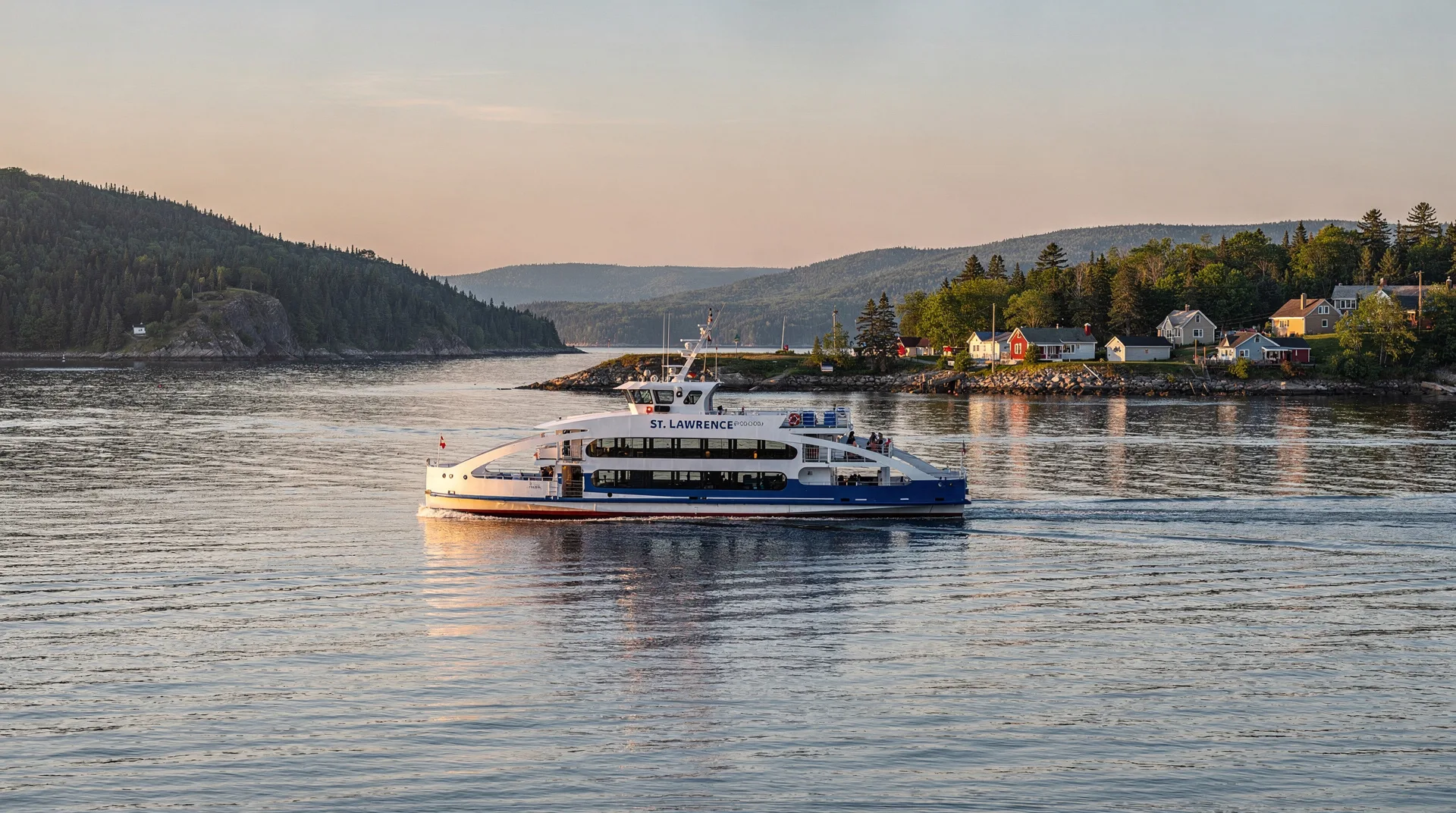
Ferries across the St. Lawrence: routes, schedules and tips
Where can I take a ferry across the St. Lawrence?
Key Quebec ferries: Lévis-Quebec City (free, 15 min), Tadoussac-Baie-Sainte-Catherine (free, 10 min), Rivière-du-Loup-Saint-Siméon (paid, 65 min), Matane-Baie-Comeau-Godbout (paid, 2h15), and Trois-Pistoles-Les Escoumins (paid, 90 min).
The St. Lawrence River defines Quebec — and crossing it by ferry is, in several places, the only practical way to travel between its two shores. The Quebec government operates a network of ferries under the Société des traversiers du Québec (STQ), supplemented by a few privately operated routes. For road-trippers, cyclists, and travellers exploring the lower St. Lawrence and Côte-Nord regions, these ferries are essential infrastructure — and they can be a scenic highlight in their own right.
This guide covers the six crossings most useful to visitors, the reservation and fare systems, typical sailing times, and how to plan a trip that uses the ferries to shorten driving or reach otherwise-inaccessible regions.
| Free crossings | Paid crossings | |
|---|---|---|
| Routes | Quebec City-Lévis, Tadoussac, Sorel-Tracy, Île aux Coudres | Rivière-du-Loup-Saint-Siméon, Matane-Baie-Comeau/Godbout, Trois-Pistoles-Les Escoumins |
| Booking | Not available, first come first served | Recommended (Rivière-du-Loup) to essential (Matane) in summer |
| Typical crossing time | 10-20 minutes | 65 minutes to 2h15 |
| Best time to travel | Arrive early on summer weekend afternoons | Book vehicle space 1-2 weeks ahead for July-August |
The STQ system
STQ operates most Quebec ferries. The ticketing, schedules, and reservation systems are consistent across routes. Key points:
- Free ferries: some short crossings are free (Tadoussac, Quebec City-Lévis)
- Paid ferries: most longer crossings charge per vehicle and per passenger
- Reservations: recommended in summer for vehicle crossings; book at traversiers.com
- Arrive early: 30-45 minutes before scheduled departure for paid crossings; earlier in peak season
- Walk-on pedestrians: usually don’t need reservations
- Seasonal variations: some routes run May-November only; schedules shift seasonally
The six key ferry crossings
1. Quebec City ↔ Lévis (free, 12-15 minutes)
The most famous Quebec ferry. Not essential for crossing the river (there are bridges downstream), but essential for the view. Pedestrians board free; vehicles pay a small fee.
- Frequency: every 20-30 minutes, 6 am to 2 am
- Duration: 12-15 minutes
- Fare: Free for pedestrians, $8 per car
- Terminal: Terminal du Vieux-Port (Quebec City side), Lévis Marina (south shore)
Why take it: the view of Château Frontenac from the water is iconic. Time the return trip with sunset for the best photos. Works well as an evening activity — take the ferry to Lévis for dinner, walk the lookout, take the ferry back.
2. Tadoussac ↔ Baie-Sainte-Catherine (free, 10 minutes)
A functional ferry that has to exist — Route 138 (the main road along Quebec’s north shore) ends at Baie-Sainte-Catherine and picks up again at Tadoussac. Without the ferry, you couldn’t drive Route 138 east from Quebec City.
- Frequency: every 20-40 minutes, 24/7 in summer, reduced winter schedule
- Duration: 10 minutes
- Fare: Free for all
- Terminal: Route 138 dead-ends into both terminals — you literally drive down the highway onto the ferry
Why take it: you must, if you’re driving to Tadoussac, Saguenay Fjord, or any point east along Route 138. Beluga whales are often visible during the crossing in summer — keep your eyes on the water near the fjord mouth. This is the cheapest beluga-watching you’ll ever do. If you want a closer look, you can also browse guided tours across Canada that include whale-watching cruises.
3. Rivière-du-Loup ↔ Saint-Siméon (paid, 65 minutes)
The south-to-north crossing in the lower St. Lawrence. Useful for travellers heading from Bas-Saint-Laurent to Charlevoix.
- Frequency: 5-7 crossings daily April-January; suspended in deep winter (typically Jan-April)
- Duration: 65 minutes
- Fare: Car + driver ~$55, passengers $20 each
- Operator: Traverse Rivière-du-Loup
Why take it: saves 4+ hours of driving if you’re on the Bas-Saint-Laurent side and want to reach Charlevoix or Saguenay without going back through Quebec City. Whale watching possible mid-crossing. Book vehicle space 1-2 weeks ahead in summer.
4. Matane ↔ Baie-Comeau / Godbout (paid, 2h15)
The longest of the major Quebec ferries. Critical for drivers navigating between Gaspésie and the north shore — there is no road around the St. Lawrence estuary at this latitude.
- Frequency: 2-3 crossings daily, reduced in winter
- Duration: 2 hours 15 minutes
- Fare: Car + driver ~$80-100, passengers $45 each
- Terminal: Matane (south), Baie-Comeau or Godbout (north — boats alternate)
Why take it: essential for a Gaspésie + Côte-Nord road trip. Also saves significant driving if you’re on Gaspésie and want to reach Labrador (via the eventual end of Route 138 in Côte-Nord).
Book well ahead in summer. This ferry runs near capacity from June through September. Dining room on board, cabins available for longer crossings.
5. Trois-Pistoles ↔ Les Escoumins (paid, 90 minutes)
A secondary south-to-north crossing, useful for travellers who want to reach the north shore from the middle of Bas-Saint-Laurent.
- Frequency: 1-3 crossings daily May to October
- Duration: 90 minutes
- Fare: Car + driver ~$65, passengers $25 each
- Operator: Compagnie de navigation des Basques
Why take it: alternative to Rivière-du-Loup-Saint-Siméon for travellers further east. Good for whale watching en route. Les Escoumins is an uncrowded, excellent whale watching base.
6. Sorel-Tracy ↔ Saint-Ignace-de-Loyola (free, 10 minutes)
West of Quebec City. Connects Montérégie side to Lanaudière side.
- Frequency: every 15-20 minutes
- Duration: 10 minutes
- Fare: Small vehicle fee; free pedestrians
- Operator: STQ
Why take it: less of a tourist route, more a local commute, but relevant if you’re exploring Lac Saint-Pierre UNESCO Biosphere Reserve or connecting Trois-Rivières to Lanaudière backroads.
Smaller ferries worth knowing
- L’Isle-aux-Coudres (Charlevoix): free ferry to Île aux Coudres from Saint-Joseph-de-la-Rive. 15 minutes. Essential for visiting the island.
- L’Île Verte (Bas-Saint-Laurent): seasonal ferry from L’Isle-Verte village to the island. For specialty trips.
- Anticosti Island (Côte-Nord): the Relais Nordik supply ship from Rimouski or Sept-Îles. Multi-day trips.
- Berthier-sur-Mer ↔ Grosse-Île: tour boats (not public ferries) run to the National Historic Site.
- Îles de la Madeleine: ferry from Souris, PEI — a 5-hour crossing, critical for visiting the islands by vehicle (alternative: fly from Montreal).
Reservations and fares
The STQ reservation system
Use traversiers.com for:
- Matane-Baie-Comeau-Godbout
- Tadoussac-Baie-Sainte-Catherine (no reservations needed, but schedule info)
- Sorel-Tracy
- Quebec City-Lévis
Private operators have their own systems:
- Rivière-du-Loup-Saint-Siméon: traversierrdl.com
- Trois-Pistoles-Les Escoumins: traversiertr.com
Credit card payments, mostly
All crossings accept credit cards. Most also accept cash. Some smaller crossings may require exact change.
Passenger vs. vehicle fares
For most ferries, the fare structure is:
- Base fare for the vehicle (includes driver)
- Additional fare for each extra passenger
- Reduced fares for children, seniors
- Pedestrian fares are typically modest
Budget example — Matane to Godbout with 2 adults and a car: approximately $150 for the vehicle + 1 passenger.
Planning ferry-based road trips
The Gaspésie + Côte-Nord loop
A classic Quebec road trip combines both shores of the St. Lawrence:
- Drive Quebec City down Route 132 south shore (Bas-Saint-Laurent → Gaspésie loop via Percé)
- From Matane, take the Matane-Godbout ferry to the north shore
- Drive Route 138 west through Côte-Nord to Tadoussac
- Take Tadoussac ferry (free) back to Baie-Sainte-Catherine
- Continue Route 138 back to Quebec City via Charlevoix
This creates a ~7-10 day loop. See our Gaspésie itinerary and Bas-Saint-Laurent-to-Gaspésie road trip for detail.
Quebec City ↔ Charlevoix ↔ Saguenay
- Quebec City → Charlevoix (drive Route 138)
- Charlevoix → Tadoussac (ferry at Baie-Sainte-Catherine, free)
- Tadoussac → Saguenay Fjord → Quebec City (loop back on Route 138)
No paid ferries needed for this loop.
Tips for the crossings
- Arrive early in summer. Peak crossings fill. 45 minutes minimum for paid crossings.
- Bring snacks / have meals. Longer ferries have cafeterias but quality varies.
- Leave the car for the crossing. Most ferries let you out of the car and up on deck during sailing; standing at the rail watching the river is part of the experience.
- Watch for whales. Tadoussac and the longer crossings regularly have belugas, minkes, and occasionally fin or blue whales. Stay on deck.
- Motion sickness: the St. Lawrence can be choppy, especially on Matane-Godbout. Over-the-counter medication if prone.
Matching the ferry to the trip you are planning
Each crossing suits a different kind of traveller, and it helps to decide what you want from the river before you pick a route. If the priority is scenery and wildlife, the crossings near Tadoussac are the obvious choice, and the Quebec whale watching guide explains how a ferry deck compares with a dedicated excursion. The whale season overview and the page on blue whale viewing in Quebec help you judge which part of the summer suits your dates.
If the priority is simply to save driving, think about where you will sleep each night. A crossing that lands you in the evening on the opposite shore can turn a long driving day into an easy one, but only if your accommodation is close to the terminal. Look at your landing point on a map before booking, and keep a little slack in the schedule in case the boat is delayed by weather. The Charlevoix versus Gaspésie comparison is a good way to decide which shore deserves more of your time, and the Charlevoix four-day itinerary shows how the north shore fits together once you have landed.
Ferries on a city-based trip
Not every traveller is planning a long loop. Plenty of visitors only want a short river outing during a stay in the provincial capital. In that case the Lévis crossing pairs naturally with a day spent in the walled city: see the Old Quebec guide for what to do on the Quebec City side, then cross in the late afternoon and come back for dinner. If you are arriving from the south-west, the Montreal to Quebec City guide covers the drive before you ever reach the water, and the page on travelling from Montreal gives a wider picture of what is within reach.
Islands and other water crossings
The river also leads to islands that reward a slower pace. The choice between Île d’Orléans and Île aux Coudres is worth reading before you commit to the Charlevoix crossing, since the two islands feel very different. For travellers continuing east, the Îles de la Madeleine page explains what to expect on that longer sea journey, and the guide to Confederation Bridge versus the ferry on Prince Edward Island is useful if your trip carries on into the Maritimes. The Marine Atlantic ferry guide covers the sea route to Newfoundland for those going further still.
Cyclists and paddlers
Because most crossings carry bicycles, the river is a natural companion to a cycling holiday. The Quebec cycling routes guide shows how to string riverside sections together and use a boat to switch banks without retracing your route. Paddlers heading for the fjord should read the Saguenay kayaking guide before they arrive, since the ferry terminal at Tadoussac is a handy reference point for planning a day on the water.
A calmer way to travel
It is easy to treat a ferry as dead time between two stops. Try treating it as part of the holiday instead. Bring a layer for the deck even on a warm day, because the wind over the water is cooler than it feels in the car park. Put the camera away for part of the crossing and simply watch the shoreline change. If you would rather have a day on the water organised for you, Canada tours and excursions are easy to book in advance. Families with children often find that the open deck, the moving horizon and a snack make the crossing one of the most memorable parts of the day, which is why the longer routes in particular reward a relaxed schedule rather than a tight one.
Combining with other Quebec practical content
See our Quebec in October guide, driving Quebec winter guide, and regional destination guides for Gaspésie, Côte-Nord, Charlevoix, and Saguenay-Lac-Saint-Jean.
Choosing between the two south-to-north crossings
Travellers heading from Bas-Saint-Laurent toward Charlevoix or the Côte-Nord have two paid options: Rivière-du-Loup–Saint-Siméon and Trois-Pistoles–Les Escoumins. Rivière-du-Loup is shorter, better connected to Highway 20, and the natural choice for most itineraries starting from Montreal or Quebec City.
Trois-Pistoles is worth choosing instead if your route already runs further east along the south shore, or if you specifically want the quieter, less-booked crossing with good whale-watching odds from the deck. Either way, Charlevoix is the natural landing zone on the north shore, and from there the Côte-Nord opens up for travellers continuing toward Tadoussac and beyond.
For a full loop that uses several of these crossings in sequence, the Gaspésie 7-day loop and the Bas-Saint-Laurent to Gaspésie itinerary both build the ferries in as necessary legs rather than optional detours.
Frequently asked questions about Ferries across the St. Lawrence
Which St. Lawrence ferry is best for seeing whales?
The Tadoussac–Baie-Sainte-Catherine crossing has the most reliable beluga sightings because it crosses the Saguenay Fjord mouth where belugas concentrate; the longer Matane and Trois-Pistoles crossings also see whales in the shipping channel but less predictably.
Can I bring a bicycle on the St. Lawrence ferries?
Yes, on all the routes covered here — bicycles are carried as foot-passenger items on most crossings for a small fee or free, which makes the free Tadoussac and Lévis-Quebec City ferries popular with cycle tourists following Route Verte sections along the river.
Final word
Quebec’s St. Lawrence ferries aren’t glamorous infrastructure but they make half the province accessible by road. Reserve ahead in summer, take the crossings slowly enough to enjoy the view, and use them to build a road trip that covers both shores of the river — which is really the Quebec road trip experience at its best.