Snowshoeing in Canada: top trails for beginners and beyond
Do you need experience to go snowshoeing in Canada?
No. Snowshoeing is one of the most accessible winter activities — if you can walk, you can snowshoe. Most national parks and resorts offer rentals and beginner-friendly trails. A first-timer can be confidently moving through a snowy forest within minutes of strapping on snowshoes.
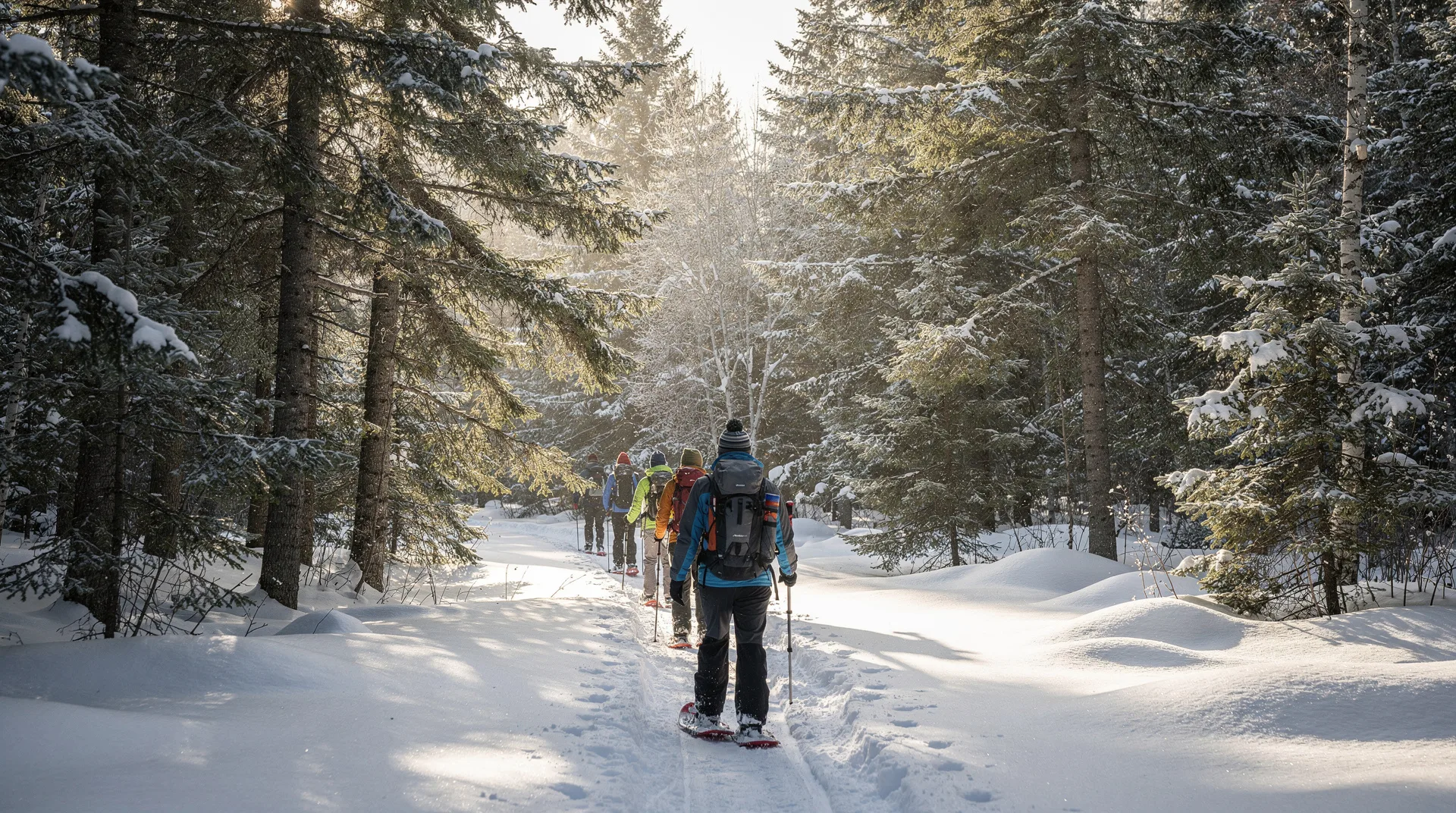
Snowshoeing requires no particular athletic ability, no prior training, and equipment that most winter destinations rent by the hour. You strap wide-framed shoes over your boots, walk out into a snow-covered forest or across a frozen lake, and suddenly the Canadian winter — which can feel hostile and inhospitable from behind a car window — becomes something extraordinary: quiet, white, and alive with animal tracks, snow-weighted spruce trees, and a physical sense of wilderness that no other winter activity quite replicates.
| At a glance | |
|---|---|
| Where | Banff/Rockies, BC (Whistler/Vancouver), Quebec, Ontario, Yukon |
| Cost | Around CAD 20-40/day rental; CAD 60-110 for a guided 2-3 hr tour |
| Time needed | 1-2 hours for a beginner loop; a full day for backcountry routes |
| Getting there | Most trailheads are 20 min-2 hrs from a base town |
| Best time | December through March, when snowpack is established |
Canada is one of the world’s best snowshoeing destinations. The country has the terrain (mountains, boreal forest, frozen tundra, coastal ranges), the snow (reliable winter snowpack across huge areas), and the infrastructure — national parks with groomed snowshoe trails, rental outfitters in virtually every ski town, and guided tour operators in all major winter destinations. Whether you want a gentle one-hour loop through a national park or a multi-day backcountry route with hut accommodation, Canada has it.
This guide covers the best snowshoeing trails across the country, organized by region, with everything you need to know to get started.
Why snowshoeing is worth your time
Skiing and snowboarding are the headline winter sports in Canada, but snowshoeing offers something different: access. Snowshoes go where skis cannot — through dense forest, up ridgelines, across varied terrain that would be unmanageable on skis. They are quiet in a way that ski lifts and groomed runs are not. And they are democratic: a family with young children, a couple in their sixties, and an athletic solo traveller can all have excellent snowshoe experiences at the same park.
The physical experience is gentle enough for complete beginners but can be made demanding — steep climbs, deep unconsolidated snow, and long distances all increase difficulty substantially. The activity scales with your ambition in a way that few winter sports do.
Best snowshoeing in Banff and the Canadian Rockies
Banff National Park is the premier snowshoeing destination in Canada. The combination of dramatic mountain scenery, reliable deep snowpack, well-maintained trails, and an extensive rental and guide infrastructure makes it exceptional for both beginners and experienced snowshoers.
Johnston Canyon (Banff)
Johnston Canyon is one of the most spectacular snowshoeing routes in Canada and is beginner-accessible. The trail follows frozen Johnston Creek through a narrow limestone canyon, passing two sets of frozen waterfalls (Lower Falls at 1.1 km, Upper Falls at 2.7 km from the trailhead). In winter, the waterfalls freeze completely and the canyon takes on an otherworldly blue-white appearance.
The trail is groomed and wide, with catwalk sections built into the canyon walls. Distance to Upper Falls and back: approximately 5.4 km. Elevation gain is minimal. This trail is extremely popular — start early (before 9am) to beat the crowds.
Getting there: 26 km west of Banff townsite on the Bow Valley Parkway (Highway 1A). Parking fills by mid-morning on weekends.
Lake Louise and Moraine Lake (Banff)
The Lake Louise area offers several excellent snowshoeing routes. The trail around Lake Louise itself (3.4 km loop) is flat, beginner-friendly, and provides continuous views of the lake and Victoria Glacier. The Fairmont Chateau Lake Louise rents snowshoes at the lakeshore.
Moraine Lake Road is closed to vehicles in winter, making the road itself a popular snowshoeing route — approximately 14 km return from the winter closure gate to Moraine Lake. The scenery is exceptional, particularly on clear days with the Valley of the Ten Peaks visible above the frozen lake.
See our Banff National Park guide for broader planning.
Sunshine Meadows (Banff)
In summer, Sunshine Meadows is a wildflower-covered alpine plateau. In winter, it becomes one of the most beautiful snowshoeing areas in the Rockies — open, high-elevation terrain with 360-degree mountain views. Access is via the Sunshine Village ski resort gondola (a fee applies to use the gondola for snowshoeing access).
Browse guided snowshoe tours and winter experiences in BanffBest snowshoeing in British Columbia
Garibaldi Provincial Park (near Whistler)
Garibaldi Provincial Park borders Whistler and contains some of the most dramatic snowshoeing terrain in BC. The Diamond Head area (accessible year-round, unlike the higher Garibaldi Lake trail which is a significant winter undertaking) offers a 16 km return route to the Red Heather Meadows and Elfin Lakes — a popular but demanding snowshoe that rewards with volcanic mountain views.
Difficulty: Moderate to challenging. Elevation gain of approximately 490 metres.
Cypress Mountain (Metro Vancouver)
Cypress Mountain near Vancouver has designated snowshoeing trails groomed and maintained separately from ski runs. The First Lake loop (4 km) is ideal for beginners and families. The Howe Sound Crest Trail section is more demanding. Equipment rentals and lessons are available at the resort.
For a Vancouver-based winter day out that does not require driving to Whistler, Cypress is an excellent option.
Best snowshoeing in Quebec
Mont-Tremblant National Park
The national park adjoining the ski resort has over 100 km of trails open for snowshoeing in winter. The terrain is rolling Laurentian boreal forest — less dramatic than the Rockies but deeply peaceful. The Lac des Femmes and Lac Chat loops (each around 7–10 km) are well-marked and beginner-friendly. The park rents snowshoes at the service centres.
Jacques-Cartier National Park (Quebec City area)
Jacques-Cartier National Park, 40 km north of Quebec City, is one of the finest winter parks in eastern Canada. The valley of the Jacques-Cartier River is flanked by 500-metre ridges, and the 40+ km of snowshoe trails take you through boreal forest, across frozen rivers, and up to ridge viewpoints. The park rents equipment and has warming huts along the longer routes.
See our Quebec Winter Carnival guide for winter activities in Quebec City.
Best snowshoeing in Ontario
Algonquin Provincial Park
Algonquin is Ontario’s most famous park and a superb snowshoeing destination from December through March. The Bat Lake Trail (5.6 km loop) and the Lookout Trail (2.1 km) are popular beginner routes. For more distance, the park has over 130 km of marked trails, many of which become excellent snowshoe routes once the snowpack is established.
The park has a small visitor centre open year-round, and rental snowshoes are available in the nearby town of Whitney. Wildlife in winter includes wolves, moose, and various birds — snowshoeing in Algonquin in January has a different, quieter character than the crowded summer canoe trips.
See our Algonquin Provincial Park guide for more detail.
Best snowshoeing in the Yukon and northern Canada
Whitehorse area trails
The Yukon capital has an excellent trail network that becomes a world-class snowshoeing system in winter. The Miles Canyon trail system (accessible from town) winds through boreal forest above the frozen Yukon River. The Grey Mountain and Haeckel Hill area provides views over the Whitehorse basin.
For those combining snowshoeing with northern lights viewing, the Yukon is particularly compelling — the combination of a dark, clear night in the boreal forest with an active aurora display is a travel experience unlike anything else.
Book guided Yukon winter experiences including snowshoeing and northern lights toursSnowshoeing vs other winter activities
| Activity | Skill needed | Cost (CAD) | Best for |
|---|---|---|---|
| Snowshoeing | None | 20-40/day rental | Anyone, families, solo travellers wanting quiet |
| Cross-country skiing | Some technique | 25-45/day rental | Fitter visitors wanting more distance and speed — see cross-country skiing in Canada |
| Dog sledding | None (guided) | 150-350/experience | A bigger-ticket, less physically active alternative — see dog sledding in Canada |
| Snowmobile touring | Driver’s licence | 180-350/half-day | Covering more ground, less quiet immersion — see snowmobile tours |
How to book and get started
Renting equipment: Snowshoe rentals are available at virtually all ski resorts, national park service centres, and outdoor gear shops in winter destinations. Expect to pay CAD 20–40 per day for rental snowshoes. Most rentals include poles, which are highly recommended for beginners (they help with balance and reduce the load on your legs on climbs and descents).
Guided tours: Guided snowshoe tours are widely available — from 2-hour guided walks to full-day backcountry tours. For a first-time visitor, a guided tour in a national park is excellent value: guides provide equipment, teach technique, interpret the natural environment, and take you to the best spots.
Booking ahead: Guided tours fill quickly on weekends and holidays. Book at least a week ahead during peak season (Christmas, February school breaks, March).
Costs in CAD
| Item | Estimated cost (CAD) |
|---|---|
| Snowshoe rental (per day) | 20–40 |
| Guided beginner snowshoe tour (2–3 hrs) | 60–110/person |
| Full-day guided backcountry tour | 150–250/person |
| National park entry (day pass, Banff) | 12.25/person |
| Parks Canada Discovery Pass (annual, family) | 167.50 |
What to wear and bring
Footwear: Waterproof winter boots with ankle support — ideally insulated to -20°C or colder for Banff, the Yukon, or Quebec in January. Your boot must be compatible with the rental snowshoe binding — most modern rental systems accommodate most winter boot styles.
Gaiters: Highly recommended. Gaiters prevent snow from entering your boot from above, which happens frequently when stepping through unconsolidated snow or postholing in variable conditions.
Layering: Same principle as all winter activities — moisture-wicking base layer, insulating mid-layer, waterproof shell. Snowshoeing generates significant body heat, so you will overheat quickly if overdressed. Start cold and remove layers as you warm up.
Poles: Almost all rentals include poles. Use them — they transform the experience, particularly on steep terrain.
Pack essentials: Water (at least 1 litre), snacks, a basic first aid kit, a trail map (downloaded offline — phone GPS often fails in national parks), and an emergency whistle.
Sun protection: Essential in winter — UV is intense on snow. Sunscreen plus sunglasses or goggles.
Where to stay near top snowshoeing areas
Banff: Stay in Banff townsite for easy access to Johnston Canyon, the Lake Louise area, and the trail network radiating from town. Options range from hostels to the Fairmont Banff Springs.
Quebec City/Jacques-Cartier: Stay in Quebec City’s Vieux-Québec for access to both Jacques-Cartier National Park and the network of Laurentian parks within 1 hour.
Whitehorse: The city has a range of hotels and B&Bs — compact enough to walk between central accommodation and the Miles Canyon trail network.
See our Banff with kids guide if snowshoeing with children.
Frequently asked questions about Snowshoeing in Canada: top trails for beginners and beyond
How difficult is snowshoeing for complete beginners?
Snowshoeing is genuinely easy to start. The learning curve is roughly five minutes of adjusting your gait (walking slightly wider to avoid stepping on the frame of the opposite snowshoe) and you are moving confidently through snow. The difficulty scales with terrain — flat groomed trails are effortless; steep, ungroomed backcountry terrain is demanding. Most beginner trails are appropriate for people of any fitness level.
Do children snowshoe well?
Yes — children typically love snowshoeing. Most rental operations have smaller snowshoes for children from about age 4–5 upward. Younger children can be carried in appropriate backpack carriers. The key consideration is distance: children tire faster, so plan for shorter loops (2–4 km) with frequent stops, warm snacks, and the option to turn back early.
What temperature is too cold for snowshoeing?
There is no absolute answer — it depends on your preparation. With proper clothing, snowshoeing is comfortable at -25°C. Below -30°C, exposed skin becomes a serious concern and the activity requires more careful preparation (extra face protection, shorter duration, knowledge of frostbite signs). Most beginners should start with days above -15°C until they understand their cold tolerance.
Can I snowshoe in a national park without a guide?
Yes. Most national parks have marked, groomed snowshoe trails with maps available at park entry and visitor centres. A Parks Canada day pass or Discovery Pass is required for entry. For beginner trails in well-visited parks like Banff or Jacques-Cartier, self-guided snowshoeing is straightforward and safe.
Is snowshoeing safe for solo travellers?
On marked, well-maintained trails in national parks, solo snowshoeing is generally safe. For backcountry routes, off-trail exploration, or trails in remote areas, always tell someone your planned route and expected return, carry emergency signalling equipment, and check weather forecasts before departure.
How does snowshoeing compare to cross-country skiing for a first winter trip?
Snowshoeing has a near-zero learning curve, while cross-country skiing takes an hour or two of practice before it feels natural. If you only have one winter activity to try, snowshoeing is the lower-risk choice; skiers who already know the sport will cover more ground and may prefer groomed cross-country tracks, detailed in the cross-country skiing guide.
Browse guided winter tours and snowshoeing experiences across Canada