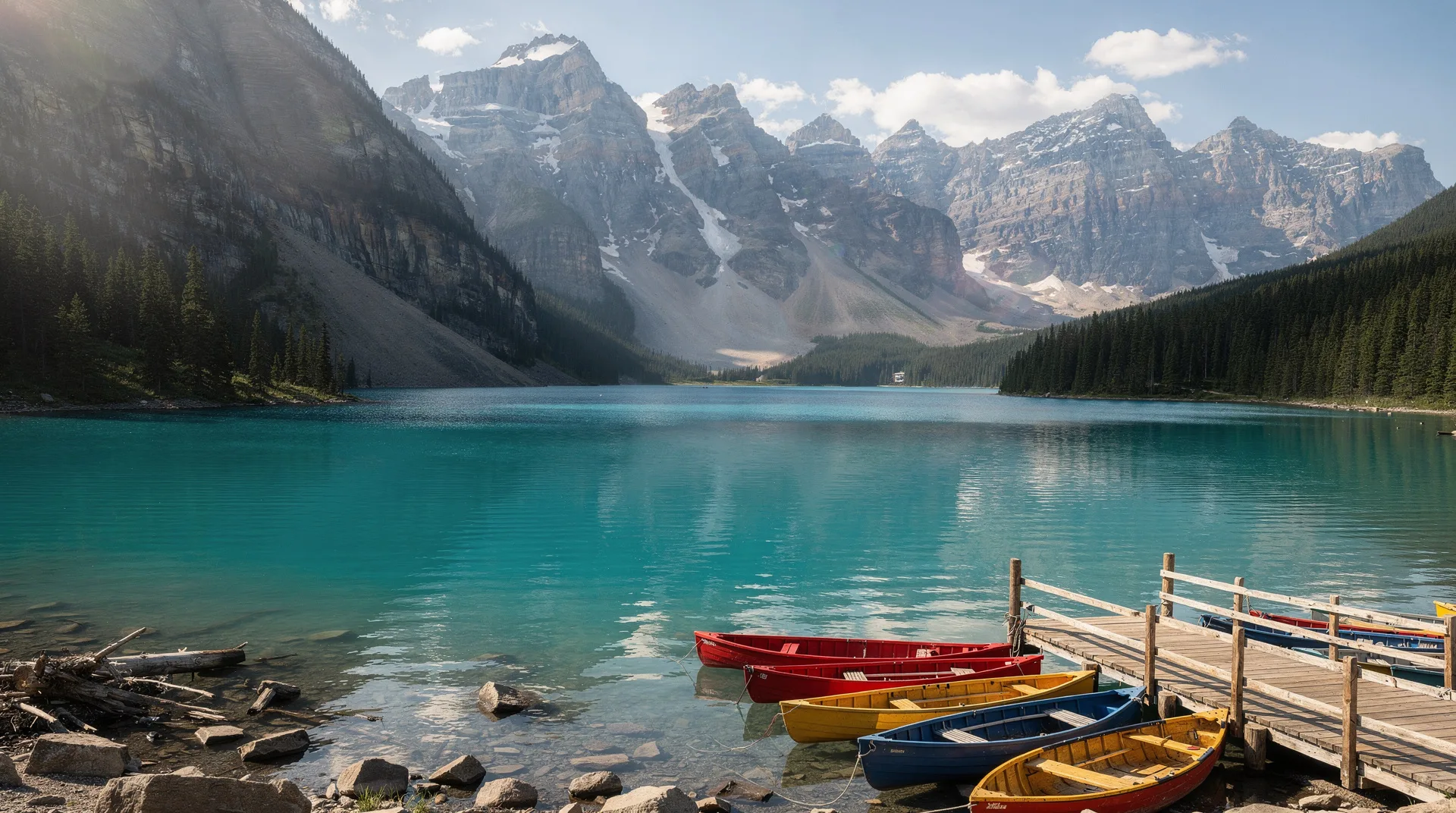
Banff National Park guide: lakes, glaciers and the Canadian Rockies
What's special about Banff National Park?
Banff is Canada's oldest and most visited national park, protecting a spectacular stretch of the Alberta Rockies. It combines turquoise glacial lakes, ancient icefields, abundant wildlife and the charming resort town of Banff within one UNESCO World Heritage landscape.
Banff National Park sits at the top of almost every traveller’s Canadian bucket list, and it earns that status every single time. Established in 1885 — making it Canada’s first and the world’s third national park — Banff protects 6,641 square kilometres of the front ranges and main ranges of the Canadian Rockies in Alberta. The landscape is operatic in scale: peaks above 3,000 metres dusted with permanent snow, valleys carved by ancient glaciers, rivers the colour of liquid jade, and lakes so vividly turquoise they look edited. Then there is the wildlife — grizzly bears, black bears, wolves, elk, bighorn sheep and mountain goats going about their business with magnificent indifference to the cameras pointed at them.
The town of Banff, located within the park boundaries, provides a well-equipped base. Comfortable hotels, world-class restaurants, and boutique shops exist within minutes of genuine wilderness. The Trans-Canada Highway threads through the valley, making Banff accessible from Calgary (about 128 km to the east) year-round. The Icefields Parkway — one of the greatest scenic drives on earth — connects Banff to Jasper National Park to the north. Together, Banff and its neighbouring parks form a UNESCO World Heritage Site that encompasses more protected mountain terrain than anywhere else in the world.
Why Banff deserves its reputation
The combination of accessibility and raw wilderness is what sets Banff apart. Most of the park’s iconic sights — Lake Louise, Moraine Lake, the Valley of the Ten Peaks, the Bow Valley — require nothing more than a drive and a short walk. Yet step 500 metres off the beaten path and you are in genuine backcountry, with silence broken only by the wind in the larch trees and the distant crack of a calving glacier. Banff simultaneously rewards the casual visitor and the serious mountaineer.
The park also sits within the Bow Valley, a natural wildlife corridor where animals move freely between the mountains. Driving the Bow Valley Parkway at dawn or dusk offers wildlife encounters that rival anything you will find in a safari park — except here they happen against a backdrop of cathedral peaks rather than savannah. That fusion of accessibility, scenery, and wildlife density is rare anywhere in the world.
Culturally, Banff has deep First Nations connections. The Stoney Nakoda, Blackfoot Confederacy, and Ktunaxa peoples have lived in and around these mountains for thousands of years. The Banff Centre for Arts and Creativity, one of Canada’s premier cultural institutions, adds an intellectual and artistic dimension that surprises many first-time visitors expecting only outdoor adventure.
Top things to do in Banff National Park
Visit Lake Louise and the Plain of Six Glaciers
Lake Louise is the image that launched a thousand tourism campaigns, and it exceeds expectations even for the most cynical traveller. The lake’s extraordinary turquoise colour comes from glacial rock flour suspended in meltwater from the Victoria Glacier, which hangs at the valley’s head like a curtain of ice. The Fairmont Chateau Lake Louise stands on the north shore, its Victorian silhouette perfectly positioned to catch the morning light on the mountains reflected in the water.
The Plain of Six Glaciers trail (13.8 km return) begins at the lakeshore and climbs through subalpine meadows past a historic teahouse to a moraine overlooking six glaciers. It is one of the finest walks in Canada. Canoe rentals are available on the lake in summer — paddling across that blue water with the Victoria Glacier ahead of you is a genuinely transcendent experience.
Book a full-day Lake Louise, Moraine Lake and Banff Gondola tour with hot springsMoraine Lake and the Valley of the Ten Peaks
Moraine Lake rivals Lake Louise for visual impact and surpasses it for sheer drama. The lake sits in a cirque below the Valley of the Ten Peaks — a wall of ten named summits above 3,000 metres that forms one of the most photographed backdrops in North America. The classic viewpoint is reached by a short scramble up the Rockpile Trail (0.8 km, 30 metres elevation gain) at the lake’s eastern end.
Access to Moraine Lake is by reservation or shuttle from Lake Louise village. Private vehicles are restricted from the Moraine Lake Road during peak season (typically late June to early October) due to the extreme volume of visitors. Book your shuttle slot or tour well in advance — spots sell out weeks ahead. The sunrise light on the Ten Peaks, turning from steel blue to pink to amber, is worth setting an early alarm for.
Browse guided Moraine Lake experiences and sunrise toursDrive the Icefields Parkway
The Icefields Parkway (Highway 93 North) runs 232 kilometres from Lake Louise to Jasper, threading through mountain scenery of relentless grandeur. Glaciers spill down from the Columbia Icefield. Waterfalls cascade off cliff faces hundreds of metres high. Turquoise lakes — Peyto Lake, Bow Lake, Hector Lake — appear around every second bend. Bighorn sheep rest on the road. It takes a minimum of four hours to drive without stops; allow a full day to do it justice.
The Athabasca Glacier, accessible from the Columbia Icefield Discovery Centre midway along the parkway, is one of the most accessible glaciers in the world. You can walk to the glacier’s toe on a short trail, or book an Ice Explorer tour onto the glacier’s surface for a more immersive experience. The Glacier Skywalk, a cliff-edge glass walkthrough 280 metres above the Sunwapta Valley, adds a vertiginous perspective.
Book a 2-day Banff and Jasper tour covering the full Icefields ParkwayBanff Gondola and Sulphur Mountain
The Banff Gondola lifts passengers 698 metres to the summit of Sulphur Mountain in eight minutes, depositing them at an elevation of 2,281 metres with a 360-degree panorama of the Bow Valley, Spray Valley, and surrounding ranges. The Banff Cosmic Ray Station, a National Historic Site, sits at the summit alongside a boardwalk that connects to the highest point, Sanson Peak. Sunrise and sunset visits are spectacular; book ahead as gondola tickets sell out frequently in summer.
Book a Banff sightseeing and gondola package with Lake Louise and Moraine LakeSoak in the Banff Upper Hot Springs
The Banff Upper Hot Springs, operated by Parks Canada, are thermal mineral pools at 1,585 metres elevation with views of Mount Rundle. The water temperature sits between 37 and 40 degrees Celsius year-round. Soaking in the outdoor pool while snow falls around you and steam rises over mountain peaks is a quintessential Banff experience. Towel and swimsuit rentals are available. The historic bathhouse building dates from 1932.
Bow Valley Parkway wildlife drive
The Bow Valley Parkway (Highway 1A) runs parallel to the Trans-Canada between Banff town and Lake Louise, offering a quieter and more wildlife-rich alternative. Early morning and evening drives regularly produce sightings of elk, deer, black bears, and sometimes wolves. Stop at Johnston Canyon for the 5.8 km return trail to the Upper Falls — the canyon walls close to within a few metres overhead as the Ink Pots beyond reveal themselves as vivid blue-green springs.
Town of Banff and the cultural scene
The town of Banff is a compact grid of streets with a character shaped by its unusual status as a resort town inside a national park. Banff Avenue is the commercial spine — gift shops, restaurants, outfitters, and galleries. But a short walk toward the Bow River reveals a quieter Banff of footbridges, beaver ponds, and mountain reflections. The Whyte Museum of the Canadian Rockies tells the story of the people who shaped this region, from Stoney Nakoda elders to early mountaineers.
Best viewpoints and photo spots
Moraine Lake Rockpile — The classic Valley of the Ten Peaks shot. Arrive before 7 am via shuttle for soft morning light and no crowds.
Lake Louise lakeshore — The Chateau framed by the Victoria Glacier. Walk to the far end of the lake for the reverse perspective back toward the hotel.
Peyto Lake viewpoint — A short walk from the Bow Summit parking area (the highest point on the Icefields Parkway at 2,088 m) reveals a wolf-shaped lake of impossible blue. Best at midday when the sun is high.
Banff Gondola summit — Panoramic views over the entire Bow Valley. The late afternoon golden hour on the peaks opposite is exceptional.
Vermilion Lakes — Three shallow lakes just west of Banff town, with Mount Rundle’s pyramid reflected in still water. Classic sunrise and sunset location.
Valley of the Ten Peaks from Sentinel Pass — For hikers willing to push to 2,611 metres, the view back over Moraine Lake from Sentinel Pass is among the finest in the park.
Two Jack Lake — A quieter alternative to Vermilion Lakes for mountain reflections, located northeast of Banff town near the Mount Norquay road.
Hiking trails in Banff National Park
Easy trails (under 5 km, minimal elevation gain)
Bow River Loop (2.3 km, flat) — Banff town’s accessible riverside path passing the Bow Falls and Surprise Corner viewpoint above the Fairmont Banff Springs Hotel.
Lake Louise Lakeshore Trail (4 km return, minimal elevation) — The flat path along the north shore of Lake Louise to the far end of the lake, with views directly at the Victoria Glacier.
Rockpile Trail at Moraine Lake (0.8 km, 30 m elevation) — The short but essential scramble to the classic Moraine Lake viewpoint.
Johnston Canyon Lower Falls (2.6 km return, easy) — Canyon walkway to the 10-metre lower falls. Metal catwalk bolted to the cliff wall; accessible year-round.
Moderate trails (5–15 km, 300–700 m elevation gain)
Plain of Six Glaciers (13.8 km return, 365 m gain) — From Lake Louise to a teahouse and glacier views above the treeline. The teahouse serves homemade baked goods from mid-June to early October.
Johnston Canyon to the Ink Pots (11 km return, 215 m gain) — Beyond the upper falls, a forested trail leads to seven blue-green mineral springs in an open meadow. Watch for wildlife in the upper valley.
Tunnel Mountain (4.8 km return, 260 m gain) — Banff town’s accessible summit hike with excellent views over the Bow Valley. Suitable for most fitness levels.
Consolation Lakes (5.8 km return, 65 m gain) — From the Moraine Lake parking area through boulder fields to a pair of lakes backed by dramatic cliffs. Relatively easy access to superb mountain scenery.
Larch Valley (9.4 km return, 565 m gain) — Best visited mid-September to early October when the larch trees turn gold. The trail from Moraine Lake climbs through larch forest to open meadows with views of the Ten Peaks.
Difficult trails (15+ km or 700+ m elevation gain)
Sentinel Pass (11.6 km return, 725 m gain) — Continues from Larch Valley to Banff’s most dramatic pass at 2,611 metres, with Moraine Lake visible below on one side and the Paradise Valley on the other.
Ha Ling Peak (from Canmore, 6 km return, 725 m gain) — Technically outside park boundaries but the most popular summit day hike in the Bow Valley, with views over the entire Three Sisters range.
Egypt Lake via Healy Pass (22 km return, 655 m gain) — A classic Banff backcountry route through high meadows and past alpine lakes. Backcountry permit required for overnight.
Mount Temple (17 km return, 1,660 m gain) — The highest summit accessible as a day hike in the Canadian Rockies at 3,543 metres. Technical scrambling required; experience essential.
Wildlife you might see
Banff’s wildlife is both the park’s greatest draw and its most serious management challenge. The park hosts large populations of elk — herds are frequently encountered along the Bow Valley Parkway and sometimes on the streets of Banff town itself, particularly during the September rut when bulls bugle and spar. Maintain 30 metres of distance.
Grizzly bears and black bears are regularly spotted in spring and autumn. The Bow Valley Parkway and the section of the Icefields Parkway between Lake Louise and Saskatchewan River Crossing are productive bear viewing areas. Always carry bear spray when hiking and make noise on the trail.
Wolves prey on elk and deer throughout the park. The Bow Valley wolf pack is occasionally visible near the Bow Valley Parkway early in the morning. Coyotes are nearly ubiquitous and often spotted near the town.
Bighorn sheep tend to congregate near mineral licks along the Icefields Parkway and near Banff town. They are remarkably unbothered by human presence. Mountain goats appear on high cliff faces — the sheer face of Mount Rundle is a good spot to scan with binoculars.
Moose are most likely near wetlands and willows. The Vermilion Lakes area and the Bow Valley north of Banff town are productive. Wolverines and lynx exist in the park but are rarely seen.
Birdlife includes Clark’s nutcracker, Steller’s jay, white-tailed ptarmigan (in alpine areas), and common loon on many of the lakes.
Getting there and around
From Calgary — Banff town is 128 km west of Calgary via the Trans-Canada Highway (Highway 1), a journey of about 90 minutes in normal traffic. Calgary International Airport is the main arrival point for international visitors.
Book a small-group Banff day tour from CalgaryRoam Transit operates bus services within Banff town and between Banff and Lake Louise. Moraine Lake and Lake Louise are accessible by Roam shuttle during peak season (reservations required). The Parks Canada reservation system for shuttle tickets opens in spring and sells out weeks in advance.
Driving within the park — A private vehicle gives maximum flexibility outside of the peak shuttle zones. Watch for wildlife on all roads, especially at dawn and dusk. Speed limits are strictly enforced.
From Jasper — The Icefields Parkway connects the two parks. Allow at least a full day for this 232 km drive with stops.
Book a guided tour from Calgary through Banff and Jasper National ParksWhere to stay
Inside the park
Fairmont Chateau Lake Louise — The iconic lakeshore hotel is one of the great hotel experiences in Canada. Rooms face either the lake or the mountains. Book 6–12 months ahead for peak season. From around CAD 700 per night.
Fairmont Banff Springs — The “Castle in the Rockies” sits above the Bow River confluence with 764 rooms, multiple restaurants, and a full spa. From around CAD 500 per night.
Rimrock Resort Hotel — Cliff-side location above the Banff Upper Hot Springs with exceptional valley views. More affordable than the Fairmont properties at around CAD 350 per night.
HI Banff Alpine Centre — Hostelling International property near the gondola base with private and dormitory rooms. From around CAD 50 per night in a dorm.
Parks Canada campgrounds — Tunnel Mountain, Two Jack, and Lake Louise campgrounds offer serviced and unserviced sites. Book through the Parks Canada reservation system; sites at prime campgrounds fill up within minutes of the reservation window opening in January.
Nearby towns
Canmore — 25 km east of Banff in the Bow Valley Corridor, Canmore is outside the national park and offers a wider range of accommodation at lower prices. An excellent base for exploring both Banff and Kananaskis Country.
Lake Louise village — A small service community at the junction of the Icefields Parkway and the road to Lake Louise, with a handful of mid-range hotels and the massive Samson Mall services complex.
Best time to visit Banff National Park
July and August are peak season. Wildflowers bloom in alpine meadows, all facilities are open, temperatures are warm (highs around 22°C in the valley), and every iconic trail is accessible. The trade-off is crowds — Lake Louise and Moraine Lake require shuttle reservations, and accommodation must be booked months ahead. The infamous “turquoise” colour of the lakes is at its most vivid from late June through September when glacial melt peaks.
September is many experienced travellers’ favourite month. Crowds thin noticeably after Labour Day. The larch trees in Larch Valley and around Lake O’Hara in adjacent Yoho National Park turn gold from mid-September, creating some of the most spectacular autumn colour in North America. Wildlife is active: elk are in rut, bears are feeding intensively before denning, and the morning air carries a crispness that makes every vista more vivid.
October and November — Most campgrounds close, some restaurants shutter, and snow can arrive at any time above 2,000 metres. But the valley remains open, accommodation is readily available and much cheaper, and the park takes on a melancholy beauty that photographers love.
December through March — Winter transforms Banff into a world-class ski destination. Lake Louise Ski Resort, Sunshine Village, and Mount Norquay offer combined ski-area access. The Bow Valley Parkway closes to private vehicles on winter evenings to protect wolves and other predators. Ice skating on Lake Louise — the world’s largest natural outdoor ice rink — is a unique winter experience. Temperatures frequently drop below -20°C; dress accordingly.
April and May are shoulder season. Snow lingers on trails above the valley floor. The waterfalls are at their most powerful as snowmelt peaks. Wildlife emerges from winter and is highly active. Many higher trails and facilities are not yet open. A good time to visit if you want a quieter experience of the valley.
Practical info for visiting Banff
Park pass — A Discovery Pass is required to enter any Canadian national park. A daily pass for Banff costs CAD 10.50 per adult, CAD 9.00 per senior, or CAD 21.00 per family/group. The annual Parks Canada Discovery Pass (CAD 75.25 per adult, CAD 145.25 per family) gives unlimited access to over 80 national parks and national historic sites across Canada for 12 months — strongly recommended for visits of more than two days.
Park gates — The park entrance gates on the Trans-Canada Highway (east and west), on the Icefields Parkway, and at the Banff townsite entrance are staffed year-round. Purchase passes at the gate or in advance online at Parks Canada.
Bear safety — Carry 120 mL of bear spray on all backcountry hikes and know how to use it. Make noise on trails, especially in dense forest. Do not approach wildlife under any circumstances. Follow Parks Canada advisories — trails are sometimes closed due to bear activity.
Backcountry permits — Required for all overnight camping in the backcountry. Available through the Parks Canada reservation system from January. Frontcountry campsite reservations also open in January and sell out rapidly for peak season.
Cell coverage — Reasonably good in Banff town and along the Trans-Canada. Limited to non-existent along much of the Icefields Parkway and on trails. Download offline maps before entering the park.
Altitude — Banff town sits at 1,383 metres. Many trails reach 2,000–2,600 metres. Give yourself a day to acclimatise before strenuous hiking if you are arriving from sea level. Stay hydrated.
Frequently asked questions about Banff National Park
Do I need to book Moraine Lake access in advance?
Yes, access to Moraine Lake by private vehicle has been replaced by a mandatory shuttle and tour system during peak season (typically late June through early October). Shuttle tickets through Roam Transit sell out weeks in advance and must be booked through the Parks Canada reservation system. Tour operators also offer guided access. Arrive at the shuttle terminal in Lake Louise village before 6 am if you want the sunrise light on the lake without the midday crowds.
When is the best time to see the turquoise colour of the lakes?
The iconic turquoise colour develops as glacial meltwater flowing into the lakes peaks in summer. Lakes are typically at their most vivid blue-green from late June through early September. By October the colour fades as melt slows. Lake Louise and Moraine Lake are at peak colour in July and August.
How long should I spend in Banff?
A minimum of three full days allows you to see Lake Louise, Moraine Lake, the town of Banff, and drive a section of the Icefields Parkway. Five to seven days lets you add serious hiking, the full Icefields Parkway to Jasper, and more wildlife time on the Bow Valley Parkway. Travellers who camp or stay in backcountry huts can easily fill two weeks.
Is it safe to hike alone in Banff?
Solo hiking is possible but requires good preparation. Always carry bear spray, tell someone your itinerary, and download offline maps. Parks Canada posts trail condition reports and bear activity alerts on their website and at park visitor centres. Solo hikers are advised to make extra noise to avoid surprising bears. The busier trails near Lake Louise and the town of Banff always have other hikers present.
Can I see the northern lights in Banff?
Yes, though Banff is not the optimal location due to its southern latitude and light pollution from the town. The best aurora viewing in the area is on the Icefields Parkway between Saskatchewan River Crossing and Jasper — Jasper National Park is a designated Dark Sky Preserve and significantly better positioned for aurora observation. In Banff, try Two Jack Lake or the Vermilion Lakes for shots with mountain reflections.
What is the Icefields Parkway and how long does it take?
The Icefields Parkway (Highway 93 North) is a 232 km scenic highway connecting Lake Louise to Jasper. It passes 100+ glaciers, six major icefields, and more named waterfalls and lakes than anywhere else in Canada. Without stops, it takes about three hours to drive. With stops at Bow Lake, Peyto Lake, the Columbia Icefield, and Sunwapta Falls, allow a full day each way. It is open year-round but can be closed temporarily in winter due to avalanche control or ice storms.
Are there entrance fees to the town of Banff?
No, the town of Banff is within the national park and access requires a valid park pass. However, simply driving through the park on the Trans-Canada Highway to reach another destination also requires a pass. Purchase your pass at the park entrance gate or online in advance through Parks Canada.
What should I do if I encounter a bear on the trail?
Do not run. Make yourself look large, speak in a calm low voice, and assess whether the bear is aware of you. Back away slowly. If the bear charges, deploy your bear spray when it is within 10 metres. Most bear charges are bluffs. In the rare event of a grizzly contact attack, fight back. For black bears: always fight back if attacked. Report all bear encounters to Parks Canada. Check the Parks Canada website for current trail advisories before every hike.