Quebec Winter Carnival: Bonhomme, ice castle and what to expect
When is the Quebec Winter Carnival and what should I not miss?
The Carnaval de Québec runs for 17 days in late January and early February (dates vary; typically late January to mid-February). The ice palace, Bonhomme's appearances, the night parade, and the ice canoe race on the St. Lawrence are the iconic must-sees.
The Carnaval de Québec has been running since 1894 (with interruptions for the World Wars), making it not just North America’s largest winter festival but one of the continent’s oldest. The combination of Quebec City’s extraordinary setting — a fortified city on a cliff above the St. Lawrence River, its streets lined with 17th and 18th-century stone buildings — and the festival’s genuine local roots makes it something fundamentally different from other winter festivals.
This is not a manufactured event aimed primarily at tourists. Quebec City residents genuinely celebrate the Carnaval — families build snow sculptures in their front yards, bars fill with people drinking Caribou (the festival’s spiced wine and whisky drink) from plastic canes, and the arrival of Bonhomme Carnaval, the festival’s giant snowman mascot, is greeted with an enthusiasm that says something real about Quebec identity. Winter here is not endured; it is celebrated.
The numbers are significant: approximately 400,000 visitors over 17 days, events spread across multiple sites in both Haute-Ville (the upper town within the walls) and Basse-Ville (lower town near the St. Lawrence), and programming that runs from morning to late night every day.
Bonhomme Carnaval: the festival’s heart
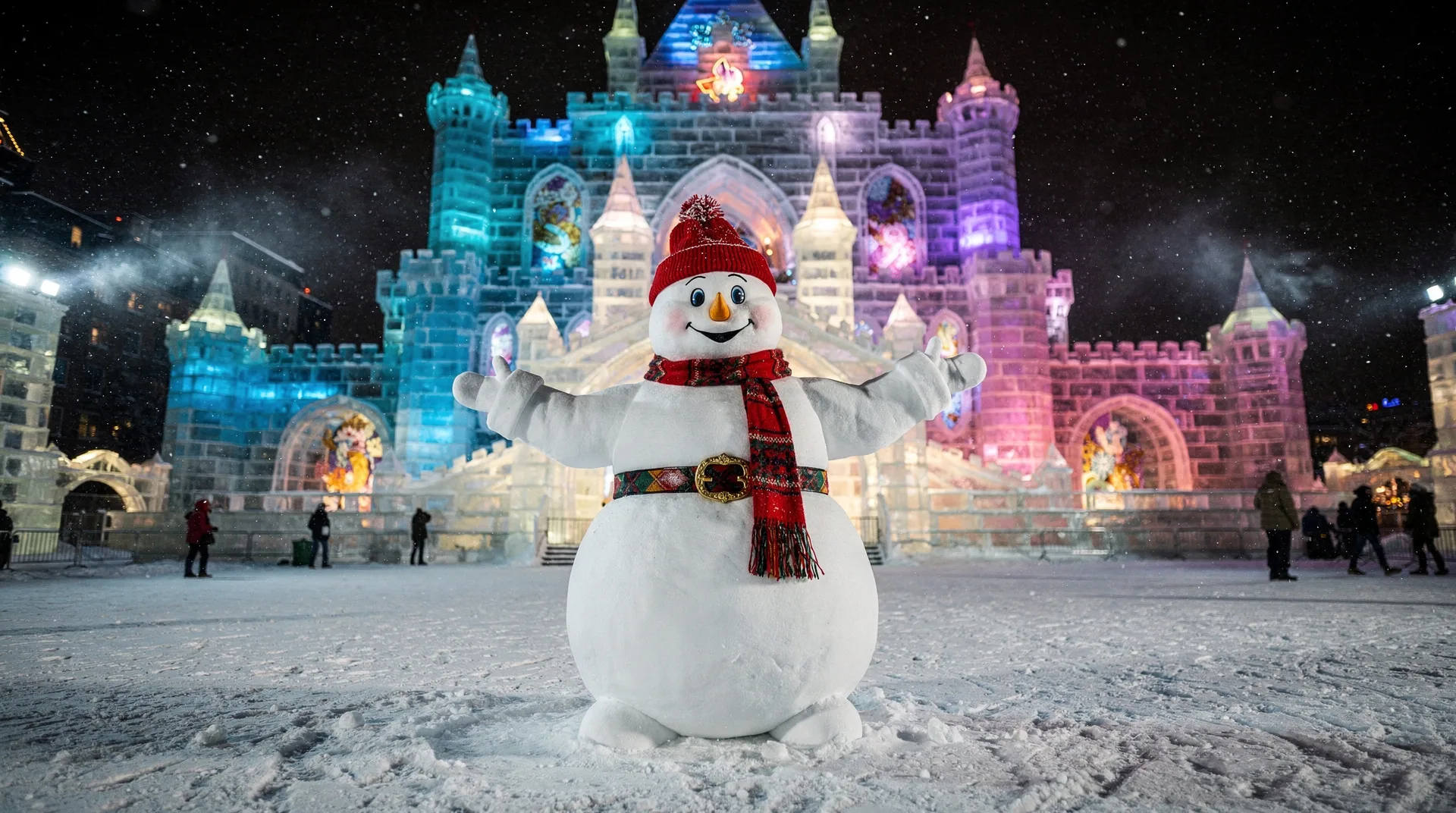
Bonhomme is the festival’s white snowman mascot, distinguished by his red sash (a symbol of French-Canadian heritage) and his colourful hat. He has appeared at every Carnaval since 1954 and functions as the symbolic ruler of the festival — his ice palace is the event’s centrepiece, and his public appearances (multiple times daily at scheduled locations across the grounds) draw crowds of families and children.
Meeting Bonhomme — getting a photograph, shaking the enormous white hand — is a childhood rite of passage for Quebec families and a genuine novelty for visitors. The schedule of Bonhomme appearances is published daily and is worth tracking.
The ice palace
Bonhomme’s ice palace (Palais de Glace) is the architectural centrepiece of the Carnaval and one of the most striking winter constructions in the world. Built each year from blocks of ice cut from the St. Lawrence River, the palace typically stands 2–3 storeys tall, with towers, gates, and interior rooms lit from within. Construction begins in December and the palace is complete by opening weekend.
The palace is lit beautifully at night — the blue and white glow from its ice walls is the signature Carnaval image. Entry to the palace is included with the Carnaval passport (the all-event pass) or can be purchased separately.
The palace site also hosts daytime activities, carnival games, and hot chocolate and Caribou vendors.
Night parades
The Carnaval has two night parades during its run, typically on consecutive Saturdays. These parades are genuinely spectacular: floats lit with thousands of lights, giant puppet characters, bands, and performers winding through the streets of Vieux-Québec to crowds of tens of thousands.
The parades take place on the main streets of the walled city — Boulevard René-Lévesque and Grande Allée are the primary viewing corridors. Arrive at least 90 minutes early to secure a viewing spot on the front barrier. Standing in -15°C for an extended parade requires serious cold-weather preparation — this is the event most likely to produce cold-related discomfort for visitors who underestimate the conditions.
The ice canoe race
The canoe race on the St. Lawrence River is the Carnaval’s most dramatic sporting event. Teams of five paddle and drag their canoes across the partly frozen river between Quebec City and Lévis on the south shore — a crossing that requires physically pushing the canoe over ice floes, paddling through open water channels, and repeating in both directions.
The race takes place near the lower town (Basse-Ville) and draws large spectator crowds on the riverbank. It is one of the most physically demanding traditional events in Canada — rooted in the historical necessity of crossing the St. Lawrence in winter before the bridge was built.
The race typically takes place on a weekend mid-Carnaval. Check the official schedule for exact dates.
Snow sculptures and outdoor activities
The Plains of Abraham (the historic battlefield park above the St. Lawrence) hosts the Carnaval’s largest outdoor activity zones during much of the festival period. Snow sculptures — created by competing teams from across Canada and internationally — are displayed throughout the grounds. The sculptures range from precise figurative work to abstract forms and are illuminated at night.
Tubing, sliding, and other snow activities are available at the outdoor activity zones. The Carnaval typically operates a large outdoor slide (glissades) that is a signature activity for families.
Drinking Caribou
Caribou is the Carnaval’s official drink — a mix of red wine, whisky (or other spirits), spices, and sugar, served warm or at room temperature. It is sold in the festival’s iconic red-and-white cane containers (you keep the cane) from Caribou kiosks throughout the grounds and from street vendors.
Drinking Caribou while walking through the Carnaval in Stetsons-equivalent (tuques, scarves, and Quebec winter fashion) is as much a cultural act as a recreational one. The drink is genuinely warming and genuinely strong — typically around 12–15% alcohol content. Pace yourself.
Browse Quebec City guided tours and winter experiencesDates and tickets (2026)
The Carnaval de Québec 2026 dates are typically announced in the fall. The festival usually runs for approximately 17 days beginning the last Friday of January through the second Sunday of February. For 2026, expect approximately January 30 – February 15, 2026 (confirm at carnaval.qc.ca for official dates).
Carnaval Passport (Effigie): The festival’s all-access pass grants entry to the main events, the ice palace, and activity zones. Approximately CAD 22–26 (adult), CAD 14–18 (child 6–12), and free for children under 6. Passports are sold online and at the grounds.
Individual event tickets: Some activities (specific concerts, themed events) require separate tickets beyond the passport.
How to book transport and tours
Many visitors book day trips or packages to Quebec City for the Carnaval from Montreal — a 2.5 hour train or 2.5–3 hour drive.
Book a Quebec City and Montmorency Falls winter day tour from MontrealVia Rail: Montreal–Quebec City trains run multiple times daily (2.5 hours). Book well ahead during Carnaval weekends — trains sell out.
Driving: Highway 20 (south shore) or Highway 40 (north shore) connects Montreal to Quebec City. Parking in Vieux-Québec is limited and expensive; park on the outskirts and take the bus or taxi.
Costs in CAD
| Item | Approximate cost (CAD) |
|---|---|
| Carnaval Passport (adult) | 22–26 |
| Carnaval Passport (child 6–12) | 14–18 |
| Caribou drink (festival vendor) | 6–10 |
| Via Rail Montreal–Quebec City (return) | 80–160 |
| Hotel (Vieux-Québec, Carnaval weekend) | 200–450/night |
| Hotel (lower town / outside walls) | 130–280/night |
| Restaurant dinner (Vieux-Québec) | 35–65/person |
What to wear
Quebec City in late January and early February averages -12°C with regular nights reaching -20°C or colder. The Carnaval is entirely an outdoor festival — there is no indoor “main arena” to retreat to. Dressing correctly is not optional.
The layering rule applies strongly: moisture-wicking base layer (avoid cotton), insulating mid-layer (fleece or down), outer windproof and waterproof shell. When standing watching the night parade, you have no activity to generate heat — this is when most visitors get cold. Add hand warmers and extra layers for parade nights.
Footwear: Insulated waterproof winter boots rated to -30°C. The streets of Vieux-Québec are cobblestone and get icy — grip matters.
Face protection: A balaclava or neck gaiter and warm hat (tuque). Ear protection is essential.
Waterproof outer layers: Snow activities involve contact with snow and slush. Everything should be waterproof.
Where to stay in Quebec City
Vieux-Québec (Old Town, within the walls): The most atmospheric location — you are in the heart of the festival, steps from the ice palace and parade routes. The Fairmont Le Château Frontenac (the iconic clifftop castle hotel) is the prestige choice, from CAD 350–700/night during Carnaval. Smaller boutique hotels like Auberge Saint-Antoine and Hôtel Le Priori are beautiful but book out months in advance.
Grande Allée and Saint-Jean-Baptiste neighbourhood: Just outside the walls, within walking distance of all main events. More hotel inventory and typically lower prices than within the walls.
Sainte-Foy and outside the city: Budget hotels and chain properties along Autoroute 40 west of the city — 15–20 minutes from Vieux-Québec by taxi or bus.
See our Canada in February guide for broader winter travel planning.
Frequently asked questions about Quebec Winter Carnival: Bonhomme, ice castle and what to expect
Is the Quebec Winter Carnival good for families?
Absolutely — it is one of the best family festivals in Canada. The Bonhomme appearances, snow slides, tubing, the ice palace, and the accessible outdoor activities make it ideal for children aged 3 and up. The parade nights require patience and cold-weather preparation but are memorable for older children. The activity zones in the Plains of Abraham are specifically designed for family participation.
How many days do I need for the Carnaval?
One full day (arriving in the morning, staying for the night parade) gives you the highlights. Two days allows you to experience the ice palace in both daylight and evening lighting, catch a Bonhomme appearance, try the ice canoe race viewing, and explore Vieux-Québec at a more relaxed pace. Most visitors find two nights and two days the optimal commitment.
Can I visit Quebec City for the Carnaval as a day trip from Montreal?
Yes — the train is 2.5 hours each direction, making a long day trip possible. Leave Montreal on the first train (around 6:30–7am), arrive in Quebec City by 9:30am, and take the 6–7pm or later train back. You will miss the night parade unless you take a later train back. For the parade, an overnight stay is the better choice.
Is the Carnaval only in Quebec City?
The official Carnaval de Québec is based in Quebec City. There are winter festivals in other Quebec cities (Montréal’s Fête des neiges at Parc Jean-Drapeau runs concurrently), but nothing matches the scale or tradition of the Quebec City event.
What language is the festival in?
Primarily French — Quebec City is deeply Francophone and the Carnaval is a celebration of French-Canadian culture. That said, all major tourist services at the festival are bilingual, volunteers and staff speak English, and English-speaking visitors experience no difficulty. The French-language immersion is part of the cultural experience and warmly welcomed.
What happens if it is too warm during Carnaval?
In recent years, warming winter temperatures have occasionally affected ice and snow construction. The Carnaval has contingency plans for ice palace construction (alternative ice cutting sites, accelerated timing) and has maintained operations through variable winters. January in Quebec City typically has reliable cold temperatures, but recent years have seen occasional mild spells.