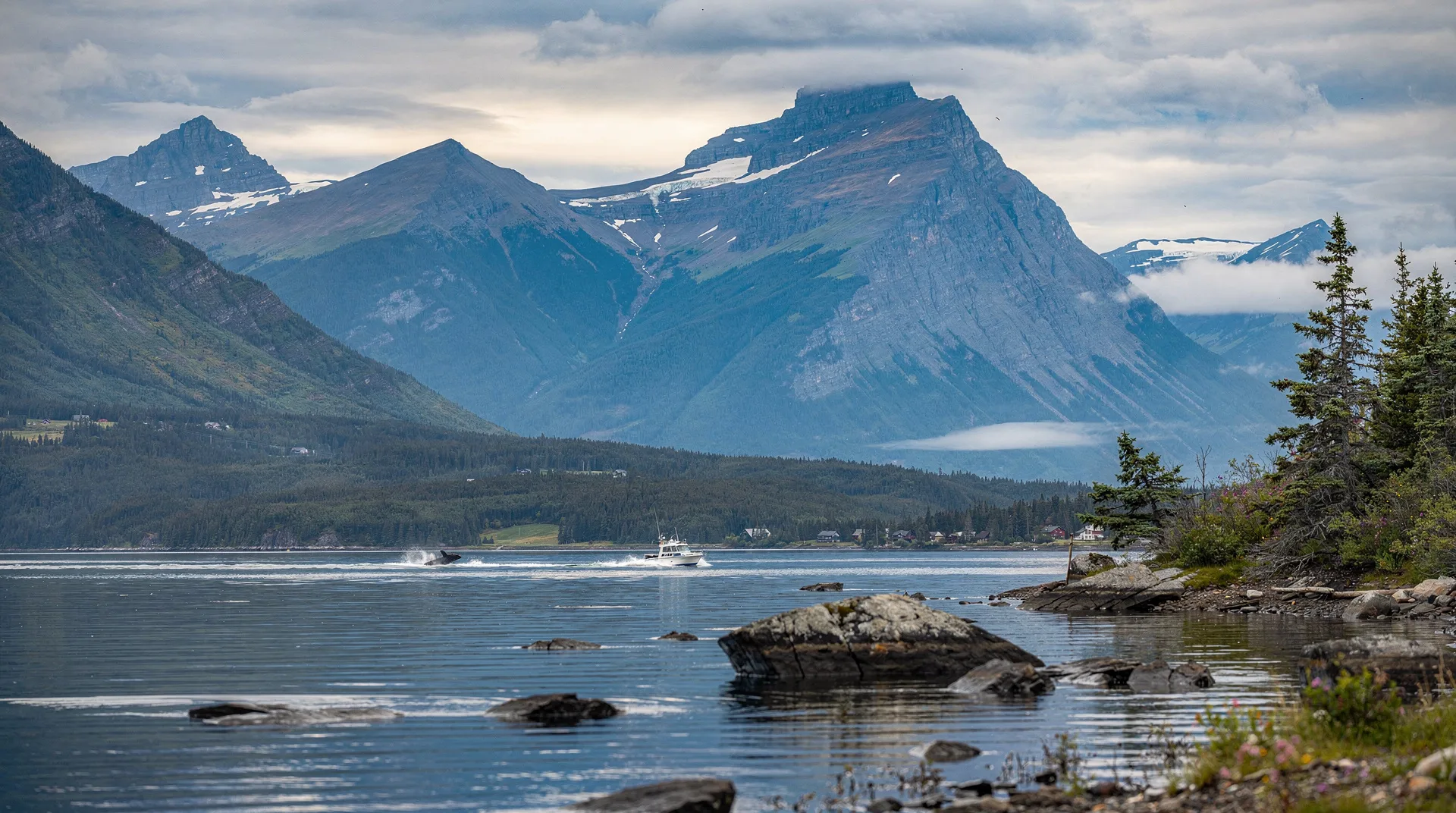
Quebec Whale Season: Month-by-Month Guide to the St. Lawrence
When is the best time to see whales in Quebec?
The peak of Quebec's whale watching season is July and August, when blue, fin, humpback, minke, and beluga whales are all present in the Saguenay–St. Lawrence Marine Park. June is excellent for belugas and minkes; September is often quieter but can produce excellent blue whale encounters as they feed intensively before migration. Most operators run from late May to mid-October.
The St. Lawrence estuary is among the finest whale watching destinations on earth. The combination of the Saguenay River’s cold, deep water mixing with the St. Lawrence creates an upwelling of nutrients that draws an exceptional diversity of cetacean species — from the compact, ivory-coloured beluga to the blue whale, the largest animal that has ever lived on Earth. Within a few kilometres of the village of Tadoussac, and along a stretch of the St. Lawrence accessible from several towns, visitors can regularly encounter species that require open ocean expeditions in most other parts of the world.
This guide covers the whale watching season month by month, the species you can expect to see, the best locations and operators, and the practical information needed to plan a trip around this extraordinary wildlife experience.
| At a glance | |
|---|---|
| Where | Tadoussac and the north/south shores of the St. Lawrence estuary, roughly 200 km northeast of Quebec City |
| Cost | Around CAD $80-120 for a 2-3 hour boat tour, adult; shore-based viewing is free |
| Time needed | Half a day for a boat tour with travel; a full day if combined with the Charlevoix drive |
| Getting there | Self-drive via Highway 138 and the free Tadoussac-Baie-Sainte-Catherine ferry, or an organised day trip from Quebec City |
| Best time | Late June to mid-September, with July-August offering the widest range of species |
Seasonality: month-by-month snapshot
| Month | Species likely | Crowds |
|---|---|---|
| May-June | Belugas, minkes, first fin whales | Light |
| July | All species, including blue and humpback | Heavy, book ahead |
| August | Peak diversity, best blue whale odds | Heaviest |
| September | Blue whales into mid-month, strong feeding activity | Moderate, thinning after Labour Day |
| October | Minkes, fin whales; season closing | Light |
Why the St. Lawrence supports so many whales
The key is geography and oceanography. The Laurentian Channel — a deep underwater trench that runs from the Gulf of St. Lawrence — channels cold, nutrient-rich water from the Atlantic deep into the estuary. Where this cold water meets the shallower, warmer surface water, it upwells, carrying krill, capelin, and sand lance to the surface. This concentration of prey supports feeding populations of multiple large whale species within the river itself, not merely the gulf.
The Saguenay–St. Lawrence Marine Park, established in 1998, protects approximately 1,245 square kilometres at the confluence of the Saguenay Fjord and the St. Lawrence. The park’s regulations govern how closely vessels can approach whales, maintaining the quality of encounters and protecting the animals from harassment. The beluga population within the park — a genetically distinct, resident population that does not migrate — has been the subject of intensive scientific study for decades.
Month-by-month whale watching calendar
May: season opening, belugas and minkes
Late May marks the beginning of the commercial whale watching season at Tadoussac. Water temperatures are still cold, and the major feeding aggregations of large whales have not yet fully established. Minke whales — the smallest and most acrobatic of the baleen whales commonly seen here, at 8–10 metres — are reliably present. Belugas are visible year-round in the Saguenay fjord and estuary, and May encounters with these sociable, pale whales are excellent.
The advantage of May: boat tours run with far fewer passengers, guides have time for extended explanations, and the light in late May has a quality that makes photography rewarding. The fjord’s steep walls are still dusted with snow in early May, creating a dramatic backdrop. Most operators begin weekend-only service in mid-May, transitioning to daily departures by late May.
June: minkes, belugas, and first fin whales
June is an underrated month for whale watching at Tadoussac. Minke whales are actively feeding on capelin, often coming close to the surface in predictable feeding patterns. Beluga encounters are consistent. Fin whales — the second-largest animal on Earth, reaching 25 metres — begin appearing in the estuary in earnest through June, often in small groups feeding along tidal fronts.
June also offers the season’s best combination of reasonable crowds and reliable wildlife. July and August bring significantly more visitors, meaning boat tours are fuller and parking in Tadoussac becomes a logistical challenge. June visitors have a notably more spacious experience.
Weather in June on the St. Lawrence can be unpredictable — fog is common in the morning, clearing by midday. Afternoon departures often offer cleaner views.
July: peak season — all species present
July is the month when Quebec’s whale watching reaches its greatest diversity. All species that use the estuary are typically present simultaneously:
Blue whales (Balaenoptera musculus): The largest animal on Earth — reaching 27 metres and 150 tonnes in the St. Lawrence population — feeds intensively on krill in the estuary through summer. Tadoussac and the Les Bergeronnes area are the most reliable blue whale viewing locations in eastern Canada. Encounters with blue whales are never guaranteed (no whale encounter is), but July and August provide the best probability.
Fin whales: Often seen in pairs or small groups. Their distinctive asymmetric colouring (white on the lower right jaw, grey on the left) is unique among cetaceans. Fin whales tend to surface multiple times in a predictable sequence before a deep dive, giving photographers multiple opportunities.
Humpback whales: Present in smaller numbers than the previous two species but providing the most spectacular behaviour — breaching, pec slapping, and lobtailing are regularly observed. Their elaborate songs carry through the estuary.
Minke whales: Present throughout the season. More agile than the larger species and often observed feeding close to shore.
Belugas: The resident population of approximately 900 belugas is present year-round. In July, groups of adult males (the “boys’ club,” as researchers call them) are often visible from shore near Pointe-Noire interpretation centre, socialising at the surface.
Harbour porpoise: Small, fast, and often overlooked beside the larger species, harbour porpoise are common throughout the estuary.
July is also the month of highest visitor numbers. Accommodation in Tadoussac and Baie-Sainte-Catherine fills weeks in advance for July weekends. Book early.
Book a Tadoussac whale watching cruise on the St. LawrenceAugust: second peak, blue whales intensify
August mirrors July in wildlife diversity and often exceeds it for blue whale encounters. The whales are feeding at maximum intensity ahead of their autumn migration, meaning they spend more time at the surface in feeding behaviour — lunge feeding, skimming, and the characteristic dives that show the tail flukes before a long submergence.
The Parc marin saguenay–Saint-Laurent hydrophone network shows August as the month with the highest acoustic activity from multiple species simultaneously. For a visitor, this translates to boats moving between species encounters across a stretch of water that feels genuinely teeming.
August is also the warmest month for the water crossing — zodiac tours are cold regardless of season (dress for wind chill, not air temperature), but August conditions are the most comfortable. The light in August evenings is warm and south-facing, ideal for photography on afternoon cruises.
September: quieter boats, excellent feeding conditions
September is perhaps the month most underestimated by whale watchers. Blue whales are still present in good numbers through mid-September, feeding as intensively as at any point in the season ahead of their migration south. Humpbacks can be highly active. But visitor numbers drop sharply after Labour Day (first Monday of September), and the experience of being on a boat with fewer passengers, in September light, with whales at peak feeding activity, can feel significantly more special than the crowded boats of July.
The trade-off: some operators begin reducing departure frequency in September, and the weather window becomes tighter. Fog and rain are more frequent. By late September, the season is winding down noticeably.
October: season close
Early October can still produce excellent encounters, particularly with minkes and fin whales that are among the last to depart. Blue whales typically begin their migration in late September. Most Tadoussac operators run their final cruises in the first two weeks of October. The St. Lawrence in October has a moody, atmospheric quality that dedicated wildlife photographers appreciate, but visitors prioritising wildlife probability should target the June-to-September core season.
See our Quebec in October guide for what else the province offers in the fall season.
Best whale watching locations
Tadoussac and Baie-Sainte-Catherine
The twin towns at the mouth of the Saguenay Fjord are the undisputed centre of Quebec whale watching. The car ferry crossing between Tadoussac and Baie-Sainte-Catherine (free, and itself an excellent vantage point for beluga and porpoise) crosses some of the most productive whale habitat in the estuary. Multiple tour operators run from both towns, offering zodiac tours (smaller, faster, wetter, closer to the wildlife) and larger covered-vessel tours (more stable, better for those prone to seasickness, with indoor viewing).
Croisières AML and Groupe Dufour are the largest operators at Tadoussac, running multiple departures daily at peak season on large vessels. Smaller zodiac operators — Mer et Monde Écotours and Otis Escalade are consistently well-reviewed — provide more intimate experiences at a higher price point.
Les Bergeronnes and Les Escoumins
Driving northeast from Tadoussac along the north shore of the St. Lawrence, the villages of Les Bergeronnes and Les Escoumins offer a different perspective. The Cap-de-Bon-Désir interpretive site in Les Bergeronnes has an underwater ledge where belugas regularly pass at close range — a shore-based viewing experience that requires no boat. The site is managed by Parks Canada and provides excellent interpretation.
Les Escoumins has its own whale watching departures and is slightly less visited than Tadoussac. The marine park boundary runs through this area, and fin whale encounters from this departure point are reliable.
Rimouski and the south shore
The south shore of the St. Lawrence opposite Tadoussac — accessible from Rimouski, Trois-Pistoles, and Rivière-du-Loup — offers a different angle on the same waters. Several operators depart from Rimouski, and the perspective of looking north toward the Charlevoix mountains provides a different photographic backdrop. South shore departures tend to be less crowded and are easier to reach from the Highway 20 corridor that most drivers use approaching from Quebec City.
Book a whale watching excursion from Quebec City toward the St. Lawrence Marine ParkWhat to wear on a whale watching boat
This point cannot be overemphasised: whale watching on the St. Lawrence is cold regardless of the air temperature onshore. A July afternoon that feels comfortable in Tadoussac village (20°C) becomes 10–12°C on the water with wind chill from the boat’s speed. Zodiac tours at 50 knots are significantly colder.
Recommended layers for any whale watching departure:
- Thermal base layer (even in summer)
- Fleece or warm mid-layer
- Windproof and waterproof outer jacket
- Warm hat (bring one even in August)
- Waterproof gloves for zodiac tours
- Sunscreen — the reflection off the water is intense
Most zodiac operators provide flotation suits that add considerable insulation. Larger vessel operators typically have indoor heated cabin space for warming up between surface-level viewing.
Shore-based whale watching
For visitors who prefer not to take a boat tour, or who want to supplement a cruise with shore time, several locations offer productive shore-based viewing during peak season:
Pointe-Noire interpretation centre (Baie-Sainte-Catherine): Parks Canada facility with elevated viewpoints directly above the confluence of the Saguenay and St. Lawrence. Beluga groups are regularly visible from shore. Interpretive staff are present daily in season.
Cap-de-Bon-Désir (Les Bergeronnes): As mentioned above, the underwater ledge here brings belugas and occasionally minkes into viewing range from the shore platform. Parks Canada staff and hydrophones allow visitors to hear whale vocalisations while watching.
Route 138 coastal pullouts between Tadoussac and Les Escoumins: Several roadside viewpoints above the river provide scanning positions for larger species. Fin whales surfacing in the shipping channel are visible with binoculars from several pullouts.
Combining whale watching with a Quebec trip
Whale watching fits naturally into several Quebec itinerary structures:
From Quebec City: A day trip to Tadoussac is possible but long (approximately 2.5–3 hours each way, 280 kilometres). A one-night stay allows a morning departure with more comfort. See our 7-day Quebec itinerary for a route that includes Charlevoix and the whale coast.
Charlevoix base: Baie-Saint-Paul in Charlevoix is approximately 1.5 hours from Tadoussac, making it a natural base for whale watching combined with the region’s excellent food and art scene. See our Charlevoix 4-day guide for a full plan.
The Gaspésie loop: The Gaspésie Peninsula that curves around the southern Gulf of St. Lawrence also offers whale watching, particularly around Forillon National Park at the Gaspé tip. Different species composition (more humpbacks and minkes, fewer blue whales) but a spectacular coastal driving context. See the Gaspésie 7-day loop for details.
Booking realistically for peak season
July and August are the months most first-time visitors target, but they’re also when Tadoussac accommodation and boat departures sell out fastest. If your dates are flexible, June or September deliver a strong species mix (fin whales and belugas reliably, blue whales possible in a good September) with noticeably lighter boats and easier parking.
Whichever month you choose, book the boat tour before the accommodation — cruise departures fill first in peak weeks, and there’s little point locking in a hotel near Tadoussac only to find every operator sold out for your dates. For a broader look at how whale season fits Quebec’s wider calendar, see our Quebec in summer guide and Quebec festivals calendar if you’re stacking the trip with other events.
Where to stay
Tadoussac itself has limited accommodation that books out fast in July and August. Baie-Sainte-Catherine, just across the free ferry, is a practical overflow base with similar access to departures. Travellers building whale watching into a longer loop often base instead in Charlevoix, roughly 1.5 hours south, which offers considerably more lodging choice and its own food and art scene, or push further to Saguenay-Lac-Saint-Jean for the fjord side of the same marine park.
Frequently asked questions about Quebec Whale Season: Month-by-Month Guide to the St. Lawrence
Are blue whale sightings guaranteed?
No whale sighting is guaranteed. Blue whales are present in the estuary from approximately late June through mid-September, and the probability of encountering them during a July or August cruise is reasonably high — experienced operators know the feeding grounds and current conditions. However, whales are wild animals in a large body of water. Most operators offer a second cruise at no charge if no whales are sighted, though this is rare in peak season.
Is Tadoussac the only whale watching location?
Tadoussac is the main hub, but operators also depart from Baie-Sainte-Catherine, Les Escoumins, Rimouski, Trois-Pistoles, Rivière-du-Loup (south shore), and Percé (Gaspésie). Each offers a slightly different species mix and geographic context. Tadoussac remains the most reliable for blue whale encounters due to its position at the Saguenay confluence.
Which is better: zodiac or large vessel?
This depends on priorities. Zodiacs are faster, get closer to wildlife, and are more exciting — but they are cold, wet, and uncomfortable for those prone to motion sickness. Large vessels are more comfortable, offer better shelter, and are more accessible for families with young children or older adults. For wildlife photography, zodiacs generally provide better angles and proximity. For a first whale watching experience, a large vessel gives a more relaxed introduction.
How long does a whale watching cruise last?
Most Tadoussac-area cruises run 2 to 3 hours, though some larger-vessel tours extend to closer to 4 hours. Factor in check-in time before departure and the drive or ferry crossing to reach the dock.
Can I see whales without taking a boat tour?
Yes. Shore-based viewpoints such as Pointe-Noire in Baie-Sainte-Catherine and Cap-de-Bon-Désir near Les Bergeronnes regularly produce beluga and porpoise sightings at no cost, and the free Tadoussac-Baie-Sainte-Catherine ferry crossing itself passes through productive whale habitat.