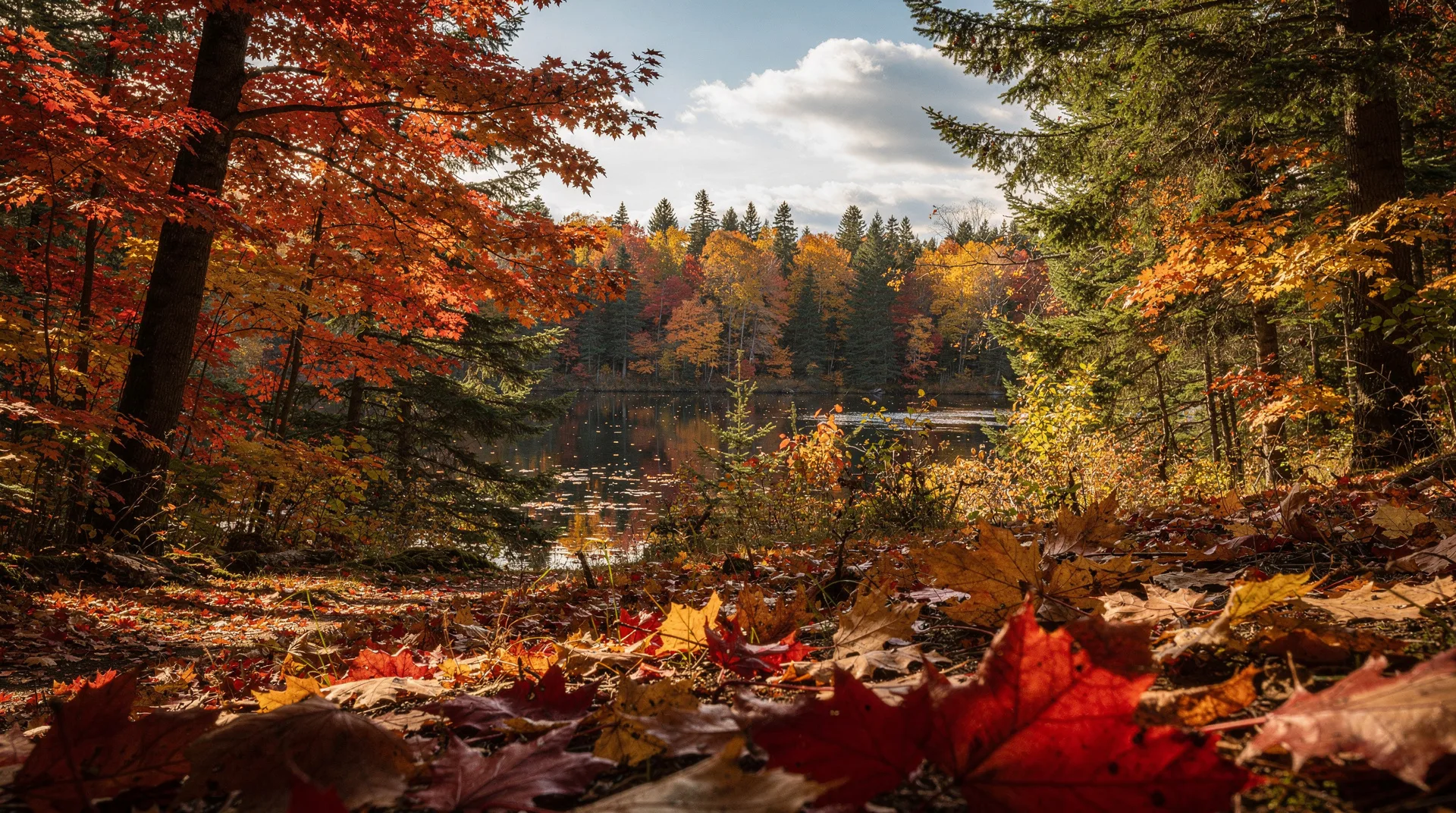
Ontario fall colours: where and when to see peak foliage
When do Ontario fall colours peak?
Ontario fall colours peak from the third week of September in the far north to the third week of October in Niagara. Algonquin Park typically peaks the last week of September through the first week of October. Muskoka and Haliburton peak early October; Toronto and Niagara peak mid-to-late October.
Ontario is the province that gave Canadian fall foliage its reputation. The great hardwood forests of the Canadian Shield — dominated by sugar maple, red maple, yellow birch, and red oak — produce the deepest and most varied autumn colour in the country, running from the sharp scarlet of a sugar maple on a cold September morning to the deep burgundy of oaks still holding leaves in late October. Between mid-September and early November, colour moves across the province in a slow wave that can be chased, photographed, or simply enjoyed from a cottage dock.
This guide covers when colour peaks in each Ontario region, the best drives and experiences, and how to build a fall-colour trip that does not involve fighting the Algonquin weekend crowds.
| At a glance | |
|---|---|
| Where | Across Ontario, peaking earliest in the far north and latest along Lake Erie/Niagara |
| Cost | Free to view from public roads and lookouts; some trails and the Agawa Canyon train (around CAD 140-180) charge |
| Time needed | A day trip for a single region, 4-7 days to chase colour across the province |
| Getting there | Car is essential for most drives; the Agawa Canyon train departs from Sault Ste. Marie |
| Best time | Late September (north/Algonquin) through late October (Niagara/Toronto) — see the regional table below |
Ontario fall colour by region: when to go
| Region | Typical peak | Notes |
|---|---|---|
| Far north (Lake Superior Park, Chapleau) | Third week of September | Earliest colour in the province |
| Algonquin, Temagami, Sudbury | Late September-early October | Busiest weekend of the year at the park |
| Muskoka, Haliburton, Agawa Canyon, Manitoulin | First two weeks of October | Overlaps with cottage-closing season |
| Kawarthas, Bruce Peninsula, Thousand Islands | Second-third weeks of October | Quieter than Algonquin, still strong colour |
| Toronto, Hamilton, Niagara Escarpment | Mid-to-late October | Best for day trips without a long drive |
| Niagara Parkway, Lake Erie shoreline | Late October-early November | Latest colour in southern Ontario |
When Ontario fall colours peak
Fall progresses north to south and cools inland before the Great Lakes moderate colour on the coasts. As a rough calendar:
- Third week of September: far northern Ontario — Lake Superior Provincial Park, Chapleau, Lake of the Woods
- Last week of September to first week of October: Algonquin Park, Temagami, North Bay, Sudbury
- First two weeks of October: Muskoka, Haliburton Highlands, Agawa Canyon, Manitoulin Island
- Second and third weeks of October: Kawarthas, Bruce Peninsula, Thousand Islands, Prince Edward County
- Mid-to-late October: Hamilton area, Dundas Valley, Toronto ravines, Niagara Escarpment
- Late October to early November: Niagara Parkway, Lake Erie shoreline, downtown Toronto street trees
The exact peak date shifts by 5 to 10 days year to year. Cool nights (below 5 Celsius) with warm sunny days produce the most vivid reds; warm cloudy Septembers mute colour to yellow. An early hard frost accelerates drop; a wet October shortens the peak.
The Ontario Parks fall colour report updates weekly from mid-September and is the single best timing tool. The Algonquin Park visitor centre posts a daily percentage estimate during peak weeks.
Algonquin Provincial Park
Algonquin is the signature fall-colour destination in Ontario and one of the most-visited autumn landscapes in Canada. The park is dominated by sugar maple at mid-elevations — the species responsible for the classic fiery red that advertises Canadian autumn — and the mix of maple, birch, and aspen produces a full spectrum of reds, oranges, and yellows.
Peak window: last week of September through the first week of October for red maples; yellows (aspen, birch) peak a few days to a week later.
What to do:
- Highway 60 corridor lookouts. The 56-km stretch of Highway 60 that crosses the southern edge of the park has several signed lookouts — most notably the Lookout Trail (2 km return, stunning panorama) and the Two Rivers Trail. Arrive early. Parking at the Lookout Trail fills by 9 am on peak weekends.
- Canoe day-rentals at Canoe Lake or Opeongo. A short paddle takes you away from road-level crowds and into a colour experience no drive can match. Rentals run about CAD 45 to 60 per day; advance booking recommended in peak week.
- Centennial Ridges Trail (10 km loop) for the best hiking view in the park.
- Algonquin Visitor Centre — excellent exhibits and a viewing deck that is open even on rainy days.
Lodging reality: park campgrounds and the classic in-park lodges (Arowhon Pines, Killarney Lodge, Bartlett Lodge — all close before or just after peak) book out 6 to 12 months in advance for the peak weekend. Look at gateway towns — Huntsville, Whitney, Dwight — for late availability, or plan a midweek visit.
A longer Ontario 7-day itinerary can use Algonquin as its centrepiece without losing the rest of the province.
Book Algonquin Park guided tours and fall-colour experiencesThe Agawa Canyon tour train
The Agawa Canyon Tour Train runs from Sault Ste. Marie north into the Agawa Canyon wilderness — a full-day rail experience that is one of the best ways to see fall colour from a seat rather than a car. The route climbs gradually into the Canadian Shield, crosses trestle bridges over rocky gorges, and stops at the canyon floor for a 90-minute break with short walks to waterfalls and viewpoints.
Running season: late September through mid-October, with daily departures during the peak window. Duration: 9 hours round trip, departing Sault Ste. Marie around 8 am. Cost: approximately CAD 140 to 180 adult depending on date and class.
Peak colour in the canyon is typically the last week of September to the first week of October — a few days earlier than Algonquin. Booking opens in spring and the peak dates sell out well in advance. Agawa is best paired with a longer Northern Ontario loop; the trip is a full commitment from Sault Ste. Marie.
Muskoka and the Haliburton Highlands
Muskoka is the cottage country north of Toronto — a landscape of rocky Canadian Shield, deep lakes, and rolling hardwood forest that photographs beautifully in autumn. Peak colour falls in the first half of October, overlapping neatly with the final weekends before cottages close for winter.
Best drives:
- Highway 35 north of Minden — a two-hour drive through Haliburton Highlands with continuous colour.
- Highway 11 / Muskoka Road 117 — the loop from Huntsville to Dorset via the Lake of Bays touches a string of small harbour towns and dramatic lookouts.
- Dorset Lookout Tower — 142 stairs to a 360-degree view that is arguably the best fall panorama in the province. Arrive at sunrise for quiet.
- Arrowhead Provincial Park — short trails, uncrowded, ideal for a morning walk before the day-trip crowds arrive.
- Torrance Barrens — high rocky outcrops looking out over mixed forest, especially striking in golden hour.
Steam trains run in Muskoka on occasional autumn weekends; the region also hosts a busy calendar of fall fairs. See our Muskoka destination guide for overnight options.
The Niagara Parkway
The Niagara Parkway — the scenic road running 55 km along the Canadian side of the Niagara River from Niagara-on-the-Lake to Fort Erie — was famously called “the prettiest Sunday afternoon drive in the world” by Winston Churchill. In mid-to-late October it lives up to the quote. Sugar maples and red oaks line much of the route; the river is a deep blue; and the vineyards of Niagara-on-the-Lake turn red and gold in the same window.
Best stops from north to south:
- Niagara-on-the-Lake — historic town, wineries, harvest tastings.
- Queenston Heights — hilltop park, Brock Monument, panoramic gorge view.
- Niagara Glen — short stair descent into the Niagara Gorge; mature hardwood forest; excellent hiking.
- Dufferin Islands — just upstream of the falls; quiet ponds ringed with maples.
- Niagara Falls proper — colour in November framing the falls is one of the underrated images of the province.
Niagara is a logical late-October destination for travellers who miss Algonquin’s peak; colour arrives 3 to 4 weeks later.
Other strong fall-colour drives
- Kawartha Highlands and Bancroft area: mid-October; very quiet midweek.
- Thousand Islands Parkway: second and third weeks of October; river views with oaks and maples.
- Bruce Peninsula: early-to-mid October for the Bruce Trail; late October on the lower peninsula.
- Manitoulin Island: first two weeks of October; the long drive rewards those who combine with Lake Superior Provincial Park.
- Prince Edward County: mid-October; combine fall colour with a vineyard weekend.
- Dundas Valley Conservation Area (Hamilton): third week of October; excellent for day trips from Toronto.
Combining fall colour with other activities
Autumn in Ontario is the best season for combination trips because multiple seasonal experiences peak together.
- Fall colour + apple orchards and cider mills: Blue Mountain, Georgian Bay area, Niagara Escarpment.
- Fall colour + migrating birds: Point Pelee on Lake Erie is one of the great raptor migration points in North America.
- Fall colour + wine harvest: Niagara, Prince Edward County, and the Lake Erie North Shore all host harvest festivals through October.
- Fall colour + canoeing: Algonquin interior paddling in late September and early October is empty, cool, and stunning.
- Fall colour + hiking: Bruce Trail sections north of Hamilton peak between 1 and 3 weeks later than Algonquin.
Timing a one-week Ontario fall-colour trip
A seven-day itinerary from Toronto, timed for late September to early October:
- Day 1: arrive Toronto; evening walk in High Park or the Don Valley.
- Day 2: drive to Algonquin Park via Huntsville (3.5 hours). Late-afternoon Lookout Trail.
- Day 3: morning canoe on Canoe Lake; Centennial Ridges Trail in the afternoon.
- Day 4: drive south into Muskoka; Dorset Lookout Tower; overnight on Lake of Bays.
- Day 5: Haliburton Highlands scenic loop; Bancroft or Minden overnight.
- Day 6: drive to Prince Edward County or Niagara-on-the-Lake via the Thousand Islands Parkway.
- Day 7: vineyards, Niagara Parkway, return to Toronto.
A shorter 3-day version concentrates on Algonquin midweek. For a longer Ontario 10-day itinerary that adds Agawa Canyon and Lake Superior, start and end in Sault Ste. Marie.
Practical tips
- Book accommodation early — the peak Algonquin weekend is one of the busiest travel weekends in Ontario each year.
- Watch the weekly Ontario Parks fall colour report. It is accurate to within a few days and updated every Wednesday from mid-September.
- Drive midweek if possible. Tuesday and Wednesday at the Algonquin lookouts can be 70 percent quieter than Saturdays.
- Photography light: overcast days often reveal colour better than bright sun. First and last hour of the day are the best. Polarising filters pull saturation out of wet leaves after rain.
- Pack layers. Peak week temperatures range from 2 to 15 Celsius; mornings on canoe water can be near freezing.
- Wildlife: October is peak rut for moose in Algonquin; bears are actively feeding before denning. Keep distance and carry bear spray off-trail.
Ontario’s autumn is shorter than summer but the most photogenic season of the year. A four or five day visit timed to the weekly colour reports consistently delivers the single image people associate with Canada — and if you stay beyond the weekend crowds, the province rewards patience with empty trails, cheap lakefront rooms, and colour that arrives at a different place every week into November.
Book fall-colour tours from Toronto and NiagaraRelated guides
- Ontario provincial parks guide — camping and access details for Algonquin and beyond
- Ontario cottage country guide — Muskoka and Haliburton in more depth for a fall trip
- Canoeing Algonquin — pairing fall colour with a paddling trip
- Toronto destination guide — a base for day trips to Niagara and Hamilton fall colour
Frequently asked questions
Is Algonquin or Muskoka better for fall colour?
Algonquin peaks about a week earlier and has more varied terrain (lookouts, canoe lakes, hiking trails), while Muskoka peaks in early October and pairs colour with lakeside towns and resorts. Neither is objectively better — Algonquin suits active, hiking-and-paddling trips, Muskoka suits a more relaxed lake-and-drive itinerary; see the Ontario cottage country guide for more on the Muskoka option.
How far in advance should I plan an Ontario fall colour trip?
Book Algonquin-area accommodation for the peak weekend (late September-early October) 6-12 months ahead if possible. For less concentrated regions like the Kawarthas, Niagara or Toronto day trips, a few weeks’ notice is usually sufficient, and you can adjust the exact dates closer to travel using the weekly colour reports.