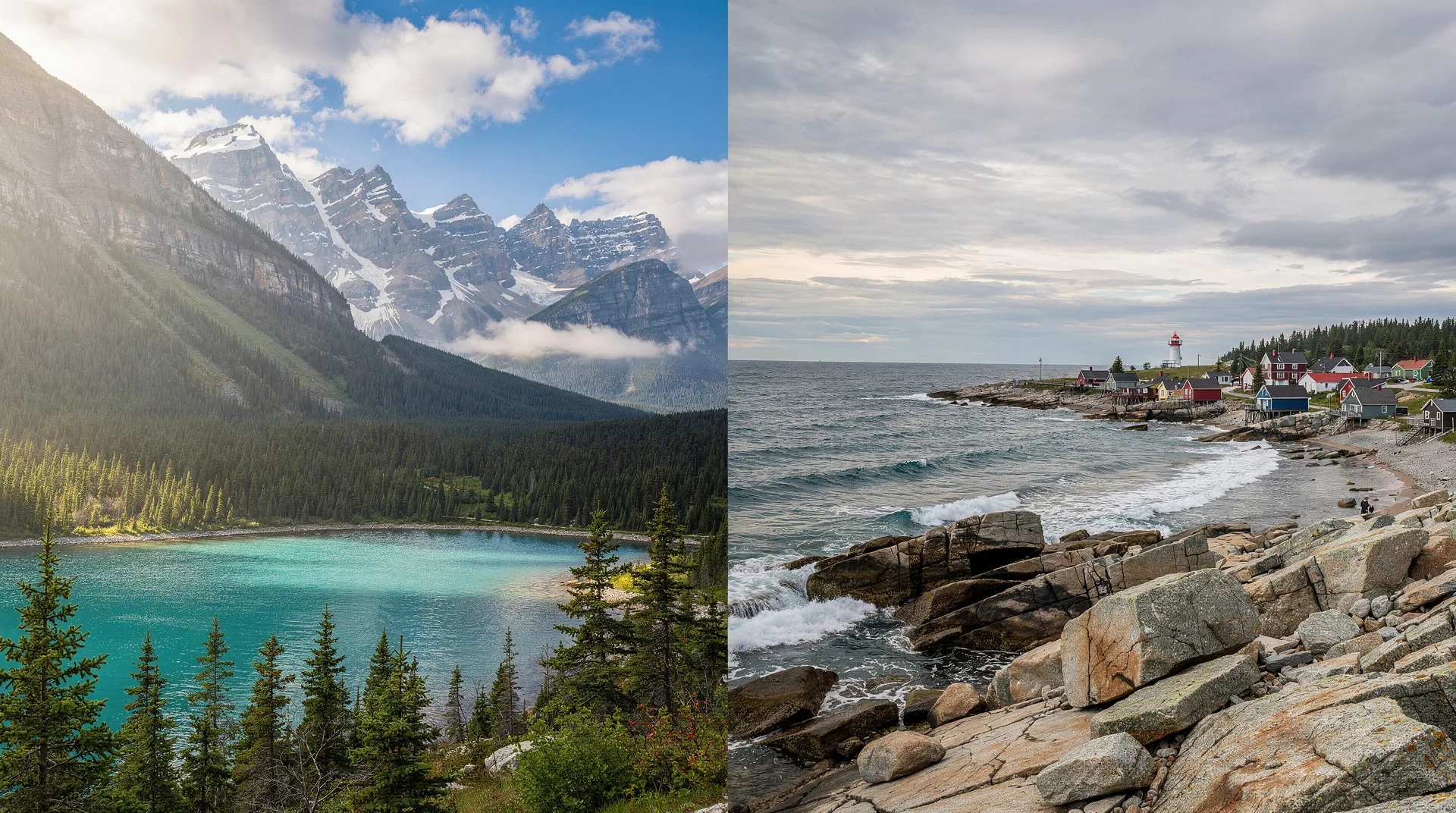
Nova Scotia vs New Brunswick: which Atlantic province to visit?
Should I visit Nova Scotia or New Brunswick?
Nova Scotia wins for scenic drama (Cabot Trail, coastal scenery, lighthouse route), overall tourism infrastructure, and Halifax as a base. New Brunswick wins for the Bay of Fundy (world's highest tides, Hopewell Rocks), whale watching diversity, and the bilingual Acadian culture. Most visitors to Atlantic Canada benefit from including both.
Nova Scotia and New Brunswick share a provincial border and a great deal of history, but as travel destinations they offer genuinely different experiences. Nova Scotia draws visitors with its dramatic coastal scenery, the famous Cabot Trail, the UNESCO-listed Lunenburg, and Halifax’s waterfront energy. New Brunswick’s defining feature — for any traveller who encounters it — is the Bay of Fundy, the world’s tidal phenomenon of record.
Understanding what makes each province distinctive helps enormously in planning. This guide compares Nova Scotia and New Brunswick directly on the dimensions most relevant to visitors: scenery, major attractions, wildlife, food, cultural character, accommodation, and accessibility.
At a glance
| Nova Scotia | New Brunswick | |
|---|---|---|
| Main draw | Cabot Trail, coastal scenery, Halifax | Bay of Fundy tides, Hopewell Rocks, Acadian culture |
| Getting there | Halifax Stanfield (YHZ), most international options | Moncton (YQM) or Saint John, mostly domestic |
| Time needed | 5-7 days for a meaningful circuit | 3-5 days for a meaningful circuit |
| Cost | Mid to upper mid-range, Halifax pricier | Generally a touch cheaper outside Moncton |
| Best time | June-September for driving and whale watching | June-September, plus low tide timing for Hopewell Rocks |
The core identity of each province
Nova Scotia
Nova Scotia (“New Scotland” in Latin) is the most visited Atlantic province and the one with the best-developed tourism infrastructure. The province wraps around three bodies of water — the Atlantic Ocean, the Gulf of St. Lawrence, and the Bay of Fundy — creating an extraordinary variety of coastal character within a relatively compact geography.
The province’s population (approximately 1 million) includes significant Scottish, Acadian, Mi’kmaq, African Nova Scotian, and German communities, each with a distinct cultural legacy. Halifax, the capital, is a well-developed city of 400,000 with a genuine pub scene, excellent seafood, strong university culture, and direct international flight connections.
The Cabot Trail on Cape Breton Island is the province’s most famous attraction — a 298-km coastal loop drive through Cape Breton Highlands National Park that is consistently rated among the finest scenic drives in North America.
New Brunswick
New Brunswick is the only officially bilingual province in Canada. The province’s population (approximately 800,000) is approximately 33% French-speaking Acadian, with the Acadian community concentrated primarily along the north shore and the Moncton area. The bilingualism is not merely official — walking through Moncton or Caraquet, both languages are genuinely in daily use.
New Brunswick’s signature attraction is the Bay of Fundy — specifically, the world’s highest tidal range and the dramatic experiences it creates. Hopewell Rocks, where you walk on the ocean floor among 15-metre Flower Pot formations, is the province’s most distinctive single attraction. The Bay of Fundy whale watching, primarily from the outer bay islands, is among the finest in eastern North America.
The province is larger than Nova Scotia (72,000 km² vs 55,000 km²) but less intensively visited, with tourism infrastructure that is somewhat less developed — particularly outside of Moncton, Saint John, and the Fundy coast.
Scenery
Nova Scotia
Nova Scotia’s scenery is consistently beautiful over a large area. The Lighthouse Route (the southwest shore from Halifax to Yarmouth) strings together fishing villages, lighthouses, and rocky coves. The Cabot Trail’s highland-meets-coast drama in Cape Breton is world-class. The Sunrise Trail along the Northumberland Shore has a gentler pastoral beauty. The Fundy Coast in Nova Scotia (primarily the Digby Neck area) is dramatic in a different way from the Cabot Trail — the deep, cold bay and the Annapolis Valley’s pastoral softness on the other side of the province.
Nova Scotia has a greater variety of scenic types within a compact geography than any other Atlantic province.
If the coastline is what you came for, the Cabot Trail guide explains how to pace the loop, and the Peggy’s Cove and Lunenburg pages cover the most photographed stretches of the south shore. For a broader view of the island itself, see Cape Breton.
New Brunswick
New Brunswick’s scenery is more episodic — concentrated in specific places rather than continuously beautiful across the landscape. The Bay of Fundy coast is dramatic and distinctive: the red sandstone cliffs and enormous tidal range create a landscape that changes completely between high and low tide. The Fundy Trail Parkway and Fundy National Park protect some of the finest coastal scenery in the province.
The interior of New Brunswick (the Saint John River Valley, the Miramichi River country) is beautiful boreal and agricultural landscape but less dramatically scenic than the Nova Scotia coastline. The Acadian Coast along the north shore — particularly around Caraquet and Shippagan — has a flat, open beauty that is very different from Cape Breton’s grandeur.
Winner for overall scenic variety: Nova Scotia.
Winner for most distinctive single landscape: New Brunswick (Bay of Fundy tidal drama).
Travellers who want to go deeper on the New Brunswick side can read about Fundy National Park and the wider Bay of Fundy region, where the scenery rewards slow mornings and a flexible schedule built around the tides.
Browse Nova Scotia tours and experiencesMajor attractions
Nova Scotia highlights
- Cabot Trail: 298-km coastal loop, consistently ranked among the world’s best scenic drives
- Halifax: Vibrant waterfront city, excellent seafood, Titanic connection, Pier 21 immigration museum
- Lunenburg: UNESCO World Heritage Site, most beautiful small town in Atlantic Canada
- Peggy’s Cove: Most photographed lighthouse in Canada
- Cape Breton Highlands National Park: The Skyline Trail hike, highland barrens, whale watching
- Fortress of Louisbourg: The most significant French colonial fortress in North America (partially reconstructed)
- Alexander Graham Bell Historic Site: Excellent science and invention museum in Baddeck
New Brunswick highlights
- Hopewell Rocks: Ocean floor walk among Flower Pot formations at low tide — utterly unique
- Fundy National Park: 120 km of hiking trails, dramatic coastal scenery
- St. Andrews-by-the-Sea: Beautifully preserved Victorian resort town on Passamaquoddy Bay
- Grand Manan Island: Remote outer bay island with world-class whale watching and birding
- Moncton: Bilingual commercial hub, tidal bore experience
- Fundy Tidal Bore: Multiple rivers experience the bore; rafting on the Shubenacadie (technically in NS, accessible from Moncton) is the adventure version
- Kouchibouguac National Park: Dune beaches, bird colonies, and gentle Acadian coastal scenery on the north shore
Winner for quantity and variety of attractions: Nova Scotia.
Winner for most unique attraction with no equivalent elsewhere: New Brunswick (Hopewell Rocks tidal walk).
Two of these attractions have their own pages worth reading before you commit days to them: the Fortress of Louisbourg tour guide for the reconstructed French colonial town, and the Halifax page for the city’s waterfront, museums and the Titanic connection. On the New Brunswick side, Grand Manan Island and St. Andrews-by-the-Sea each reward an overnight stay rather than a rushed visit.
Wildlife
Whale watching
Both provinces border the Bay of Fundy, creating overlapping whale watching opportunities.
Nova Scotia (Brier Island): The outer bay waters accessible from Brier Island and Digby Neck are among the most productive in North America — humpbacks, finbacks, minkes, and the critically endangered North Atlantic right whale. The Brier Island operators have an excellent reputation for knowledgeable naturalist guides.
New Brunswick (Grand Manan, St. Andrews): Grand Manan sits in the outer bay convergence zone — critical right whale habitat in August. Grand Manan Whale & Seabird Research Station combines genuine research with public tours. St. Andrews is more accessible with good whale watching but in less productive water than Grand Manan.
See our Bay of Fundy whale watching guide for detailed comparison.
Winner for whale watching: Nova Scotia (Brier Island) and New Brunswick (Grand Manan) are roughly equivalent; Grand Manan is the right whale specialist’s choice, Brier Island the better all-rounder.
Other wildlife
Nova Scotia’s Cape Breton has dense moose populations and reliable pilot whale encounters on the Cabot Trail. New Brunswick’s shorebird populations (particularly at the Bay of Fundy tidal flats, which host millions of migrating sandpipers in late summer) are world-class for birders.
Winner for birding (shorebirds): New Brunswick.
Winner for moose: Cape Breton / Nova Scotia.
Food and drink
Nova Scotia
Halifax has the best restaurant scene in Atlantic Canada east of Montreal — genuinely interesting, with seafood as the centrepiece but extending into international cuisine, craft beer, and a lively food truck culture. Lunenburg, Chester, and the Cabot Trail communities all have good food options. The province’s wine industry (Annapolis Valley AVA) is modest but producing increasingly interesting whites. PEI-style community lobster suppers are less of a tradition in NS but whole lobster is ubiquitous.
New Brunswick
Moncton has improved significantly as a food city, with a bilingual food culture that incorporates both Acadian traditions (rappie pie, fricot, ployes/buckwheat pancakes) and contemporary cuisine. The Acadian food culture in Caraquet and the north shore communities is distinctive and authentic. Saint John has a developing food scene. The province’s overall restaurant density is lower than Nova Scotia’s.
Winner for overall food and restaurant scene: Nova Scotia.
Winner for distinctive regional cuisine: New Brunswick (Acadian food culture).
Seafood fans should also read our East Coast lobster guide, which helps you decide where a lobster dinner is worth planning a day around, and the lobster season in Atlantic Canada page for timing your trip.
Cultural character
Nova Scotia
Nova Scotia’s cultural complexity is one of its underappreciated strengths. The province has distinct cultures within its geography: Celtic Scottish in Cape Breton (with surviving Gaelic language use and a remarkable fiddle music tradition), Acadian French in the Clare area and Cape Breton’s Cheticamp, Mi’kmaq Indigenous culture across the province, German heritage in the Lunenburg area, and the urban culture of Halifax. The province is predominantly English-speaking but culturally diverse.
New Brunswick
New Brunswick’s defining cultural feature is its genuine, lived bilingualism. This is not a token bilingualism of road signs — in Moncton, Caraquet, and much of the north shore, French and English are used interchangeably in daily life, and the province’s Acadian community has maintained a distinct culture since the 1755 deportation (the Grand Dérangement) that shaped it profoundly. The Acadian Museum in Caraquet and the Village Historique Acadien near Caraquet are excellent introductions to this history.
Winner for cultural complexity and distinctiveness: Roughly equal; different cultural stories.
To understand the Acadian story that runs through both provinces, start with the Acadian heritage guide. For the Celtic side of Cape Breton, the Celtic music in Cape Breton page explains where the fiddle tradition is easiest to experience as a visitor.
Accessibility
Nova Scotia
Halifax Stanfield International Airport (YHZ) has direct international flights from the UK (Air Transat seasonal), US (Boston, New York, Newark), and good domestic connections from Toronto, Montreal, Ottawa, and Calgary. It is the most internationally connected airport in Atlantic Canada.
Sydney Airport (Cape Breton) has domestic connections to Halifax and Toronto.
New Brunswick
Moncton Airport (YQM) has domestic connections to Toronto, Montreal, and Halifax. Saint John Airport connects to Toronto. Neither has international connections comparable to Halifax.
Winner for accessibility from international origin points: Nova Scotia (Halifax).
Accommodation
Both provinces have full ranges of accommodation. Halifax and the Cabot Trail have the most sophisticated options in the region — boutique hotels in Halifax, the Keltic Lodge on Cape Breton, excellent B&Bs throughout the Lighthouse Route. New Brunswick’s St. Andrews has the Algonquin Resort and good Victorian-era inn accommodation. Fundy National Park area has limited but adequate options.
Winner for accommodation quality and variety: Nova Scotia, particularly Halifax and the Cabot Trail area.
Cost of visiting each province
Neither province is cheap by Canadian standards, but the shape of the spending differs. In Nova Scotia, Halifax accommodation and the more developed Cabot Trail tourism infrastructure push costs up, though motels and B&Bs outside the main circuit are reasonably priced. In New Brunswick, Moncton and Saint John are cheaper bases than Halifax, but the appeal of the Fundy coast means Hopewell Rocks-area lodging and St. Andrews can carry a premium in July-August. Renting a car is close to essential in both provinces; public transport between towns is limited. Ferries (Digby-Saint John, or Wood Islands PEI-Caribou NS) add real cost if your route includes them — budget these into any Atlantic Canada loop.
For a wider look at road conditions and planning on this coast, our driving Atlantic Canada guide and the Atlantic Canada weather guide help you choose dates and build a realistic daily route. If you are also weighing other destinations in the region, the comparison of Cape Breton vs PEI is a useful companion read.
Which province should you visit?
Visit Nova Scotia if:
- This is your first visit to Atlantic Canada and you want the most scenic and well-developed introduction
- The Cabot Trail is on your bucket list
- You are flying from Europe, the US, or western Canada (Halifax connections)
- You want a city base (Halifax) combined with spectacular coastal driving
- See our 7-day Atlantic Canada itinerary for the optimised Nova Scotia circuit
Visit New Brunswick if:
- The Bay of Fundy tidal phenomenon is your priority
- You want whale watching that includes right whale potential
- Bilingual Acadian culture interests you
- You are driving from Quebec or Ontario (NB is geographically between Quebec and NS)
- See our 7-day Bay of Fundy loop itinerary for the complete NB circuit
Visit both if: You have 10+ days and want to experience the complementary highlights of both provinces. The standard Atlantic Canada road trip includes both as adjacent sections of a single circuit — see our 14-day Atlantic Canada itinerary.
Frequently asked questions about Nova Scotia vs New Brunswick: which Atlantic province to visit?
Which province has better seafood?
Nova Scotia has the edge for restaurants and variety of experience. PEI (neither NS nor NB) has the most famous lobster — the community hall lobster suppers are matchless. New Brunswick has excellent fresh seafood but fewer destination restaurants outside Moncton.
Which province has better hiking?
Cape Breton Highlands National Park (Nova Scotia) has the best hiking in the region, with the Skyline Trail being the single best coastal hike. Fundy National Park (NB) has excellent hiking with the added dimension of tidal coastal walks. Nova Scotia wins for hiking quality.
How long do I need for each province?
A meaningful Nova Scotia circuit (Halifax, Lunenburg, Cabot Trail) requires 5-7 days minimum; a week is better. A meaningful New Brunswick circuit (Fundy coast, Hopewell Rocks, St. Andrews) requires 3-5 days. Combining both is ideal in 10+ days.
Do I need a car in Nova Scotia and New Brunswick?
Essentially yes. Both provinces have very limited intercity public transport, and the highlights — the Cabot Trail, the Bay of Fundy coast, Peggy’s Cove — are only practical to see with a rental car. Halifax and Moncton have local transit within the city, but a road trip is the only realistic way to see either province properly.