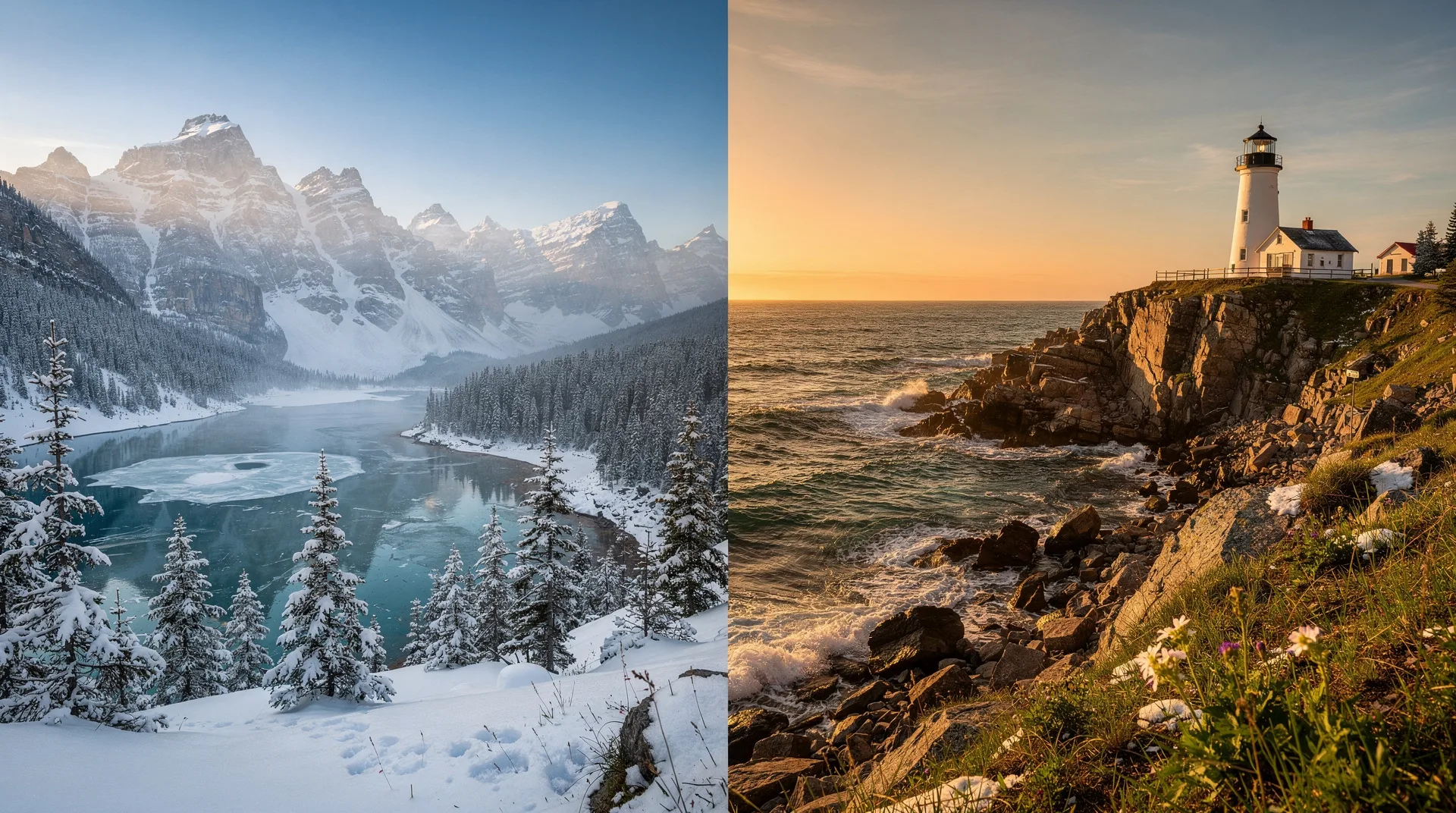
Newfoundland vs Labrador: wild vs wilder
Should I visit Newfoundland or Labrador?
For a first trip, choose Newfoundland — it has the accessible iconic sites (Gros Morne, St. John's, Viking Trail, Twillingate icebergs), better tourism infrastructure, and works as a standalone 7-14 day trip. Labrador is a significantly more remote, specialised destination best added to a second Newfoundland trip or approached as its own premium expedition.
| Newfoundland | Labrador | |
|---|---|---|
| Where | island at Canada’s eastern edge | continental territory north of the Quebec border |
| Getting there | fly into St. John’s, Deer Lake, or Gander; or ferry from North Sydney, NS | fly into Happy Valley-Goose Bay; or ferry/road via Quebec’s North Shore |
| Cost | around CAD 2,000-4,000 per person for a 10-day trip | around CAD 5,000-25,000+ per person for a 10-day trip |
| Time needed | 7-14 days | 5-14 days |
| Best time | June-September, with June-July for icebergs | June-September; land-based polar bear season varies by location |
Newfoundland and Labrador are a single province politically — admitted to Canadian Confederation in 1949 — but they are two utterly distinct destinations in every meaningful travel sense. Newfoundland is the large island at the eastern edge of Canada. Labrador is the enormous continental territory (three times the size of the island) extending north from the Quebec border into the Arctic. They share a provincial government and a flag, but they have different landscapes, different peoples, different economies and radically different tourism realities. Choosing which one to visit — or how to combine them — is the central planning question for travellers drawn to this corner of Canada.
This guide compares the two destinations across the dimensions that matter for trip planning: accessibility, cost, wildlife, landscapes, cultural content, practical logistics and suitable trip types.
The quick summary
Newfoundland: Island destination, accessible by air or ferry, with developed tourism infrastructure. Includes St. John’s (the provincial capital), Gros Morne National Park (UNESCO), the Viking Trail to L’Anse aux Meadows (UNESCO), Twillingate icebergs, Fogo Island, the Bonavista Peninsula and a 10,000-year-old cultural history. Standard trip length: 7-14 days.
Labrador: Continental territory, accessible by fly-in or ferry to southern Labrador, with minimal tourism infrastructure. Includes Red Bay (UNESCO), Torngat Mountains National Park (polar bears), Nain (Inuit capital) and some of the most remote wilderness in eastern Canada. Standard trip length: 5-14 days, significantly more expensive.
For first-time visitors to the province: Newfoundland is the strong recommendation. For repeat visitors, specialists, or those with a specific Labrador interest (polar bears, Basque whaling, Inuit culture, extreme wilderness): Labrador.
Accessibility and getting there
Newfoundland
By air: St. John’s International Airport (YYT) has direct flights from Toronto, Montreal, Halifax, Ottawa and several US cities. Deer Lake Airport (YDF) serves the west coast and Gros Morne region. Gander (YQX) serves central Newfoundland. All three are practical entry points for standard trips.
By ferry: Marine Atlantic operates year-round from North Sydney, NS to Port aux Basques, NL (7-hour crossing) and summer-only from North Sydney to Argentia, NL (16-hour crossing). Both carry vehicles. Reservations essential in summer.
Rental cars are widely available at all airports and ferry terminals.
Labrador
By air: Happy Valley-Goose Bay (YYR) is the main airport, served by Air Canada and PAL from Halifax, St. John’s and Montreal. Nain (YDP), Churchill Falls (ZUM) and several other smaller airports serve outlying communities, all with limited scheduled service.
By ferry: Labrador Marine operates seasonal ferries: Blanc-Sablon, Quebec (accessible by road from the Quebec North Shore) to L’Anse-au-Clair in southern Labrador, and Lewisporte or Happy Valley-Goose Bay coastal service along the Labrador coast (summer only).
By road: The Trans-Labrador Highway connects Labrador to Quebec (via Fermont/Churchill Falls) and to Newfoundland (via the Strait of Belle Isle ferry from Newfoundland’s Viking Trail). Road quality is good to fair; sections are gravel. A 4WD vehicle is advisable; bring a full-size spare tire and emergency equipment.
Rental cars: Available at Happy Valley-Goose Bay but limited. Reserve well in advance.
Landscape and scenery
Newfoundland
Newfoundland is an island of rocky coastlines, boreal forest, tablelands (Gros Morne’s Tablelands are a globally significant exposed mantle rock), fjords, outport fishing communities and the inland Great Northern Peninsula. The scenery is consistently dramatic, with the west coast (Gros Morne) and Great Northern Peninsula (Viking Trail) arguably the most spectacular sections.
Key visual features: sea stacks, pack ice and icebergs (June-July), fjord coastlines, cliff-top lighthouses, colourful outport villages, and the peculiar “Newfoundland green” of the inland barrens in summer.
Labrador
Labrador is vast continental territory — boreal forest south, tundra in the far north, the Torngat Mountains (highest peaks in mainland Canada east of the Rockies), massive rivers, and tens of thousands of lakes. The scenery becomes increasingly stark and extreme as you move north. The Mealy Mountains, the Torngat fjords, and the rivers of the central plateau represent some of the largest surviving unspoiled wilderness in eastern Canada.
Key visual features: Torngat fjords, caribou barrens, the George and Churchill rivers, northern tundra, and the extensive glaciated landscape that defines the interior.
Verdict for scenery: Both are spectacular. Newfoundland offers more varied and accessible scenic highlights per day of travel. Labrador offers deeper, wilder landscapes that require expedition-style travel to experience.
Wildlife
Newfoundland
Whales: Humpback, minke, fin, pilot. Excellent viewing from shore and boat tours from June through September.
Puffins: Witless Bay Ecological Reserve (second-largest Atlantic puffin colony in North America) and several smaller colonies. Peak viewing July.
Seabirds: Cape St. Mary’s gannet colony (one of the most accessible in the world), plus murres, razorbills, kittiwakes across multiple colonies.
Moose: Extremely common — a highway hazard at all times of year. Introduced population, now one of the densest in North America.
Caribou: Small woodland caribou populations in several reserves; not reliably viewable.
Icebergs (technically not wildlife but a natural phenomenon): Spectacular, seasonal, June-July peak.
Labrador
Polar bears: Present along the Torngat coast and northern Labrador. This is one of the few places in the world where land-based polar bear encounters are reliable outside Arctic communities.
Caribou: The George River herd (severely declined) and the Torngat Mountains herd. Reliable viewing is difficult but possible in specific seasons and locations.
Black bears: Common across southern and central Labrador.
Wolves, wolverines, lynx: Present but rarely seen.
Marine mammals: Harp seals, ringed seals, bearded seals, occasional bowhead whales in far north.
Seabirds: Seabird colonies on the Labrador coast are less developed for tourism than Newfoundland’s but include major colonies in specific locations.
Verdict for wildlife: Labrador offers more dramatic wilderness species (polar bears, Arctic-influenced species), but access is expensive and difficult. Newfoundland offers more accessible and reliably viewable wildlife for standard travellers.
Cultural content
Newfoundland
Indigenous: Mi’kmaq communities on the south and west coasts; the Beothuk extinction is a central piece of Newfoundland colonial history.
European settlement: Continuous English and Irish settlement since the 1500s-1600s. Distinctive Newfoundland-English dialects and folk traditions (music, storytelling, foodways) survive actively.
Culinary: Fish and chips, jiggs dinner, cod tongues, salt cod preparations, Newfoundland fruit cake, toutons, and the evolving contemporary cuisine movement in St. John’s.
Music: Traditional Newfoundland folk (accordion, fiddle, bodhran, ballad singing) is actively performed at pubs, festivals and community events across the province. Notable in George Street, St. John’s, and at summer folk festivals.
Historic sites: L’Anse aux Meadows (UNESCO, Norse), Colony of Avalon (Ferryland, 17th-century English), Signal Hill (military and communications history), Ryan Premises (cod fishery).
Labrador
Indigenous: Inuit (Nunatsiavut — northern Labrador), Innu (central and southern Labrador), NunatuKavut (Southern Inuit, southern Labrador). Indigenous peoples represent a substantial portion of Labrador’s population and cultural identity is active and politically significant.
European settlement: Moravian missions (from 1771) in northern Labrador; English/Irish fishing settlements in southern Labrador; Quebec-influenced communities in the west.
Historic sites: Red Bay (UNESCO, Basque whaling 1550-1600), Battle Harbour (19th-century cod fishing station, preserved), Mealy Mountains National Park, Hebron (abandoned Moravian mission).
Contemporary Indigenous tourism: Growing, particularly around the Torngat Mountains Base Camp which is co-managed by the Nunatsiavut Government.
Verdict for culture: Both have deep cultural content. Newfoundland’s Anglo-Irish cultural inheritance is more accessible and interwoven with the standard tourism experience. Labrador’s Indigenous cultural content is more distinct from mainstream Canadian culture and requires more intentional engagement to experience meaningfully.
Cost
Newfoundland
Accommodation: Comparable to mainland Canadian rates, with premium pricing in peak season (July-August). B&Bs CAD $100-180 per night; hotels CAD $150-300.
Food: Standard Canadian pricing; seafood at restaurants CAD $25-50 for mains.
Car rental: CAD $70-120 per day in peak season.
Experiences: Iceberg boat tours CAD $90-150; puffin tours CAD $60-80; Screech-in ceremonies are inexpensive to free.
Total budget guideline: CAD $2,000-4,000 per person for a 10-day trip including flights.
Labrador
Accommodation: Limited supply and higher prices. Happy Valley-Goose Bay hotels CAD $200-300; remote community guesthouses CAD $150-250; Torngat Mountains Base Camp packages CAD $7,500-15,000 (all-inclusive, 5-10 days).
Food: Significantly more expensive due to freight costs — add 30-50% to mainland prices.
Flights: Expensive relative to distance flown due to limited competition.
Experiences: Base camp and remote-lodge pricing is premium. Independent travel is cheaper but operationally demanding.
Total budget guideline: CAD $5,000-25,000 per person for a 10-day trip including flights, depending on style.
Verdict for cost: Newfoundland is comparable to standard Canadian travel costs. Labrador is significantly more expensive, particularly for experience-focused trips.
Trip length and style
Newfoundland
Minimum meaningful trip: 7 days — covers St. John’s, Gros Morne and one Viking Trail or Twillingate extension. Tight but workable.
Comfortable trip: 10-14 days — covers the major sites without rushing. This is the most common Newfoundland trip length.
Deep trip: 21 days — allows Labrador extension from the Viking Trail, or deep exploration of specific regions (Avalon, Burin, Northern Peninsula).
Suitable for: Independent road trippers, experienced travellers comfortable with changing weather, first-time Atlantic Canada visitors after the standard Maritimes.
Labrador
Minimum meaningful trip: 5 days — typically a Torngat base camp package or a fly-in fishing/canoe lodge week.
Standard trip: 7-14 days — Torngat, Red Bay, Battle Harbour, or a combination with Newfoundland’s Viking Trail.
Deep trip: 14-21+ days — river expedition, multi-community coastal trip, or combined Newfoundland + Labrador loop.
Suitable for: Repeat visitors, wilderness specialists, serious wildlife photographers, travellers with specific cultural interests (Inuit, Innu, Basque whaling), and those with the budget for expedition-style travel.
Browse Newfoundland and Labrador tours and experiencesCombining Newfoundland and Labrador
For travellers interested in both, the natural combination is:
The Strait of Belle Isle crossing: Drive the Viking Trail from Deer Lake to St. Barbe (northern Newfoundland), take the 1.5-hour ferry to Blanc-Sablon (Quebec), drive 5 km into Labrador, and explore the Labrador Coastal Drive (Red Bay, L’Anse-au-Clair, Forteau). This adds 2-3 days to a standard Viking Trail itinerary and delivers a genuine Labrador experience without the commitment of a fly-in trip.
The base camp add-on: Complete a standard Newfoundland trip, then fly to Happy Valley-Goose Bay for a Torngat Mountains base camp stay. This is a premium combination — typically 10 days Newfoundland + 7 days Torngat = 17-day trip.
Recommended choices by traveller type
First-time Canadian Atlantic Visitor: Newfoundland.
Repeat Newfoundland visitor looking for what’s next: Labrador, specifically Torngat or Red Bay/Battle Harbour.
Wildlife photographer: Both have merit. Newfoundland for puffins, whales, icebergs. Labrador for polar bears and Arctic-influenced species.
Cultural history specialist: Both. Newfoundland for L’Anse aux Meadows and Anglo-Irish outport culture. Labrador for Basque whaling (Red Bay) and Inuit culture.
Family with children: Newfoundland. Labrador tourism infrastructure is not designed for independent family travel.
Luxury / premium experience seeker: Both. Newfoundland has Fogo Island Inn (iconic design hotel). Labrador has Torngat Mountains Base Camp (premium Arctic-Indigenous experience).
Budget traveller: Newfoundland. Labrador costs scale rapidly with remoteness.
Related content
Newfoundland 7-day itinerary — starter Newfoundland trip.
Viking Trail itinerary 7 days — Gros Morne to L’Anse aux Meadows.
Torngat Mountains National Park — Labrador premium destination.
Red Bay, Labrador — Basque whaling UNESCO site.
L’Anse aux Meadows — Viking UNESCO site.
Marine Atlantic ferry — NS to NL sea link.
Connectivity and practical realities
Cell coverage is patchy across both, but the gap is much wider in Labrador: expect no signal for long stretches on the Trans-Labrador Highway and in outport communities, and plan accordingly (download offline maps, carry paper backups, tell someone your route). Newfoundland’s coverage is reasonably reliable along the main highways (the Trans-Canada across the island and the Viking Trail) but thins out on secondary roads and in national parks like Gros Morne.
Weather in both is genuinely changeable year-round — fog, wind, and rain can arrive with little warning even in July. Pack layers and waterproofs regardless of season, and build slack into any itinerary that depends on boat tours (puffins, whales, icebergs) or flights to remote communities, since both are weather-dependent and cancellations happen.
If icebergs are a priority, timing matters more than destination choice: peak iceberg season runs roughly May-June along Newfoundland’s northeast coast (Twillingate and Bonavista are the classic viewing bases), tapering off by mid-July most years.
Frequently asked questions
Can I visit both Newfoundland and Labrador in one trip?
Yes, and it is a common combination. The simplest version is the Strait of Belle Isle crossing from the Viking Trail (adds 2-3 days), or a more ambitious Newfoundland-plus-Torngat-base-camp trip of around 17 days for those with the budget.
Is Labrador safe to visit independently?
Yes, but it demands more self-sufficiency than most Canadian road trips: sparse services, limited cell coverage, and genuine remoteness on the Trans-Labrador Highway. Independent travel is entirely feasible with proper preparation; first-time visitors often prefer a guided base camp or lodge package instead.