Quick facts
- Area
- 9,700 km²
- Established
- 2005
- Access
- Charter flight or ship only
- Season
- July to early September
- Days needed
- 5-10 days
| At a glance | |
|---|---|
| Where | Northern tip of Labrador, Newfoundland and Labrador |
| Cost | Base camp packages run roughly CAD $7,500-$15,000 per person, all-inclusive |
| Time needed | 5-10 days |
| Getting there | Commercial flight to Happy Valley-Goose Bay, then charter flight included in base camp booking |
| Best time | Mid-July to early September (the only ice-free window) |
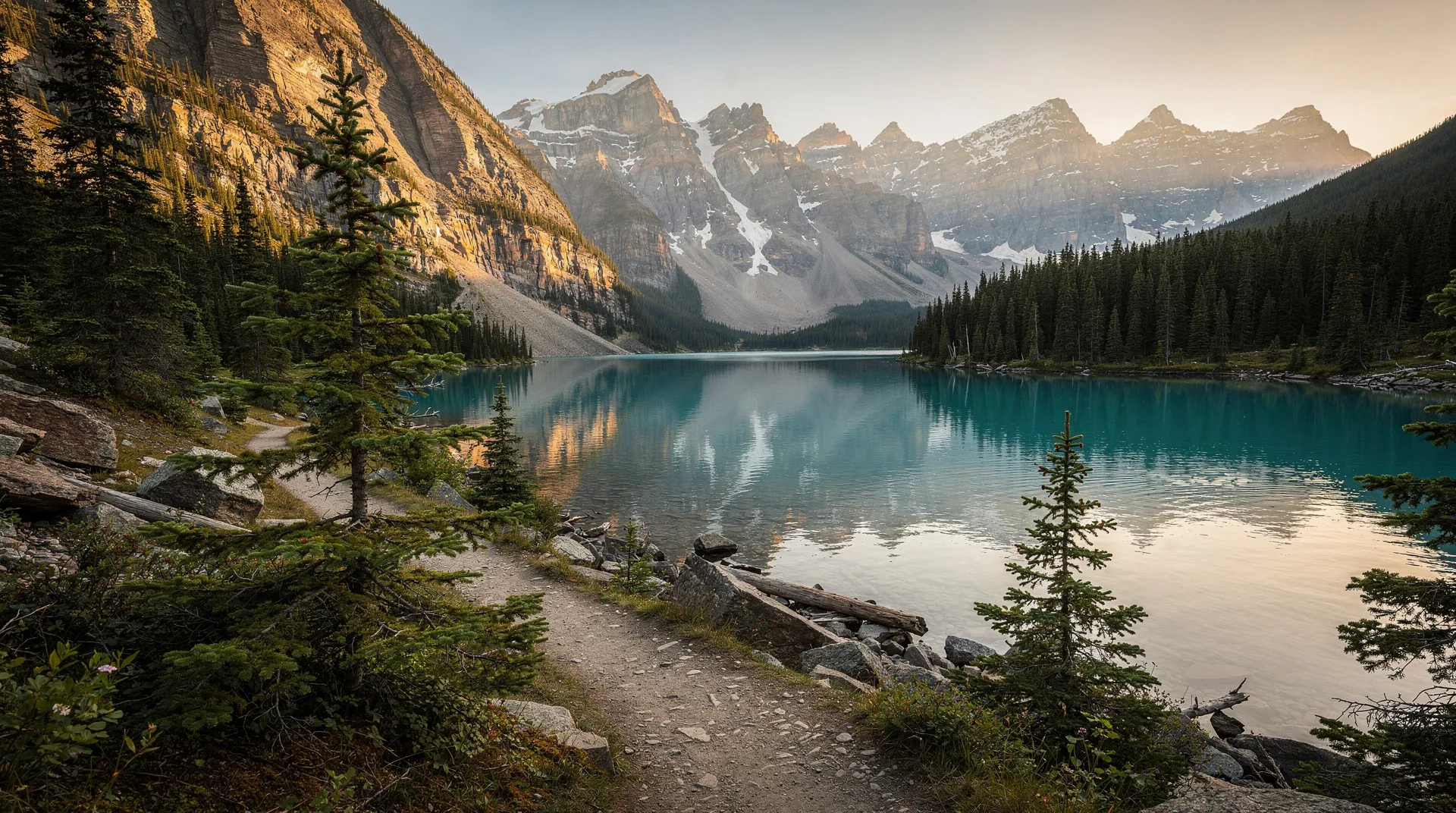
Torngat Mountains National Park occupies the northern tip of Labrador — 9,700 square kilometres of mountains, fjords, glacial valleys and Arctic tundra stretching from Saglek Bay to the northernmost point of mainland Canada at Cape Chidley. There are no roads. There are no permanent settlements within the park boundary. Access is by charter flight from Goose Bay or by ship from the Inuit community of Nain, and the visitation window is a narrow window of roughly seven weeks each summer. Torngat is the most remote and least-visited national park in eastern Canada, and for the small number of travellers who make it here, it is one of the most extraordinary places in the world.
This is a park co-managed by Parks Canada and the Inuit of Nunatsiavut and Nunavik. The name Torngait means “place of spirits” in Inuttitut — a reference to the mountains’ status in Inuit cosmology as the home of the spirits that govern weather, wildlife and the sea. Travel here is not simply a wilderness holiday; it is an entry into Inuit homeland, undertaken with Inuit guides, in accordance with Inuit protocols.
Why Torngat matters
The park protects the highest mountains in mainland Canada east of the Rockies — the Torngats rise to 1,652 metres at Mount Caubvick on the Labrador-Quebec border. The geology is ancient: the rocks here are among the oldest exposed on Earth, dating back over 3.9 billion years. Glaciers have carved the mountains into a spectacular sequence of fjords, hanging valleys, cirques and U-shaped glacial valleys that extend inland from the Labrador Sea.
The wildlife is extraordinary and genuinely dangerous. Polar bears are present throughout the summer along the coast — this is one of the few places in the world where visitors reliably encounter polar bears on land outside Arctic communities. The park’s base camp operates behind an electrified perimeter fence, and all travel outside the fence requires an armed Inuit bear guard. Black bears, caribou, Arctic hare, ringed and bearded seals, Arctic foxes and gyrfalcons are all present. The George River caribou herd, once the largest in the world, has declined catastrophically — populations in and near the park are a fraction of historical numbers.
The Inuit history of the region is the park’s central cultural story. Inuit have occupied these fjords for at least 5,000 years. The archaeological record includes Thule winter houses, Dorset-era sites, Moravian mission sites from the 19th century, and active contemporary use by the communities of Nain (south) and Kangiqsualujjuaq (west). The former settlement of Hebron, a Moravian mission closed and forcibly relocated by the government of Newfoundland in 1959, sits within the park boundary and remains a site of powerful historical meaning.
Torngat Mountains Base Camp
The Torngat Mountains Base Camp and Research Station at Saglek Bay is the practical entry point for almost all non-expedition visitors. Operated by the Nunatsiavut Government in partnership with Parks Canada, the base camp runs from mid-July through early September and provides the only commercially accessible way to experience the park.
The base camp is a tented facility on a raised wooden boardwalk platform, surrounded by an electric fence (polar bears). Accommodation is in heated sleeping tents (shared or private). Meals are served in a central dining tent — Inuit country food (char, caribou when available) is prominent alongside standard camp fare. There are hot showers, a library, an Elder’s tent, and a full kitchen.
Programming at base camp includes daily boat excursions into the fjords, guided hiking with armed bear monitors, visits to former Inuit sites including Hebron, cultural programming with Inuit Elders, and helicopter transfers to remote destinations within the park. Kayaking is available in the sheltered waters near base camp. All activity outside the fenced camp requires an Inuit bear guard.
Booking is through the Nunatsiavut Government’s tourism arm. Packages typically run 5, 7 or 10 days and include all meals, programming, and transfer flights to and from Goose Bay. Prices are premium — expect costs comparable to Arctic expedition cruises. Capacity is limited and the season books up months in advance.
Browse Newfoundland and Labrador tour operators including Torngat-area tripsExpedition cruise access
A small number of expedition cruise ships visit the Torngat coast as part of Arctic or Atlantic voyages. Adventure Canada, Aurora Expeditions, One Ocean and similar operators include Torngat stops on certain itineraries in July and August. Ship-based visits allow shore excursions into the fjords with Inuit guides and Parks Canada interpreters but do not provide the depth of cultural programming available at base camp.
Independent sailing or yacht visits are possible but require full Arctic expedition preparation — the Labrador Sea is demanding, and charts, communications and emergency support are minimal. The park requires advance registration for all independent visitors.
The landscape and key sites
Saglek Bay and Saglek Fjord — the base camp location. The fjord extends 60 kilometres inland from the Labrador Sea and is surrounded by mountains rising directly from the water. Daily boat excursions from base camp explore the fjord.
Nachvak Fjord — accessed by boat from base camp, this is one of the most dramatic fjord systems in the park. The mountains here are among the highest in the park, rising sheer from the water.
Hebron — the abandoned Moravian mission and Inuit community, relocated in 1959 in one of the defining traumas of recent Labrador Inuit history. The restored mission church and the remaining buildings are visited as part of base camp programming with an Elder commentary that is genuinely significant as cultural education.
Ramah Bay — the source of the Ramah chert, a translucent black-and-white stone that was traded by Inuit and their predecessors across the entire northeast of North America. Archaeological sites throughout the park and across Labrador contain Ramah chert tools from the past 4,000 years.
Cape Chidley and the Button Islands — the northernmost point of the park and of mainland Canada. Visited occasionally as part of extended base camp or cruise itineraries.
Mount Caubvick / Mont D’Iberville — the highest point at 1,652 metres, on the Labrador-Quebec border. Climbing requires a serious mountaineering expedition and is not a base camp activity.
Wildlife expectations
Polar bears are the defining wildlife presence. They are present along the coast throughout the summer, swimming between ice floes or foraging onshore. Sightings during base camp stays are frequent. All encounters are managed by armed Inuit bear guards following strict protocols. The electric fence around base camp exists for real reasons.
Black bears are present in the valleys and lower slopes. Caribou are seen in small numbers — the George River herd has declined from historical highs of 700,000 animals to under 10,000, a collapse whose causes are still debated.
Marine mammals include harp seals, ringed seals, bearded seals, bowhead whales (rare but present), minke whales and harbour porpoise. Walrus are occasional visitors.
Birds include peregrine falcon, gyrfalcon, snowy owl, rough-legged hawk, and the seabird colonies of the outer coast.
Inuit cultural programming
The co-management of Torngat by Inuit governance structures means that cultural content is central to the visitor experience rather than an add-on. Elder presence at base camp is the defining feature — conversations with Elders about family history in Hebron, about country food, about hunting and sewing and language, are programmed into every day’s schedule. Inuttitut language lessons, drum dance demonstrations, country food meals, traditional tool demonstrations and storytelling evenings are routine.
The protocols for visiting this landscape — what to photograph, where not to walk, how to approach Elders, how to interact with archaeological sites — are explained during orientation and are taken seriously. Travel to Torngat is not independent wilderness travel; it is travel as guest in someone else’s homeland.
Practical logistics
Getting to base camp: Participants fly commercially to Happy Valley-Goose Bay (YYR) the day before their booking. Goose Bay is served by Air Canada and PAL from Halifax and St. John’s. From Goose Bay, charter flights to the base camp airstrip are included in booking packages.
Climate and packing: Summer temperatures at base camp range from 5°C to 15°C, with frequent fog, wind and rain. Full waterproofs, layered insulation, warm hats and gloves, and serious hiking boots are essential. Base camp provides detailed packing lists.
Fitness: The experience is not physically demanding for standard base camp activities — boat travel, moderate hiking with stops, and camp life. Travellers should be comfortable on uneven terrain and with basic camping conditions.
Communications: Satellite communication only. No cell service, no wifi. A daily satellite phone check-in from base camp is standard.
Insurance: Comprehensive travel insurance including emergency evacuation coverage is strongly recommended and may be required.
Related destinations
Happy Valley-Goose Bay is the gateway town in central Labrador. Red Bay, a UNESCO-listed Basque whaling site, is in southern Labrador and accessible by road. Nain is the northernmost Inuit community in Labrador and the administrative centre of Nunatsiavut. The Viking Trail on Newfoundland’s Great Northern Peninsula is the nearest accessible destination with road access.
Comparing the three ways to visit
| Option | Cost | Access | Depth of experience |
|---|---|---|---|
| Base Camp (Saglek Bay) | Around CAD $7,500-$15,000, all-inclusive | Charter flight from Goose Bay, mid-July to early September | Deepest — daily Elder programming, guided hikes, boat excursions |
| Expedition cruise stop | Comparable to a premium Arctic cruise fare | Ship-based, July-August only, part of a longer voyage | Shorter shore excursions, less cultural programming |
| Independent expedition | Highly variable, expert self-outfitting required | Own vessel or charter, full Arctic preparation needed | Most freedom, but no infrastructure and real risk |
For nearly everyone, base camp is the realistic route. Cruise stops suit travellers who want a taste of Torngat as part of a broader Labrador or Arctic voyage; independent access is only for experienced Arctic expedition travellers with satellite communication and emergency evacuation plans already arranged.
Planning a wider Labrador and Newfoundland trip
Torngat is difficult to combine with a single trip through the rest of the region because of the distances and the narrow booking window, but many travellers pair it with a longer swing through Newfoundland either before or after. Gros Morne National Park on the island’s west coast and L’Anse aux Meadows, the UNESCO Viking site on the Great Northern Peninsula, are the natural anchor points for that side of a trip — see the Viking Trail guide for how they connect by road.
St. John’s is the main air gateway into the province and a reasonable place to spend a few days at either end of the itinerary; the 7-day Newfoundland itinerary covers that side of the trip in detail. For travellers weighing Labrador against the rest of Atlantic Canada, the guide comparing Newfoundland and Labrador is a useful starting point, and iceberg season on the island (roughly May-June, covered in the guide to iceberg viewing in Newfoundland) does not overlap with the Torngat base camp window, so the two need separate trips or careful timing. For the island leg, you can book guided tours in Newfoundland and Labrador ahead of time.
Frequently asked questions about Torngat Mountains National Park
How do I get to Torngat Mountains National Park?
Almost all visitors go through the Torngat Mountains Base Camp, which provides charter flights from Happy Valley-Goose Bay as part of its booking package. The base camp operates mid-July through early September. A small number of expedition cruise ships also visit the coast. Independent access is possible but requires full Arctic expedition preparation.
When is the best time to visit?
The base camp season runs from mid-July through early September. Late July and August typically offer the best combination of weather, daylight, and programming. Mid-September sees the first winter snow and the season ends.
How much does a Torngat trip cost?
Base camp packages start around CAD $7,500–$15,000 per person depending on duration (5 to 10 days) and accommodation type. This is inclusive of charter flights, all meals, all guided activities, and cultural programming. Commercial flights to Goose Bay are additional.
Will I see polar bears?
Polar bear encounters are very common during the base camp season. All outside-fence activity is guided by armed Inuit bear guards following strict protocols developed over decades of base camp operation. The electric perimeter fence at base camp exists because bear presence is routine.
Can I visit independently?
Independent expedition-style visits are possible for experienced Arctic travellers with satellite communication, emergency evacuation plans, and Parks Canada registration. The park has no infrastructure — no trails, no cabins, no services. For nearly all travellers, base camp is the practical way to experience Torngat.
Can I combine Torngat with a Newfoundland trip?
Not easily in a single visit, given the distances and the narrow base camp window, but many travellers do both on separate legs of a broader Atlantic Canada trip — Torngat via Goose Bay, and Gros Morne or L’Anse aux Meadows via St. John’s or Deer Lake.
Is Torngat suitable for a first-time visitor to the North?
It can be, since base camp handles all logistics, guiding, and safety, but the cost and remoteness mean it suits travellers who are comfortable with basic camping conditions and genuinely motivated by wilderness and Inuit cultural immersion rather than conventional sightseeing.