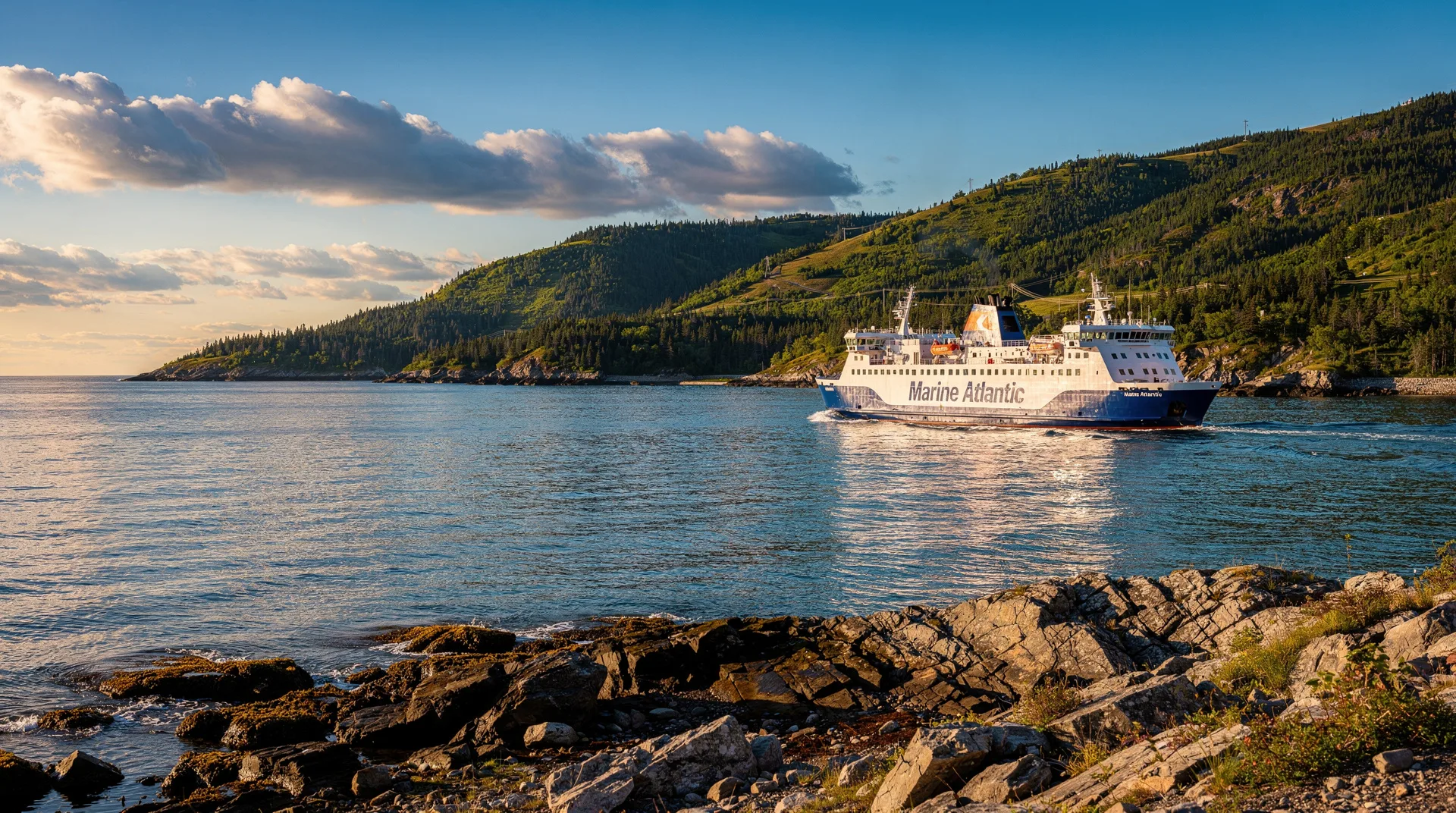
Marine Atlantic ferry: NS to Newfoundland complete guide
How do I take the Marine Atlantic ferry to Newfoundland?
Marine Atlantic operates two routes: North Sydney, NS to Port aux Basques, NL (7 hours, year-round) and North Sydney, NS to Argentia, NL (14-16 hours, seasonal June-September). Book online at marineatlantic.ca well in advance for summer. Cabins are strongly recommended for the overnight crossing.
| At a glance | |
|---|---|
| Where | North Sydney, Nova Scotia to Port aux Basques or Argentia, Newfoundland |
| Cost | around CAD $45-65 per adult passenger, plus $110-175+ for a standard vehicle |
| Time needed | 6-7 hours (Port aux Basques, year-round) or 14-16 hours (Argentia, seasonal June-September) |
| Booking | online at marineatlantic.ca, ideally 2-3 months ahead for summer vehicle space |
| Best time | book early for July-August; shoulder-season crossings are easier to secure last-minute |
For most visitors arriving in Newfoundland by surface, the Marine Atlantic ferry is the only way across. The Cabot Strait between Cape Breton, Nova Scotia and Newfoundland is 90 km of open North Atlantic — a serious body of water with serious weather — and Marine Atlantic has been operating the crossing since Newfoundland joined Canada in 1949. This guide covers everything you need to know to book, prepare for, and make the most of the crossing.
Marine Atlantic routes
North Sydney to Port aux Basques
The main route, operating year-round. North Sydney is in Cape Breton, Nova Scotia; Port aux Basques is in the far southwest of Newfoundland. The crossing distance is approximately 180 km; the crossing time is typically 6-7 hours depending on conditions and vessel.
This route is used by the majority of Marine Atlantic’s traffic: residents, commercial vehicles, tourists arriving by car. It operates multiple times daily in peak season (typically 2-3 crossings per day, alternating between vessels), with reduced frequency in winter.
Key facts:
- Crossing time: 6-7 hours in good conditions
- Port aux Basques is 900 km from St. John’s (approximately 9-10 hours’ driving)
- Year-round operation
- Most practical for those exploring western Newfoundland (Gros Morne, the Viking Trail)
North Sydney to Argentia
The seasonal route, operating approximately June through September. Argentia is on the Avalon Peninsula, about 90 km from St. John’s — dramatically more convenient for exploring eastern Newfoundland.
The crossing is significantly longer: 14-16 hours, making an overnight cabin not merely comfortable but essentially necessary. Departures are typically twice weekly in each direction, not daily — check current schedules carefully.
Key facts:
- Crossing time: 14-16 hours
- Argentia is 90 km from St. John’s (1 hour driving)
- Seasonal: approximately late June to mid-September
- Twice-weekly sailings (check exact schedule)
- Ideal for those focused on St. John’s, the Avalon Peninsula, and eastern Newfoundland
The Argentia route is worth the longer crossing time for visitors to eastern Newfoundland — avoiding the 9-10 hour drive across the island from Port aux Basques is a very significant time saving.
Booking the ferry
Book online at marineatlantic.ca. Marine Atlantic has invested significantly in its online booking system in recent years; it is reasonably well-designed and allows seat/cabin selection.
When to book
As early as possible for summer travel. July and August vehicle spaces fill weeks or months in advance. If you are travelling with a car or RV in peak summer, booking 2-3 months ahead is not excessive. The Argentia route, with its twice-weekly departures, fills even faster than the Port aux Basques route.
Foot passengers (without a vehicle) have an easier time booking last-minute, but accommodation aboard (cabins and reserved recliner seats) also fills quickly.
Cancellation policies are relatively flexible compared to airline tickets; check the current terms when booking.
What you’re booking
When you book Marine Atlantic, you are booking:
- Vehicle space (if applicable) — based on vehicle length
- Passenger tickets — per person, separate from the vehicle
- Accommodation — cabin (private room with beds) or reserved recliner seat, or general seating
All three components have separate pricing and availability.
Accommodation options aboard
Cabins
Marine Atlantic’s vessels offer private cabins ranging from 2-berth to 4-berth. Cabins have fold-down bunk beds, a small porthole, and a basic washroom in most configurations (some cabins share corridor washrooms). They are not luxury cabins — the standard is comfortable but functional.
Why to book a cabin:
- The overnight crossing (Argentia route, 14-16 hours) is genuinely difficult without a place to sleep
- The Port aux Basques crossing (7 hours) is manageable without a cabin but a cabin provides a quiet retreat if the seas are rough or the vessel is busy
- Cabins are limited and book early; do not leave the decision until after you’ve booked the vehicle space
Types available: 2-berth and 4-berth are the most common. Some vessels offer slightly larger “deluxe” cabins with a window rather than a porthole.
Cost: Approximately CAD $80-150 per cabin per crossing, depending on size and route; check current pricing.
Reserved recliner seats
Comfortable aircraft-style reclining seats in a designated area. These are significantly better than general seating for sleeping on long crossings and are priced between general seating and cabin accommodation. A reasonable choice for the Port aux Basques crossing; less comfortable than a cabin for Argentia.
General seating
Open lounge seating on a first-come, first-served basis. Adequate for a 7-hour Port aux Basques crossing in good sea conditions; not recommended for the Argentia overnight crossing.
What to expect on board
Vessels
Marine Atlantic operates several vessels in the fleet (MV Blue Puttees, MV Highlanders, MV Leif Ericsson, MV Smallwood, among others). Vessel assignments change based on route and season. The vessels range from older (more basic facilities, smaller cabins) to more recently refitted ships with better dining and amenities.
Facilities
Standard facilities on most crossings include:
- A self-serve cafeteria and a sit-down restaurant (both typically cafeteria-style; do not expect fine dining)
- Vending machines and a snack bar
- A small gift shop with Marine Atlantic merchandise, Newfoundland souvenirs, and basic provisions
- Lounges with seating, TV screens, and games areas
- Vehicle decks accessible only by crew (your car is locked in the hold for the crossing)
- Dog kennels on the vehicle deck (check policies for pets travelling in vehicles)
Food: The cafeteria food is functional rather than exceptional. Consider bringing food from shore for the crossing, particularly for the Argentia overnight route. Hot food is available throughout the crossing.
Cell service and WiFi: Connectivity is available for part of the crossing but unreliable mid-strait. Download entertainment in advance.
Browse Newfoundland tours and experiencesPractical preparation
Getting to North Sydney
North Sydney is on Cape Breton Island, Nova Scotia — approximately 30 km from Sydney, and about 4.5 hours from Halifax by Trans-Canada Highway (430 km). The Marine Atlantic terminal is well-signed from the Trans-Canada.
From Halifax: Allow 4.5-5 hours of driving. Do not cut this too close — late arrival can result in missing your sailing.
From Sydney: The terminal is 30 minutes from Sydney Airport and the city. If flying to Sydney (Cape Breton) and taking the ferry onward, this is straightforward.
Arriving early: Vehicles must check in at least 1 hour before departure (check current requirement on your booking confirmation). The terminal has a waiting area, a café, and WiFi.
Seasickness preparation
The Cabot Strait has a reputation for rough crossings, particularly in autumn and winter. In summer, conditions are generally better but swells of 2-3 metres are not unusual. If you are susceptible to motion sickness:
- Take medication (Gravol/Dimenhydrinate, Bonine/meclizine, or prescription scopolamine patch) before boarding, not after you feel sick
- Ginger (capsules, ginger ale, ginger chews) helps some people
- Acupressure bands (Sea-Bands) provide relief for mild susceptibility
- Stay on deck in fresh air rather than in enclosed lounges when seas are rough
- Midship positions at the vessel’s centre of roll are more stable than bow or stern
Pets and vehicles
Dogs and cats can travel in air-conditioned kennels on the vehicle deck. You cannot access the vehicle deck during the crossing, so your pet is in the kennel for the full duration. Marine Atlantic has specific policies about pet sizes, documentation, and kennel requirements; check current policy at marineatlantic.ca before booking.
Vehicles are driven onto the vessel at departure and off at arrival. Pack everything you need for the crossing in a bag you carry to the passenger decks — you will not have access to your vehicle during the crossing.
Costs (approximate CAD, 2025-2026)
| Item | Cost |
|---|---|
| Passenger ticket (adult) per crossing | $45–$65 |
| Standard vehicle (to 5.5m) per crossing | $110–$175 |
| Larger vehicle/RV (per metre over 5.5m) | $20–$35/m |
| 2-berth cabin | $85–$120 |
| 4-berth cabin | $100–$145 |
| Reserved recliner seat | $20–$35 |
Prices are higher in peak season (July-August) and for the Argentia route (longer crossing). Check marineatlantic.ca for current pricing.
Senior discounts: Available for passengers 60+.
Frequent traveller: A fare advantage program exists for residents and frequent users.
The Port aux Basques to St. John’s drive
If arriving at Port aux Basques (the main year-round route), the drive to St. John’s crosses the full width of Newfoundland — approximately 900 km, 9-10 hours on the Trans-Canada. This is a genuine cross-island drive through interior Newfoundland, which is boreal forest, bog, and moose country.
Moose warning: Newfoundland has the highest moose-vehicle collision rate in Canada. The Trans-Canada at night and at dawn and dusk is genuinely dangerous. Drive carefully; moose are dark and large and appear suddenly. Consider an overnight stop at Gander (midway across the island) rather than attempting the drive in a single day after a ferry crossing.
Corner Brook: 70 km from Port aux Basques, Corner Brook is the province’s second city and a good stop for fuel, food, and an overnight if needed. The Corner Brook Pulp and Paper Mill, visible from the highway, is one of the largest industrial facilities in Atlantic Canada.
The alternative: flying to Newfoundland
For visitors focused on eastern Newfoundland and St. John’s, the question of ferry vs. fly is worth addressing directly.
The ferry from Argentia (seasonal, June-September) saves the island-crossing drive and provides an enjoyable 14-16 hour sea experience. The cost is comparable to flying once vehicle costs are included.
Flying (St. John’s Airport, YYT) has good connections from Toronto, Montreal, Halifax, Ottawa, and London Heathrow. For those without a vehicle, or those renting a car in Newfoundland, flying is more efficient.
The decision: If you are bringing your own vehicle across Canada, the ferry is required. If you are renting a car in Newfoundland, fly into St. John’s and rent there. See our 7-day Newfoundland itinerary for the Avalon Peninsula approach.
Combining the ferry with the Viking Trail
The Port aux Basques crossing is the natural entry point for the Viking Trail — you arrive in western Newfoundland and drive north to Gros Morne and L’Anse aux Meadows. See our 7-day Viking Trail itinerary for the complete northern peninsula circuit from Deer Lake, or the Viking Trail Newfoundland guide for a route-focused breakdown. If you are building a longer trip around the crossing, you can also compare guided tours across Canada before you book.
The alternative crossing to consider: Confederation Bridge and PEI
Marine Atlantic is the only way to reach Newfoundland by road, but if your route also includes Prince Edward Island, the crossing logistics are entirely different — PEI connects to New Brunswick by the toll-free (in one direction) Confederation Bridge, not a ferry booking. See the Confederation Bridge vs ferry PEI guide if PEI is also on the itinerary; it’s a useful contrast for understanding just how much more planning the Marine Atlantic crossing demands compared to the rest of Atlantic Canada’s connections. For context on whether Newfoundland fits your itinerary at all against the mainland Maritimes, see the Maritimes vs Newfoundland comparison.
Timing the crossing around iceberg and puffin season
Visitors planning the Argentia route specifically to combine the ferry with iceberg viewing should note that iceberg season (roughly May-June) sits right at the edge of the Argentia route’s typical late-June start — check the current season’s exact opening date before building an itinerary around both. See the best time for icebergs in Newfoundland guide and the iceberg viewing guide for exact windows, and the puffin watching guide for the overlapping wildlife season most Argentia-route travellers are also chasing.
Frequently asked questions about Marine Atlantic ferry: NS to Newfoundland complete guide
How far in advance should I book Marine Atlantic in summer?
For vehicles in July and August: 2-3 months ahead. The Argentia route (twice weekly) fills even faster. Foot passenger tickets are easier to add later.
Can I travel without a vehicle on the ferry?
Yes — foot passengers are welcome. In Newfoundland, you would then need to rent a car on arrival (car rental is available at or near both ferry terminals).
What happens if my sailing is cancelled due to weather?
Marine Atlantic cancels or delays sailings in severe weather. Passengers are rebooked on the next available departure. The Cabot Strait can be rough, particularly in autumn and winter; build flexibility into your schedule.
Is there a restaurant on the ferry?
Yes — a cafeteria-style restaurant is on all Marine Atlantic vessels. The food is functional. The cafeteria serves hot meals, sandwiches, snacks, and drinks throughout the crossing. It is adequate, not exceptional.
Is the ferry scenic?
The Port aux Basques crossing is open ocean — scenic primarily in the sense of watching waves and seabirds. Gannets, shearwaters, storm petrels, and the occasional whale are possible. The Argentia route passes more coastal scenery as it approaches the Avalon Peninsula. Neither is a fiord cruise — manage expectations accordingly.
Should I take the ferry or fly if I’m not bringing a car?
Fly. Without a vehicle, the ferry offers no practical advantage over flying into St. John’s (YYT) or Deer Lake, both of which have good connections from mainland Canada, and flying saves the 6-16 hour crossing time entirely.
Does the Argentia route’s season overlap with iceberg season?
Only partially. Iceberg season runs roughly May-June, while the Argentia ferry typically starts in late June — check the current year’s exact Argentia opening date if you’re planning to combine both, since they may not overlap at all in a given year.