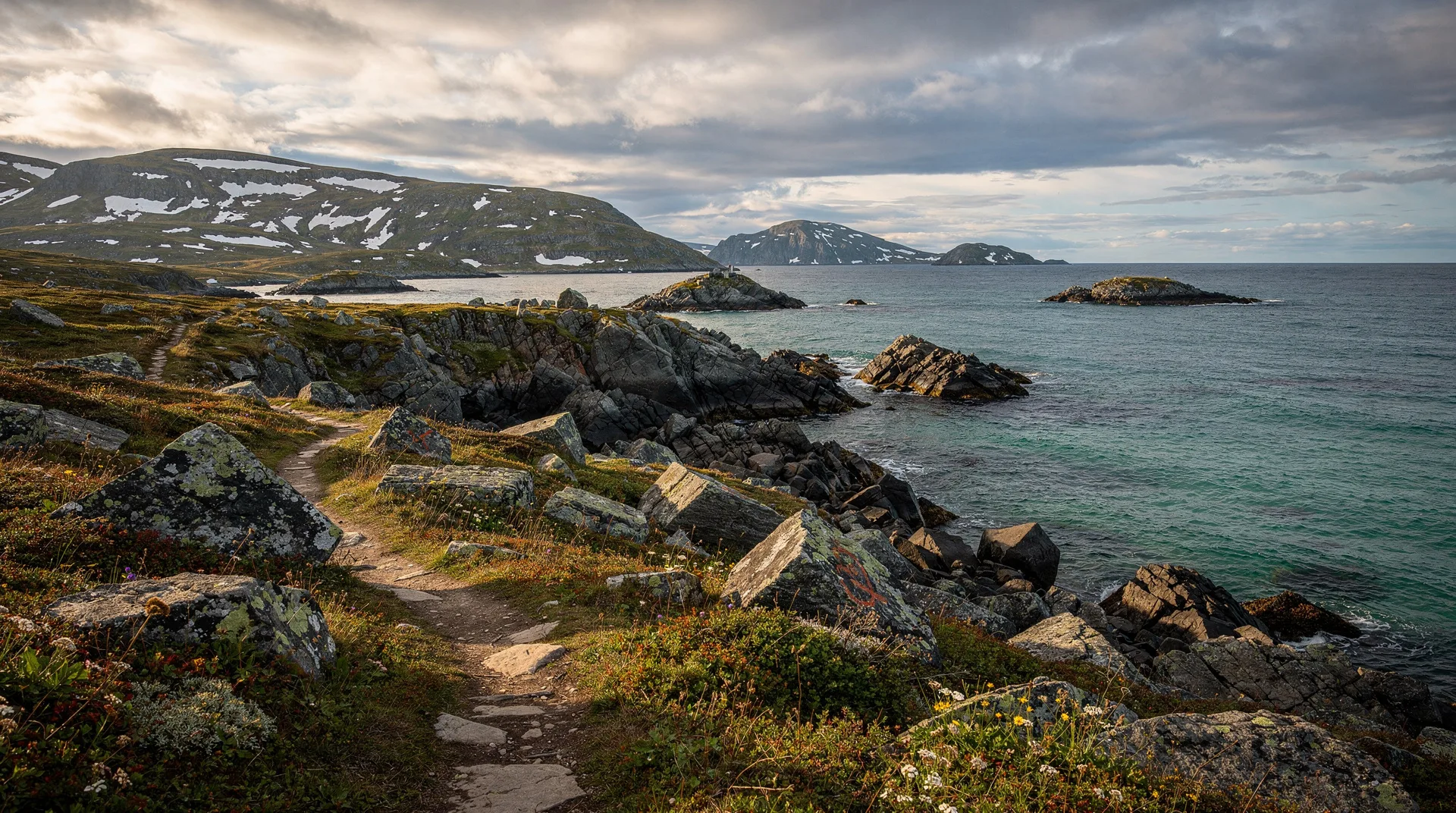
Viking Trail 7-day itinerary: L'Anse aux Meadows loop
Overview
The Viking Trail — Route 430 north from Deer Lake — is one of the most historically and scenically remarkable drives in Canada. In 500 kilometres, it passes through two UNESCO World Heritage Sites (Gros Morne National Park and L’Anse aux Meadows), some of the world’s oldest exposed geology, and the most remote inhabited coastline in eastern North America.
This 7-day itinerary flies into Deer Lake, drives the full Viking Trail to L’Anse aux Meadows (the only confirmed Norse settlement in the Americas), and returns via the same route with enough time to explore the parks and communities properly.
| Day | Destination | Approx. drive |
|---|---|---|
| 1 | Deer Lake → Rocky Harbour (Gros Morne) | 55 km / 1 hr |
| 2 | Gros Morne — Tablelands, Western Brook Pond | In-park |
| 3 | Rocky Harbour → Cow Head / Port au Choix | 120 km / 1.5 hrs |
| 4 | Port au Choix → St. Anthony | 170 km / 2 hrs |
| 5 | L’Anse aux Meadows | 28 km from St. Anthony |
| 6 | St. Anthony: icebergs, whales | Local |
| 7 | Return to Deer Lake | 445 km / 5 hrs (driving day) |
Best season: June through August. June combines iceberg season with the start of whale watching. July-August is peak season with all services operating.
At a glance
Start/end: Deer Lake Regional Airport (YDF)
Car required: Yes — essential
Total driving: Approximately 1,000 km return
Budget range: CAD $1,800–$2,800 per person excluding flights
Day 1: Deer Lake to Rocky Harbour
Fly into Deer Lake Regional Airport (connections from Halifax, Toronto, and Montreal). Pick up your rental car and drive 55 km north on Route 430 to Rocky Harbour — the main service town for Gros Morne National Park, about 45 minutes.
Rocky Harbour is a small town with several decent restaurants (the Java Jack’s café and restaurant is consistently good), a grocery store for provisions, and comfortable accommodation options. In the late afternoon, walk to the Lobster Cove Head Lighthouse at the edge of town for views over Bonne Bay — one of the finest fjord-lake systems in eastern Canada.
The Gros Morne Discovery Centre (the national park visitor centre, located between Rocky Harbour and Woody Point) has exceptional geological exhibits explaining the park’s extraordinary significance. If you arrive in time, visit on arrival day.
Day 2: Gros Morne National Park
Gros Morne is a UNESCO World Heritage Site with exceptional status even by that standard — the exposed ocean-floor mantle of the Tablelands is one of the key pieces of evidence in the development of the theory of plate tectonics.
The Tablelands
The Tablelands Trail (4 km return) begins on Highway 431 south of Woody Point. The orange-brown plateau of peridotite rock — ocean floor mantle pushed up by tectonic collision 450 million years ago — looks startlingly unlike any other landscape in eastern Canada. The rock is toxic to most plants; the result is a barren, Mars-like landscape on a mountaintop. Geologically, this is one of the most significant accessible pieces of earth on the planet.
Allow 2-3 hours including the walk and time for the geology to become real in your mind.
Western Brook Pond boat tour
Western Brook Pond is a landlocked fjord — a glacier-carved canyon now isolated from the sea, with cliff walls rising 600 metres above crystal water. The 3-km walk across the coastal bog from the highway is easy; the boat tour of the pond (2 hours) is unmissable.
Reserve ahead: The boat tour is capacity-limited and popular. Book online through Parks Canada (reservation.pc.gc.ca) before you arrive. Early morning tours typically have calmer conditions.
Gros Morne Mountain (optional — full day required)
The park’s summit trail (16 km return, 800 m elevation gain) is one of Newfoundland’s finest hikes. The summit plateau is an arctic landscape at 806 metres. Only attempt this if you have a full day and are in good physical condition; the trail is well-marked but demanding.
Browse Newfoundland tours and Gros Morne experiencesDay 3: Northward — Cow Head and Port au Choix
Drive north from Rocky Harbour, leaving the park boundary and entering the less-visited central section of the northern peninsula.
Cow Head
The small community of Cow Head is home to the Gros Morne Theatre Festival (running in summer), which stages professional theatre productions in a community hall. The combination of high-calibre performance and extraordinary surrounding landscape makes this an unlikely cultural highlight. Check the schedule before your trip — evening performances allow an overnight in Cow Head.
The headland at Cow Head itself is an unusual geological feature — a pile of displaced deep-ocean rocks sitting on the coastal platform, preserved from the same tectonic event that created the Tablelands.
Port au Choix National Historic Site
Port au Choix preserves 5,500 years of Indigenous occupation along this coast: Maritime Archaic people (4,500-4,000 years ago), Groswater Palaeo-Inuit, and Dorset Palaeo-Inuit cultures, each of whom lived here for centuries. The site museum is excellent, with artifacts from the Philip’s Garden cemetery and residential sites.
This is also one of the best areas for shore-based iceberg viewing in late May and June — icebergs travel past this western coast before reaching their southernmost extent. See our iceberg viewing guide for the best timing.
Stay overnight in Port au Choix (Jenniex House is a reliable B&B) or continue toward St. Barbe.
Day 4: To St. Anthony
Drive approximately 170 km north from Port au Choix to St. Anthony — about 2 hours on Route 430. The landscape becomes increasingly boreal and remote; bog and scrub forest dominate the plateau with the occasional fishing community punctuating the coast.
St. Barbe
St. Barbe is the departure point for the MV Apollo ferry to Blanc-Sablon, Quebec — the starting point for the southern Labrador coast. The ferry runs in summer; a day trip to Blanc-Sablon and Labrador Straits (reaching the Labrador-Quebec border) is possible from St. Barbe for those with extra time and appetite for remote travel.
St. Anthony
St. Anthony (population ~2,400) is the largest community on the northern peninsula and the gateway to L’Anse aux Meadows. The town has good accommodation (Vinland Hotel, Nordic Lodge), a hospital (important: this is the medical hub for a very remote region), and Fishing Point Park.
Fishing Point Park: A clifftop viewpoint on the headland outside St. Anthony looking directly into the Labrador Current. In May-June, icebergs are frequently visible from this single vantage point — sometimes multiple simultaneously. Humpback whales feed in the same current. The park is free, and the combination of icebergs and whales from shore is one of the finest wildlife watching moments in Atlantic Canada.
Day 5: L’Anse aux Meadows
Drive 28 km from St. Anthony on Route 436 to L’Anse aux Meadows National Historic Site — about 25 minutes.
The Norse settlement
L’Anse aux Meadows is the only confirmed pre-Columbian European settlement in the Americas, discovered in 1960 and designated a UNESCO World Heritage Site in 1978. The site presents the excavated remains of eight buildings (the originals are covered for preservation) and full-scale reconstructions of Norse longhouses built directly from the archaeological evidence.
Allow 3-4 hours for the complete site experience. The Parks Canada interpretive program is excellent — costumed guides demonstrate Norse crafts, explain the archaeological evidence, and discuss the sagas. The reconstructed longhouses convey the scale, the darkness, and the functional reality of Norse settlement architecture in a way that foundation outlines cannot.
See our Viking Trail guide for the full history and context.
Norstead
The complementary Norse village reconstruction (2 km from the historic site, private operator) offers hands-on activities including archery, a replica Norse vessel, and artifact handling. Particularly good for families. Allow 1-2 hours.
Afternoon options
Fishing Point from St. Anthony: If the morning at L’Anse aux Meadows finishes early, return to Fishing Point Park in St. Anthony for afternoon iceberg watching with the best light.
The lighthouse at St. Anthony: The point lighthouse has a history connected to Wilfred Grenfell, the remarkable physician-philanthropist who operated the Grenfell Mission in northern Newfoundland in the early 20th century. The Grenfell Historic Properties in St. Anthony are worth a visit.
Day 6: St. Anthony — whales, icebergs, and sea
A full day based in St. Anthony for wildlife and exploration.
Iceberg and whale watching boat tour
Take a boat tour from St. Anthony Harbour — local operators combine iceberg viewing with humpback whale watching in the Labrador Current. In June, encounters with both on the same tour are entirely common; the combination of a 20-metre iceberg and a surfacing humpback in the same frame is the defining Newfoundland wildlife image.
Check the current ice and whale report from the operator before booking — conditions vary day to day. Book ahead, particularly in June when demand peaks during iceberg season. You can compare departures and reviews for Newfoundland boat and whale tours before you travel.
Exploring the northern tip
If time permits, drive to the communities of Raleigh or Quirpon (beyond L’Anse aux Meadows on Route 436, some sections unpaved) for additional coastal views from the northernmost point of the Newfoundland mainland. The Quirpon Lighthouse Inn (on an island, accessible by small boat) is a remarkable experience for those who want to stay — book well ahead.
Evening: Screech-In
End the northern peninsula adventure with a Screech-In ceremony at a local bar — the ritual initiation into honorary Newfoundland status. See our Screech-In guide for what to expect.
Day 7: Return to Deer Lake
The driving day: 445 km back to Deer Lake, approximately 5 hours without stops.
Option A: Drive straight through for a late afternoon Deer Lake arrival, flying out the same day if schedules allow.
Option B: Break the drive with a stop at the Arches Provincial Park (about halfway, 2 km west of the highway on Route 430) — impressive sea arches carved into Ordovician limestone by the sea. Also stop at Wiltondale, where the moose population is extremely dense and the boreal forest is beautiful in any light.
Option C: Spend a final night in Rocky Harbour, revisiting any Gros Morne experience you didn’t complete on Day 2 (particularly the beach at Green Point or the Berry Hill Pond walk), and fly out of Deer Lake on Day 8.
Budget guide
| Category | Budget/person | Moderate/person |
|---|---|---|
| Accommodation (6 nights) | CAD $600 | CAD $950 |
| Food | CAD $400 | CAD $600 |
| Car rental + fuel | CAD $400 | CAD $500 |
| Activities (boat tours, park pass, Norstead) | CAD $200 | CAD $350 |
| Total (excl. flights) | ~$1,600 | ~$2,400 |
Practical tips
Book ahead: Rocky Harbour accommodation and the Western Brook Pond boat tour should be booked 2-4 weeks ahead in July. St. Anthony accommodation is more limited — book early.
Cellular coverage: Very limited north of Cow Head. Download offline maps (Maps.me or downloaded Google Maps) before leaving Rocky Harbour.
Weather: Weather on the northern peninsula is unpredictable — fog, rain, and cold can occur in any month. The park and historic sites operate regardless of weather; icebergs are more easily visible in calm conditions.
Fuel: Fill up at Rocky Harbour, Port au Choix, and St. Anthony. Stations between these points are sparse.
Iceberg timing: Peak iceberg season is May-June. July visitors will still see icebergs but in decreasing numbers. August visitors should not plan the trip primarily for icebergs.
Variations
Extended (10 days): Spend 4 nights in Gros Morne instead of 2, adding the Gros Morne Mountain summit hike, the Green Gardens Trail (9 km coastal hike to stunning volcanic sea stacks), and the Long Range Traverse for experienced backcountry hikers.
Southern add-on: After returning to Deer Lake, drive 45 minutes east to Corner Brook and add a night exploring the city before flying home.
Comparing this route to other Newfoundland itineraries
The Viking Trail is a there-and-back drive along a single highway, which makes it logistically simpler than a full loop but means retracing 445 km on the return leg. If you have more time, the Newfoundland 7-day itinerary covers a broader mix of the island including the Avalon Peninsula and St. John’s, at the cost of less depth on the northern peninsula specifically.
For context on how this region compares to the rest of the island, see our Newfoundland versus Labrador guide, and for how Gros Morne’s landscape and hiking compare to the Rockies or Atlantic alternatives, the best hikes in Canada roundup places the Gros Morne Mountain trail in national context.
Weather and crowds by month
| Month | Conditions | Crowds | Icebergs |
|---|---|---|---|
| May | Cold, variable, some services not yet open | Quiet | Peak season begins |
| June | Cool, increasingly reliable | Moderate, building | Strong, tapering late month |
| July | Warmest, most stable | Busiest of the season | Occasional, declining |
| August | Warm, still reliable | Busy | Rare |
| September | Cooling, services start closing | Quiet | None |
Frequently asked questions about Viking Trail 7-day itinerary: L’Anse aux Meadows loop
Is the Viking Trail suitable for RVs?
Yes, with caveats. All of Route 430 is paved. The road to Quirpon and some side roads are gravel and narrow. RV parks operate at Rocky Harbour and there are campgrounds throughout the park.
What if I miss iceberg season?
The whale watching at St. Anthony is excellent through July-August even without icebergs. L’Anse aux Meadows and Gros Morne are fully worth the trip in any month the sites are open.
Can I fly into St. Anthony?
St. Anthony has a small airport (YAY) with scheduled service from St. John’s and occasionally Halifax. Flying in and out of St. Anthony allows a concentrated northern peninsula experience without the drive from Deer Lake.
How does the Viking Trail compare to driving the Cabot Trail?
The two are Newfoundland and Nova Scotia’s respective signature drives but are quite different in character: the Cabot Trail is a compact loop through Cape Breton Highlands National Park with dramatic coastal cliffs, while the Viking Trail is a long linear drive through remote boreal terrain to a UNESCO archaeological site. See our Cabot Trail versus Gaspesie guide for how Atlantic Canada’s scenic drives stack up against each other.