L'Anse aux Meadows: visiting the Norse settlement in Newfoundland
What is L'Anse aux Meadows?
L'Anse aux Meadows is an archaeological site on the northern tip of Newfoundland, discovered in 1960, where Norse Vikings established a small settlement around 1000 AD. It is the only confirmed pre-Columbian European settlement in the Americas and has been a UNESCO World Heritage Site since 1978. Parks Canada manages the site, which includes reconstructed sod buildings and costumed interpreters.
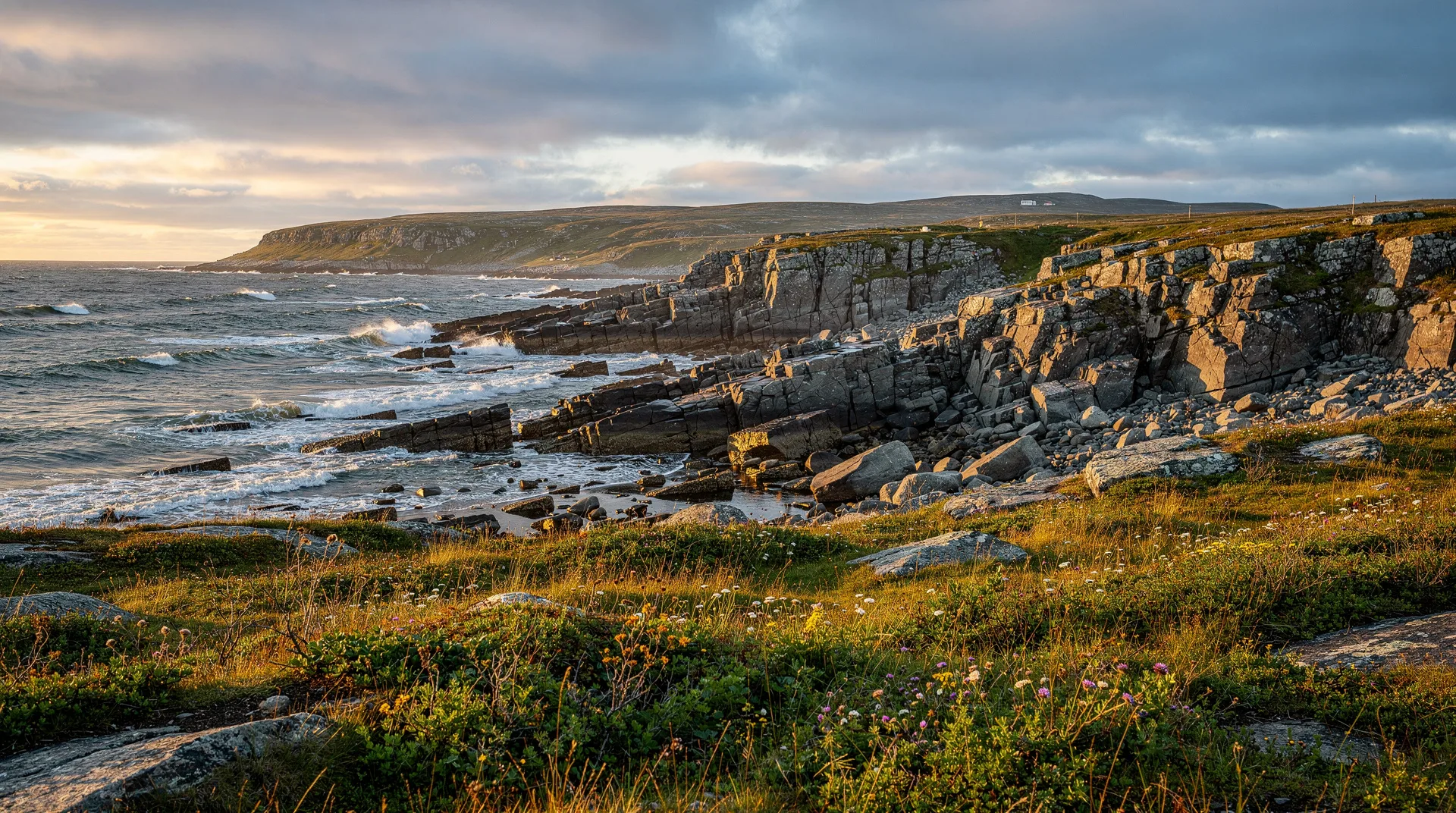
You arrive at L’Anse aux Meadows by driving to the end of the road. Route 436 peters out on a headland of subarctic barrens, the North Atlantic stretches unbroken to Labrador, and the turf mounds on the meadow below — subtle, easy to miss on a first look — are a thousand years old. They are the only scientifically confirmed remains of a Norse presence in North America, the closest thing archaeology has produced to physical proof that the Vinland sagas describe something that actually happened.
This guide focuses tightly on the archaeological site, the history of its discovery, what you see when you visit, and the practical logistics of getting here from Gros Morne and St. Anthony. For the wider road trip context — Route 430, Gros Morne, Port au Choix, the full northern peninsula — see our companion guide to the Viking Trail in Newfoundland.
| At a glance | |
|---|---|
| Where | Northern tip of the Great Northern Peninsula, Newfoundland, 28 km from St. Anthony |
| Cost | Around CAD $13 adult admission (free for youth 17 and under); covered by the Parks Canada Discovery Pass |
| Time needed | Around 3-4 hours for the site, add 1-2 hours for the adjacent Norstead village |
| Getting there | Self-drive only, end of Route 436; nearest airport is Deer Lake, roughly 5 hours away |
| Best time | Early June to early October (the site is closed in winter); June and September are quieter than the July-August peak |
The discovery, in brief
For centuries the Vinland sagas — Icelandic prose narratives written down in the 13th century, drawing on oral tradition five or six generations older — described Norse voyages from Greenland to a forested land west called “Vinland”. The sagas named three overlapping regions: Helluland (probably Baffin Island), Markland (probably the Labrador coast), and Vinland further south. The Norse were not imagining these places, but no physical evidence had been found, and the sagas were widely treated as semi-mythical by academic historians.
That changed in 1960. Norwegian writer and former explorer Helge Ingstad, convinced by close reading of the sagas that a Norse settlement should be findable on the northern tip of Newfoundland, arrived by boat at L’Anse aux Meadows and asked a local fisherman, George Decker, whether there were any “old ruins” in the area. Decker walked him straight to the turf mounds below the village — locally known as “the Indian camp” — and Ingstad immediately recognised the layout as Norse.
His wife, archaeologist Anne Stine Ingstad, led excavations from 1961 to 1968. The first hard evidence — a Norse-pattern bronze cloak pin, a spindle whorl, iron-working slag — came in the first season. Carbon dates averaged around 1000 CE. The interpretation was accepted internationally; UNESCO inscribed the site in 1978.
What the archaeology shows
Eight turf-and-timber buildings were identified, grouped into three complexes. The largest building is a 28-metre hall with space for 30 people; the others include smaller dwellings, a smithy, and workshops for iron-working, carpentry, and possibly boat repair.
The evidence consistent with a Norse, rather than Indigenous or later European, origin includes:
- Iron-working slag and a furnace base — iron smelting from bog ore, a technology absent in pre-contact North America and standard in Norse settlements.
- Iron boat rivets — rivets of the Norse ship-building pattern, a technology not used by Indigenous peoples of the region.
- A soapstone spindle whorl of a form common in Viking Age Iceland and Greenland. The whorl is significant both technically (proving textile production on site) and socially (soapstone spinning tools are strongly associated with women in Norse contexts, implying a mixed-sex settlement, not an all-male exploration camp).
- A bronze ring-headed pin of a type produced in Norse Ireland and Scotland in the late 10th and early 11th centuries.
- Butternuts (Juglans cinerea) whose native range does not extend north of the Gulf of St. Lawrence. Finding them at L’Anse aux Meadows proves the site’s occupants travelled at least as far south as New Brunswick or the St. Lawrence estuary — opening the possibility that “Vinland” proper, with its grapes, lies further south and that L’Anse aux Meadows was a staging base.
Radiocarbon dating and dendrochronology place the occupation around 990-1050 CE. The consensus estimate is that the settlement operated for roughly a decade before being abandoned; nothing suggests violent destruction, and careful clean-up of the smithy indicates a planned departure.
The site today
The excavated foundations themselves are covered with turf to protect them from weathering. What you see on the ground are the low outlines of the original buildings, marked with gravel and short posts, and — a short walk away — three reconstructed sod buildings built by Parks Canada using period techniques.
The visitor centre
Your first stop. The building sits just inland from the archaeological site, is architecturally subdued (to avoid competing with the landscape), and houses an exceptionally well-curated exhibit: an introduction to the Norse Atlantic diaspora, the original Ingstad excavation story, the key artifacts (many on display; others are in Ottawa or Oslo), and short films. Plan to spend 45-60 minutes here before walking to the site.
The reconstructed buildings
A 500-metre boardwalk path leads from the visitor centre out to the three reconstructed Norse buildings — a great hall, a smaller dwelling, and a workshop. Inside, Parks Canada interpreters in period costume explain Norse daily life, demonstrate crafts (weaving, blacksmithing, woodwork), and engage visitors in conversation. The interpreters are deeply trained — many have spent multiple seasons on site, read the sagas in translation, and handle the archaeological literature well — and are a large part of what makes the visit memorable.
The buildings’ interiors are dim, smoky from the central hearths, and smell distinctly of peat and wool. They are as close to an immersive experience of the Norse settlement as modern archaeology can responsibly produce.
The original site
Beyond the reconstructions, a further boardwalk loops around the original excavated foundations. Interpretation is provided by small signs at each building outline and, during peak season, by interpreters leading guided walks. The layout, scale, and coastal setting of the original settlement are best appreciated in this open section — the reconstructions are dense, but the original site is spare, low, and contextualises the Norse choice of location with views out to the sea they crossed.
Norstead (adjacent, separate operation)
Two kilometres from the Parks Canada site sits Norstead, a privately run Viking village reconstruction. It is more participatory than the Parks Canada site — visitors can try archery, handle tools, and board a replica knarr (Norse merchant ship). It is not a substitute for the national historic site but a good complement, particularly for families with children.
Practical visit: logistics
When it is open
L’Anse aux Meadows National Historic Site operates from early June through early October. Opening and closing dates shift slightly year to year; check the Parks Canada website in advance. Winter access to the site is not available — the road is plowed to L’Anse aux Meadows village, but the national historic site itself is closed.
Peak visitation is mid-July through mid-August; June and September are significantly quieter and pleasant.
Admission (2026, approximate)
- Adult: CAD $13.00
- Senior: CAD $11.25
- Youth 17 and under: free
- Family/group: CAD $26.25
The Parks Canada Discovery Pass covers admission here and at hundreds of other sites; if your trip includes Gros Morne and other national parks, it pays for itself quickly.
Norstead charges separately: CAD $12 adult, $6 child.
How long to budget
A thorough visit to L’Anse aux Meadows itself needs 3-4 hours — 45-60 minutes at the visitor centre, an hour or more at the reconstructed buildings with the interpreters, and 45 minutes on the original site. Add 1-2 hours for Norstead if you are combining them.
Getting there
L’Anse aux Meadows is at the end of Route 436, 28 km north-west of the town of St. Anthony, which is itself the largest community on the northern peninsula. Driving distances:
| From | Distance | Typical drive |
|---|---|---|
| St. Anthony | 28 km | 30 minutes |
| Gros Morne (Rocky Harbour) | 465 km | 5 h 30 |
| Deer Lake Airport | 440 km | 5 h |
| Port au Choix | 275 km | 3 h 15 |
| St. John’s | 1,080 km | 12 h + ferry |
There is no public transit to L’Anse aux Meadows; a vehicle is essential. The nearest airport is Deer Lake (YDF) with daily connections to Halifax, Toronto, and Montreal.
Accommodation
The immediate area has a small cluster of B&Bs and inns in the villages of Hay Cove, L’Anse aux Meadows, and Gunners Cove. The Norseman Restaurant (next to the historic site) is the best-known dining option in the area — reservations essential in summer. For larger hotels and services, base in St. Anthony (Grenfell Heritage Hotel, Haven Inn) and day-trip the site; this adds 30-60 minutes each way but vastly expands your accommodation and restaurant options.
Browse Newfoundland tours and guided experiencesCombining with other northern peninsula stops
L’Anse aux Meadows is the anchor of a northern peninsula trip that logically includes several further stops along Route 430, the Viking Trail proper.
Gros Morne National Park
Approximately 450 km south, Gros Morne is a UNESCO World Heritage Site in its own right, protecting the Tablelands (exposed ocean-floor mantle rock), the Western Brook Pond landlocked fiord, and the Long Range Mountains. Almost every visitor to L’Anse aux Meadows spends at least 2 nights in Gros Morne.
Port au Choix
Halfway up the peninsula, Port au Choix National Historic Site preserves evidence of 5,500 years of Indigenous Maritime Archaic, Dorset Palaeo-Inuit, and Groswater occupation. Pairing Port au Choix with L’Anse aux Meadows on the same trip frames the Norse arrival in its longer human context.
Iceberg and whale watching from St. Anthony
The Labrador Current runs close to the northern peninsula coast and delivers reliable iceberg and whale viewing in May-July. Fishing Point Park in St. Anthony is a free clifftop vantage; boat tours operate from St. Anthony harbour. See our iceberg viewing guide for timing. If you are building a longer trip, you can also compare tours and activities across Canada before you book.
The wider Atlantic Canada context
If L’Anse aux Meadows is your primary destination, the broader Atlantic Canada 7-day itinerary shows how to work Newfoundland’s northern peninsula into a larger regional loop.
Planning the wider Newfoundland trip
L’Anse aux Meadows sits far enough from St. John’s that almost no one visits it as a standalone trip — it is normally the anchor of a longer northern peninsula loop or a full Newfoundland 7-day itinerary. If Labrador and Newfoundland are both on your list, our Newfoundland vs Labrador guide helps decide how to split limited time between the two.
For a taste of local culture after a day of Norse history, most towns on the northern peninsula offer a “screech-in” ceremony — see our Newfoundland screech-in guide — and the same May-July window that brings icebergs past St. Anthony also brings puffins to several colonies further down the coast; see our puffin watching guide.
Understanding what L’Anse aux Meadows is — and is not
A few framing points that help a visit:
It is not “the” Vinland. The sagas describe a land called Vinland characterised by wild grapes — which do not grow at the latitude of L’Anse aux Meadows. The presence of butternuts on site, a species whose natural range lies well south, strongly suggests that L’Anse aux Meadows was a staging base from which the Norse travelled further south into the Gulf of St. Lawrence or New Brunswick. L’Anse aux Meadows is thus a Vinland site but probably not “Vinland” proper.
It is not a large settlement. Between 70 and 90 people, in eight buildings, for roughly a decade. It is proof of concept, not colonisation. The scale matters for understanding why it was ultimately abandoned.
It is not Columbus being “wrong”. Columbus’s 1492 voyage had quite different consequences because of the demographic, technological, and political context of 15th-century Europe. L’Anse aux Meadows does not “demote” Columbus; it tells a different, earlier story about a smaller Norse presence that neither colonised nor transmitted knowledge back to a wider European audience.
The interpretation is conservative. Parks Canada and the academic consensus are careful not to overclaim. The site gives you evidence — artifacts, dates, building plans — and leaves you to connect it to the sagas for yourself.
Frequently asked questions about L’Anse aux Meadows: visiting the Norse settlement in Newfoundland
Was L’Anse aux Meadows really a Viking site?
Yes. The evidence — iron-smelting slag, Norse-pattern boat rivets, the soapstone spindle whorl, the bronze ring-pin, the building forms, and consistent radiocarbon dates around 1000 CE — is definitive and internationally accepted. What remains actively debated is the site’s relationship to specific places named in the sagas.
How long did the Norse stay?
The archaeological evidence suggests roughly 10 years of occupation. Why they left is uncertain; probable factors include distance from the Greenland Norse settlements (supply and reinforcement were difficult), and conflict with local Indigenous peoples (referred to in the sagas as “Skraelings”).
Are the reconstructed buildings in the original locations?
No. Parks Canada deliberately built the reconstructions a short distance from the original excavated foundations, to preserve the archaeological evidence and allow visitors to see both the reconstructions and the original outlines.
Is the site wheelchair accessible?
The visitor centre is fully accessible. The boardwalk to the reconstructed buildings is paved and accessible, though the interiors of the sod buildings have thresholds and low doorways typical of Norse construction. The loop around the original excavations is on boardwalk and generally accessible; check with Parks Canada staff at arrival for current conditions.
Can I combine L’Anse aux Meadows with Labrador?
Yes. The St. Barbe-to-Blanc-Sablon ferry connects the northern peninsula to the Labrador coast; the Labrador Coastal Drive extends from Blanc-Sablon up Route 510. This adds significant distance and time; plan a minimum of 3 additional days. Our Newfoundland vs Labrador guide has more on how to split your time.
Is L’Anse aux Meadows worth the long drive?
Most visitors who make the trip say yes — it is unlike anything else in Canada, and the site is small enough to see thoroughly in half a day, so the drive is the main cost, not the visit itself. It works best combined with Gros Morne and the rest of the northern peninsula rather than as a standalone detour.