Ice walks in Alberta: Johnston Canyon, Maligne & more
When is the best time for ice walks in Alberta?
Alberta ice walks run from approximately December through February, when canyon waterfalls freeze into dramatic ice formations. January is the most reliable month for fully frozen falls. Johnston Canyon (Banff) and Maligne Canyon (Jasper) are the two premier ice walk destinations in the province.
Alberta’s canyon waterfalls freeze spectacularly in winter. Where summer hikers see curtains of white water tumbling through limestone slot canyons, winter visitors find the same water transformed into towers of blue-green ice, frozen mid-fall in forms that seem to defy physics. Ice walks — winter hikes through frozen canyons wearing microspikes — are one of the most distinctive winter activities in the Canadian Rockies and among the experiences most reliably cited by visitors as highlights of a winter trip.
The two premier ice walk destinations are Johnston Canyon in Banff National Park and Maligne Canyon in Jasper National Park. Both are excellent; they have different character and scale. This guide covers both in detail, along with other ice walk options in the province.
At a glance
| Where | Johnston Canyon (Banff National Park) and Maligne Canyon (Jasper National Park), plus Marble Canyon and Grotto Canyon |
| Cost | Self-guided is free beyond your park pass; guided tours run around CAD 60-100/person for 3-4 hours |
| Time needed | 2-4 hours depending on the canyon and whether you walk to the upper falls |
| Getting there | Car required for all four canyons; no winter shuttle service |
| Best time | January, after a sustained cold spell of two or more weeks |
A Parks Canada park pass is required for Johnston Canyon and Maligne Canyon, since both sit inside national parks — see our Banff park pass guide for costs and options. Grotto Canyon, in Kananaskis, does not require a national park pass.
Johnston Canyon ice walk (Banff)
Johnston Canyon in summer is one of Banff’s most visited trails — a catwalk system bolted into the canyon walls leads past the lower falls and upper falls in a spectacular limestone gorge. In winter, the same canyon becomes one of the most dramatic ice walk destinations in the country.
Distance and duration: 5.8 km return to the upper falls; 2.7 km return to the lower falls. Allow 2–3 hours for the full return to upper falls.
Difficulty: Easy to moderate in good conditions; more demanding when catwalks are heavily iced.
What you see:
The lower falls (winter): The 10-metre waterfall partially or fully freezes into a column of translucent blue-green ice. The viewing platform directly in front of the falls is enclosed on three sides by the canyon rock — in winter, ice covers the walls and the falls face is close enough to touch (though you should not). The spray that soaks visitors in summer crystallises into frost formations on the platform.
The upper falls (winter): The 40-metre upper falls freeze into a multi-tiered ice tower — a more complex and larger formation than the lower falls. In cold winters (sustained below -15°C), the falls freeze completely; in milder winters the upper falls may only partially freeze. A fully frozen upper falls is among the most dramatic natural ice formations in Alberta.
Self-guided: Johnston Canyon is open for self-guided winter exploration. Microspikes or ice cleats are mandatory — the catwalks are treated but still slippery, and the approach trail accumulates ice. Parks Canada provides traction device check points at the trailhead when conditions require them.
Guided tours: Several Banff outfitters offer guided ice walks to Johnston Canyon, typically 3–4 hours including transport from Banff. Guided tours add historical and geological context from knowledgeable guides and ensure you have appropriate equipment. They are particularly valuable for first-time winter hikers unfamiliar with the canyon’s layout and winter conditions.
Getting there: Johnston Canyon Resort is on the Bow Valley Parkway (Highway 1A), 17 km west of Banff. No shuttle operates in winter; car access is required. The parking area at the resort is plowed but small — arrive early on weekends. See our full Johnston Canyon guide for summer comparison and practical details.
Book guided Johnston Canyon ice walk tours from BanffMaligne Canyon ice walk (Jasper)
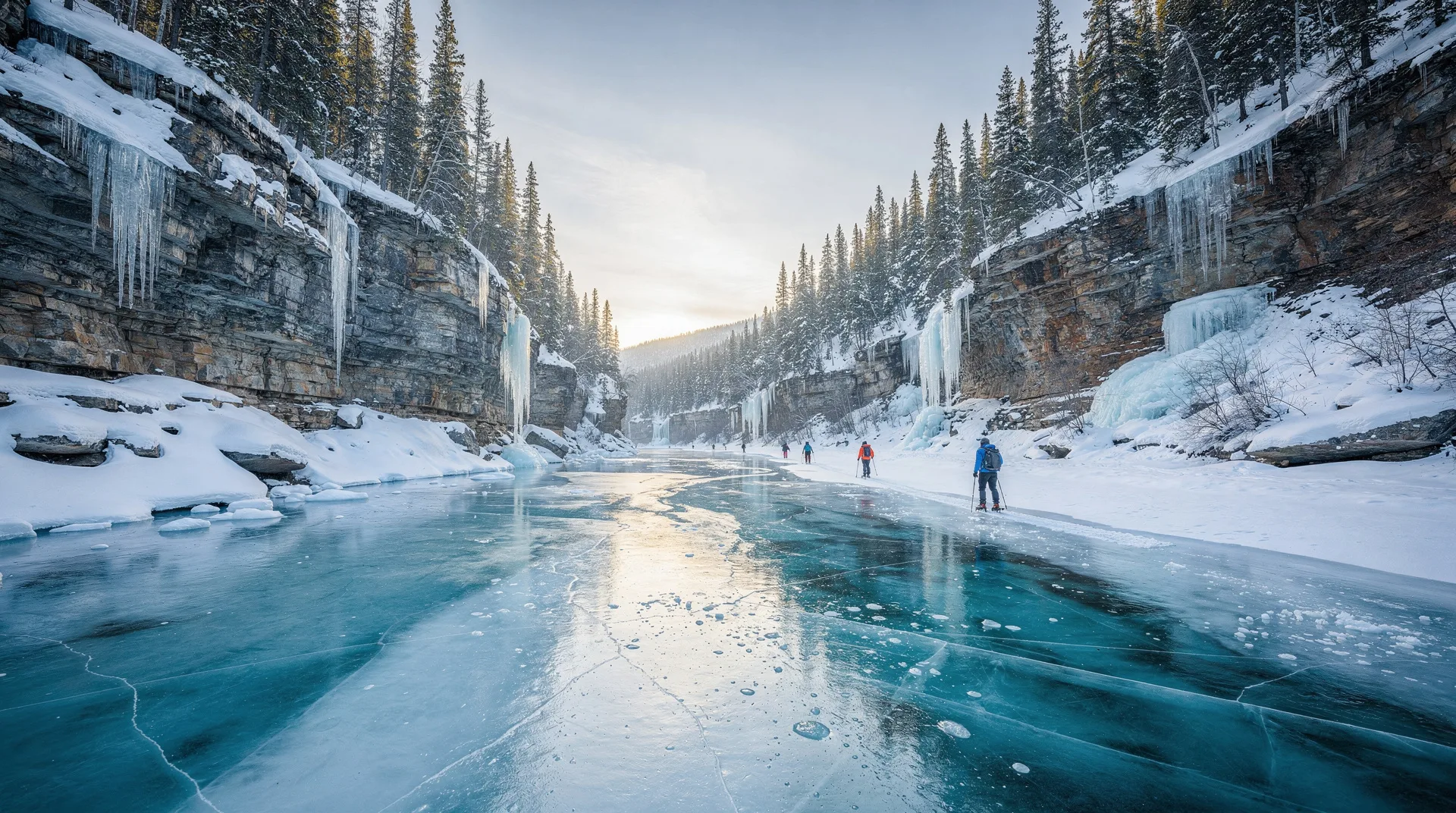
Maligne Canyon is arguably the finest ice walk destination in the Canadian Rockies. The canyon is deeper than Johnston — reaching 55 metres in places — and the frozen formations are correspondingly more dramatic. Where Johnston Canyon’s catwalks keep you adjacent to the rock face, the Maligne Canyon ice walk takes you onto the frozen canyon floor, surrounded by ice walls rising 50+ metres on both sides.
Canyon depth: Up to 55 m | Length of accessible section: 2–4 km depending on ice conditions Difficulty: Moderate (canyon floor sections are uneven ice) Duration: 2–4 hours depending on how far you walk and whether guided
What you see:
The frozen Maligne River forms the canyon floor in winter — solid enough in January and February to walk on with microspikes. The canyon walls are draped in blue-green ice formations created by seepage water freezing over the season. Ice columns hang from ledges; stalactite-like formations build from drips; the canyon walls themselves are coated in layers of ice that change colour depending on thickness and light angle.
Self-guided: Unlike Johnston Canyon (where the catwalk infrastructure makes self-guided winter exploration straightforward), Maligne Canyon’s floor walk requires more winter travel experience and confident navigation on ice. Self-guided visits are possible but the canyon floor can be genuinely tricky in icy conditions. Appropriate footwear and microspikes are non-negotiable.
Guided tours: Most visitors experience Maligne Canyon in winter via guided tours from Jasper. The guided experience is highly recommended — guides know which ice formations are stable and which to avoid, navigate canyon floor obstacles confidently, and provide context about the canyon geology and the ice formation process. Group sizes are typically 8–12 people.
Ice stability note: The canyon floor is frozen river ice. Reputable tour operators monitor ice conditions throughout the season and adjust routes accordingly. Self-guided visitors should never walk on canyon ice they cannot verify the stability of. Sticking to the established tour routes is essential for safety.
Getting there: Maligne Canyon is 11 km east of Jasper townsite on Maligne Lake Road. Car access required; the parking area is near the canyon entrance. Guided tours typically depart from Jasper townsite and include transport.
Book Maligne Canyon ice walk tours from JasperComparison: Johnston Canyon vs Maligne Canyon
| Feature | Johnston Canyon | Maligne Canyon |
|---|---|---|
| Canyon depth | 30 m maximum | 55 m maximum |
| Access | Catwalk system (easier) | Canyon floor walking (more dramatic) |
| Location | Banff National Park | Jasper National Park |
| Nearest town | 17 km from Banff | 11 km from Jasper |
| Self-guided suitability | Good (catwalk infrastructure) | Advanced hikers only |
| Guided tour availability | Excellent (many Banff operators) | Good (Jasper-based operators) |
| Main highlight | Fully frozen waterfall faces | Walking on frozen canyon floor |
If you are based in Banff with limited time, Johnston Canyon is the obvious choice. If you are in Jasper or willing to make the journey, Maligne Canyon’s deeper gorge and floor-level ice walk is more dramatic.
Gear and preparation
Microspikes and traction devices
Microspikes (coil-chain traction devices that strap over boots) are essential for all Alberta ice walks, whether self-guided or on a tour. The distinction matters:
- Microspikes (Kahtoola MICROspikes, YakTrax Pro) — appropriate for most ice walk conditions; multiple small spikes provide grip on flat ice
- Crampons — not required for standard ice walks; these are for technical ice climbing
- YakTrax basic — not adequate for canyon ice walk conditions; the grip is insufficient on uneven ice
Most guided tour operators provide microspikes as part of the tour or offer rentals. Self-guided visitors should bring their own or rent from Banff/Jasper outdoor retailers.
What to wear
Ice walks involve slow movement through cold canyon environments with minimal exertion. You will not generate the heat that summer hiking creates. Dress warmer than you think necessary:
- Base layer: Thermal merino wool or synthetic (not cotton)
- Mid-layer: Heavy fleece or puffy jacket
- Outer layer: Windproof, waterproof shell jacket and pants
- Head: Balaclava or warm hat covering ears, plus a hood
- Hands: Warm mittens
- Feet: Insulated waterproof boots — the canyon floor is ice; cold transfers through thin soles quickly
- Gaiters: Optional but helpful if snow is present on the approach trail
Temperature range: Ice walk conditions typically occur at -5°C to -25°C. In extreme cold (below -20°C), some operators adjust itineraries. Dress for the colder end of the range; you can always remove a layer.
Other Alberta ice walk locations
Marble Canyon (Kootenay National Park, BC — near Alberta border)
Marble Canyon, just across the Alberta-BC boundary near Castle Junction, offers a shorter but visually striking ice walk in a narrow turquoise canyon. The summer boardwalk trail functions as a winter ice walk trail; frozen waterfalls drop into the canyon below transparent ice bridges. Approximately 1.5 km return. No guided tours operate here; it is an accessible self-guided option for visitors with appropriate gear driving the Kootenay Parkway.
Grotto Canyon (Kananaskis)
Grotto Canyon near Canmore is a popular self-guided winter canyon walk. The canyon narrows dramatically and the creek freezes into a walkable ice surface. Less dramatic than Johnston or Maligne but accessible without a national park pass (provincial Kananaskis). The canyon also contains Indigenous rock art (petroglyphs) — a rare bonus in an ice walk setting. Approximately 4 km return.
Safety on ice walks
Falling ice: Canyon environments in freezing conditions have active rockfall and ice fall. Helmets are not standard for ice walks but moving quickly through gully sections and not stopping directly under ice formations is recommended. Reputable guided tours keep groups away from unstable ice overhead.
Ice thickness: Canyon floor ice cannot be assumed to be uniform in thickness. Follow established routes and the guidance of operators. Cracking sounds (popping, creaking) from river ice are normal — river ice behaves differently from lake ice — but sudden cracking sounds immediately underfoot warrant stopping and carefully retreating.
Hypothermia risk: Slow movement in extreme cold creates real hypothermia risk. If a group member begins shivering uncontrollably, loses coordination, or appears confused, initiate warming and evacuation immediately. Guided tours have emergency protocols; self-guided groups should understand hypothermia recognition.
Planning an ice walk into a winter Rockies trip
Both canyons work well as a half-day addition to a longer winter itinerary rather than a trip in themselves. If you’re planning a dedicated winter visit, our Rockies winter 5-day itinerary builds ice walks in alongside other cold-weather activities, and the Canada in winter overview covers what else is realistic at that time of year. Timing matters more than most visitors expect — check best time to visit Banff or best time to visit Jasper before locking in dates, since a mild early winter can leave the falls only partially frozen.
Related guides
- Johnston Canyon hike guide — summer version of the canyon walk
- Dog sledding near Banff — other winter activity in the Banff area
- Banff Upper Hot Springs — warm recovery after a cold ice walk
- Stargazing in Jasper — winter night sky experience in the Jasper Dark Sky Preserve
- Banff ski resorts guide — full winter sport options in Banff
Frequently asked questions about Ice walks in Alberta: Johnston Canyon, Maligne & more
Do I need winter hiking experience for an ice walk?
For a guided tour at Johnston Canyon or Maligne Canyon, no prior winter hiking experience is required. Operators provide briefing, equipment guidance, and guidance throughout. For self-guided canyon floor walks (particularly Maligne), previous experience with microspikes and winter trail conditions is helpful.
What is the minimum temperature for ice walks?
Ice walks are most dramatic when cold has been sustained — typically after 2+ weeks below -10°C. A single cold night does not freeze major waterfalls. January after a cold December is the most reliable time for fully frozen formations. Check local condition reports from Banff and Jasper visitor centres before planning your visit date.
Can children do ice walks?
Children of approximately 5+ can participate in guided ice walks at Johnston Canyon with appropriate gear. The catwalks at Johnston are manageable for children who are steady on their feet. Maligne Canyon floor walks are better suited to older children (10+). Ensure children have proper microspikes fitted to their footwear — adult microspikes do not function on child-sized boots.
Do I need a national park pass for an ice walk?
Yes, for Johnston Canyon and Maligne Canyon, since both sit inside Banff and Jasper National Parks and require a valid Parks Canada pass year-round, including winter. Grotto Canyon in Kananaskis does not require a national park pass.
Which is better for a first-time visitor, Johnston Canyon or Maligne Canyon?
Johnston Canyon, in most cases. Its catwalk infrastructure makes self-guided winter walking straightforward and the payoff — fully frozen waterfall faces close enough to see clearly — comes with less commitment than Maligne Canyon’s floor walk. Maligne Canyon is the better choice if you’re already in Jasper or specifically want the more dramatic, deeper canyon experience.