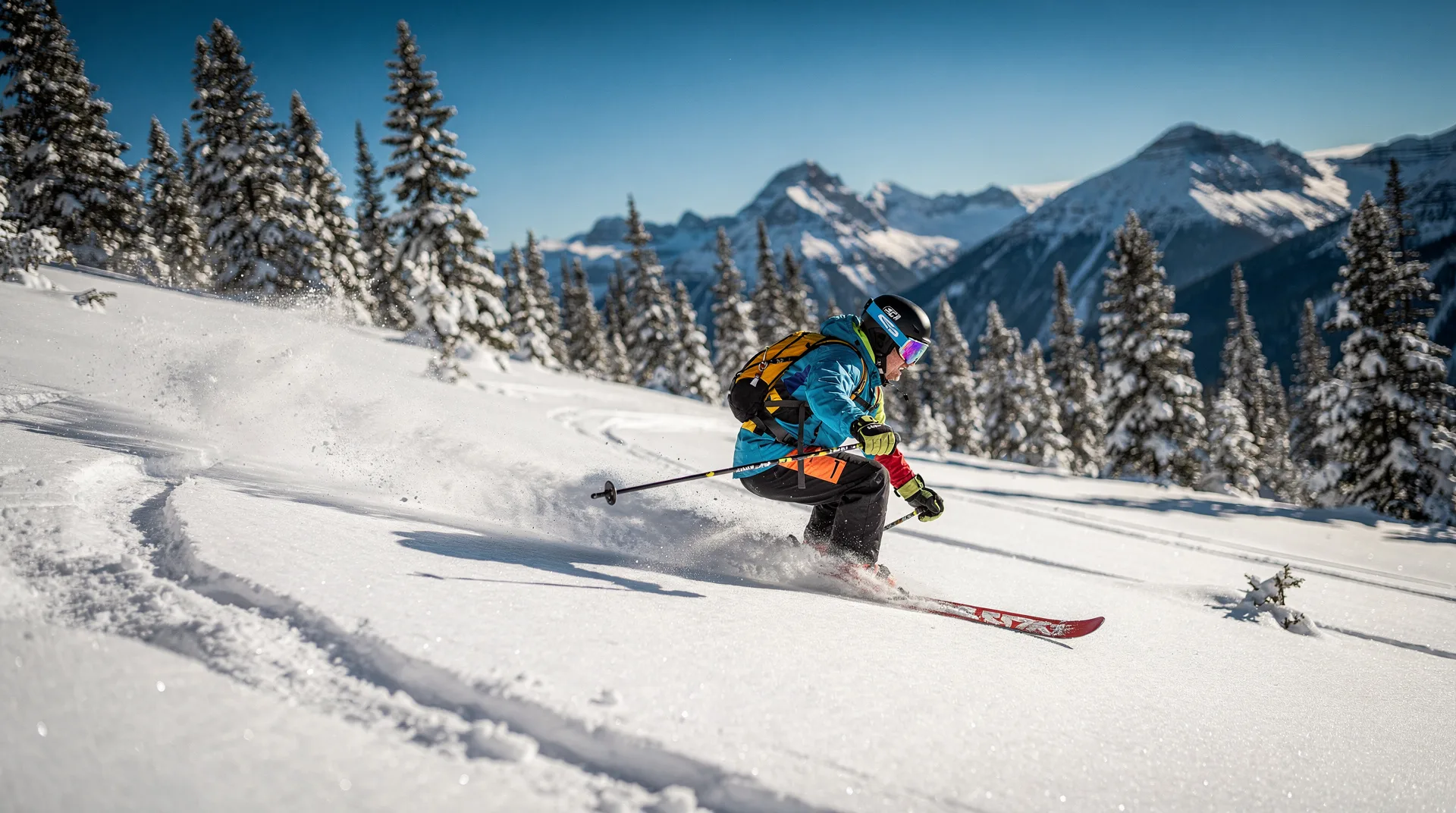
Banff ski resorts: Lake Louise, Sunshine Village and Mount Norquay
Which is the best ski resort near Banff?
Lake Louise Ski Resort offers the best combination of terrain variety and iconic scenery. Sunshine Village is best for snow quality and advanced terrain. Mount Norquay is best for beginners and locals. The tri-area pass covers all three and is the best value for a multi-day Banff ski trip.
| At a glance | |
|---|---|
| Where | Three resorts around the town of Banff, Alberta: Lake Louise, Sunshine Village, Mount Norquay |
| Cost | Around CAD 90-180/day per resort; Ski Big 3 tri-area pass from around CAD 370 for 3 days |
| Time needed | 3-7 days to sample all three properly |
| Getting there | Fly into Calgary, then free shuttles from Banff town to all three resorts |
| Best time | February for the best snow-to-crowd balance; late March/April for value and spring conditions |
Banff’s three ski resorts — Lake Louise Ski Resort, Sunshine Village, and Mount Norquay — form one of the world’s great alpine ski regions. Linked by the tri-area Ski Big 3 pass, the three mountains cover 8,000+ acres of skiable terrain across a range of character and difficulty that few ski destinations can match. They sit within or adjacent to Banff National Park, one of the most dramatic mountain landscapes in North America, where the scenery competes with the skiing for attention.
Each resort has a distinct personality. Lake Louise is vast, iconic, and genuinely excellent for all levels. Sunshine Village is above the treeline, consistently receives the deepest snow, and rewards advanced skiers. Mount Norquay is small, friendly, and ideal for beginners or those wanting a quiet, uncrowded alternative to the larger mountains. Together they represent a skiing trip that can fill a week without exhausting the terrain.
Lake Louise Ski Resort
Lake Louise Ski Resort is the flagship ski area in the Banff region — 4,200 acres of terrain across four distinct mountain faces, a vertical drop of 1,000 metres, and views over the famous turquoise lake and Victoria Glacier that are among the most spectacular from any ski mountain anywhere in the world.
Terrain at Lake Louise
| Face | Character | Best for |
|---|---|---|
| Front face | Classic Alpine skiing, wide groomed runs, excellent intermediates | Blue-run intermediates, beginners on lower sections |
| Back bowls (Larch and Ptarmigan) | Open bowl skiing, more challenging, less crowded | Intermediate to advanced; good in powder |
| North face / Men’s Downhill | World Cup race terrain, steep and consistent pitch | Advanced to expert |
| Shoulder | Varied intermediate terrain connecting front and back | Intermediates wanting variety |
The front face of Lake Louise is the central experience for most visitors: well-groomed runs with a consistent pitch, the lifts fanning upward from the Whiskyjack Lodge at the base, and at every turn views over the valley to the peaks beyond. The back bowls (accessed via Larch and Ptarmigan lifts) provide open bowl skiing and more adventurous terrain, typically less crowded than the front face.
Lake Louise’s Men’s Downhill course is the steepest and fastest ski terrain in the Banff area — hosting the annual World Cup downhill event, it is a legitimate expert run that punishes insufficient preparation.
Lodges and base facilities
The Whiskyjack Lodge at the base is Lake Louise’s main hub — well-equipped with rentals, ski school, food, and equipment storage. Mid-mountain, the Temple Lodge provides excellent ski-in lunch options. The Kokanee Kabin at the top of the Ptarmigan Triple is a small warming hut good for a break before running the bowls.
The Fairmont Chateau Lake Louise is 5 km from the ski area base — accessible by shuttle bus (included with lift ticket). Skiers staying at the Chateau have direct access to shuttle service to and from the mountain.
Book a Banff ski gondola and Lake Louise sightseeing packageLake Louise practical info
- Season: Typically opens mid-November; closes mid-April
- Daily lift pass: CAD 130–180 (varies by date; advance purchase cheaper)
- Vertical: 1,000 m
- Terrain: 4,200 acres, 145 runs
- Access: 60 km from Banff town on the Trans-Canada; free shuttle from Banff and Lake Louise village
Sunshine Village
Sunshine Village is the snow-certainty choice among Banff’s three ski areas. The resort sits at 2,160 metres base elevation — higher than any other ski resort in Canada with the exception of Whistler’s summits — which means it sits above the fog and temperature inversions that can affect the Bow Valley in winter. When Banff town is grey and cold, Sunshine Village is frequently in brilliant sunshine (hence the name) above the cloud layer.
The snow is Sunshine’s defining advantage. Sitting in a mountain cirque that acts as a natural snow trap, Sunshine receives an average of 9 metres of snow per year — significantly more than Lake Louise or Norquay — with a snowpack that begins accumulating from October. The resort is entirely above the treeline, giving it an exposed, high-alpine character that Lake Louise’s forested lower sections do not replicate.
Terrain at Sunshine Village
Sunshine’s terrain is divided between the main village area (accessed via the base gondola from the highway) and the Goat’s Eye Mountain extension, which provides the most challenging expert terrain in the Banff ski area:
Wawa bowl / Village runs: The central terrain around the village base, ranging from wide groomed intermediates to steeper blue-black runs. The most consistent exposure for most visitors.
Goat’s Eye Mountain: A separate peak connected to Sunshine Village by a short lift from the village. Steeper, rockier, and more committing than the main Sunshine area. The Goat’s Eye Express chair serves terrain that is consistently more challenging and less crowded than the main village runs.
Standish face: Intermediate terrain on the face directly above the village; some of the resort’s most scenic runs with views across the valley.
The Shoulder: High alpine terrain above the main resort area accessed via the Continental Divide Chair — Sunshine’s upper mountain with views into BC on one side and Alberta on the other.
The Ski Out run — a long blue-run exit back to the base gondola area — is a Sunshine tradition: 5.5 km of winding, scenic trail through the lower mountain on the way out.
Sunshine practical info
- Season: Opens November (one of Canada’s earliest openings); historically the last major resort to close in late May
- Daily lift pass: CAD 130–175 (varies; advance purchase cheaper)
- Vertical: 1,070 m
- Terrain: 3,358 acres, 107 runs
- Access: 24 km from Banff town; free shuttle from Banff; base gondola to the main resort (no road to the village itself)
- Accommodation: Sunshine Mountain Lodge at the village base is the only ski-in/ski-out accommodation in the Banff area
Mount Norquay
Mount Norquay is Banff’s local mountain — compact, accessible, and uncrowded compared to Lake Louise and Sunshine. Located just 6 km from Banff townsite, Norquay is a 20-minute drive from the centre of Banff on the Norquay access road.
Norquay’s 1,650 acres of terrain is divided between gentle beginner slopes (some of the best-maintained beginner terrain in the Banff area) and a handful of genuinely steep expert runs on the North American face — a cliff-band of double-black terrain that is as challenging as anything on the larger mountains. The intermediates are limited compared to Lake Louise and Sunshine, but what Norquay lacks in terrain volume it compensates with lack of crowds and proximity to the town.
The resort’s main value propositions:
Best beginners resort in Banff: The beginner area is well-isolated from faster traffic, and the ski school has excellent staff ratios. Families with very young children often prefer Norquay for the first day or two.
Expert runs without the commute: Norquay’s North American face (accessed via the Cliff House chair) is steep, challenging, and often emptier than comparable terrain at Lake Louise or Sunshine.
Most affordable lift tickets: Norquay’s single-day pass is typically CAD 90–120, significantly cheaper than Lake Louise or Sunshine.
Night skiing: Norquay offers night skiing Thursday through Sunday evenings during the main season — the only night skiing option in the Banff area and a unique experience under the illuminated Bow Valley.
Norquay practical info
- Season: Opens late November; closes mid-April
- Daily lift pass: CAD 90–120
- Vertical: 497 m
- Terrain: 1,650 acres (65 runs)
- Access: 6 km from Banff town; regular shuttle from Banff
The Ski Big 3 tri-area pass
The most practical approach for most visitors spending 3+ days skiing in the Banff area is the Ski Big 3 pass, which covers all three resorts with unlimited access:
| Duration | Approximate cost (CAD) |
|---|---|
| 3-day pass | CAD 370–420 |
| 5-day pass | CAD 570–640 |
| 7-day pass | CAD 720–800 |
Prices vary by season period (early season, peak, spring). Advance purchase online delivers 10–20% savings over at-resort prices. For visitors planning 4 or more days of skiing, the tri-area pass nearly always provides better value than buying individual daily passes.
Free shuttles between Banff town and all three resorts are included with lift tickets and the Ski Big 3 pass — an important practical benefit that removes the need for a rental car on ski days.
Snow comparison
| Resort | Annual average snowfall | Snow type | Base elevation |
|---|---|---|---|
| Lake Louise | 9 metres | Mixed — colder and drier than coast | 1,646 m |
| Sunshine Village | 9 metres | Drier than Lake Louise; high-alpine cold | 2,160 m |
| Mount Norquay | 3 metres | Lower elevation; less consistent | 1,629 m |
Sunshine Village and Lake Louise receive comparable annual snowfall totals, but Sunshine’s higher elevation means the snow stays drier and lighter. Norquay’s lower snowfall total means conditions are more variable — it benefits enormously from the snowfall events that hit the other mountains but is less reliable in marginal snow years.
Best time to ski Banff
| Period | Conditions | Notes |
|---|---|---|
| Late November | Early season; limited terrain open | Opening deals; quieter |
| December–January | Excellent; full season at all resorts | Christmas week very busy |
| February | Best combination — excellent snow, manageable crowds | Good value mid-week |
| March | Spring approaching; longer days; still good snow | Family ski weeks can be busy |
| April | Spring snow; Sunshine still excellent | Best value; Sunshine often open through May |
February offers the best overall combination for most visitors: full terrain access, reliable cold and dry conditions, longer days than January, and better accommodation availability than the Christmas-New Year peak. Late March and April are excellent for experienced skiers wanting value — Sunshine Village frequently delivers its deepest snowpack in March, and spring conditions (soft afternoon snow) have their own appeal.
Getting to the Banff ski resorts from Calgary
Calgary International Airport is the arrival hub for Banff ski trips. The route from Calgary to Banff is 128 km on the Trans-Canada Highway (about 90 minutes). Several shuttle operators run direct Calgary Airport to Banff town services, with connections to all three resorts.
Book a small-group Banff day tour from Calgary — perfect for first-time visitorsSee our Banff National Park guide for comprehensive information on the park, accommodation, and summer and winter activities beyond skiing.
Where to stay for Banff skiing
Banff townsite (15–60 km to the resorts): The most practical base — closest to all three resorts, best choice of accommodation and restaurants, regular shuttle service to all mountains. Hotels range from budget (HI Banff Alpine Centre from CAD 50/dorm) to luxury (Fairmont Banff Springs from CAD 500/night).
Lake Louise village (at the base of Lake Louise Ski Resort): Small settlement with several mid-range hotels. Very convenient for skiing Lake Louise; requires driving or shuttle for Sunshine or Norquay. The Post Hotel is a classic Lake Louise ski lodge.
Canmore (25 km east of Banff): Outside the national park — lower accommodation prices than Banff, more real-town character. Excellent base for the Banff resorts via shuttle.
See our Canadian Rockies guide for a broader picture of the Alberta mountain region.
If you would rather keep costs down, the Banff vs Canmore comparison explains how the two towns differ for a winter stay, and the Canmore destination page covers what the town offers once the lifts close. Staying at Lake Louise puts you closest to the largest of the three resorts, which suits a trip built mostly around one mountain.
Planning rest days around the skiing
A week of skiing is more enjoyable with a slower day in the middle, and the Banff area gives you plenty of choices. The Banff Upper Hot Springs are a natural fit after a hard day on the slopes, and the Banff itineraries show how to mix mountain days with town time. For something more adventurous without strapping on skis, dog sledding near Banff and Canmore and sleigh rides in the Rockies are both popular winter alternatives. If you want to see more of the region’s frozen scenery, the Johnston Canyon guide and the Lake Louise skating guide cover easy outings that need no ski experience.
Travelling in the middle of winter also means thinking about the road. Our Calgary to Banff driving guide and the Banff town page help you decide whether to drive yourself or rely on shuttles, and the Banff best time to visit guide puts the ski season in the context of the full year.
Do you need a park pass to ski Banff?
Yes. All three resorts sit within or adjacent to Banff National Park, and a valid Parks Canada pass is required to park at any of them — the lift ticket does not cover it. See our Banff park pass guide for daily and annual pass options; if you’re skiing multiple days, the annual Discovery Pass is usually cheaper than paying the daily rate each visit.
Skiing Banff with kids
Mount Norquay and the lower front face of Lake Louise are the most family-friendly terrain in the area, with well-isolated beginner zones and strong ski school programs. See our Banff with kids guide for a broader look at family logistics in the area, including non-ski activities for rest days.
Frequently asked questions about Banff ski resorts: Lake Louise, Sunshine Village and Mount Norquay
Which Banff ski resort is best for beginners?
Mount Norquay has the best beginner infrastructure: well-isolated learning areas, shorter lift queues, and a friendly atmosphere. Lake Louise’s beginner terrain is also good — the Sunny T-bar and lower front face provide safe learning ground with the dramatic Chateau backdrop. Sunshine Village’s high-alpine exposure and distance from amenities makes it less ideal as a learning-day resort, though its beginner runs are perfectly serviceable.
Can I ski from the Fairmont Chateau Lake Louise?
Not directly — the Chateau is 5 km from the ski area base. A free shuttle operates from the Chateau to the ski area; it is included with lift tickets. The shuttle takes approximately 10 minutes. The Chateau itself offers ski and snowboard rentals, equipment storage, and après-ski facilities. Many Chateau guests treat the shuttle commute as a feature rather than an inconvenience.
Is the Ski Big 3 pass worth buying?
For any visitor planning 3 or more days of skiing, the tri-area pass delivers better value than individual daily tickets while also giving the flexibility to choose your mountain each morning based on conditions and mood. The included shuttles between Banff and all three resorts make the logistics genuinely seamless. Book the pass online before you leave home for the best price.
When does Sunshine Village close?
Sunshine Village historically closes in late May — sometimes as late as Victoria Day weekend (third Monday in May) in years with heavy snowfall. The resort holds the record for the latest closure date among Canadian ski resorts. The spring season (April–May) at Sunshine is beloved by Alberta skiers: long days, warm spring sun, and a deep consolidated snowpack that produces the “corn snow” conditions that suit fast carving perfectly.
How does Banff skiing compare to Whistler?
Whistler Blackcomb is larger (8,171 acres vs Banff’s combined 8,000+ acres across three resorts), wetter (Pacific snow vs. continental Alberta snow), and has more vertical drop on a single mountain. Banff’s three-resort system offers more variety and arguably better snow quality (lighter and drier). Whistler’s village experience is more complete; Banff’s ski-in-a-national-park experience is unique. Both rank consistently as North America’s top ski destinations. See our Whistler vs Banff guide for a direct comparison.
What non-ski activities are available near the Banff ski resorts?
The Banff townsite offers the Banff Gondola to Sulphur Mountain summit (year-round), the Banff Upper Hot Springs, ice walks in Johnston Canyon, snowshoeing, cross-country skiing, and excellent restaurants. The Banff National Park guide covers all activities in detail.