Mount Revelstoke National Park guide: Meadows in the Sky and BC's subalpine plateau
What is Mount Revelstoke National Park known for?
Mount Revelstoke National Park is famous for the Meadows in the Sky Parkway, which climbs to a high subalpine plateau carpeted with wildflowers in late July and August. The park also contains old-growth western red cedar groves, excellent cross-country skiing, and is directly accessible from the Trans-Canada Highway.
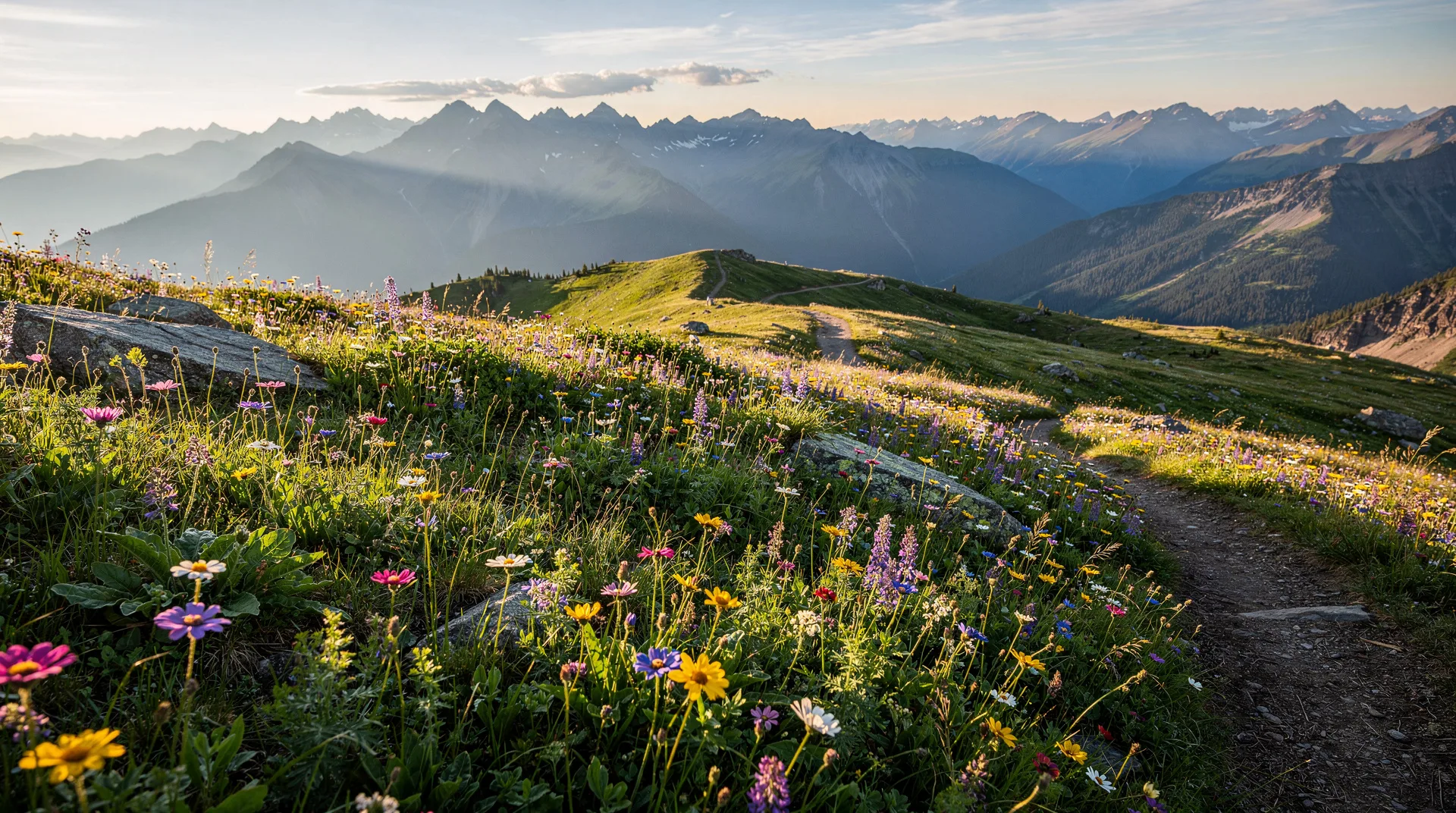
There is a particular quality of silence in the high meadows of Mount Revelstoke National Park that stays with you. At 1,800 metres above sea level, on the broad summit plateau of Mount Revelstoke in the interior ranges of British Columbia, the Columbia Valley and its surrounding peaks spread in every direction and the traffic noise of the Trans-Canada Highway below has long since dissolved into nothing. In late July and August, this plateau is carpeted with wildflowers — avalanche lilies, heather, arnica, Indian paintbrush, and the white blooms of valerian — in a display that ranks among the finest in the country.
Mount Revelstoke National Park covers 260 square kilometres of the Selkirk and Columbia Mountain ranges, a region that receives extraordinarily high snowfall (the town of Revelstoke consistently records some of the deepest snowpacks in North America, making it one of the great backcountry ski destinations on the continent). The park protects a relatively compact but ecologically rich area running from the Columbia River floodplain at 455 metres to the summits above 2,600 metres. The dramatic elevation gradient compresses multiple ecosystem zones into a short vertical distance, producing exceptional biodiversity and scenery.
The park’s accessible highlight — indeed, one of the most accessible subalpine environments in Canada — is the Meadows in the Sky Parkway, a 26-kilometre road that climbs from Revelstoke town (on the Trans-Canada) to the summit meadows. Completed in 1927, the parkway is one of the oldest mountain driving routes in Canadian national park history, and the subalpine plateau it reaches was a tourist destination before most of British Columbia’s current national parks existed. The wildflowers, the views, and the chance to walk across the summit plateau in a t-shirt on a warm August afternoon make this one of the most rewarding easy experiences in the BC mountain parks.
At a glance
| Where | Revelstoke, interior British Columbia, directly off the Trans-Canada Highway |
| Cost | Around CA$9.50/day adult park entry, or a Parks Canada Discovery Pass |
| Time needed | 1-2 hours for the roadside cedar and wetland trails; a half-day for the full Meadows in the Sky Parkway |
| Getting there | Self-drive on the Trans-Canada; the parkway itself is a 26 km spur road from Revelstoke town |
| Best time | Late July to mid-August for peak wildflowers; June for the cedar and wetland trails |
A park of dramatic contrasts
The ecological drama at Mount Revelstoke begins at river level. The Cedar-Hemlock Forest Trail (near the Trans-Canada junction) passes through ancient western red cedar and western hemlock forest, some of the most impressive old-growth rainforest in the interior of British Columbia. Trees here can be 500-800 years old, their bases buttressed with gnarled roots and draped in moss, their canopies creating a cathedral-like shade. The density of the old growth, combined with the lush ground cover of ferns, devil’s club, and skunk cabbage, creates an environment that visitors more often associate with the BC coast than the mountain interior.
Moving upward from the lowland rainforest through montane zones, the forest transitions to subalpine fir and Engelmann spruce before opening onto the summit meadows. The transition from dense forest to open, flower-covered subalpine terrain happens rapidly near the top of the parkway and is one of the most satisfying elevation transitions in the BC mountain parks. A short walk from the summit parkway parking area reaches viewpoints overlooking the Columbia Valley, the Selkirk Mountains to the west, and the Monashees to the east.
In winter, the park’s exceptional snowpack creates one of Canada’s finest backcountry and Nordic skiing environments. The adjacent Revelstoke Mountain Resort offers lift-accessed alpine skiing on vertical drops exceeding 1,700 metres — the longest vertical in North America at a ski resort. The backcountry skiing terrain surrounding the park is legendary; the surrounding Selkirk and Monashee ranges attract heli-skiing clients from around the world.
Top things to do in Mount Revelstoke National Park
Drive the Meadows in the Sky Parkway
The Meadows in the Sky Parkway (Highway 23) climbs 26 kilometres from the Trans-Canada junction near Revelstoke to the summit meadow parking area at 1,805 metres. The road passes through successively higher forest zones before emerging above treeline near the top, where views of the Columbia Valley and surrounding ranges open progressively. The final kilometre of the road is restricted to a free shuttle bus during peak season (late July to early September) — park your car at the Balsam Lake lot and take the shuttle to the summit.
The summit area encompasses a network of short walking trails through the wildflower meadows: the Summit Trail (1 km loop), the Meadows Trail (2.5 km loop), and several shorter viewpoint paths. Walking these trails in late July and August, surrounded by wildflowers and with mountains in every direction, is one of the finest easy outdoor experiences in BC.
Browse BC mountain and nature tours from VancouverWalk the old-growth cedar forest
The Giant Cedars Boardwalk Trail (0.5 km loop, easy) provides access to one of the finest accessible old-growth western red cedar forests in the Canadian Rockies region. Ancient cedar trees up to 800 years old — some with bases exceeding 3 metres in diameter — line the boardwalk trail, their fibrous, reddish bark a warm contrast to the green moss and fern carpet below. The forest is cool and dim even on hot days; the scale of the trees demands a particular kind of quiet attention. The trailhead is directly off the Trans-Canada Highway, 35 km east of Revelstoke.
The Skunk Cabbage Trail (1.2 km boardwalk, easy), in the floodplain marshes near the park’s western boundary, passes through wetland habitat notable for its spring skunk cabbage bloom (late March-April) and the diversity of songbirds attracted to the riparian edge. Both cedar and skunk cabbage boardwalk trails are wheelchair accessible.
Ski touring and snowshoeing
The summit plateau reached by the Meadows in the Sky Parkway becomes a snowshoe and ski touring destination in winter. The parkway itself is not maintained for winter vehicle access, but snowmobiles and snowshoers can access the trailhead at the closed gate and travel up the road on foot or ski. The summit meadows under snow offer a completely different but equally beautiful experience: blue winter skies, white peaks, and deep powder on the rolling terrain. The town of Revelstoke provides full services for ski and snowshoe rental. If you would rather go with a guide, you can compare guided tours across Canada before you book.
Summit Summit Trail
The Summit Trail (1 km loop) from the summit parking area is the most popular walk in the park — a gentle loop through wildflower meadows with 360-degree views. In clear weather, the Columbia Valley is visible nearly 1,400 metres below, with the brown ribbon of the Trans-Canada Highway threading through it. The Selkirk Mountains to the west and the Monashees to the east frame the panorama. The trail is accessible in sneakers; the wildflower display in late July is stunning.
Birdwatching and wildlife
Mount Revelstoke’s diverse habitat zones, from floodplain wetland to old-growth forest to subalpine meadow, support a rich bird community. The skunk cabbage wetland is productive for waterfowl, American bittern, and flycatchers in summer. The old-growth forest hosts pileated woodpeckers, barred owls, and varied thrush. The summit meadows attract white-tailed ptarmigan, horned larks, and golden eagles soaring on thermals. The Columbia River floodplain adjacent to the park boundary supports bald eagles, great blue herons, and in spring, tens of thousands of migrating waterfowl.
Best hikes and trails
Summit Trail (Meadows in the Sky) — 1 km loop, easy. The plateau wildflower walk. Best late July-August. Shuttle to trailhead during peak season.
Meadows Trail — 2.5 km loop, easy-moderate. Longer plateau circuit through the heart of the wildflower meadows. Excellent photography throughout.
Eva Lake Trail — 12.8 km return, moderate. Long descent (and return climb) from the summit plateau into a valley lake. Accessible only in conjunction with the parkway.
Miller Lake Trail — 10 km return, moderate-strenuous. Interior forest and lake circuit from the parkway. Good for solitude and fishing.
Giant Cedars Boardwalk — 0.5 km loop, easy. Old-growth cedar accessible directly from the Trans-Canada. Essential. Wheelchair accessible.
Skunk Cabbage Trail — 1.2 km loop, easy. Columbia River floodplain wetland. Excellent spring birding. Wheelchair accessible.
Inspiration Woods Trail — 2 km return, easy. Forest walk from the lower parkway area through old-growth forest with interpretive panels.
Wildlife you might see
Black bears are the most commonly seen large mammal, frequenting the berry patches and forest margins from spring through fall. Grizzly bears are present but less commonly sighted than in Banff or Kootenay. Elk inhabit the forest and valley margins; deer are abundant in the valley floor area near the park’s western boundary.
Mountain goats appear on the high cliff faces visible from the summit plateau — scan the rock walls with binoculars on clear days. The summit meadows support Columbian ground squirrels, which emerge from hibernation in May and are active through the summer, providing entertainment for hikers and aerial photography opportunities for golden eagles.
The Columbia River floodplain near the park is outstanding for wintering bald eagles (peak November-February) and spring migrant waterfowl. The old-growth cedar forest is one of the best places in BC’s interior to find pileated woodpeckers — listen for their loud, resonant hammering.
Getting there
Mount Revelstoke National Park is located in the interior of British Columbia, directly adjacent to the Trans-Canada Highway (Highway 1) at the town of Revelstoke. The park entrance is approximately 400 km east of Vancouver, 550 km west of Calgary, and 80 km west of Glacier National Park (BC).
The Meadows in the Sky Parkway entrance is within the Revelstoke town limits at the eastern edge of the city. A park pass must be purchased before entering the parkway, either online or at the self-serve kiosk at the parkway gate.
Regular bus service (Greyhound/FlixBus and Pacific Coach Lines) connects Vancouver, Kamloops, and Calgary to Revelstoke. The train (VIA Rail’s Canadian) stops in Revelstoke three times weekly. The town of Revelstoke has car rental, fuel, and full services.
Where to stay
Revelstoke is a vibrant small city with a range of accommodation — from budget motels to boutique hotels on Mackenzie Avenue, the charming downtown main street. In winter, the town operates as a ski resort base; in summer as a hiking and tourism hub. Booking ahead is recommended for July-August and the ski season (December-March).
Inside the park: There are no overnight facilities within Mount Revelstoke National Park itself. No campgrounds within the park.
Campgrounds nearby: Blanket Creek Provincial Park (21 km south of Revelstoke on Highway 23) has an excellent campground on the Arrow Lakes reservoir. Martha Creek Provincial Park (north of Revelstoke) provides camping near the Columbia River.
Best time to visit
Late July and August are the peak season for the Meadows in the Sky Parkway, when the wildflower display on the summit plateau is at its finest. Late July typically sees avalanche lilies, heather, and arnica in full bloom; mid-August adds the later-blooming asters and harebells. The shuttle bus operates during this period.
June sees the parkway open to vehicles (no shuttle required) but snow may linger on the upper sections. The cedar and skunk cabbage trails are accessible and excellent in June.
September brings the first frost to the summit plateau (usually mid-September), ending the wildflower season, but the fall colours on the lower slopes are striking. The parkway is driveable to the top in September before closure.
Winter (November–April): The parkway is closed to vehicles but snowshoers and ski tourers can access from the gate. The town of Revelstoke is at its most vibrant in winter as a skiing destination.
Parkway opening: The Meadows in the Sky Parkway typically opens in mid-June and closes in mid-October (weather dependent). Check Parks Canada for current-year opening dates.
Mount Revelstoke versus nearby Glacier National Park
Mount Revelstoke National Park is often paired on a road trip with Glacier National Park (BC), 80 km east along the Trans-Canada. The two parks are ecologically similar (both interior wet-belt ranges with heavy snowfall and old-growth cedar-hemlock forest) but offer different visitor experiences. Mount Revelstoke’s Meadows in the Sky Parkway gives easy, drive-up access to a subalpine plateau — no serious hiking required to reach spectacular scenery.
Glacier National Park, by contrast, has almost no equivalent drive-to viewpoint and rewards visitors willing to hike, particularly on the Illecillewaet trail network near Rogers Pass. A road trip combining both — the cedar boardwalks and summit meadows at Revelstoke, a hike or two at Glacier — makes an excellent one- to two-day stop on a Trans-Canada crossing. See our Nelson vs Revelstoke guide if you’re also weighing where to base yourself in the region.
Building Revelstoke into a wider trip
Mount Revelstoke rarely works as a standalone destination; it slots naturally into a longer crossing of western Canada. If you are still shaping the route, the BC in 7 days and BC in 10 days itineraries show how interior stops like this one fit between the coast and the Rockies. Travellers heading east can follow the Vancouver to Banff drive, where Revelstoke makes a natural overnight break, and those who prefer to plan around the big names will find the park is a quieter counterpart to Banff National Park and Jasper National Park.
Nearby mountain parks complement the visit well. Yoho National Park and Kootenay National Park both sit along the route toward Alberta, and the wider picture of the range is covered in our Canadian Rockies guide. If you are weighing the interior against the Alberta side of the mountains, the BC Rockies vs Alberta Rockies comparison explains the differences in crowds, scenery and character.
Planning the drive and the season
The route to Revelstoke is part of a long highway journey, so it helps to read up on driving distances in BC and on renting a car in BC before you commit to a schedule. For the best conditions across the whole province, the best time to visit BC guide helps you decide whether to aim for wildflower season or for snow. Visitors who come for the foliage rather than the blooms should look at BC fall colors, and those chasing powder can compare resorts in the BC ski guide.
If the high-country walking at the summit meadows leaves you wanting more, the best hikes in BC round up further trails across the province, and the Revelstoke destination page collects the town’s practical details in one place.
Practical info
Park entry fee (2026): Adult CA$12.25/day, family/group CA$24.50/day. Parks Canada Discovery Pass covers all national parks.
Meadows in the Sky shuttle: Free shuttle from Balsam Lake parking area to the summit. Mandatory during peak season. The parkway itself may be driven to the Balsam Lake lot at any time.
Trail conditions: The summit trails can be muddy after rain; wear waterproof footwear. Snow can remain on north-facing slope sections until mid-July.
Accessibility: Giant Cedars Boardwalk and Skunk Cabbage Trail are both wheelchair accessible. The summit trails are not accessible by wheelchair.
Frequently asked questions about Mount Revelstoke National Park guide: Meadows in the Sky and BC’s subalpine plateau
When exactly are the wildflowers at their best?
Peak wildflower bloom on the Meadows in the Sky summit plateau typically runs from late July through mid-August. Avalanche lilies bloom first as snow retreats (sometimes early July at lower sections); arnica and Indian paintbrush follow in mid-July; heather and valerian in late July; asters and harebells through August. The exact timing varies by 2-3 weeks depending on snowpack in any given year. Check Parks Canada social media or call the visitor centre in early July for current conditions.
Can I drive to the very top of the parkway?
During peak season (approximately late July to Labour Day), the final kilometre of the parkway is closed to private vehicles and served by a free shuttle bus from the Balsam Lake parking area. Outside peak season, you can drive to the summit parking area. The shuttle is designed to manage congestion on the narrow road and at the summit parking area; wait times are typically short.
Is the park worth visiting if I’m driving the Trans-Canada?
Yes, absolutely. Both the Giant Cedars Boardwalk and the Skunk Cabbage Trail are directly off the Trans-Canada and take under an hour. Even without the Meadows in the Sky drive, these two short walks represent some of the finest forest and wetland experiences accessible from the Trans-Canada corridor in BC. If time allows, the full Meadows in the Sky Parkway adds 2-4 hours for an outstanding alpine experience.
What is Revelstoke like as a base town?
Revelstoke is one of the most pleasant small towns on the Trans-Canada corridor — a vibrant community with an excellent food and coffee scene (notably Dose Coffee, La Baguette, and the Paramjit’s Kitchen), a heritage downtown, whitewater kayaking on the Illecillewaet River, and the acclaimed Revelstoke Mountain Resort nearby. It is a genuine community rather than a purely tourist service town, and the combination of park access and town character makes it a rewarding overnight stop.
Is there camping in the park?
Mount Revelstoke National Park does not have a campground within its boundaries. The nearest Parks Canada camping is at Glacier National Park (BC) to the east (Illecillewaet Campground, 80 km east). Provincial campgrounds at Blanket Creek (21 km south) and Martha Creek (north of Revelstoke) serve as practical alternatives.
Is the park good for skiing?
The adjacent Revelstoke Mountain Resort (not within the national park) offers some of the finest lift-accessed skiing in North America — 1,713 metres of vertical, deep interior snowpack, and uncrowded terrain relative to the resort’s exceptional quality. Backcountry skiing in the surrounding Selkirk and Monashee ranges is legendary for powder quality and extent. Heli-skiing operators based in Revelstoke operate in the ranges surrounding the national park. The park itself provides snowshoe and ski touring terrain on the summit plateau in winter.
How does Mount Revelstoke compare to Glacier National Park (BC)?
Mount Revelstoke offers easier, drive-up access to alpine scenery via the Meadows in the Sky Parkway, while Glacier National Park (80 km east) requires more hiking to reach comparable views but rewards effort with serious trail networks around Rogers Pass. Many visitors combine both on the same Trans-Canada crossing.
Do I need a full day for Mount Revelstoke?
No — the two roadside trails (Giant Cedars and Skunk Cabbage) take under an hour combined and need no detour from the Trans-Canada. The full Meadows in the Sky Parkway experience, including the drive and a walk on the summit meadows, adds 2-4 hours and is worth the extra time if your schedule allows it.