Quick facts
- Area
- 511 km²
- Established
- 1970
- Best time
- May to September
- Days needed
- 3-5 days
Pacific Rim National Park Reserve is Canada’s only national park on the open Pacific coast, and it is unlike anything else in the country’s national park system. Where the Rocky Mountain parks offer altitude and drama, Pacific Rim offers a different kind of intensity: an ancient temperate rainforest that runs to the edge of a continent, three-metre surf driven by Pacific storms, and a coastline that has been shaping and sinking ships since long before European contact.
The park is organized into three geographically separate units — Long Beach, the Broken Group Islands, and the West Coast Trail — spread along approximately 130 kilometres of Vancouver Island’s west coast. Each unit is distinct in character, accessible through different means, and suited to different types of visitor. Together they compose one of the most ecologically diverse stretches of protected coastline in North America.
| At a glance | |
|---|---|
| Where | Vancouver Island’s west coast, around 200 km from Nanaimo via Highway 4 |
| Cost | Discovery Pass around CAD $21.50/day per vehicle for Long Beach; West Coast Trail permit around CAD $27.50 plus reservation fee |
| Time needed | Around 3-5 days for Long Beach and Tofino/Ucluelet; add 6-8 days for the West Coast Trail |
| Getting there | Drive via Vancouver Island and Highway 4, or fly into Tofino Airport |
| Best time | May to September for beaches and hiking; November to March for storm watching |
The three units of Pacific Rim
Long Beach
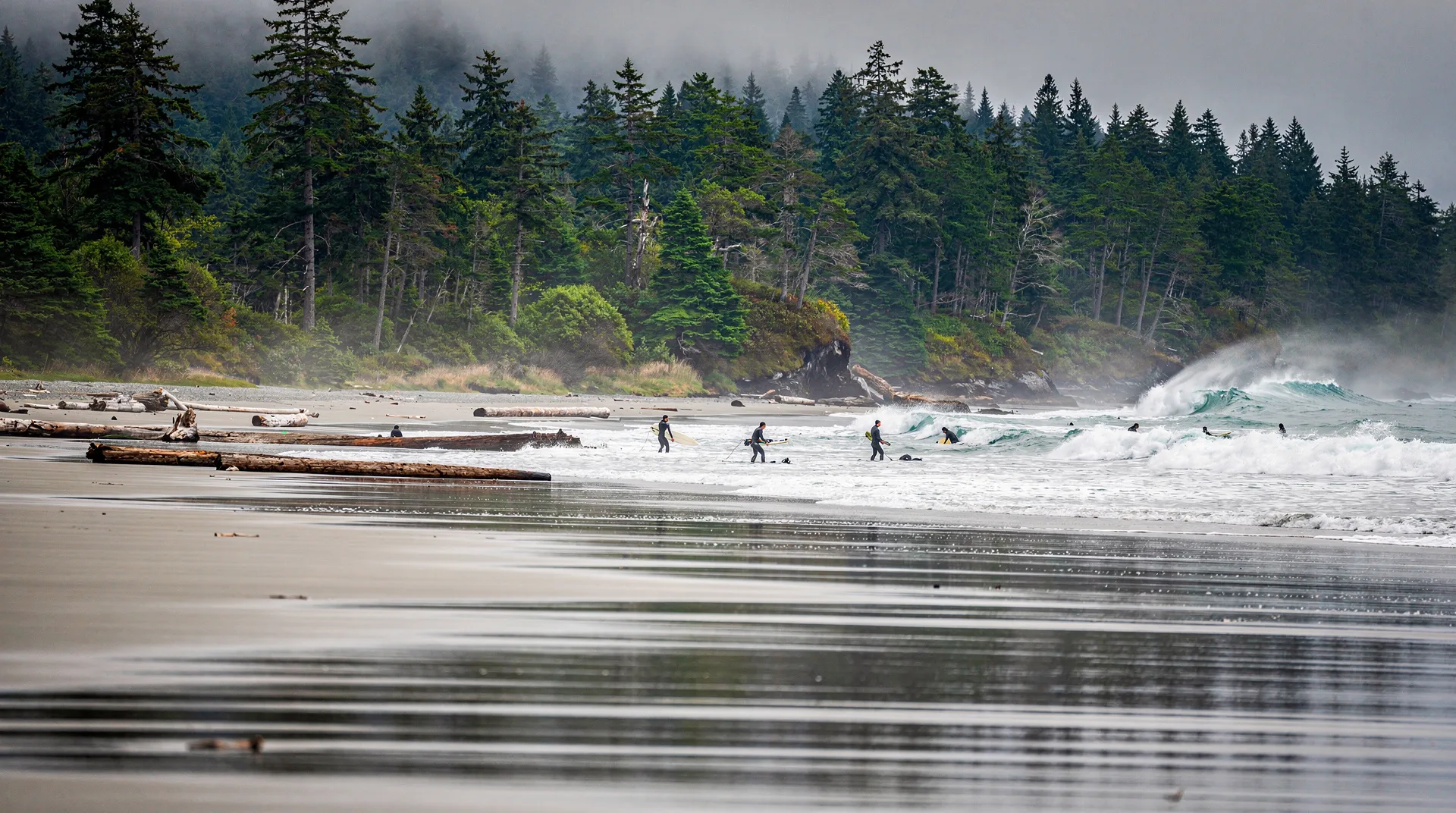
Long Beach is the accessible centrepiece of the park — a 16-kilometre sweep of open Pacific sand that runs between the gateway towns of Tofino and Ucluelet. It is the longest beach on Canada’s west coast and the reason most visitors come. The beach is wide, heavily influenced by tide, and backed by old-growth Sitka spruce and western red cedar. At high tide in winter, waves driven by North Pacific storms can break at three to four metres.
Surfing here is serious business. Tofino has been calling itself the surfing capital of Canada since the 1970s, and the claim holds: Long Beach and the surrounding breaks (Cox Bay, Chesterman Beach, Incinerator Rock) produce consistent surf year-round. In summer the water reaches 14-16°C; in winter it drops to 8-10°C, which is cold enough to require a quality wetsuit but not cold enough to drive experienced surfers away.
The beach itself is free to access at all points. Several short walking trails connect the Pacific Rim Highway to the beach through the coastal forest. The Wickaninnish Centre, operated by Parks Canada, sits at the south end of Long Beach and functions as the park’s main interpretive facility.
Broken Group Islands
The Broken Group Islands unit consists of approximately 100 islands and islets scattered across Barkley Sound, accessible only by boat from the town of Bamfield or by the passenger ferry that runs from Port Alberni in summer. There are no roads and no commercial facilities in the unit.
This is a sea-kayaking destination. The sheltered channels between the islands offer excellent paddling conditions for experienced kayakers, with abundant marine wildlife — sea otters, harbour seals, Steller sea lions, porpoises, and migratory grey whales in spring and fall. Parks Canada maintains basic campgrounds on several islands. The Frances Barkley — a working cargo and passenger ferry — runs from Port Alberni to Bamfield three times weekly from June to September and accepts kayaks, making it possible to access the Broken Group without a vehicle on the far side.
This unit is not suitable for beginners paddling without a guide. Open-water crossings between islands require navigation skills and appropriate equipment.
West Coast Trail
The West Coast Trail is a 75-kilometre wilderness trail along the most exposed and technically demanding stretch of coastline in the park. It runs from Bamfield in the north to Port Renfrew in the south, traversing a coastline of sea caves, surge channels, rope ladders, cable cars, suspension bridges, old-growth forest, and tidal platforms that require careful timing.
The trail was originally constructed as a rescue route for shipwreck survivors on the “Graveyard of the Pacific” — the stretch of coast between Cape Flattery and Victoria that claimed over 60 vessels. It is now one of the most celebrated multi-day hikes in North America, and access is strictly controlled.
Permits: Parks Canada issues a limited number of permits for the West Coast Trail — 52 hikers may depart each trailhead daily (26 from each end) during the main season. Permits are released in the spring and sell out rapidly. Reservations open online through Parks Canada typically in March for the upcoming season; last-minute permits are available by phone on the day of departure but are unreliable.
Season: The trail is open from May 1 to September 30. June and July are typically the driest months. The trail is impassable in winter.
Duration and difficulty: Most hikers take 6-8 days. The southern half (Port Renfrew to Nitinat Lake) is more physically demanding, with significant ladders and challenging terrain. The northern half is somewhat more forgiving. A Parks Canada orientation session is mandatory before starting.
Cost: Trail use permits cost CAD $27.50 per person, plus a reservation fee (CAD $24.50 online, CAD $9.75 by phone). Cable car crossings cost an additional CAD $16-18, paid in cash on the trail.
Which unit should you visit?
| Unit | Access | Skill level | Best for |
|---|---|---|---|
| Long Beach | Drive via Highway 4 | Any | First-time visitors, families, surfing, storm watching |
| Broken Group Islands | Boat/ferry from Bamfield or Port Alberni | Experienced kayakers | Multi-day sea kayaking, wildlife, solitude |
| West Coast Trail | Trailhead at Bamfield or Port Renfrew | Experienced backpackers | Multi-day wilderness hiking, permit required |
Most first-time visitors should plan around Long Beach and the towns of Tofino and Ucluelet; the Broken Group Islands and West Coast Trail are worthwhile additions only for travellers with the specific skills and gear those units demand.
Getting to Pacific Rim
From Nanaimo via Highway 4
The primary approach to the Long Beach unit is by car via the Pacific Rim Highway (Highway 4), which runs from the Trans-Canada Highway at Parksville, approximately 40 kilometres north of Nanaimo, west across Vancouver Island to Tofino. The total distance from Nanaimo to Tofino is approximately 200 kilometres, and the drive takes 2.5 to 3 hours depending on stops.
The highway is a two-lane mountain road through dense forest. The final 40 kilometres from Port Alberni to the coast traverses the Mackenzie Range and descends through some of the most striking scenery on Vancouver Island. A mandatory stop on this stretch is Cathedral Grove in MacMillan Provincial Park — a stand of Douglas fir trees up to 800 years old and 75 metres tall, accessible from a parking area directly off the highway.
Note: Highway 4 is the only road in or out of Tofino and Ucluelet. It is subject to closure after major storms and during high-snowfall periods in winter. Check BC Highway 4 conditions before departing in shoulder or winter seasons.
Getting to Vancouver Island
To reach the island from mainland BC, most visitors either fly directly to Tofino via floatplane from Vancouver Harbour (Harbour Air operates daily services, approximately 45 minutes) or drive onto a BC Ferries vessel at Tsawwassen or Horseshoe Bay, crossing to Swartz Bay or Departure Bay respectively, then driving north or west across the island.
The Tsawwassen to Swartz Bay crossing (Victoria) is the most common starting point for a south-to-north island drive. The Horseshoe Bay to Departure Bay crossing (Nanaimo) puts you closer to Highway 4 and cuts the total driving time.
A one-way car reservation on BC Ferries between Tsawwassen and Swartz Bay costs approximately CAD $60-80 for a standard vehicle plus driver in summer. Foot passengers pay approximately CAD $18. Book in advance for summer crossings — the Tsawwassen-Swartz Bay route runs at capacity on summer weekends.
Tofino Airport receives scheduled service from Vancouver, Calgary, and Victoria via Pacific Coastal Airlines. The airport is small and fares are higher than the ferry, but the time saving is significant.
When to visit
Summer (June to September) is beach season. Water temperatures are at their highest (14-16°C), surf conditions are consistent without being overwhelming, and the rainforest trails are accessible. July and August are the busiest months; Tofino’s accommodation fills weeks in advance. Long Beach parking is limited and fills by mid-morning on peak summer days. A Parks Canada reservation system may apply to certain areas in peak season — check current requirements before visiting.
Storm watching (October to March) has become a distinct and popular travel season on the Tofino coast. Pacific storms generate swells that can produce 4-5 metre waves at Long Beach, and the combination of dramatic weather, empty beaches, and a small-town atmosphere stripped of summer tourism makes this an attractive alternative. Major storm systems typically track through November to February. Accommodation in Tofino is available year-round and is significantly cheaper in winter, though some restaurants and activity operators close or reduce hours.
Spring (April to May) offers the grey whale migration. Pacific grey whales travel north past Tofino in March and April, and whale-watching operators run dedicated migration tours. The whale festival in March brings naturalists and visitors to Tofino and Ucluelet for talks, guided paddles, and migration counts.
Fall (September to October) is shoulder season — summer crowds thin after Labour Day while weather remains reasonable, and storm season has not yet begun. This is often the most pleasant time for hiking the rainforest trails.
Tofino and Ucluelet: the gateway towns
Tofino
Tofino sits at the northern end of the Tofino-Ucluelet Peninsula, where Clayoquot Sound opens to the northwest. It is a small town — permanent population around 2,000 — but its profile in Canadian travel is outsized. The main street (Campbell Street) runs for a few hundred metres between the waterfront and the residential fringe, containing most of the restaurants, surf shops, galleries, and tour operators.
Tofino is the de facto surfing capital of Canada, but it is also a serious foodie destination. The concentration of quality restaurants for a town of its size is striking — a result of the high-spending tourism market and the proximity of exceptional seafood.
Key operators and activities based in Tofino:
- Surfing lessons and rentals (Pacific Surf School, Surf Sister, Live to Surf)
- Whale watching and wildlife tours (Remote Passages, Jamie’s Whaling Station)
- Hot springs cove tour: a full-day boat excursion to natural hot springs accessible only by water, 35 kilometres north of town
- Sea kayaking in Clayoquot Sound
- Bear watching tours by water taxi to coastal meadows and inlets
Ucluelet
Ucluelet (“Ukee” to locals) is 40 kilometres south of Tofino at the southern end of the peninsula, on the edge of Barkley Sound. It is smaller than Tofino, less developed, and somewhat cheaper. The Wild Pacific Trail — a partially paved walking trail along coastal headlands with direct views of open Pacific — is the town’s main attraction and is free to access. Ucluelet is the better base for trips to the Broken Group Islands and Bamfield, and its harbour is the primary departure point for fishing charters on Barkley Sound.
The Amphitrite Lighthouse at the end of the Wild Pacific Trail is one of the better storm-watching vantage points on the coast.
Wildlife at Pacific Rim
The park’s position at the intersection of old-growth temperate rainforest and the productive waters of the continental shelf creates an exceptional wildlife environment.
Grey whales are the flagship species. Approximately 20,000 grey whales migrate past the coast each spring (north in March-April) and fall (south in October-November). A resident population of around 20-30 whales summers in the waters between Tofino and Ucluelet. Whale watching tours run March through October; the spring migration and summer resident population are both reliable.
Orca (killer whales) transit the area less predictably, primarily in summer and fall. Humpback whales have increased significantly in abundance in recent decades and are now regularly seen on tours.
Black bears are common in the forests and coastal meadows. Bears forage on beaches at low tide — a behaviour that visitors sometimes encounter at Long Beach and on boat tours to adjacent inlets. Cougars are present and occasionally sighted near Tofino and on trail systems, though encounters are rare. Vancouver Island wolves range through the park backcountry.
Bald eagles are ubiquitous — they are a daily presence on the beaches and in the harbour. Great blue herons, surf scoters, and numerous shorebird species populate the tidal flats and beach margins.
Pacific sea otters were reintroduced to the BC coast in the 1970s after being hunted to local extinction; the population has since recovered substantially and is visible in kelp beds around the Broken Group Islands and parts of Barkley Sound.
Parks Canada Discovery Pass
A Parks Canada Discovery Pass is required to enter the Long Beach unit. Daily vehicle passes cost CAD $21.50 per vehicle. The annual Discovery Pass (CAD $75.25 per adult, CAD $151.25 per family/group of up to 7) covers all national parks and historic sites across Canada for one year and is cost-effective if visiting more than one national park. Passes are available at the park gate on Highway 4, the Wickaninnish Interpretive Centre, or online at parks.canada.ca.
The West Coast Trail permit is separate from the Discovery Pass.
Where to stay
Tofino has the widest range of accommodation, from luxury wilderness lodges to budget surf hostels. Wickaninnish Inn is the definitive luxury property — a 75-room lodge on Chesterman Beach with floor-to-ceiling ocean views, a highly regarded restaurant, and spa services. Long Beach Lodge Resort on Cox Bay is the main surf-adjacent luxury option, with direct beach access and a surf school on site. Mid-range options include Pacific Sands Beach Resort (Cox Bay, self-contained suites), Middle Beach Lodge (two separate lodges between Tofino and Ucluelet, with a quieter atmosphere), and a growing number of vacation rental cottages.
Ucluelet has a quieter, more affordable accommodation scene — small inns, B&Bs, and self-contained rentals clustered around the harbour and along Barkley Sound.
Camping: Parks Canada operates the Green Point Campground at Long Beach — the most popular campground in the park and the only one with road access in the Long Beach unit. Sites are divided between those with electrical hookups and unserviced tent sites. Green Point fills from June through September; reservations open through the Parks Canada reservation system in the spring. Sites run approximately CAD $26-50/night depending on service level.
For the West Coast Trail, Parks Canada maintains backcountry campsites at regular intervals along the route.
Day trips and surrounding area
Hot Springs Cove is 35 kilometres north of Tofino, accessible only by water taxi or floatplane. Natural geothermal springs cascade into a series of pools at the edge of the ocean; the combination of hot spring water and Pacific swell is unique in Canada. Day trips depart from Tofino Harbour most mornings in season.
Meares Island — a short water taxi ride from Tofino town dock — contains old-growth cedar and red alder forest, including the Big Cedar Trail and a massive western red cedar estimated at 1,500-2,000 years old. The island was the site of a significant logging dispute in the 1980s that galvanized the Tla-o-qui-aht First Nations and environmental groups; it has been protected since.
Clayoquot Sound UNESCO Biosphere Reserve encompasses the land and ocean environment surrounding Tofino — one of the largest tracts of coastal temperate rainforest remaining in the world.
For visitors with more time on Vancouver Island, the drive north from Tofino to Gold River and east to Campbell River offers access to Strathcona Provincial Park, the oldest provincial park in BC. Combining Pacific Rim with a night in Vancouver before or after the ferry makes for a logical week-long itinerary across British Columbia.
Planning a Vancouver Island loop around Pacific Rim
Because Highway 4 is the only road in and out, Pacific Rim works best as one leg of a larger Vancouver Island loop rather than an isolated trip. A common pattern: fly or ferry into Vancouver Island at Nanaimo or Victoria, break the drive west with a stop at Parksville-Qualicum or Cathedral Grove, spend three to four nights around Tofino and Ucluelet, then either retrace the route or continue north toward Campbell River and Strathcona Provincial Park. Travellers coming from Vancouver should budget a full travel day each way once the ferry crossing and the 2.5-3 hour island drive are added together.
Frequently asked questions about Pacific Rim
Is Pacific Rim National Park worth the trip from Vancouver?
For most visitors, yes. The combination of Long Beach surf, storm watching, old-growth rainforest, whale watching, and the food scene in Tofino is exceptional and not replicated elsewhere on the BC mainland. The journey — ferry to Vancouver Island plus a 2.5-hour drive — takes most of a day, which makes a minimum stay of 2-3 nights worthwhile.
Can you swim at Long Beach?
The water temperature at Long Beach ranges from 8-10°C in winter to 14-16°C in summer. Casual swimming is possible in summer but the temperature is always cold by most standards. The surf zone can produce dangerous shore-break at high tide. Surfing with a wetsuit is the standard activity. Parks Canada advises against swimming in the surf zone without experience.
Do I need a Parks Canada pass to access Long Beach?
Yes. A daily vehicle permit (CAD $21.50) or annual Discovery Pass is required to enter the Long Beach unit. Passes can be purchased at the gate on Highway 4 or in advance online.
When is the West Coast Trail open?
The trail is open May 1 to September 30. Permits are required and are released in spring — reservations typically open in March and fill rapidly. Last-minute permits are released daily via phone but are not guaranteed. No access is permitted outside the May-September window.
What is storm watching in Tofino?
Storm watching refers to the experience of observing major Pacific winter storms from the shore, typically from the large windows of a beachside lodge or from sheltered viewpoints at Long Beach and the Wild Pacific Trail in Ucluelet. The largest storms arrive November through January, producing waves of 3-5 metres at Long Beach and intense wind and spray. It is a passive but compelling experience that has developed its own tourism infrastructure — storm watching packages at Wickaninnish Inn and similar properties are booked well in advance.
How do I get to the Broken Group Islands?
The MV Frances Barkley passenger and cargo ferry operates from Port Alberni to Bamfield three times weekly in summer, passing through the Broken Group Islands and accepting kayaks. Water taxis also operate from Ucluelet and Bamfield. There are no road connections to any of the islands, and camping is on Parks Canada-maintained backcountry sites. Prior experience in sea kayaking is strongly recommended; guided trips are available from operators in Tofino and Ucluelet.
Can I visit Pacific Rim as a day trip from Nanaimo or Victoria?
Technically yes from Nanaimo (around 5 hours round trip driving alone), but it is not recommended. The drive itself takes most of a day, leaving little time to actually experience Long Beach, Tofino, or the rainforest trails. A minimum of one night, and ideally two or three, is what makes the trip to Pacific Rim worthwhile rather than a long drive for a short beach walk.
Is Tofino better than Ucluelet as a base?
Tofino has the wider choice of restaurants, surf schools, and luxury lodges, and sits closer to Long Beach’s northern access points. Ucluelet is quieter, generally cheaper, and better positioned for the Wild Pacific Trail and trips to the Broken Group Islands. Many visitors choose Tofino for a first visit and consider Ucluelet for a return trip focused on value and quiet.