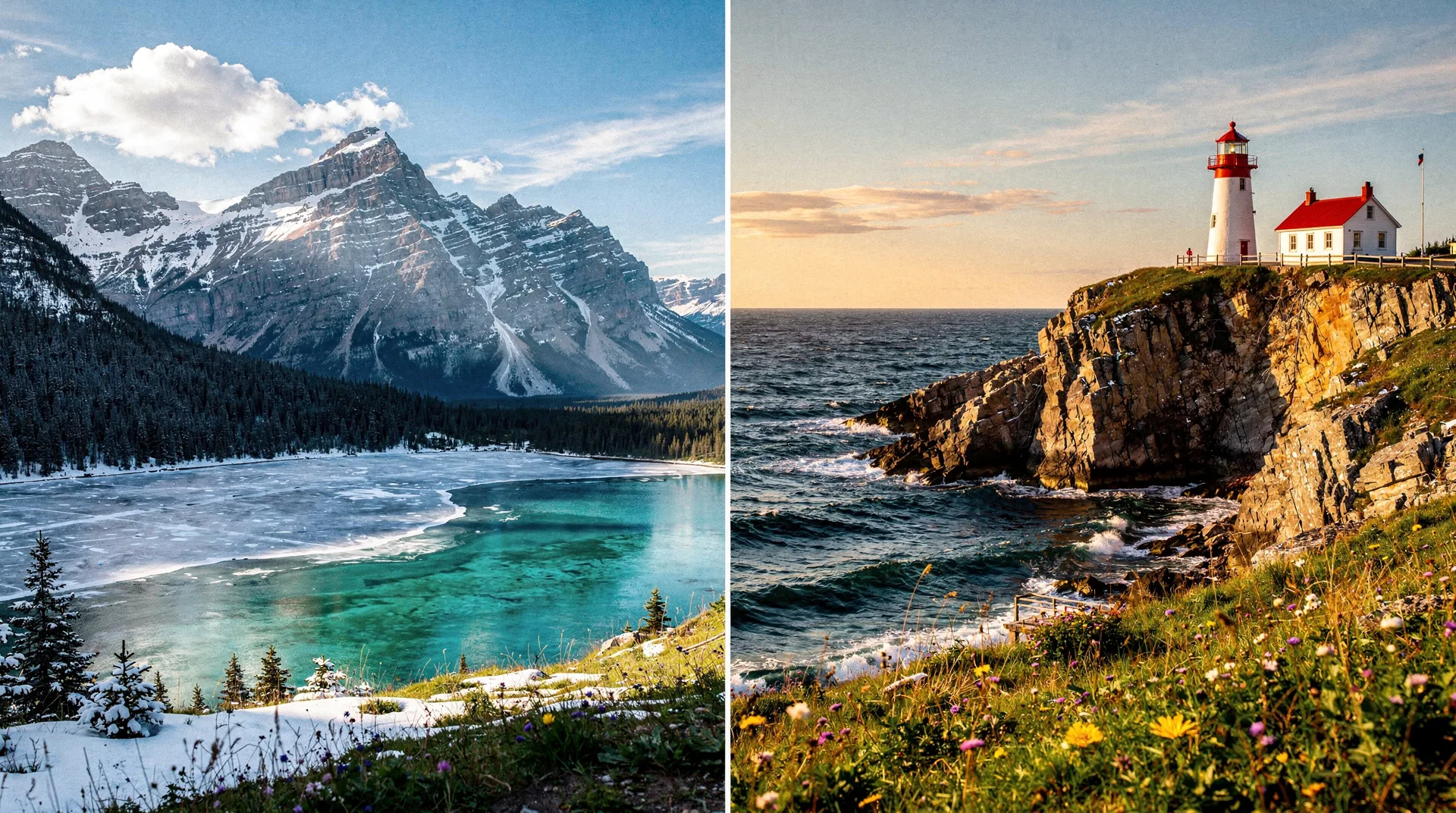
BC Rockies vs Alberta Rockies: which side should you visit?
Should I visit the BC or Alberta side of the Rockies?
Alberta has the iconic postcard names (Banff, Lake Louise, Jasper) and is easier for first-timers but far more crowded. BC (Yoho, Kootenay, Glacier, Revelstoke) is less famous but quieter, often cheaper, and contains equally spectacular scenery. Most first-time visitors should start in Alberta; return visitors should focus on BC.
One of the most common questions for first-time Canadian Rockies travellers: should I visit the Alberta side or the BC side? The Rocky Mountains span the border between the two provinces, and while both contain spectacular scenery and protected parks, the experience differs meaningfully between them. Alberta holds the famous names: Banff, Lake Louise, Moraine Lake, Jasper, the Icefields Parkway. BC holds the less-known but arguably equally impressive gems: Yoho, Kootenay, Glacier, and Mount Revelstoke National Parks, plus Golden, Fernie, and the Kootenay Rockies.
This guide compares the two sides on the factors that actually affect your trip — scenery, crowds, cost, access, activities, and timing — to help you decide which is right for your specific situation.
| At a glance | Details |
|---|---|
| Where | Alberta side: Banff, Lake Louise, Jasper (park passes required). BC side: Yoho, Kootenay, Glacier, Mount Revelstoke, plus Golden and Fernie |
| Cost | Around 40-60% more per day in Banff than in Golden or Revelstoke — accommodation and dining are the main drivers |
| Time needed | A minimum of 7 days covers highlights on both sides; 10-14 days does either justice |
| Getting there | Fly into Calgary (YYC) for the Alberta side, or Vancouver (YVR) plus a 6-8 hour drive for the BC side |
| Best time | July-August for full access and wildflowers; late September for autumn colour with fewer crowds |
The core distinction
Alberta Rockies = icon status, crowds, infrastructure. Banff National Park and Jasper National Park together receive around 4-5 million visitors per year. The Icefields Parkway is the most scenic driving highway in North America. Lake Louise and Moraine Lake are probably the two most photographed lakes in Canada. The experience is outstanding but crowded and expensive.
BC Rockies = quieter, less famous, often equally spectacular. Yoho, Kootenay, Glacier, and Mount Revelstoke National Parks cover nearly 6,400 square kilometres of protected mountain terrain immediately adjacent to the Alberta parks. Emerald Lake in Yoho rivals Lake Louise in beauty. Takakkaw Falls is higher than any waterfall along the Icefields Parkway. Rogers Pass in Glacier National Park offers as many hiking options as any Alberta park. Crowds are a fraction of Alberta’s.
Comparing the icons
Lakes
| Alberta | BC |
|---|---|
| Lake Louise (Banff NP) | Emerald Lake (Yoho NP) |
| Moraine Lake (Banff NP) | Peyto Lake |
| Bow Lake, Peyto Lake | Kinney Lake |
| Maligne Lake (Jasper NP) | Kicking Horse River canyons |
Verdict: Alberta’s iconic lakes are unmatched for sheer photograph-worthy colour. But BC’s Emerald Lake and Lake O’Hara area (Yoho) are arguably just as spectacular and often more accessible in terms of crowds and parking.
Glaciers
| Alberta | BC |
|---|---|
| Columbia Icefield (Athabasca Glacier) | Illecillewaet Glacier (Glacier NP BC) |
| Crowfoot Glacier | Rogers Pass glacier complex |
| Peyto Glacier | Various in Mount Robson area |
Verdict: Alberta’s Columbia Icefield is the standout, with easy walk-up and Ice Explorer tour access to the Athabasca Glacier. BC’s glaciers are more remote, requiring hiking.
Waterfalls
| Alberta | BC |
|---|---|
| Athabasca Falls | Takakkaw Falls (Yoho — 384 m, among Canada’s highest) |
| Sunwapta Falls | Helmcken Falls (Wells Gray) — 141 m |
| Bow Falls | Wapta Falls (Yoho) |
| Johnston Canyon falls | Numa Falls (Kootenay NP) |
Verdict: BC edges this — Takakkaw Falls is more dramatic than any Alberta waterfall, and Wells Gray Provincial Park has 42 named waterfalls (the Wells Gray guide has detail).
Towns and villages
| Alberta | BC |
|---|---|
| Banff, Canmore, Jasper, Lake Louise | Golden, Revelstoke, Fernie, Kimberley, Radium |
| High infrastructure, very touristy, expensive | More authentic, cheaper, mountain-town character |
Verdict: Alberta towns have more restaurants, hotels, and tours but feel tourist-oriented. BC towns are smaller, more character-driven, and cheaper.
National Parks in each province
Alberta: Banff, Jasper, Waterton Lakes (plus the Alberta portions of Kootenay and Yoho).
BC: Kootenay, Yoho, Glacier, Mount Revelstoke. Plus adjacent provincial parks including Mount Robson, Hamber, Top of the World.
BC has four national parks in the Rockies region; Alberta has three. The combined BC parks are smaller individually than Banff or Jasper but collectively extremely significant.
Crowds: the biggest practical difference
Banff town on a July Saturday: packed. Restaurant waits of 45-90 minutes. Parking lots full by 9 am. The Lake Louise parking lot fills by 7 am in summer and Parks Canada now runs shuttle-only access for Moraine Lake.
Yoho’s Emerald Lake on a July Saturday: busy but manageable. You can park in the main lot. The Lake trail is used but not crammed.
Jasper town: busy but significantly less intense than Banff — smaller scale, more spread out.
Glacier National Park BC: genuinely quiet. The main visitor area at Rogers Pass often has empty parking in the off-peak hours.
For travellers who value peaceful experiences over headline attractions, BC is meaningfully better. For travellers who need the famous names checked off their list, Alberta is essential.
Cost comparison
Alberta is more expensive across the board:
- Accommodation: Banff town hotels in summer average CAD $400-700/night. Canmore is slightly cheaper. Jasper is expensive but often less so than Banff.
- Dining: A mid-range meal in Banff typically runs CAD $40-60/person. The same meal in Golden runs CAD $25-40.
- Gas: Roughly comparable across both regions.
- National Park fees: Identical — CAD $12.25/adult/day, CAD $24.50/family/day. A Discovery Pass (CAD $83.50 for one year) covers both provinces’ national parks and is almost always better value than daily fees.
- Activities: Alberta’s higher profile means tour prices are usually 10-30% higher than BC equivalents.
Expect a day in Banff to cost roughly 40-60% more than a day based in Golden or Revelstoke.
Access and logistics
Flying in:
- Calgary (YYC) is the primary Alberta Rockies access point — 90 minutes to Banff, 4 hours to Jasper.
- Edmonton (YEG) is slightly closer to Jasper (4 hours).
- Vancouver (YVR) is the BC Rockies access point — 6-8 hours to Golden or Revelstoke.
Alberta is substantially easier to reach for international travellers because Calgary Airport is a major hub.
Driving between them: Banff to Golden is 1.5 hours (150 km) via the Trans-Canada Highway over the Kicking Horse Pass. This means you can easily visit both sides of the Rockies on the same trip — and most travellers should. The Alberta/BC border is essentially invisible when driving.
Activities overview
Hiking: Both sides offer world-class hiking. Alberta’s Larch Valley, Plain of Six Glaciers, and Sulphur Mountain are iconic. BC’s Iceline Trail (Yoho), Stanley Glacier (Kootenay), and Mount Robson’s Berg Lake Trail are arguably superior. Fewer crowds on the BC trails.
Skiing: Alberta has Lake Louise Ski Resort, Sunshine Village, and Norquay. BC has Revelstoke, Kicking Horse, Fernie, and Panorama — arguably a stronger collective lineup. See the BC ski guide.
Wildlife viewing: Both sides have grizzlies, black bears, elk, bighorn sheep, wolves, and moose. BC’s Kootenay Valley corridor is excellent for roadside wildlife. Alberta’s Icefields Parkway has outstanding big-game sightings.
Rafting: BC wins clearly — the Kicking Horse River near Golden is North America’s premier commercial whitewater run. See the white-water rafting guide.
Hot springs: Both sides have excellent hot springs. Banff Upper Hot Springs (Alberta) is the most famous. Radium Hot Springs (BC) is the busiest BC offering. Lesser-known BC springs (Fairmont, Lussier, Halfway) are superior for quieter experiences.
Cultural: Banff has more museums and heritage sites. BC’s mountain towns (Nelson, Fernie, Revelstoke) have stronger local-culture vibes.
Who should choose what
Alberta is better for:
- First-time Rockies visitors who want to see the famous sights
- Short trips (3-5 days) focused on icons
- Photographers chasing the classic Moraine Lake/Lake Louise shots
- Travellers flying into Calgary with limited onward travel time
- Aprés-ski and lively village atmospheres (Banff town)
BC is better for:
- Repeat visitors who have already seen Banff and want the less-crowded equivalents
- Long trips (7+ days) with time to explore quieter parks
- Budget-conscious travellers seeking better value
- Independent hikers wanting trails without crowds
- Skiers prioritising snow quality and lower ticket prices
- Travellers combining the Rockies with Pacific BC — Vancouver, Whistler, Tofino
Both together: the ideal trip
If you have 10+ days, combining both sides creates the best possible Rockies experience. A common loop: fly into Calgary, spend 4-5 days between Banff and Jasper (Alberta icons), then drive west over Kicking Horse Pass to Golden/Yoho/Kootenay (BC quiet), then continue west via Revelstoke to Vancouver for a final city stop.
Booking logistics: what to reserve ahead
Moraine Lake: private vehicles are no longer allowed on the Moraine Lake road — access is by Parks Canada shuttle, public transit (Roam Transit from Banff), or a booked tour. The Moraine Lake guide and the moraine lake shuttle guide cover current booking windows. If you would rather skip the logistics, you can book guided tours in Banff that include transport to the lakes.
National park passes: both sides require a valid Parks Canada pass (day pass or the annual Discovery Pass) — see the Banff park pass guide for current pricing and where to buy one before arrival.
On the BC side, Yoho’s Lake O’Hara area is permit-only with a separate reservation system and a much lower daily visitor cap than anything in Alberta — book the moment the reservation window opens if that lake is a priority.
Accommodation: Banff and Lake Louise hotels for July-August routinely sell out 4-6 months ahead. Golden and Revelstoke have more last-minute availability, another reason BC suits flexible travellers better.
A sample 10-day Alberta + BC Rockies itinerary
- Days 1-2: Arrive Calgary; drive to Banff. Explore Banff town, Lake Louise, Moraine Lake.
- Day 3: Drive the Icefields Parkway north. Overnight Jasper.
- Day 4: Jasper area — Maligne Lake, Athabasca Falls.
- Day 5: Drive south from Jasper to Lake Louise, then west to Golden via Yoho (see Emerald Lake, Takakkaw Falls).
- Days 6-7: Golden area — Yoho hikes, Kicking Horse River rafting, Kicking Horse Mountain.
- Day 8: Drive west to Revelstoke via Glacier National Park BC (Rogers Pass).
- Day 9: Revelstoke — Mount Revelstoke National Park, Revelstoke Mountain Resort if snow.
- Day 10: Drive to Vancouver or Kelowna for flight out.
Frequently asked questions about BC Rockies vs Alberta Rockies: which side should you visit?
Can you see both BC and Alberta Rockies in one trip?
Yes, and it is strongly recommended. The border crossings are seamless (no passport checks; both are Canadian provinces), and you can drive from Banff to Yoho in under an hour. A minimum of 7 days covers the highlights from both sides; 10-14 days does justice.
Is it cheaper to visit the BC side of the Rockies?
Yes, meaningfully. Accommodation, dining, and some activities are 20-50% cheaper on the BC side. Golden, Revelstoke, and Fernie towns offer significantly better value than Banff or Jasper.
Is Banff better than Yoho?
Banff is more famous and has more infrastructure. Yoho has less commercial development but arguably equally beautiful scenery — Emerald Lake, Takakkaw Falls, Lake O’Hara. Most travellers visit both (Yoho is a 45-minute drive from Lake Louise).
Which side is better for hiking?
Both offer outstanding hiking. Alberta has more named iconic trails; BC has equally superb trails with fewer crowds. Berg Lake Trail (Mount Robson Provincial Park, BC) and the Iceline Trail (Yoho, BC) are two of the finest hikes in Canada.
Is it safe to drive between Banff and BC national parks?
Yes. The Trans-Canada Highway over Kicking Horse Pass is well-maintained year-round. In winter, check DriveBC and Alberta road conditions before departing — mountain passes can close temporarily in severe storms.
Are there grizzly bears in the BC Rockies?
Yes. Kootenay National Park and Yoho National Park have established grizzly populations. Sightings are less reliable than in peak salmon-run coastal BC but do occur along highways and backcountry trails. See the grizzly bear viewing guide for dedicated viewing destinations.
Do I need a park pass for both sides of the Rockies?
Yes. Alberta’s national parks (Banff, Jasper) and BC’s national parks (Yoho, Kootenay, Glacier, Mount Revelstoke) each require a valid Parks Canada day pass or the annual Discovery Pass, which covers both. There is no combined provincial pass beyond the national park system — see the Banff park pass guide for current pricing.
Which is better for a family trip, Banff or Jasper?
Both work well with kids, but Banff has more family-oriented infrastructure (gondolas, easy lakeside walks, a wider choice of restaurants), while Jasper is quieter and better suited to families who want a slower pace. The Banff with kids guide has practical detail.