Quick facts
- Located in
- Kootenay Rockies / Columbia Valley
- Best time
- December to April (skiing); June to September (rafting & hiking)
- Getting there
- 2.5 hrs from Calgary; 3 hrs from [Kelowna]; 7 hrs from Vancouver
- Days needed
- 2-5 days
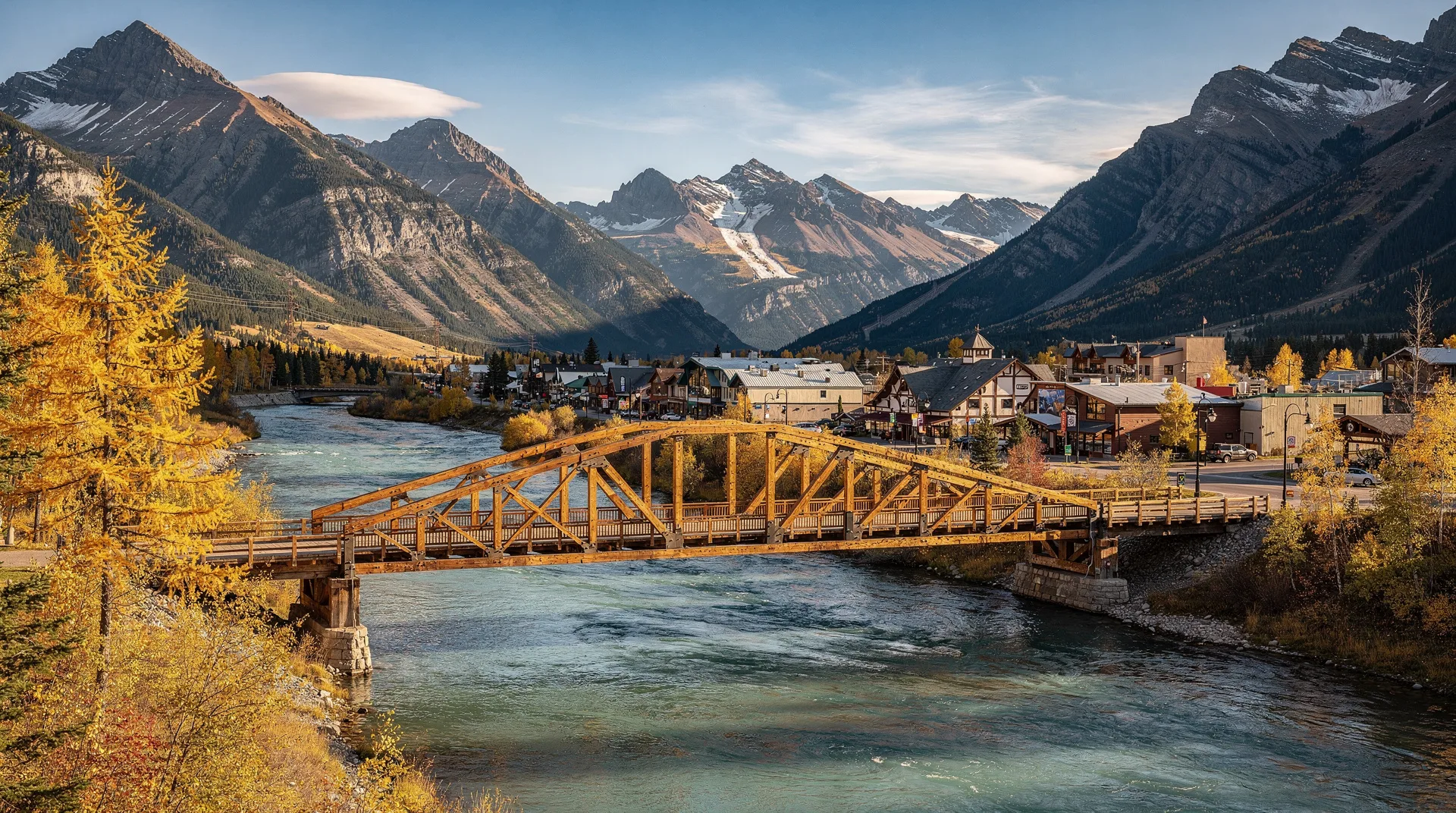
Golden sits in the Columbia Valley at the confluence of the Columbia and Kicking Horse Rivers — a position that puts it within 90 minutes of five separate national parks and at the base of two of the most dramatic mountain ranges in Canada. Yoho National Park is nine kilometres east on the Trans-Canada Highway; Kootenay National Park is an hour south on Highway 93; Glacier National Park (BC) is 50 kilometres west through Rogers Pass; Banff National Park is immediately over the Continental Divide from Yoho; and Mount Revelstoke National Park is an hour west. No other community in Canada is positioned as a gateway to so many major national parks simultaneously.
This location is the foundation of Golden’s outdoor economy. The Kicking Horse River, dropping from the Rocky Mountain pass on its descent to the Columbia Valley, is one of Canada’s premier whitewater rivers. Kicking Horse Mountain Resort on the north slopes of the valley is among BC’s most celebrated ski mountains. And the helicopter ski operations based in Golden — accessing the Purcell and Selkirk ranges on either side of the Columbia Valley — have given the town an international reputation in winter sports that vastly outpaces its size.
The town itself — population approximately 3,700 — is a compact service community built on the Trans-Canada Highway corridor, with a small heritage downtown area and a growing food and arts scene that serves the tourism and outdoor recreation economy. It is not a polished mountain resort town in the Whistler sense, which is precisely part of its appeal: Golden remains a working town with a practical energy that feels authentically Kootenay.
| At a glance | |
|---|---|
| Where | Columbia Valley, Trans-Canada Highway, BC — 2.5 hrs from Calgary |
| Cost | Mid to high in winter (heli-skiing and lift tickets), moderate in summer for rafting and hiking |
| Time needed | 2-5 days, longer to combine with the surrounding national parks |
| Getting there | Self-drive is by far the most practical option; nearest airports are Cranbrook and Kelowna, both around 3 hours |
| Best time | January-February for powder skiing; June-July for peak-flow whitewater rafting |
Kicking Horse Mountain Resort
Kicking Horse is one of the steepest and most technically demanding ski resorts in Canada — a vertical rise of 1,260 metres makes it the fourth-largest vertical in North America, and the majority of that terrain falls in the expert to advanced category. The resort covers 2,825 acres across two connected zones — the front side served by the Golden Eagle Express gondola and the back bowls accessible from the summit via cat track.
The CPR Ridge and the Bowl Over terrain at the summit (2,450 metres) are the resort’s flagship expert runs — sustained steep pitches through open terrain that hold cold powder exceptionally well after storm cycles. The Redemption Bowl on the back side is a long, sustained expert zone rarely visited by intermediate skiers. The Stairway to Heaven zone on the far right of the summit is the most remote terrain, often the last to be tracked out after a major snowfall.
Intermediate skiers are not overlooked — the Catamount and Timber Wolf zones provide long groomed runs with consistent pitch, and the gondola-served terrain gives reliable access to the upper mountain. But Kicking Horse’s reputation and identity are built on its advanced terrain, and the resort attracts a self-selected crowd of strong skiers.
Browse Kicking Horse and Canadian Rockies ski and mountain experiencesHeli-skiing in the Purcell and Selkirk Ranges
The Columbia Valley between Golden and Revelstoke is flanked by two of the world’s premier heli-skiing ranges — the Purcell Mountains to the east and the Selkirk Mountains to the west. CMH (Canadian Mountain Holidays), founded in the Bugaboos west of Golden in 1965, is the world’s largest heli-ski operation and operates multiple lodges and areas within helicopter range of the Columbia Valley. The Bugaboo Glacier area, accessible by helicopter from Golden, is one of the most celebrated mountaineering and heli-skiing environments in the world — a spire-studded granite massif rising from the Purcell icefield.
Several other heli-ski operators — Great Canadian Heli-Skiing and Purcell Heli-Skiing — use Golden as their base, accessing untracked terrain in ranges that receive over 1,000 centimetres of snowfall annually. A day of heli-skiing accesses 10-20 runs of untracked powder terrain with 25,000-40,000 vertical feet — an experience with no equivalent in resort skiing. Bookings for peak season heli-ski days sell out a year in advance.
Kicking Horse River white water
The Kicking Horse River between the Trans-Canada Highway and its confluence with the Columbia is one of Canada’s five great whitewater rivers. The lower canyon section — Class IV with some Class V features at high water — is among the most adrenaline-intensive commercially run rivers in the country. The standard commercial run covers the lower canyon in half a day, navigating named rapids including the Twin Bridges Hole and the Roller Coaster section.
Multiple outfitters operate from Golden, with morning and afternoon runs throughout the summer season (June through September). June and July at peak snowmelt produce the highest water and most intense rapids; late July through September offers lower but still challenging conditions with more technical features. Upper Kicking Horse above the canyon is a mellower float section suitable for families. To compare rafting trips and other outdoor activities, see these British Columbia tours and activities.
The Kicking Horse’s tributary rivers — the Blaeberry and Spillimacheen to the north — offer additional whitewater and flatwater options. The Columbia River itself, slow and wide through the valley bottom, is prime territory for wildlife paddling — moose, bald eagles, and osprey are reliably visible from canoes and kayaks on the river corridor.
National park day trips from Golden
Golden’s five-national-park proximity creates an extraordinary range of day trip options:
Yoho National Park (9 km east) contains Takakkaw Falls (254 metres — one of Canada’s highest accessible waterfalls), the Emerald Lake circuit (one of the most photographed scenes in the Rockies), the Natural Bridge on the Kicking Horse River, and the Burgess Shale fossil beds (guided hiking permits required). Yoho is typically the least crowded of the three Trans-Canada national parks.
Kootenay National Park (via Highway 93 south from Castle Junction, 70 km from Golden) includes Radium Hot Springs — the largest hot spring pools in Canada, at the park’s southern entrance — and the Marble Canyon and Paint Pots mineral springs near the park’s north end. The drive from Golden to Radium through the Kootenay Valley is one of the most scenic highway corridors in BC.
Glacier National Park (Rogers Pass, 50 km west on the Trans-Canada) protects the Selkirk mountain ice fields that receive the highest snowfall of any inhabited area in Canada. The Rogers Pass summit area has excellent hiking in summer — the Illecillewaet Glacier trail and the Asulkan Valley trail are both accessible from the Rogers Pass Discovery Centre.
Banff National Park is 1.5 hours east via the Trans-Canada through Yoho — the Bow Valley area and the town of Banff are feasible as a day trip from Golden, though the distance rewards an overnight stay.
Wildlife in the Columbia Valley
The Columbia Valley wetlands — a chain of marshes, oxbow lakes, and river braids along the valley floor — form one of the most significant wildlife corridors in the Canadian Rockies. The Rocky Mountain Trench, the straight north-south valley that contains the Columbia headwaters, is a migration route for wolves, grizzly bears, elk, and mountain caribou moving between the northern and southern Rockies.
The Blaeberry and Spillimacheen River valleys north of Golden provide reliable grizzly bear habitat. Elk are commonly seen on the valley floor in the early morning and evening. Mountain goats occupy the limestone cliffs above Highway 1 near Kicking Horse Pass. The Columbia wetlands south of Golden — a protected wildlife management area — are among the best birding and wildlife viewing areas in BC, with trumpeter swans, Canada geese, great blue herons, and moose in the willow marshes.
Practical information
Getting there: Golden is on the Trans-Canada Highway (Highway 1) at the confluence of the Kicking Horse and Columbia Rivers. From Calgary: 2.5 hours west through Banff and Yoho. From Kelowna: approximately 3 hours northeast via Highway 33 or via Revelstoke. From Vancouver: 7 hours on the Trans-Canada (one of the great Canadian highway drives, through Hope, the Fraser Canyon, Cache Creek, and Rogers Pass). Cranbrook Airport (YXC, 3 hours south) and Kelowna Airport (YLW, 3 hours west) are the nearest commercial airports.
Where to stay: The Prestige Mountain Resort is Golden’s main full-service hotel, with outdoor hot tubs and a restaurant. The Dreamcatcher Hostel is well-regarded in the budget category. The resort base at Kicking Horse Mountain has slopeside lodging including the Glacier Mountaineer Lodge. Vacation rentals throughout the town serve the ski and outdoor recreation market.
Food and drink: The Whitetooth Mountain Brewing taproom in the downtown area is the local gathering point for post-adventure food and craft beer. The Eagle’s Eye Restaurant at the Kicking Horse summit (accessed by gondola) is the highest elevation restaurant in Canada, with a price tag to match and views worth the expense. Cedar House Restaurant south of town is the fine dining standout.
When to visit
December through April is the ski season for Kicking Horse Mountain Resort — January and February bring the deep powder that defines the resort’s reputation. Heli-skiing operates from approximately December through April with the prime powder window in January and February. Spring skiing in March and April is slower paced and warmer.
June through September is the white-water season on the Kicking Horse River, with peak flow in June and July. Hiking in Yoho National Park and the national parks circuit is best from July (when most high trails are snow-free) through September. The Kicking Horse Resort summer bike park operates lifts from late June through September.
October and November are transitional — the white water season ends, the resort is not yet open, and the national parks see far fewer visitors. Late September and October are excellent for photography: the larch trees in Yoho’s alpine meadows (particularly around Lake O’Hara) turn gold in the third week of September, one of the most spectacular autumn colour displays in the Canadian Rockies.
Where to stay
The Prestige Mountain Resort Golden is the city’s main full-service hotel, with comfortable rooms, an outdoor hot tub, and a restaurant that serves the touring market reliably. The Kicking Horse River Lodge in the downtown area is a mid-range boutique option with a thoughtful approach to the adventure travel market.
The Glacier Mountaineer Lodge at the Kicking Horse Mountain Resort base is the best slopeside option — ski-in ski-out access, comfortable rooms, and proximity to the Eagle’s Eye gondola. For self-catering groups, the resort’s condominium inventory provides kitchen-equipped suites.
Storm Mountain Lodge near Castle Junction in Banff National Park (1.5 hours from Golden) is a heritage log cabin resort that provides a romantic alternative base for exploring the national parks corridor — bookable independently and worth considering for a multi-day parks circuit.
Golden vs. other Rockies and Kootenay bases
Golden is often cross-shopped against Banff and Canmore for a Rockies trip, or against Revelstoke for a BC-focused ski and whitewater trip. Compared to Banff and Canmore, Golden is quieter, cheaper, and less polished, but sits closer to Yoho and offers arguably better expert skiing and rafting; the Banff vs Canmore guide covers that pairing separately.
Revelstoke, an hour and a half further west, has a similar working-mountain-town feel and its own excellent resort and heli-skiing scene — the choice between the two often comes down to whether Yoho and the national parks circuit (favouring Golden) or Mount Revelstoke and Glacier National Park’s western approach (favouring Revelstoke) matters more to the trip. For a broader regional view, see the Canadian Rockies overview and the BC ski guide for how Kicking Horse stacks up against other BC resorts.
The Ktunaxa and Shuswap territories
Golden sits within the traditional territories of the Ktunaxa Nation (whose territory extends through the Kootenay region south into Montana) and the Secwépemc (Shuswap) Nation to the north and west. The Columbia River — the dominant geographic feature of the valley — was a trade and travel route for both nations for thousands of years, and the confluence at Golden was a meeting point at the boundary of their respective territories.
The Columbia Lake, at the river’s headwaters 150 kilometres south of Golden near Canal Flats, is considered the river’s source — the beginning of one of North America’s great river systems, which runs 2,000 kilometres to the Pacific through BC and Oregon. The cultural significance of the Columbia to the Ktunaxa is reflected in the nation’s involvement in discussions about the Columbia River Treaty (between Canada and the United States), which governs flood control and hydroelectric operations on the river system.
The Trans-Canada corridor through Rogers Pass
The Trans-Canada Highway through Rogers Pass west of Golden is one of the great mountain highway corridors in Canada — 50 kilometres of road through the Selkirk Mountains at 1,330 metres, passing through the avalanche-prone terrain that defeated railway engineers for a generation before the spiral tunnels rerouted the CPR main line.
The Rogers Pass Discovery Centre at the summit interprets the history of the pass — the original railway construction (1885), the catastrophic avalanche winter of 1910 that killed 62 railway workers, the construction of the Trans-Canada (1962), and the ongoing challenge of keeping the highway open through a zone that receives over 14 metres of snowfall annually and has over 130 avalanche paths crossing the road corridor.
The Glacier National Park backcountry — accessible from Rogers Pass — is among the most demanding and least-visited terrain in the national parks system. The Illecillewaet Glacier, retreating rapidly but still spectacular, is a 1-hour hike from the highway and provides the most accessible view of a major BC glacier from the Trans-Canada. The sense of the Selkirk Range’s scale — the peaks rising 2,000 metres above the highway — is the defining Trans-Canada experience in the Interior.
Frequently asked questions about Golden
Is Kicking Horse suitable for intermediate skiers?
Kicking Horse is predominantly an expert mountain, and intermediate skiers who prefer groomed blue runs may find the terrain challenging and the terrain mix not in their favour. That said, the Catamount and Timber Wolf zones provide quality intermediate runs, and the gondola access to upper-mountain views and one or two accessible groomed runs is worthwhile for any level. Beginners would be better served at Sun Peaks or Big White.
When is the best time for Kicking Horse River rafting?
June and early July produce the highest water volumes and most intense rapids following peak snowmelt. Late July through September is lower but still exciting — many operators consider mid-July to mid-August the sweet spot for reliability and intensity balance. September is the quietest month with reduced water volume but the most reliable weather.
Do I need a park pass to visit Yoho from Golden?
Yes. Yoho National Park requires a valid Parks Canada Discovery Pass. The pass covers all Parks Canada national parks and historic sites and is available daily, annually, or as a family pass. It can be purchased at the Yoho Park gate on the Trans-Canada Highway east of Golden.
Is Golden or Revelstoke the better base for a BC ski and adventure trip?
Both are strong, low-key alternatives to Banff and Whistler. Golden has the edge for national park day trips (Yoho is minutes away) and Kicking Horse’s expert terrain; Revelstoke has its own excellent resort and is closer to Mount Revelstoke National Park. Many multi-day itineraries combine both, an hour and a half apart on the Trans-Canada.